Every tincture starts with a real, whole mushroom. Learn to recognize each one by sight, understand what tradition and research say about it, and know the safety notes that matter.
Please read: this encyclopedia is for education and identification only — it is not medical advice, and these statements have not been evaluated by the FDA. Never eat a wild mushroom based on website photos alone: many edible species have toxic look-alikes. Confirm every identification with an experienced local mycologist, and talk to your healthcare provider before using any mushroom supplement — especially if you take medication, are pregnant, or manage a health condition.
The core medicinals — mushrooms prized for functional and traditional wellness use.
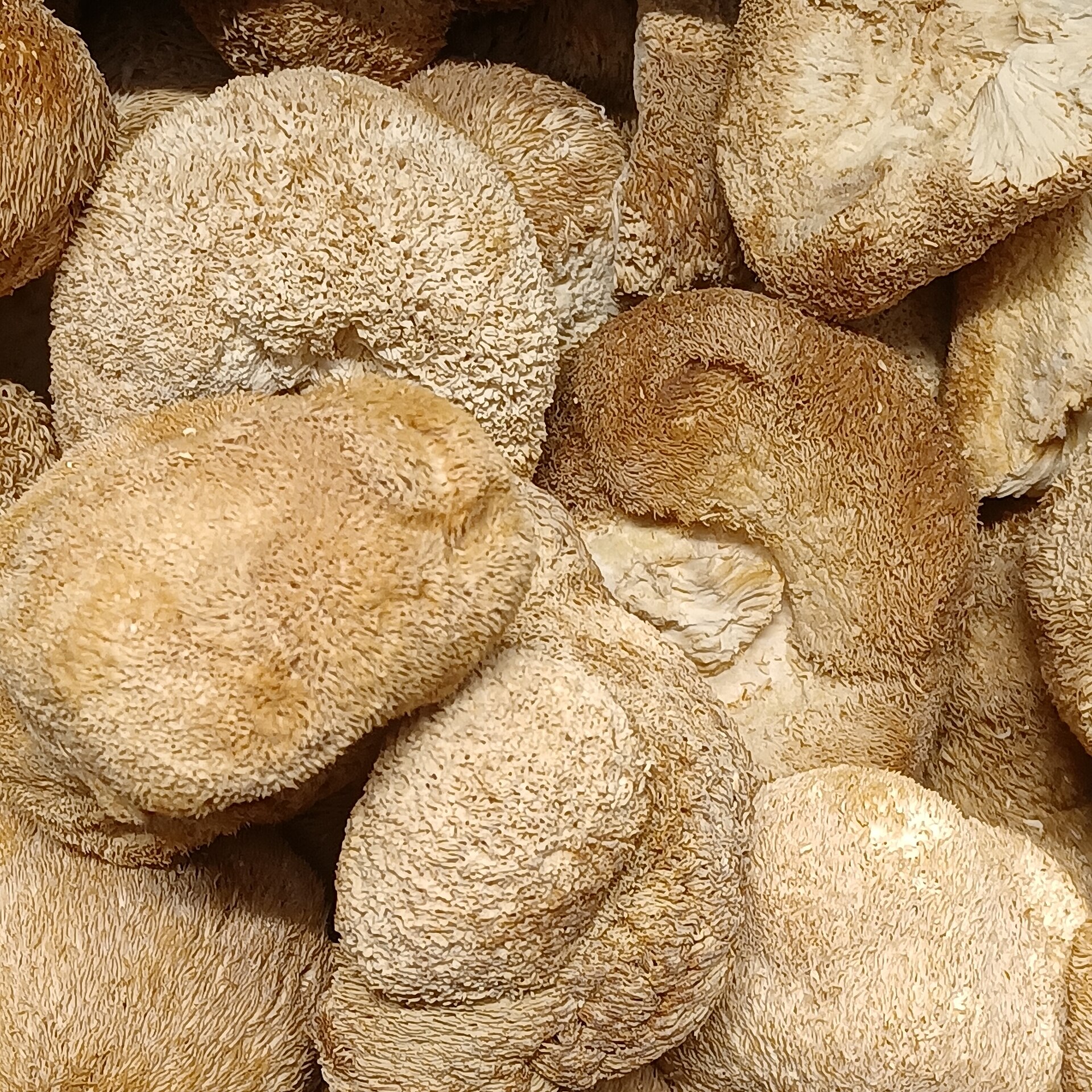
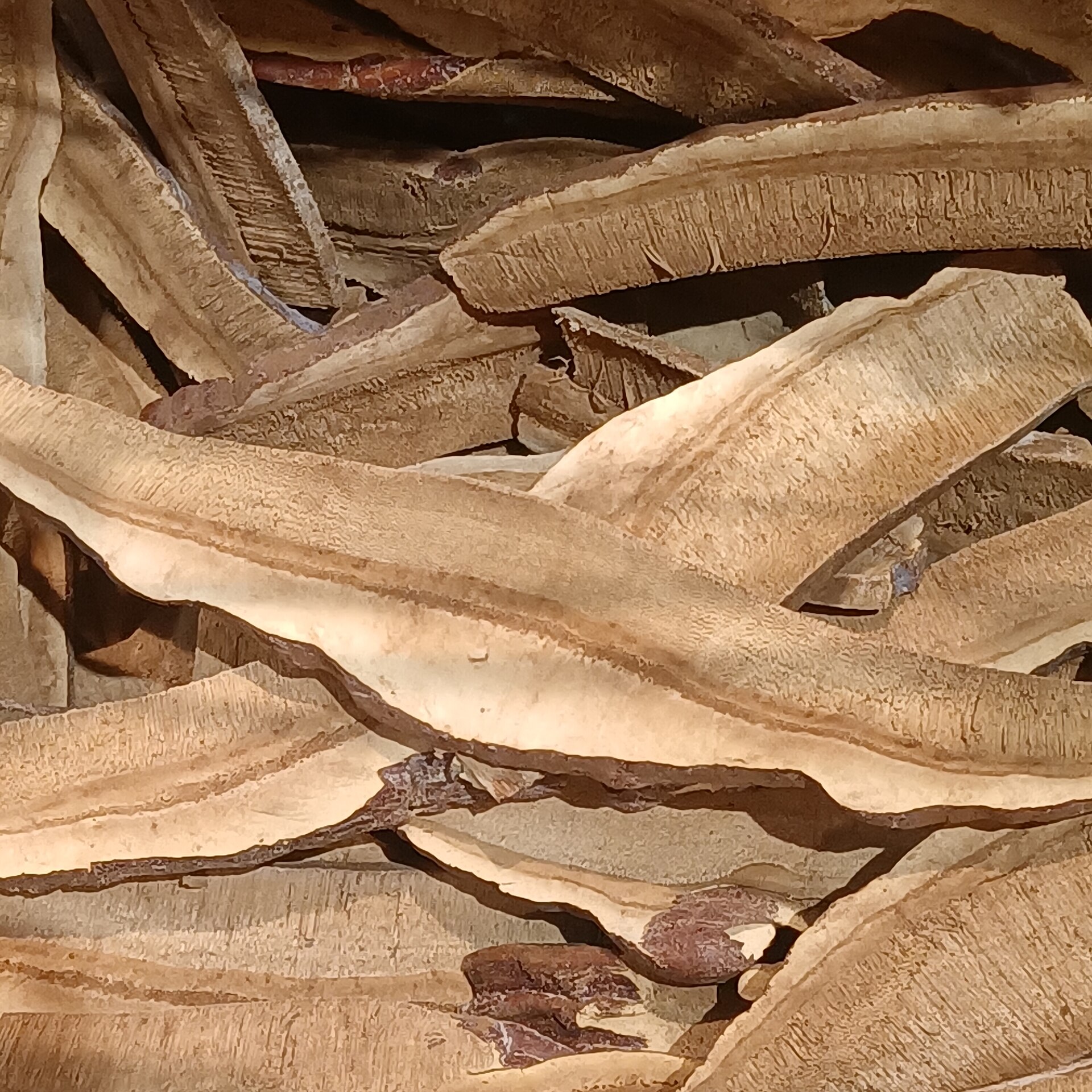
FreshDried
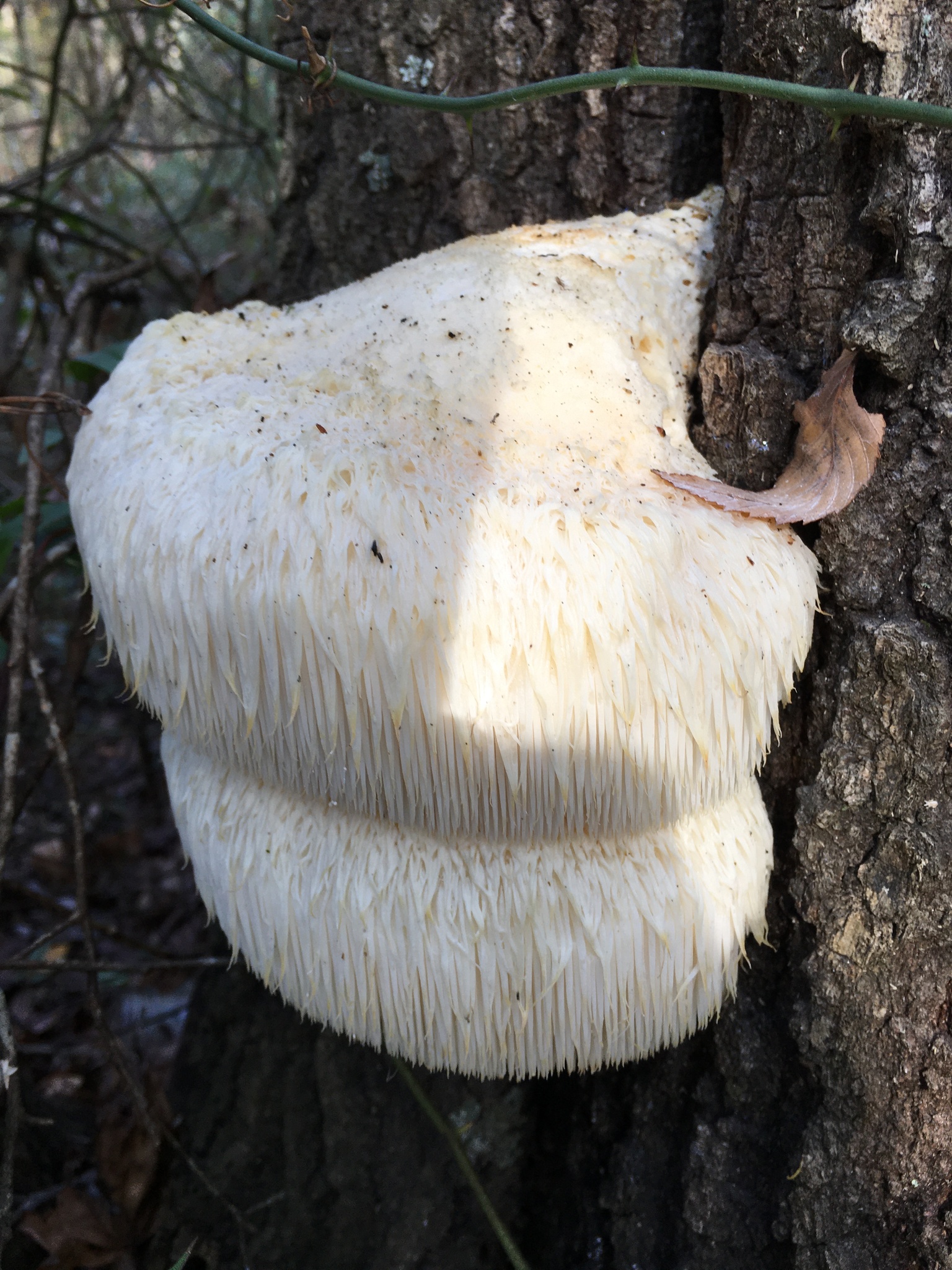
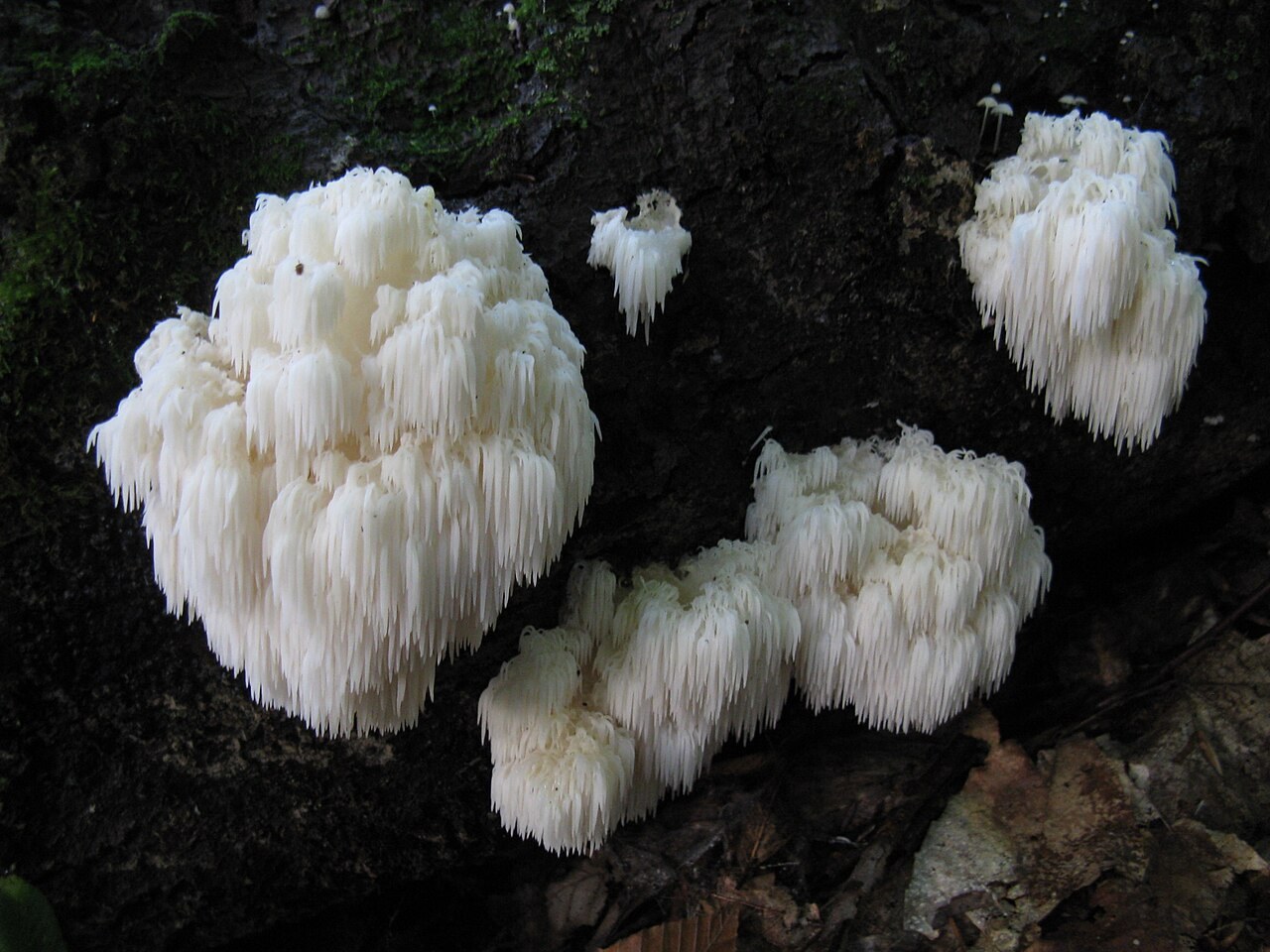
Lion's Mane
Hericium erinaceus
🌍 Native to: North America, Europe and East Asia
🔍 How to identify
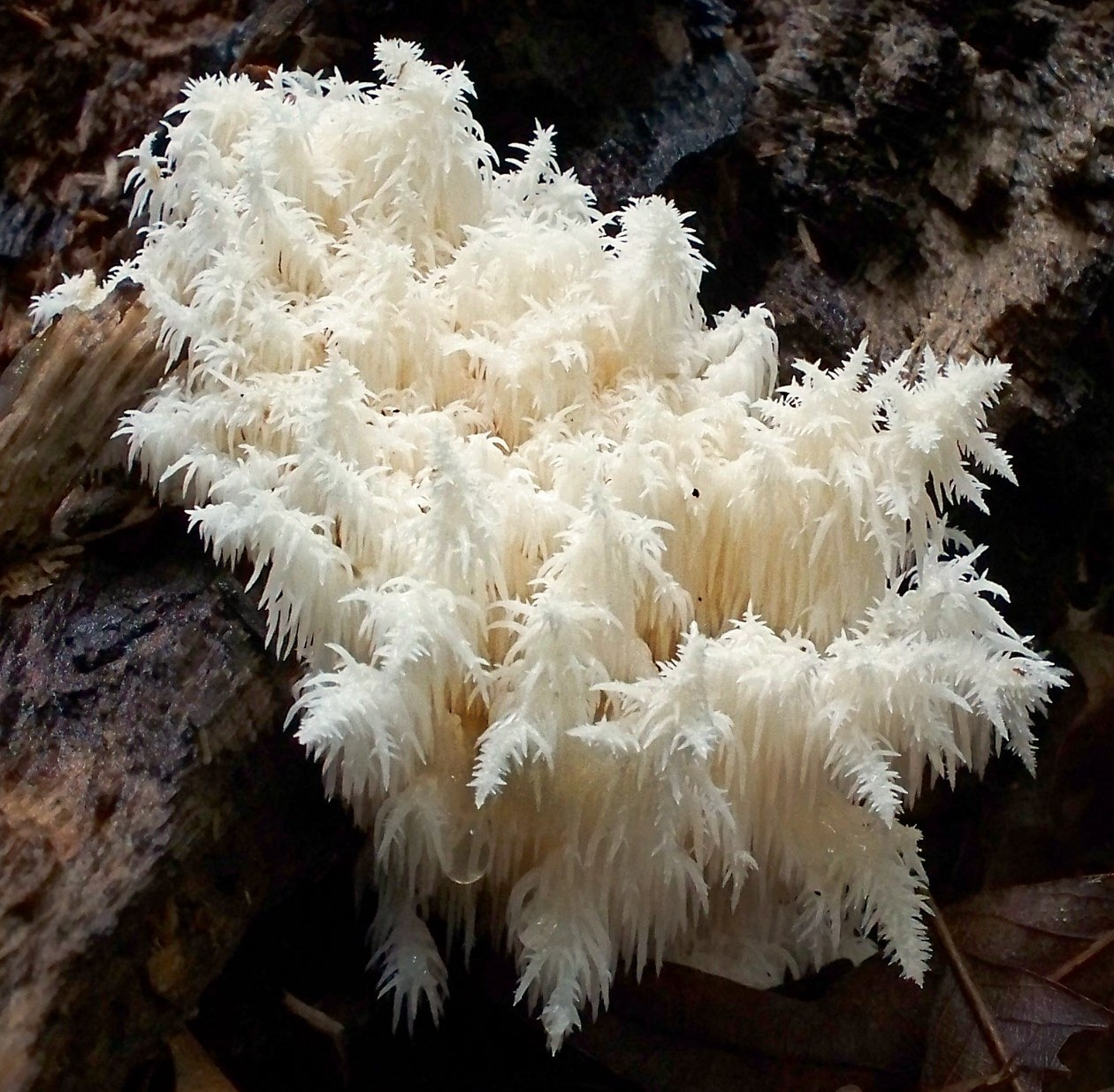
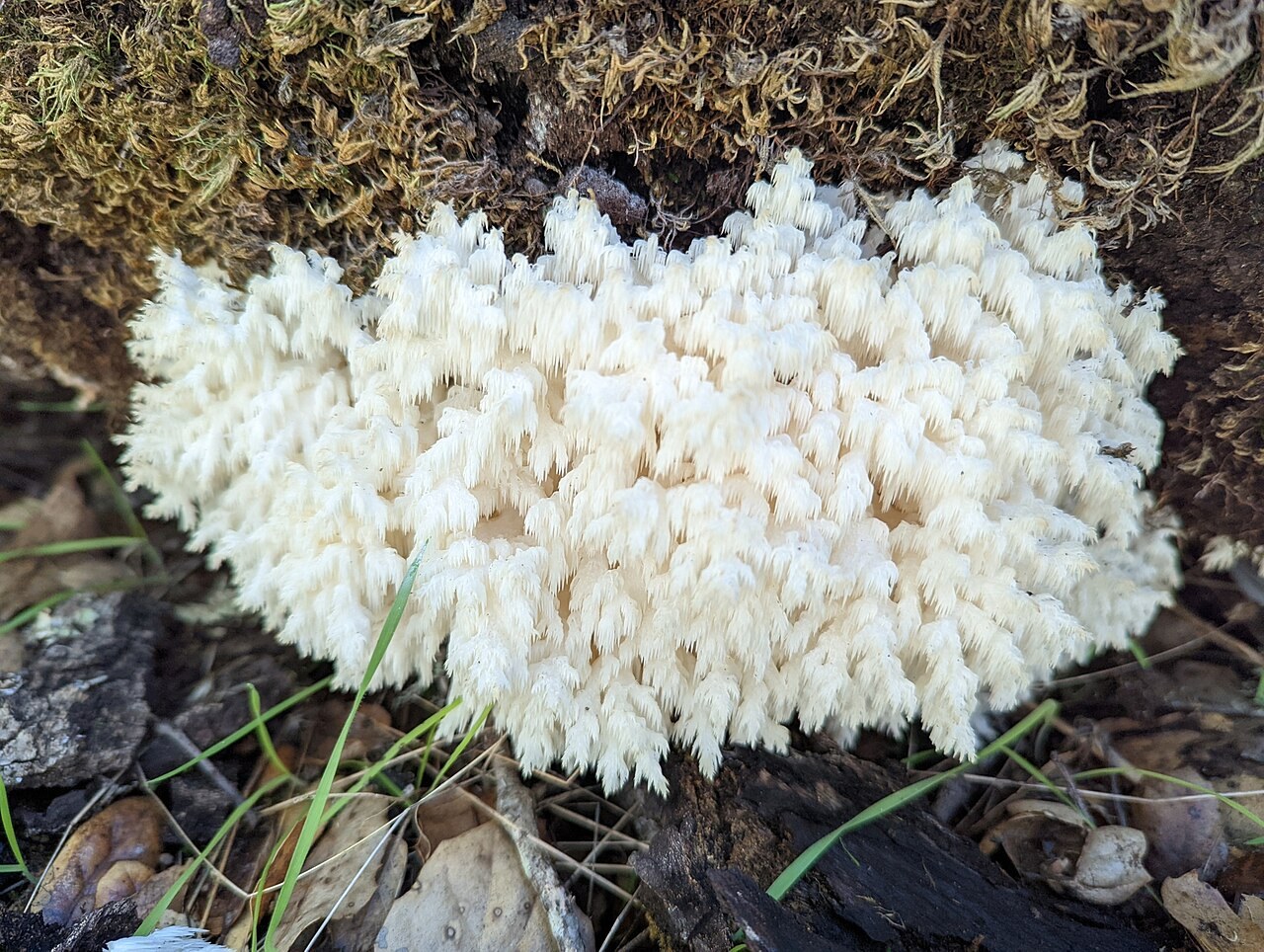
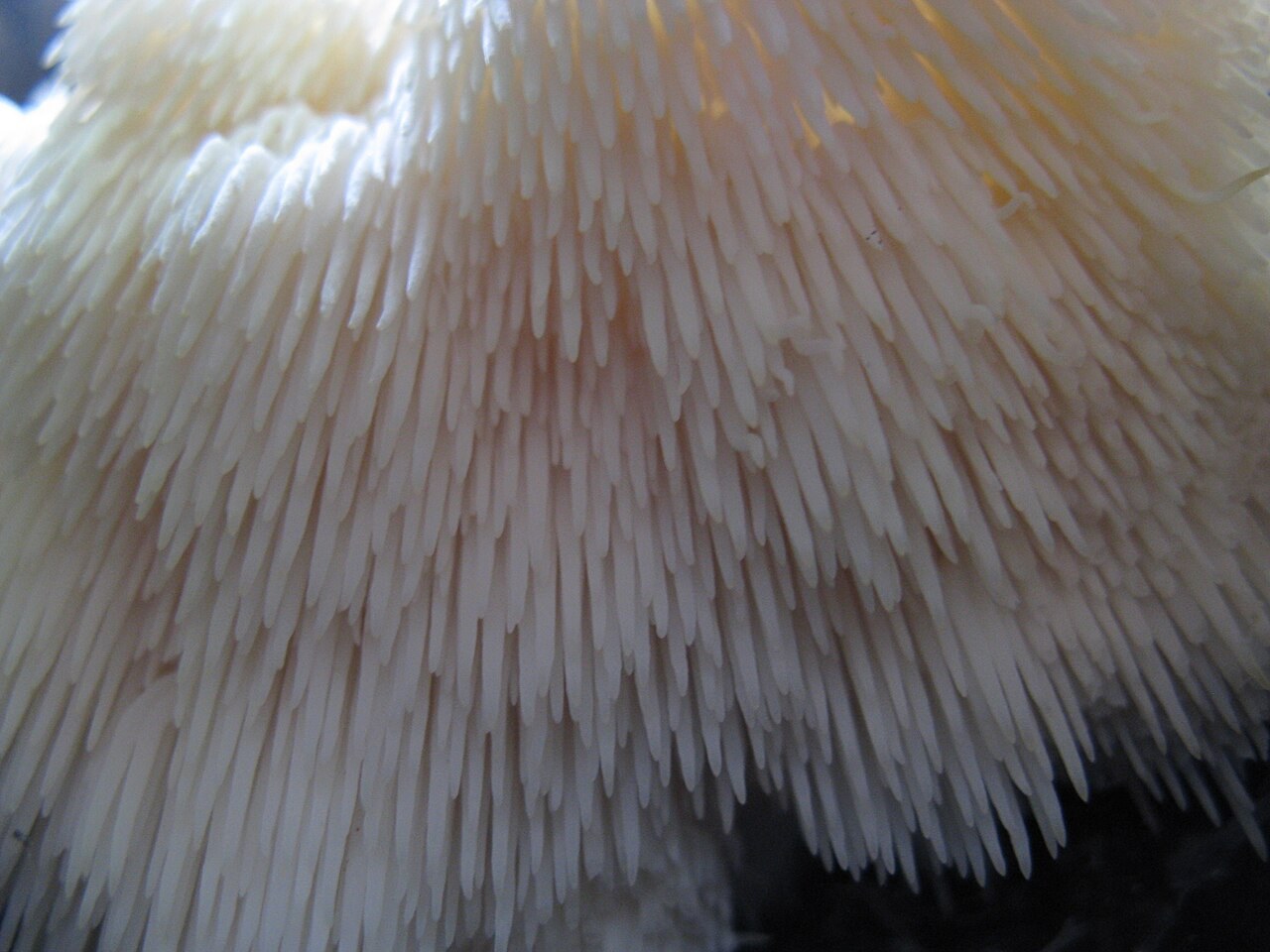
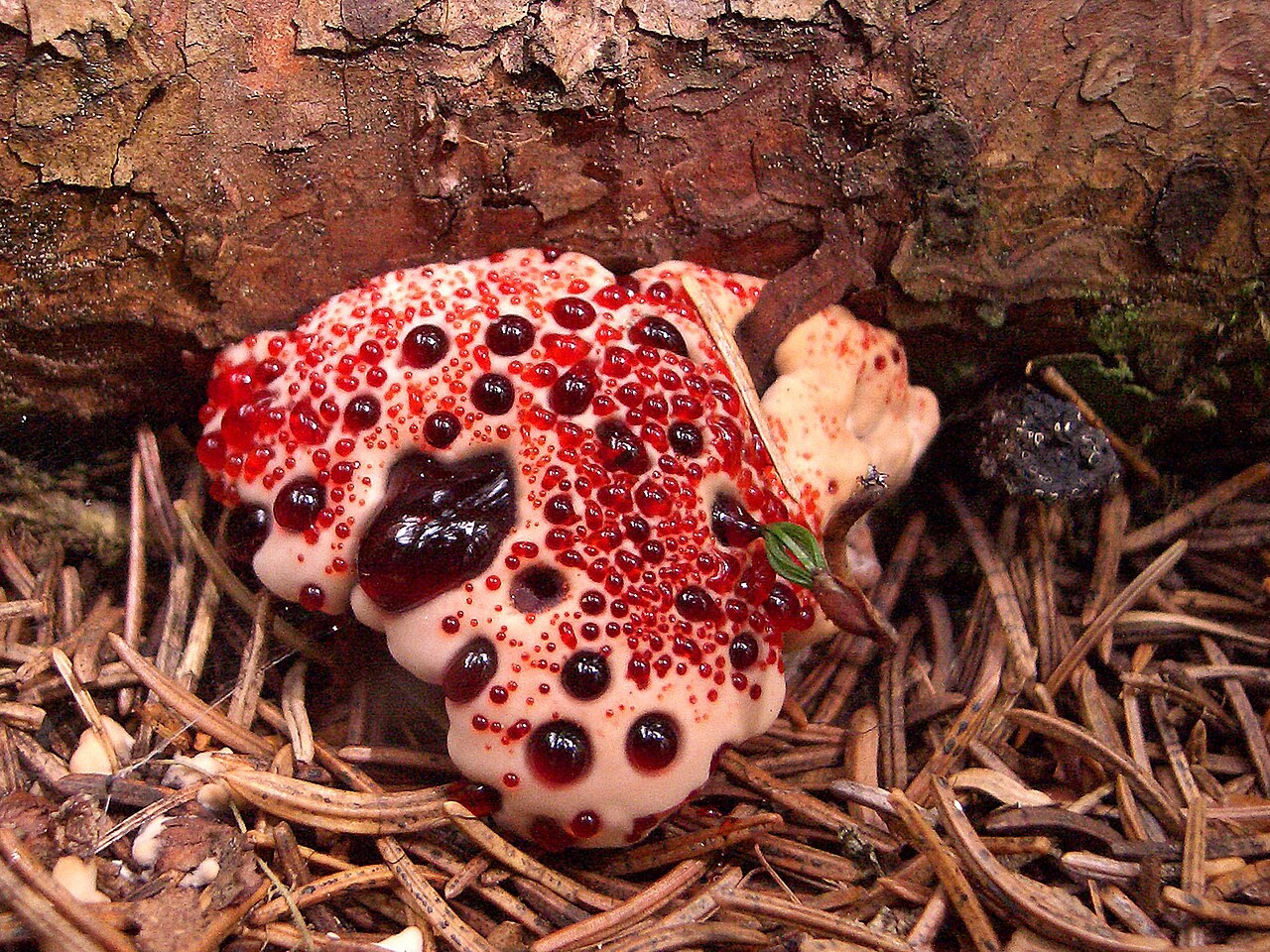
A cascading white beard of soft spines — no gills, no true cap. Look for dense clusters of icicle-like teeth (1–5 cm) hanging from a single base.
Pure white when fresh, yellowing to tan with age; teeth bruise yellow-brown where handled.
Grows from wounds and logs of hardwoods — oak, beech, maple — in late summer through fall.
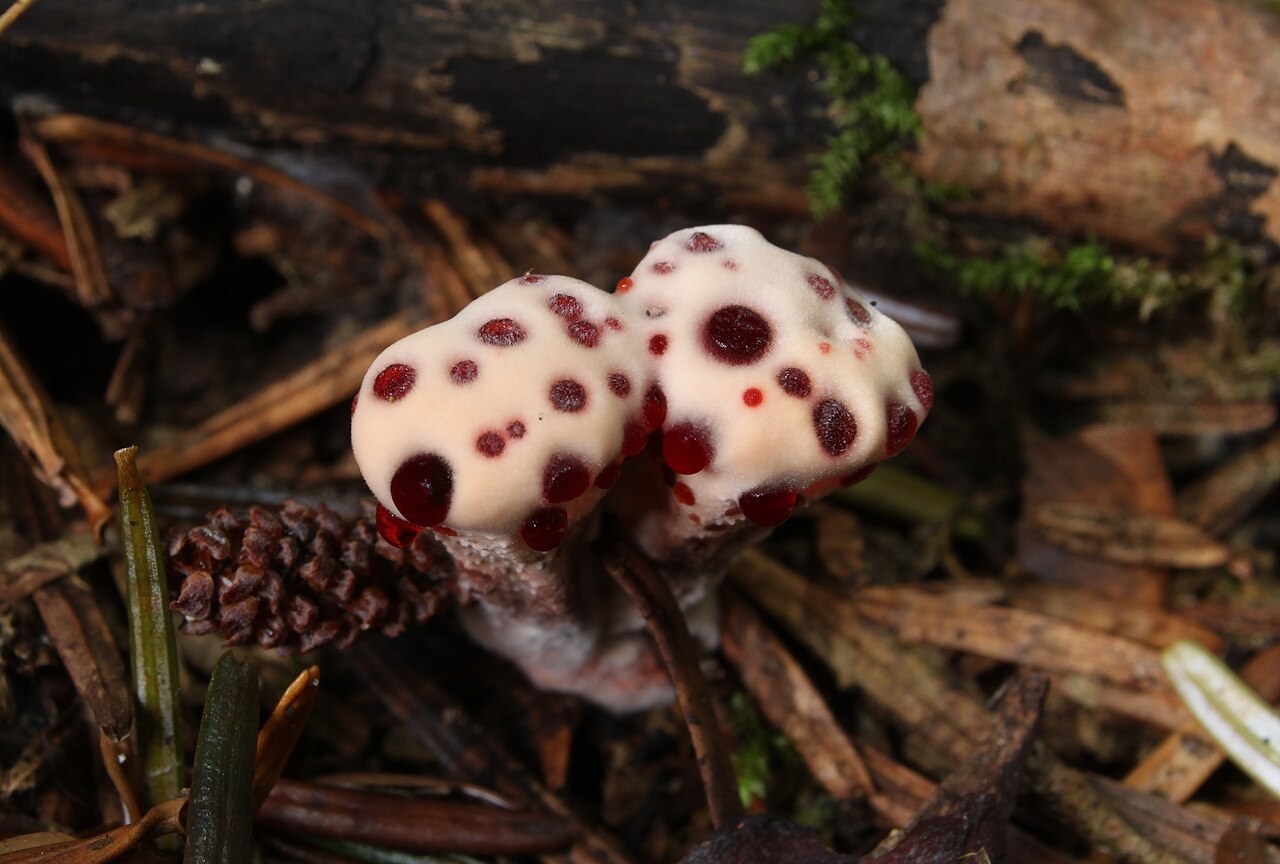
No dangerous look-alikes: its cousins bear's head tooth and coral tooth fungus are also edible.
🌿 Traditional uses & research
Traditionally used to support digestion and everyday vitality. Modern interest centers on compounds called hericenones and erinacines, studied for their relationship with nerve growth factor (NGF) — research has explored focus, memory, and cognitive support. The cornerstone of our focus blend.
⚠️ Safety notes
Generally well tolerated. As with any fungus, allergic reactions are possible. May modestly lower blood sugar — anyone on diabetes medication should check with their provider. Safety data in pregnancy and breastfeeding is limited.
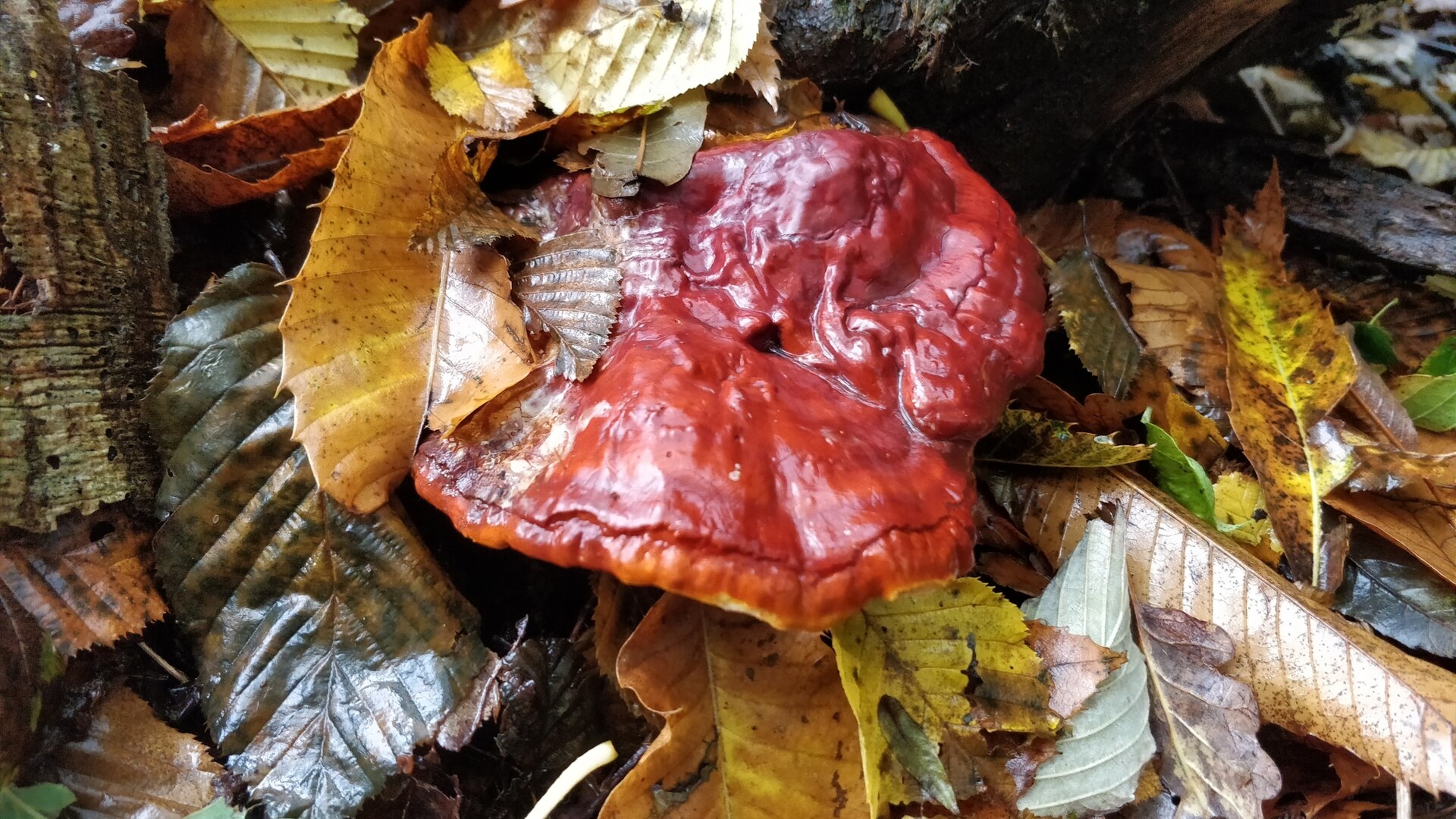
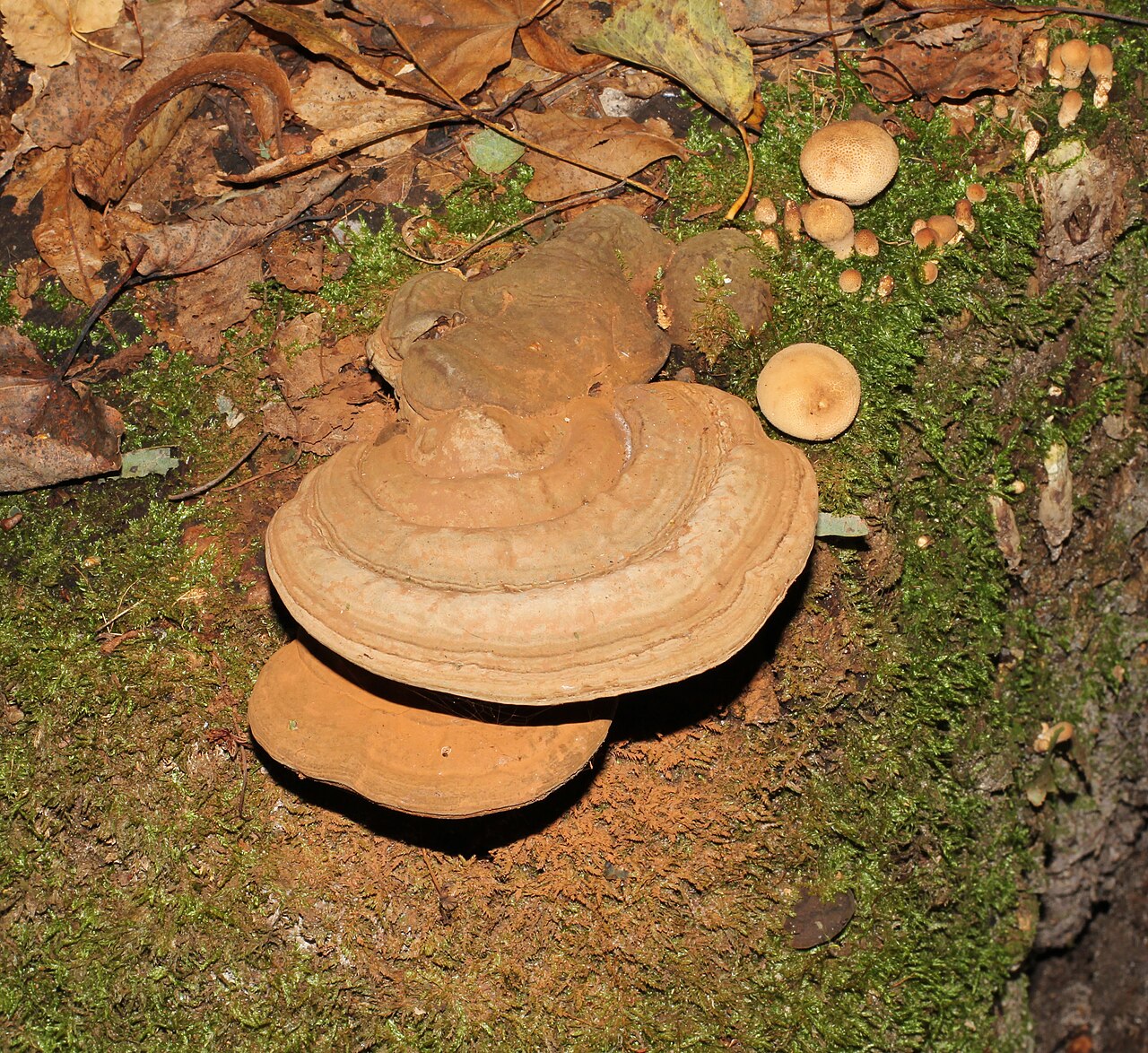
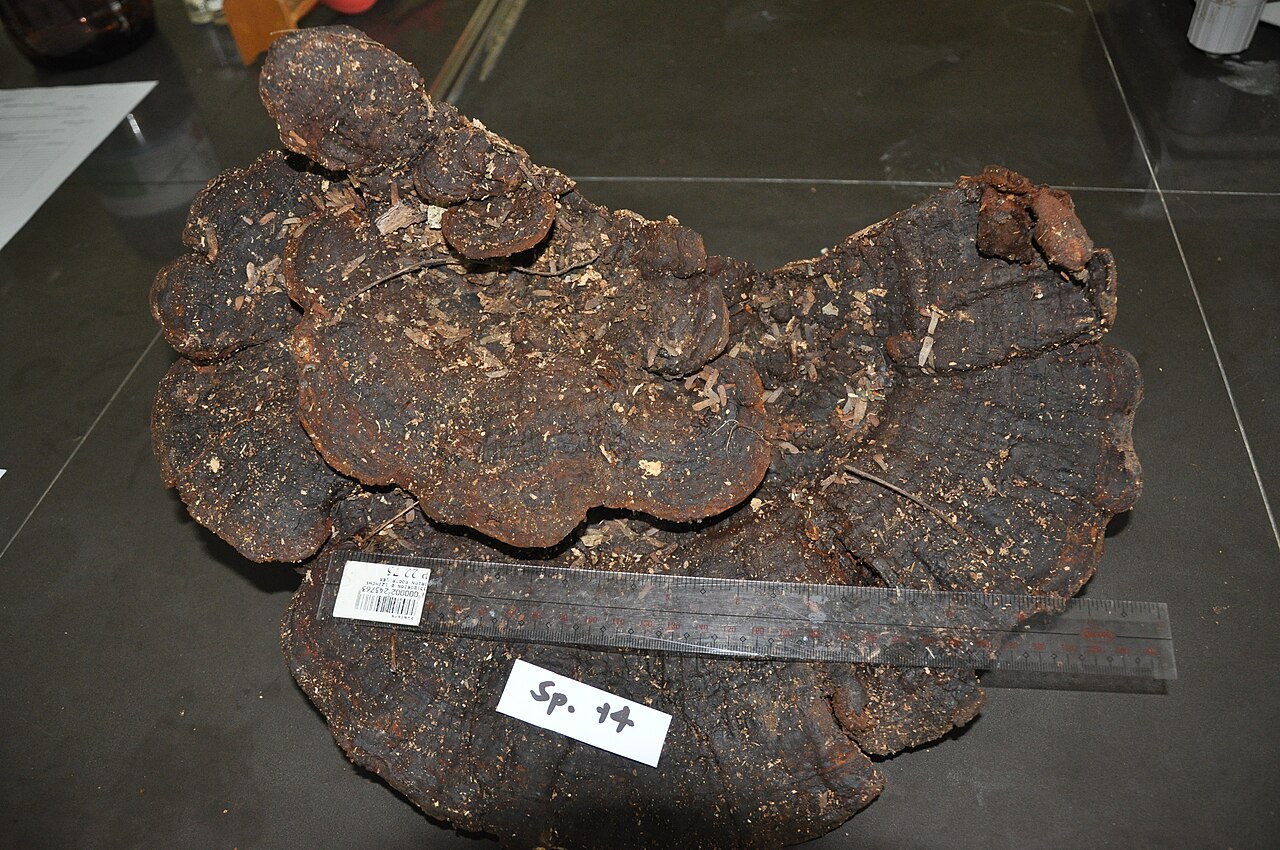
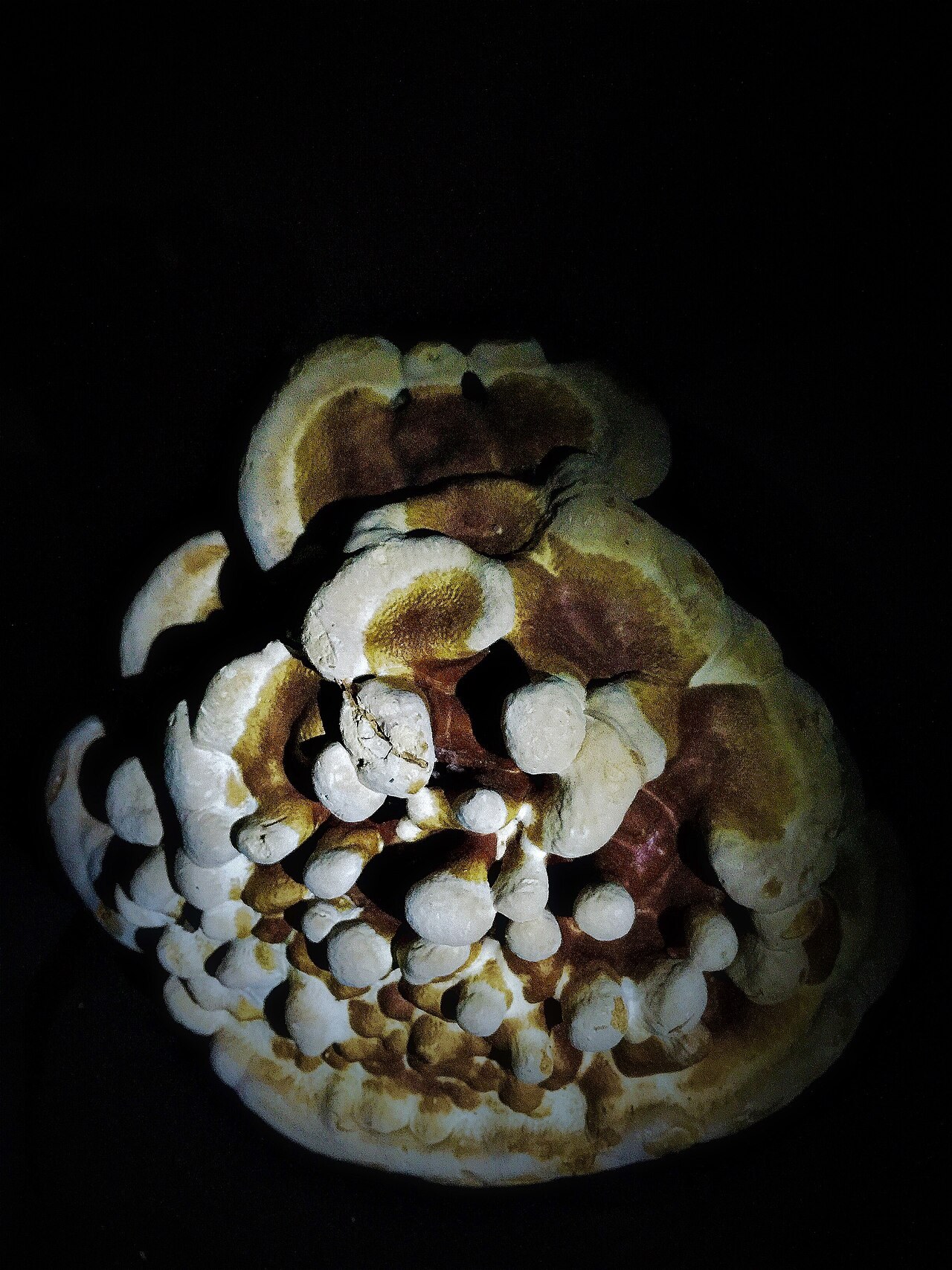
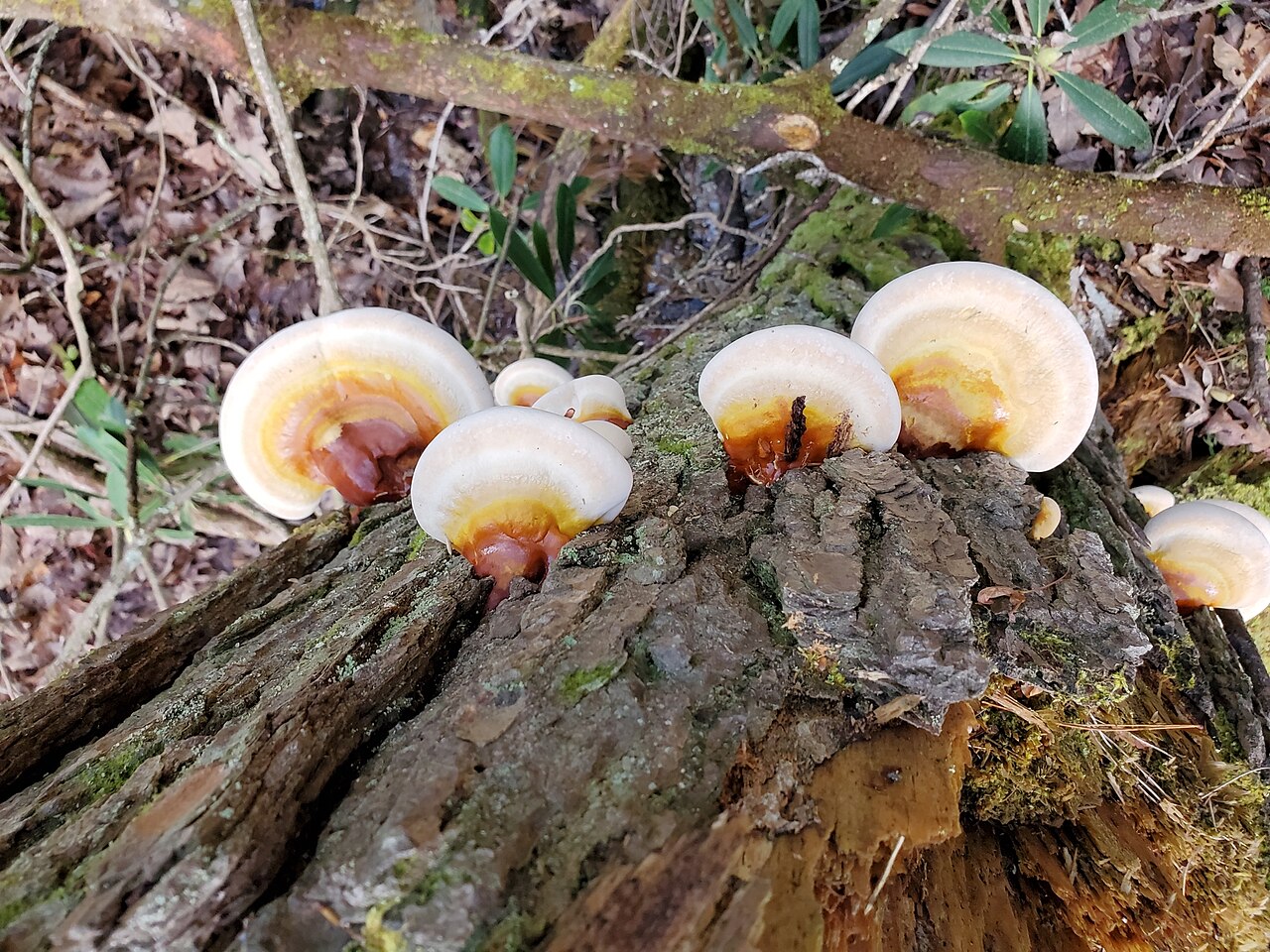
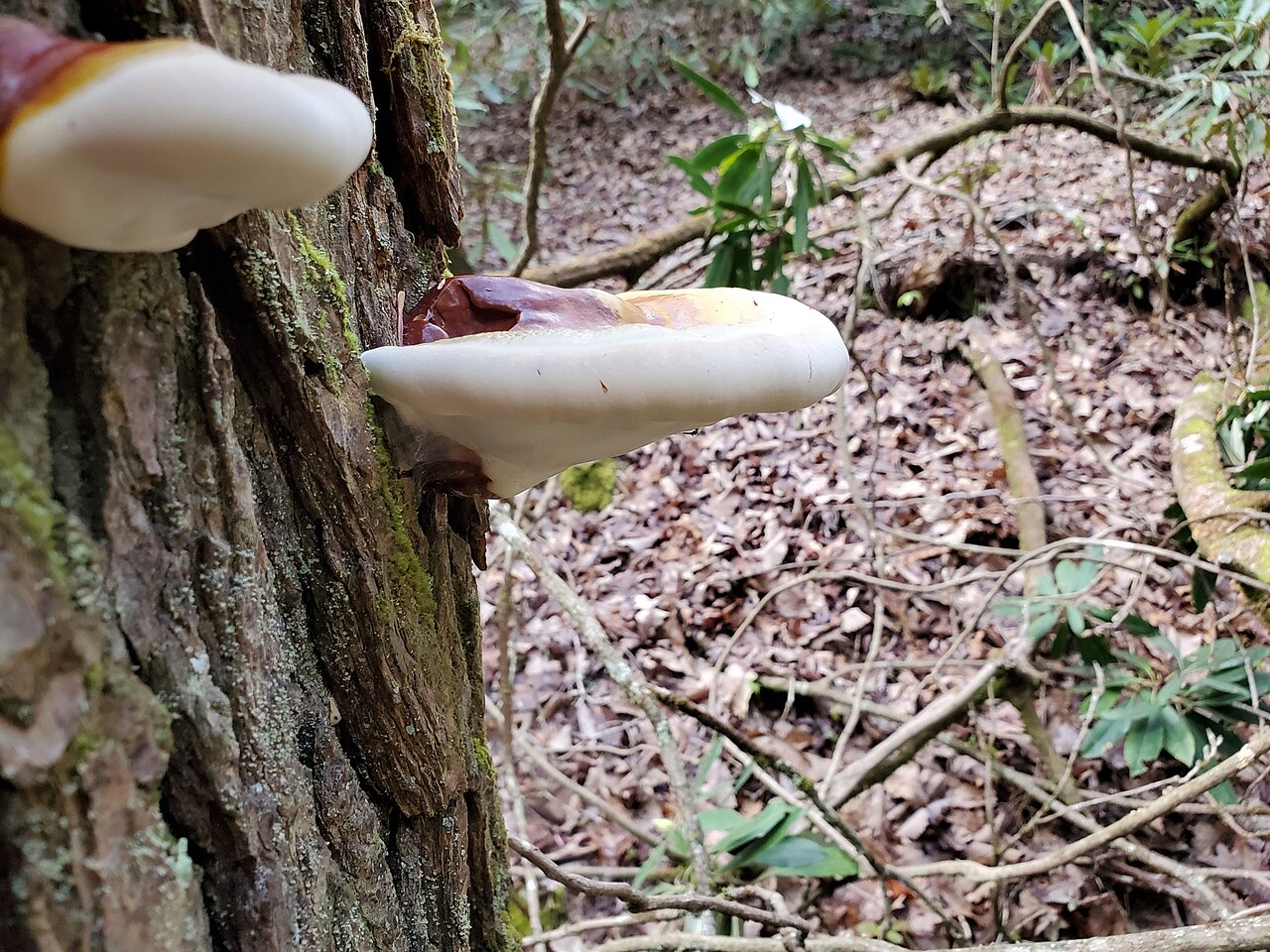
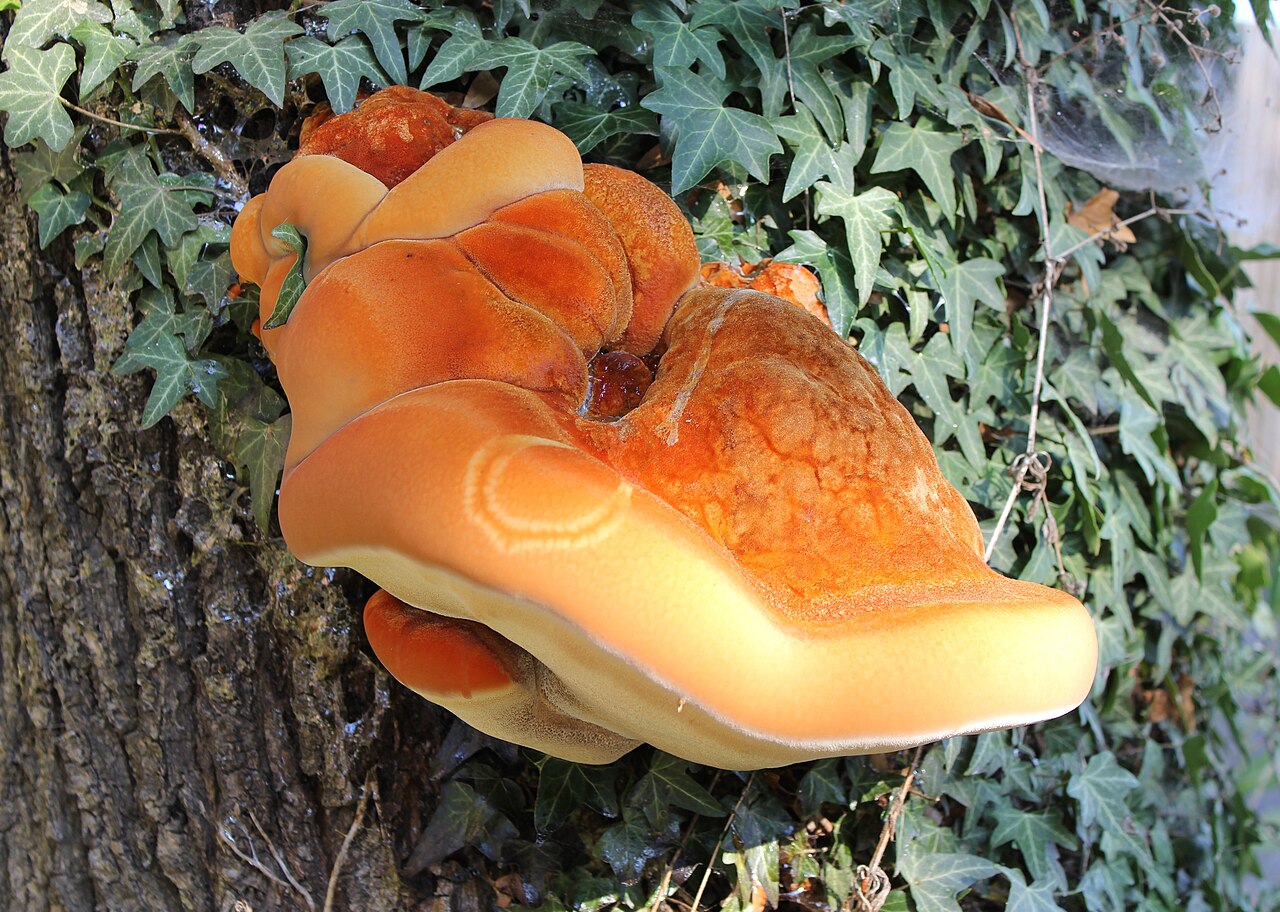
A glossy, varnished reddish-brown fan or kidney shape with a pale growing margin — it looks lacquered.
Underside shows tiny white pores, never gills. The flesh is tough and woody: you can't eat it fresh — it's strictly for tea and extraction.
Perennial on hardwood stumps and logs; the same conk can persist for years, adding a new growth ring each season.
🌿 Traditional uses & research
The 'Mushroom of Immortality' in Chinese tradition, valued for millennia for deep calm, restful sleep, and resilience to everyday stress. Its bitter triterpenes are among the most studied mushroom compounds for immune balance.
⚠️ Safety notes
May slow blood clotting — avoid with blood thinners or anticoagulants, and pause use before surgery. Can lower blood pressure; mild dry mouth or lightheadedness is reported by some. Talk to your provider if you take heart or blood-pressure medication.
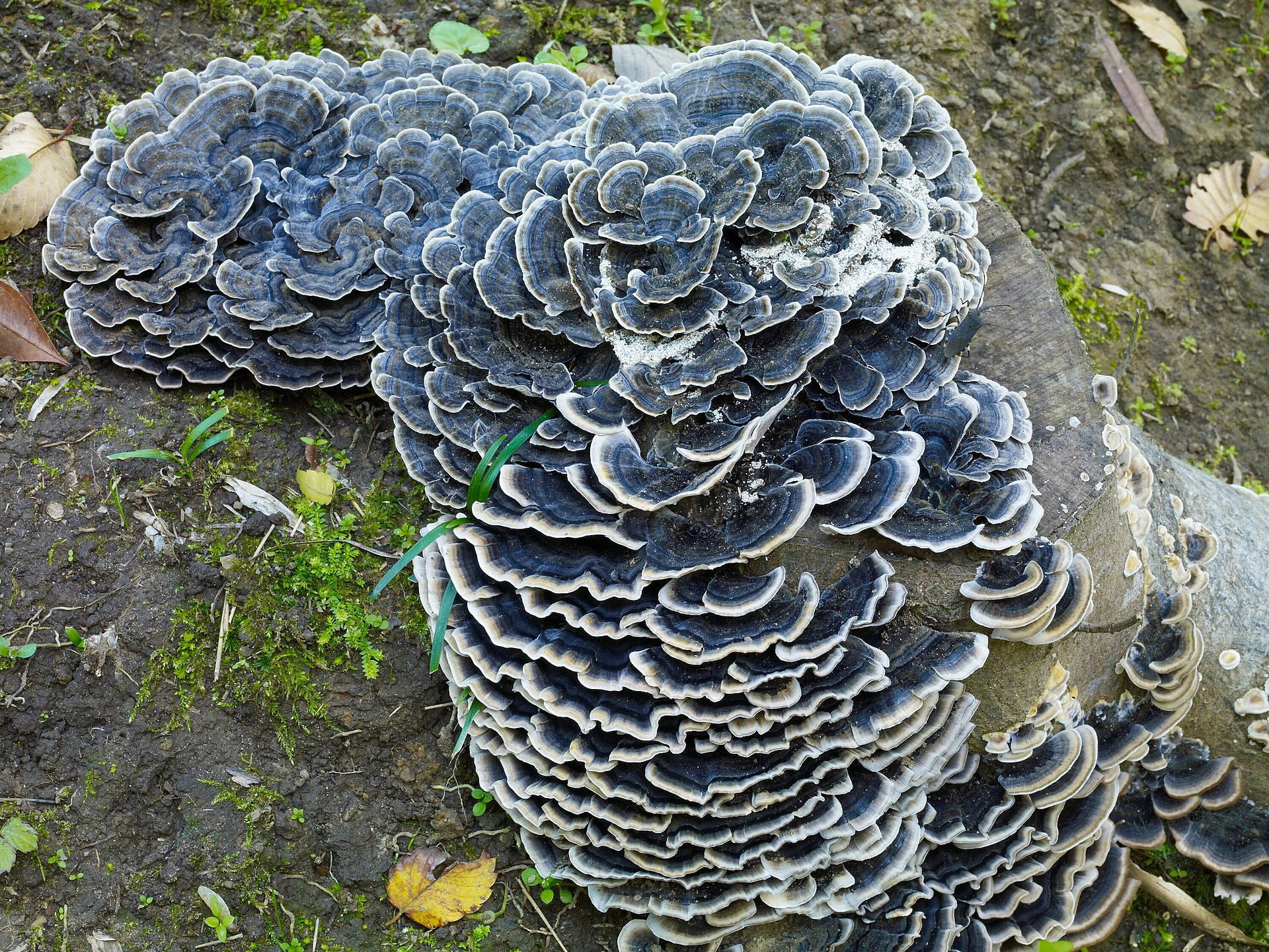
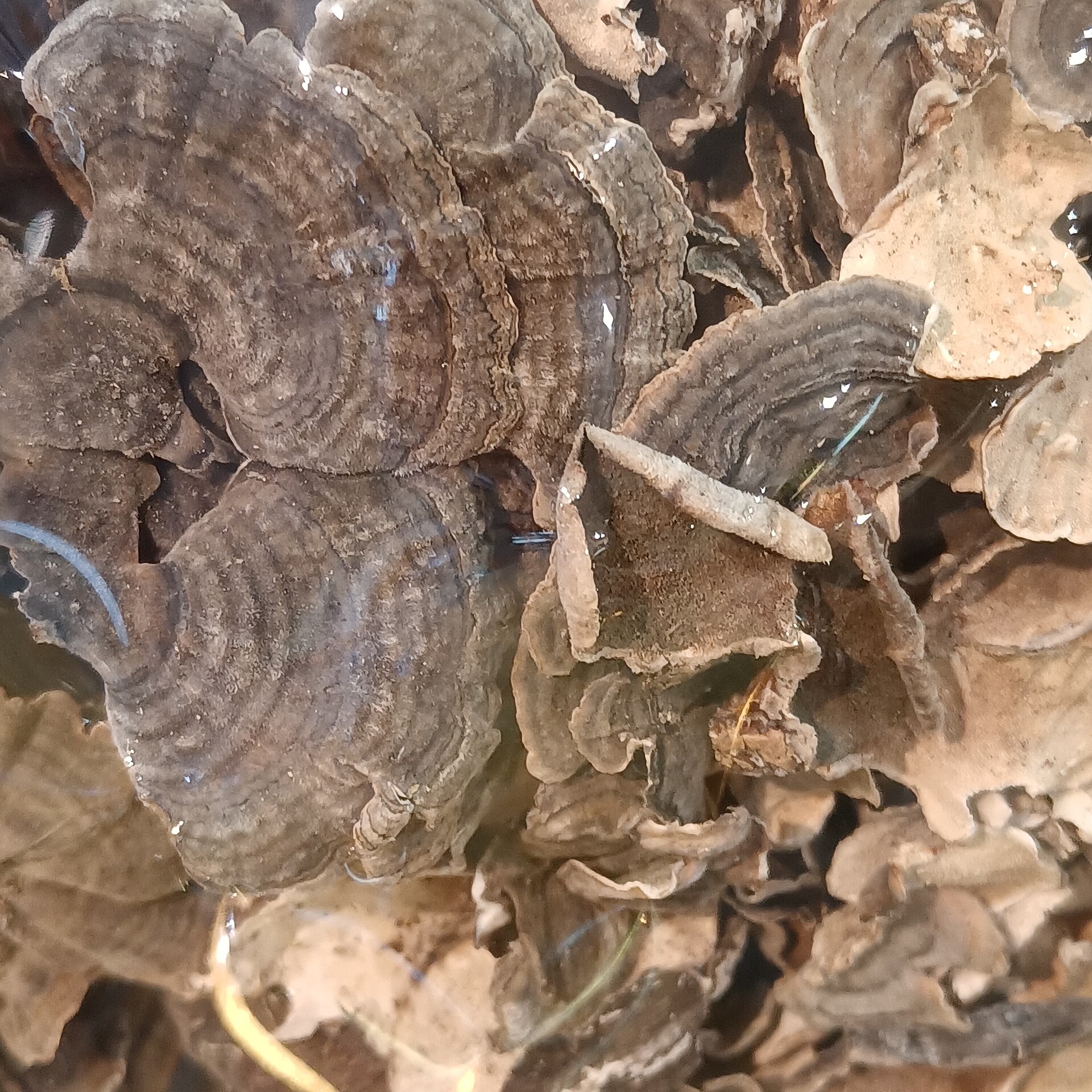
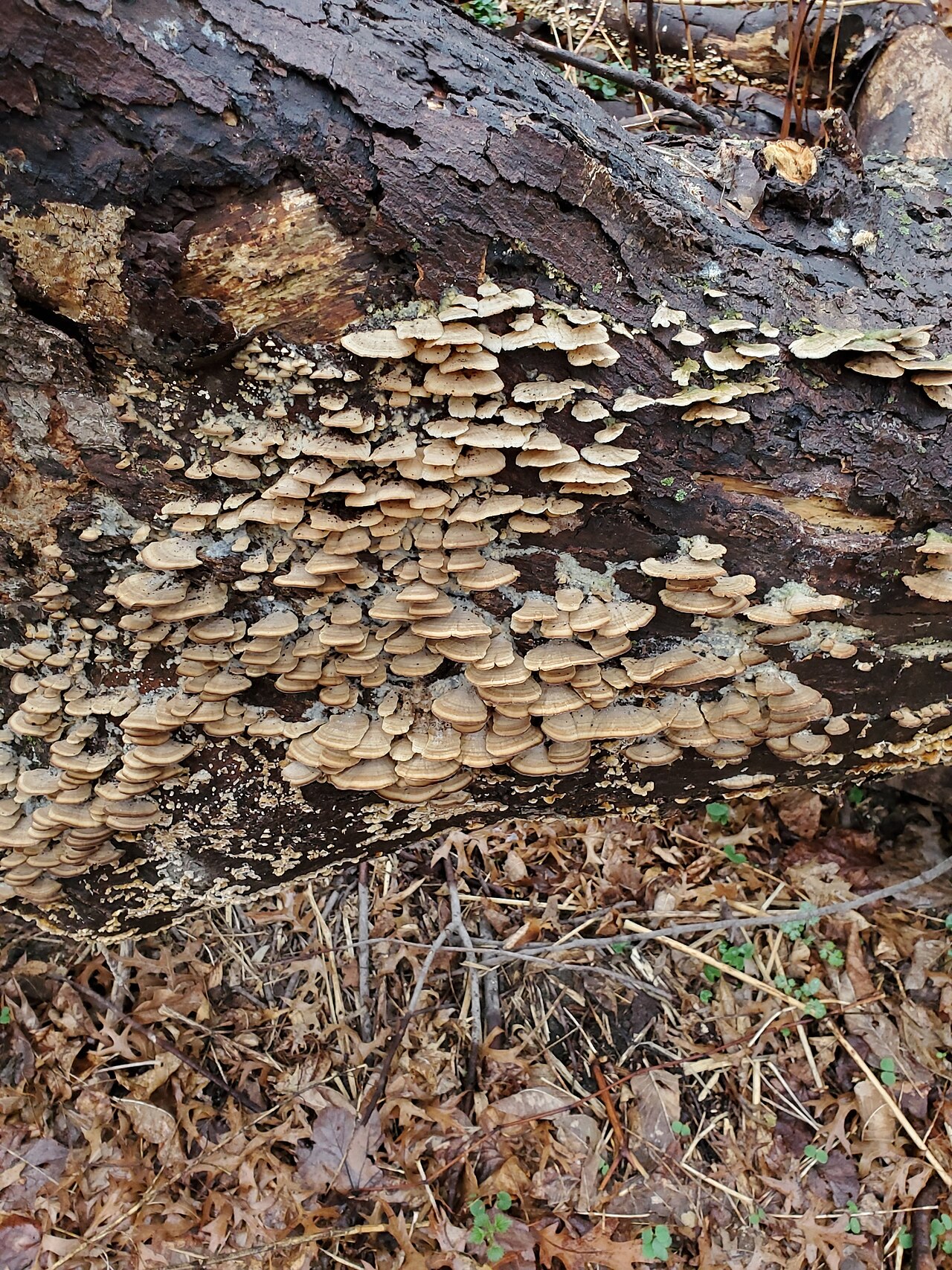
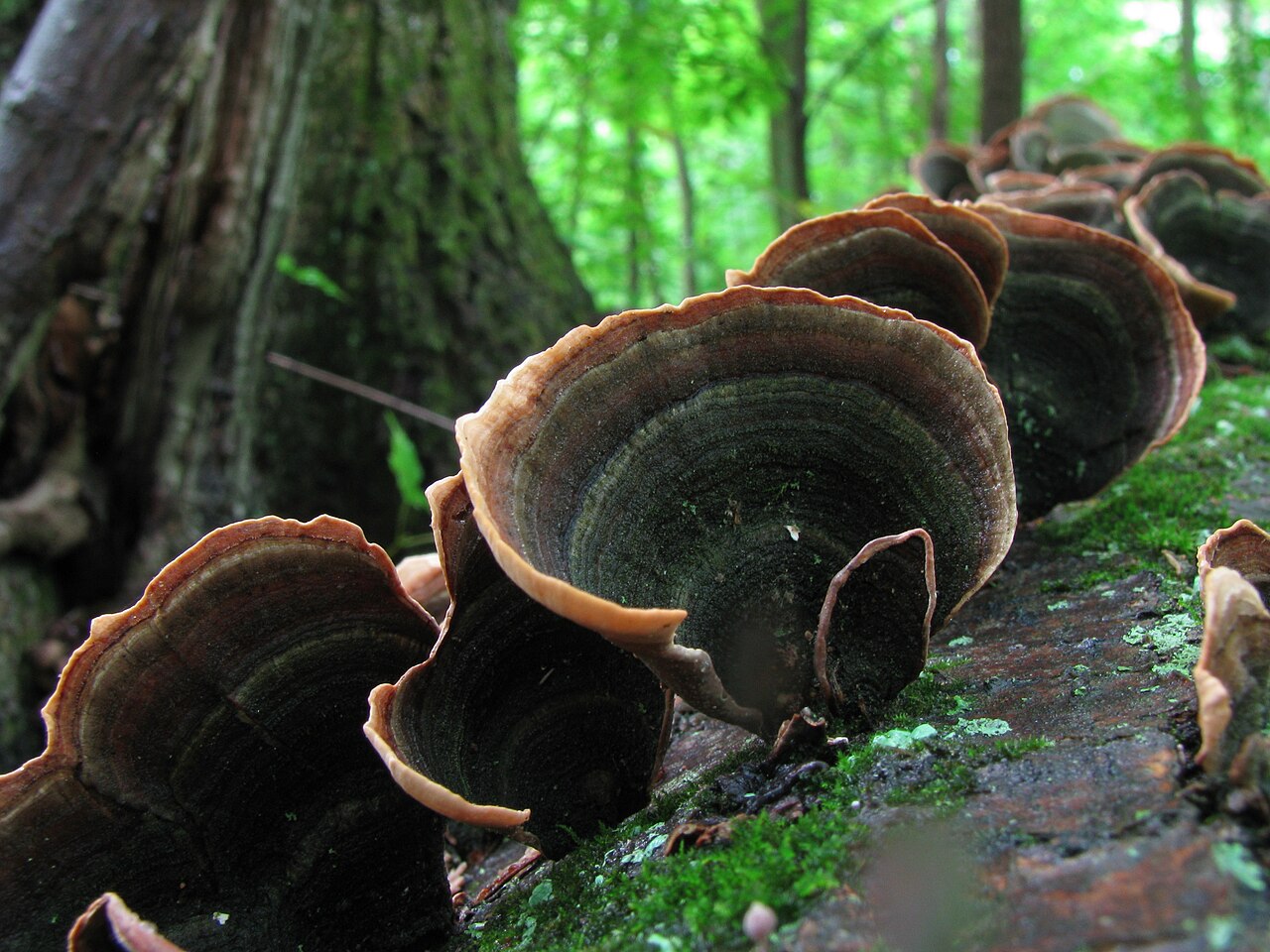
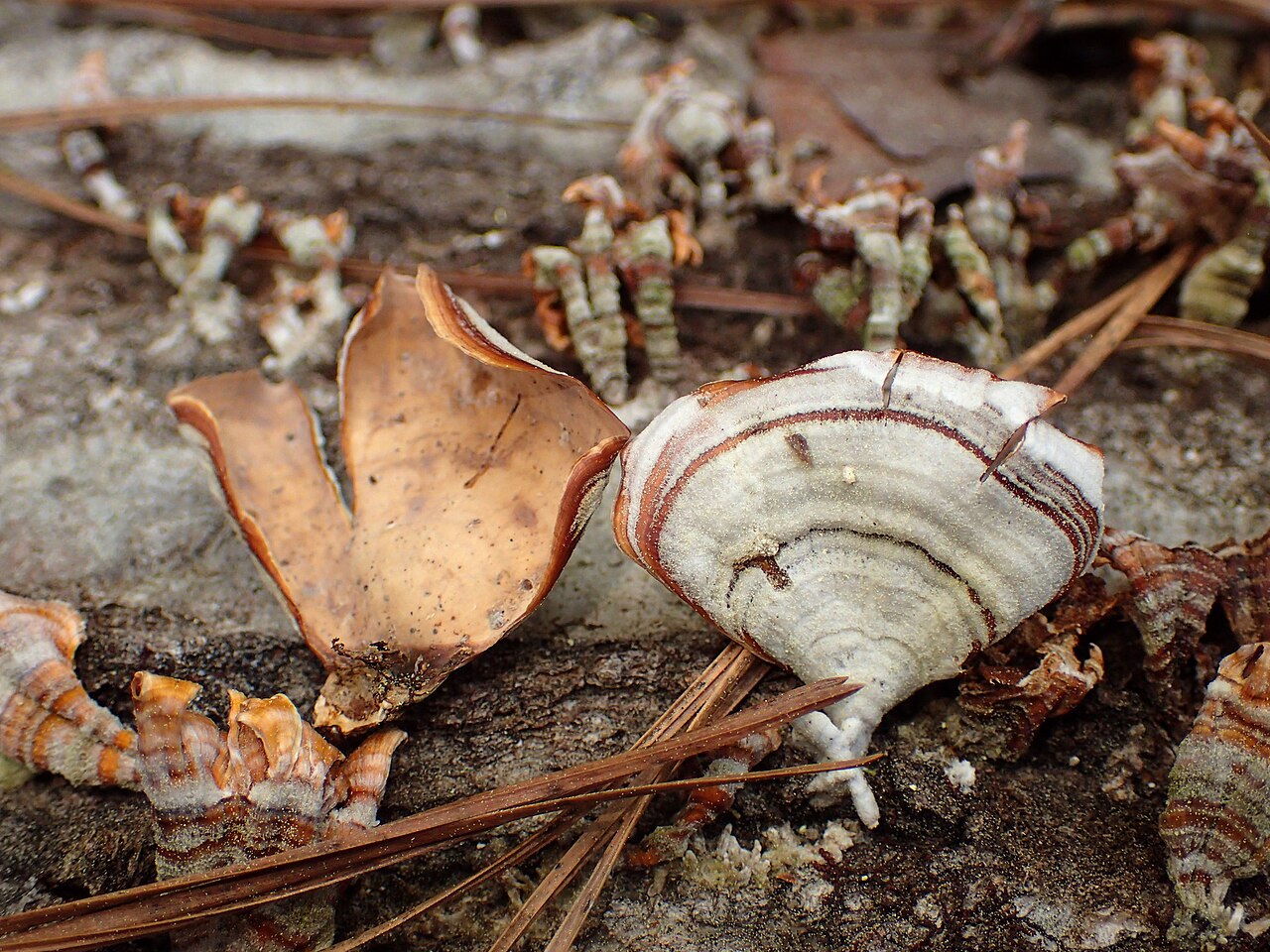
Thin, leathery brackets banded with bold concentric zones of brown, orange, ochre, blue-grey, and cream, with a finely velvety surface.
The make-or-break check: the underside must show thousands of tiny white pores. Smooth and orange underneath means false turkey tail — not the same mushroom.
Grows in overlapping shelves on dead hardwood, year-round, almost everywhere. One of the most common mushrooms on Earth.
🌿 Traditional uses & research
One of the most research-backed mushrooms in the world: its PSK and PSP polysaccharides are used in Japan as an adjunct in immune-support protocols. Traditionally brewed for gut and immune health.
⚠️ Safety notes
Very well tolerated. The main risk is misidentification — false turkey tail (Stereum ostrea) is smooth underneath with no pores. Mild digestive upset is possible when first starting.
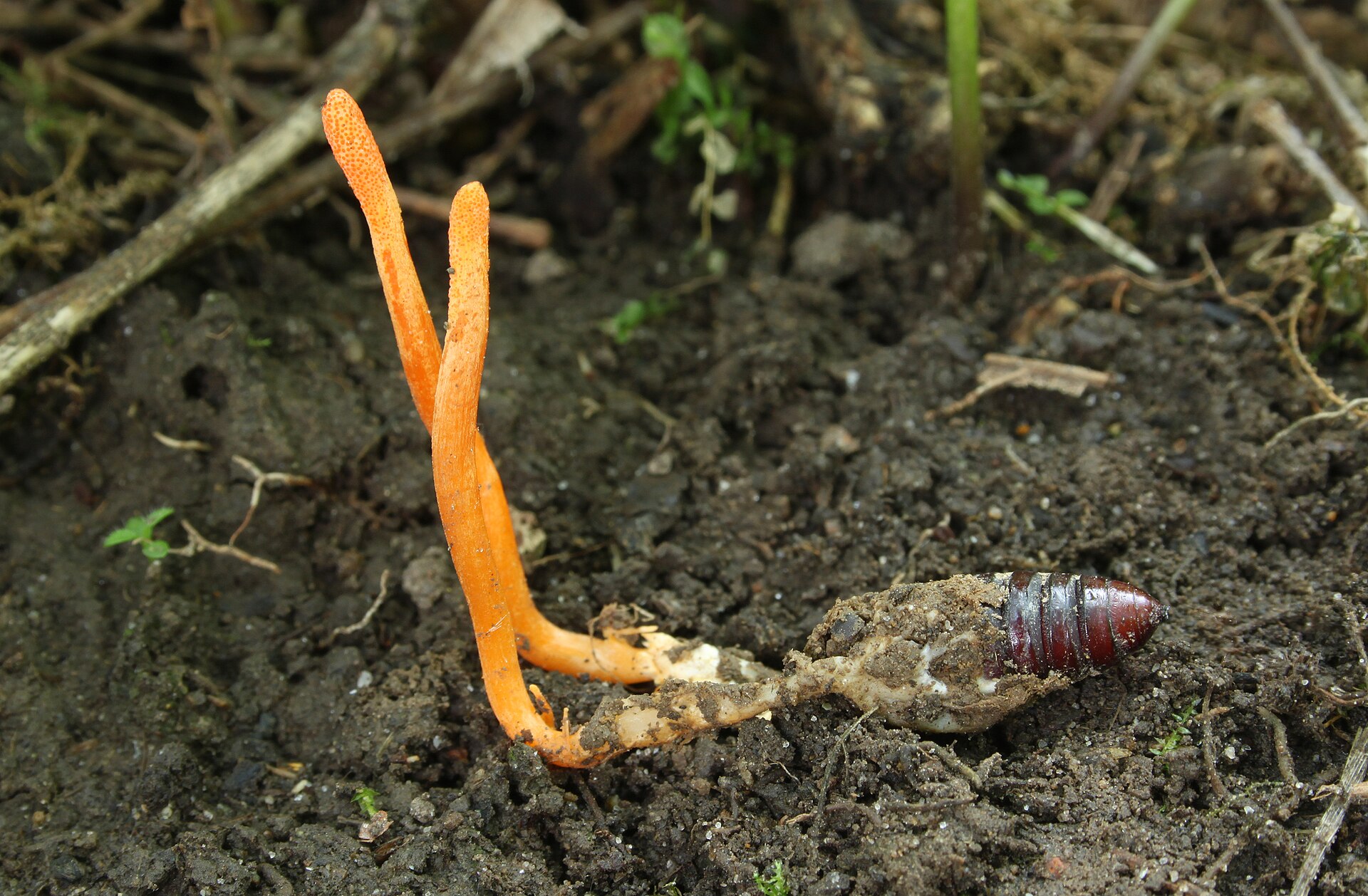
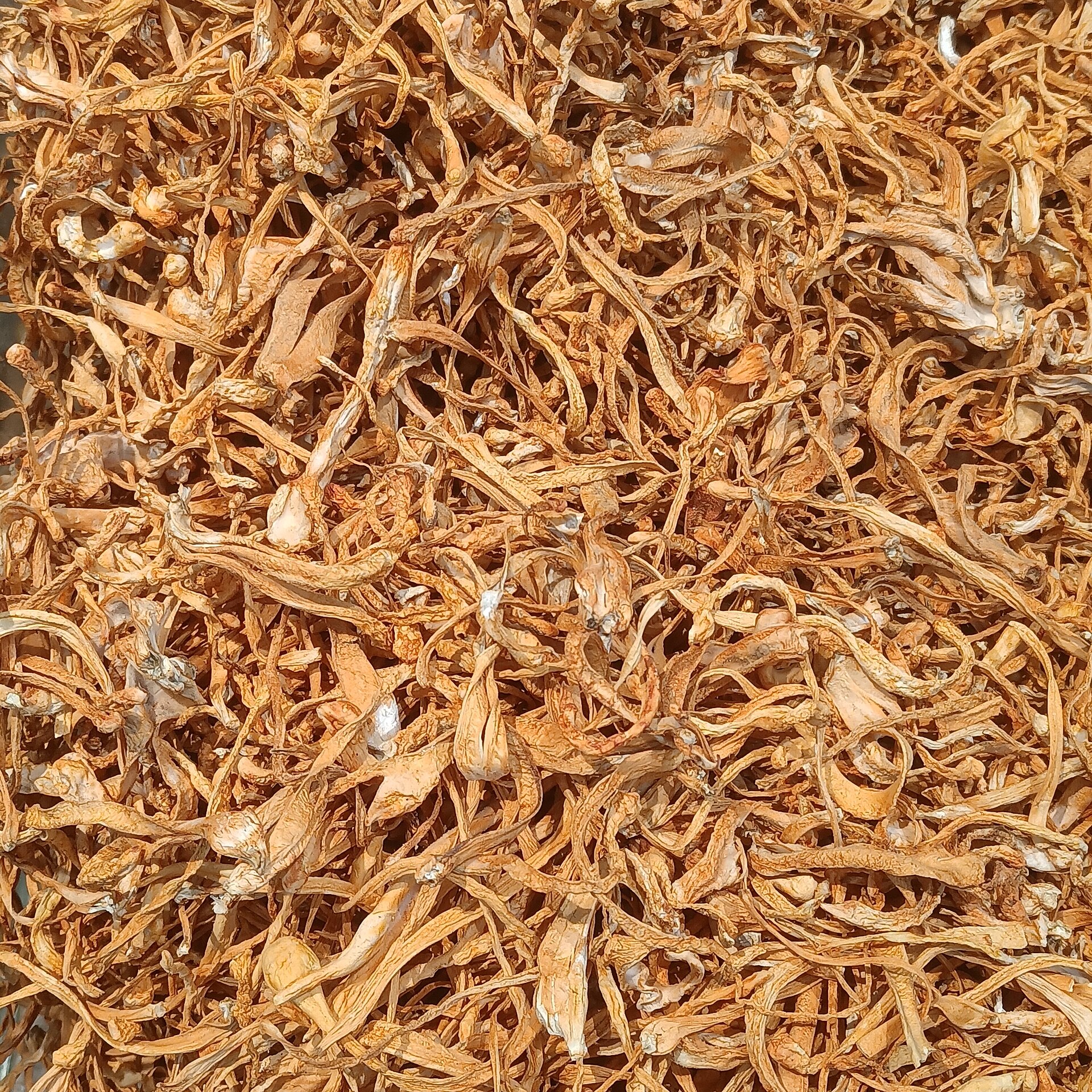
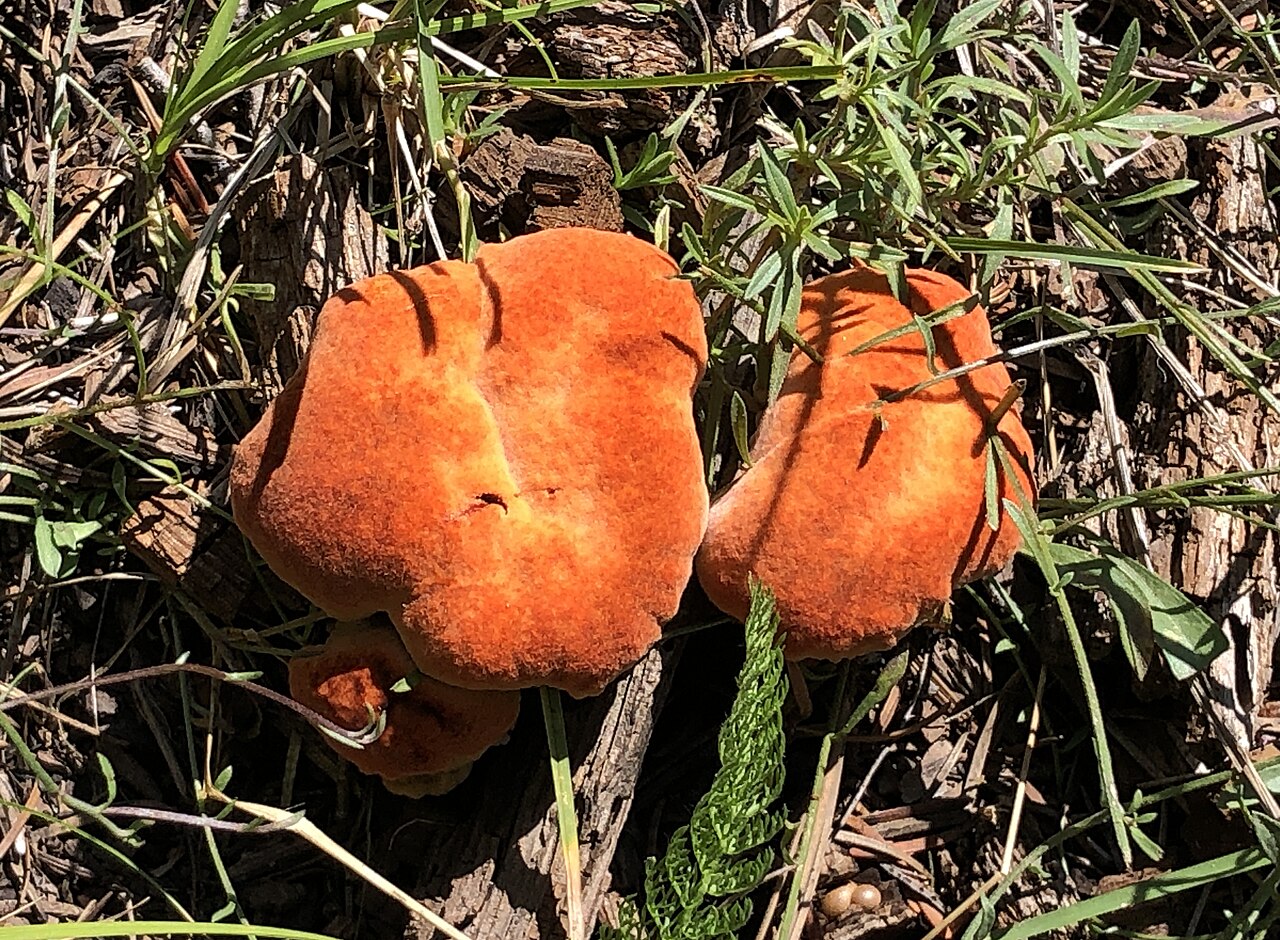
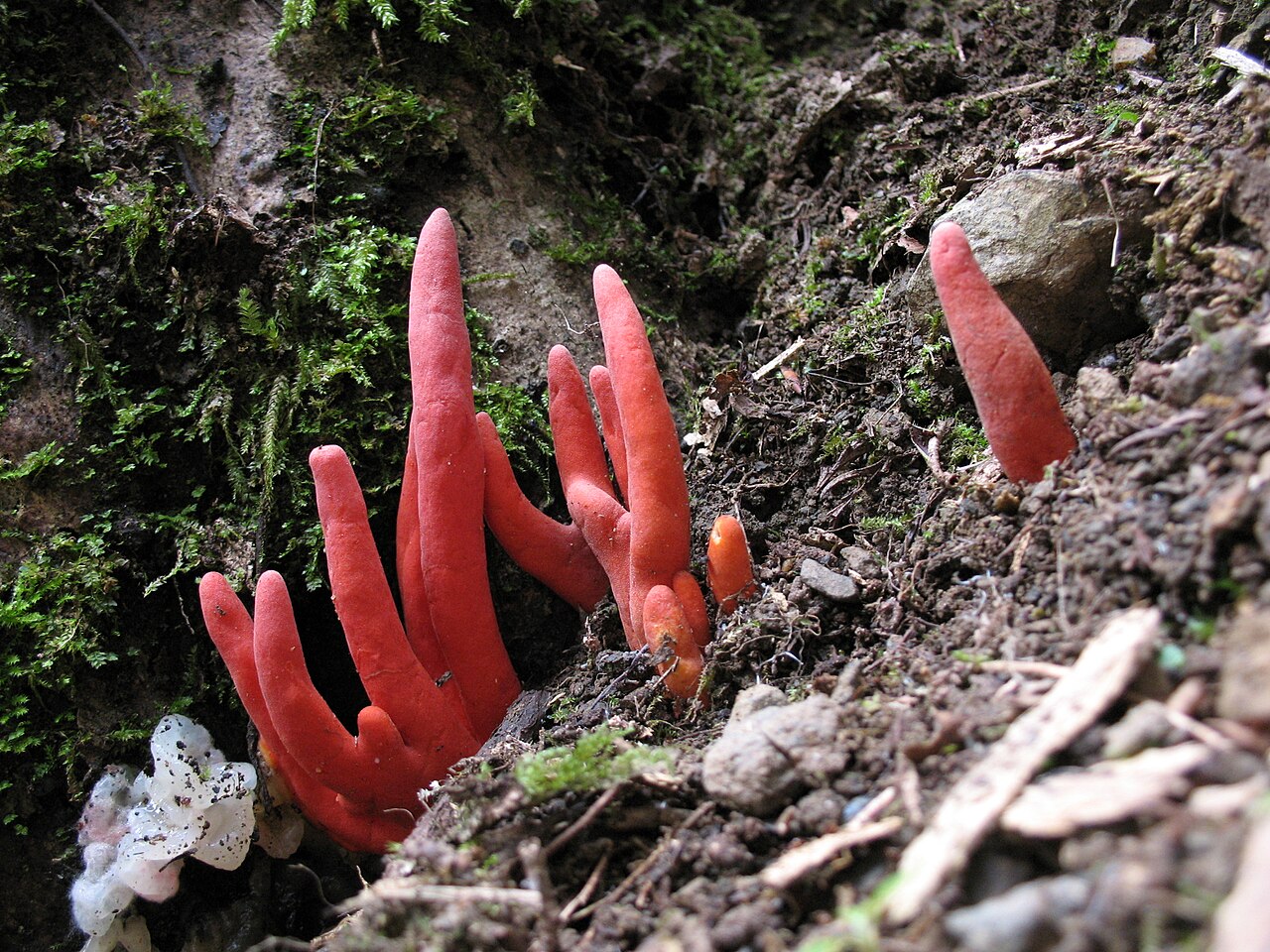
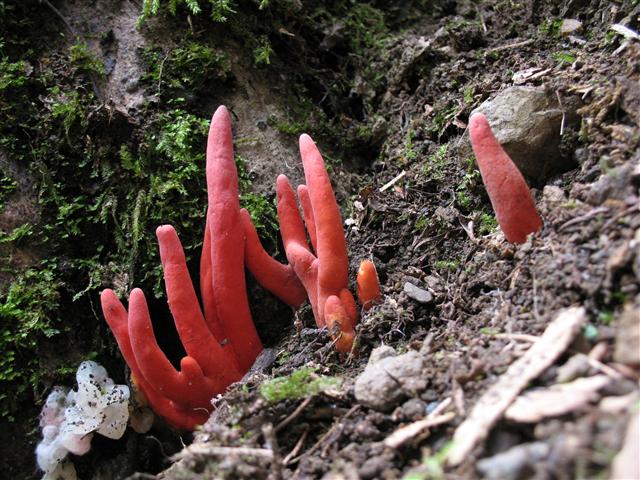
Bright orange finger-like clubs rising from their substrate — unmistakable once you've seen them.
Ours are fruiting bodies, grown on a vegetarian grain substrate. True wild cordyceps (Ophiocordyceps sinensis) grows from caterpillars high in the Himalayas and sells for thousands of dollars per pound — supplement cordyceps is the militaris species.
🌿 Traditional uses & research
Traditionally used by Himalayan peoples for stamina at altitude. Studied for energy metabolism — its compound cordycepin is researched in relation to ATP production and oxygen use. Our pick for clean, sustained energy without caffeine.
⚠️ Safety notes
Generally safe and well tolerated. May stimulate immune activity — use caution with autoimmune conditions or if taking immunosuppressant drugs. Mild nausea is possible at high doses.
🦠 The Wild Story
The orange clubs in our jars have a wilder origin than most people realize. In nature, Cordyceps militaris is an insect assassin: its spores infect the larvae or pupae of moths buried underground, then its mycelium colonizes the living insect from within, keeping it alive just long enough to build the fungal biomass it needs. The insect is mummified, and the bright orange "spore factory" clubs push up out of the dead host. Researchers have found it doesn't even need to kill quickly — in silkworms, the fungus steals a viral gene that scrambles the caterpillar's hunger signals, turning it into an eating machine that gorges on leaves to fatten up the fungus inside it. What we grow skips the insect part entirely: the same fungus fruits happily on a vegetarian grain substrate, which is why ours never comes from a bug.
🌍 Native to: Circumboreal (Northern Hemisphere boreal forests)
🔍 How to identify
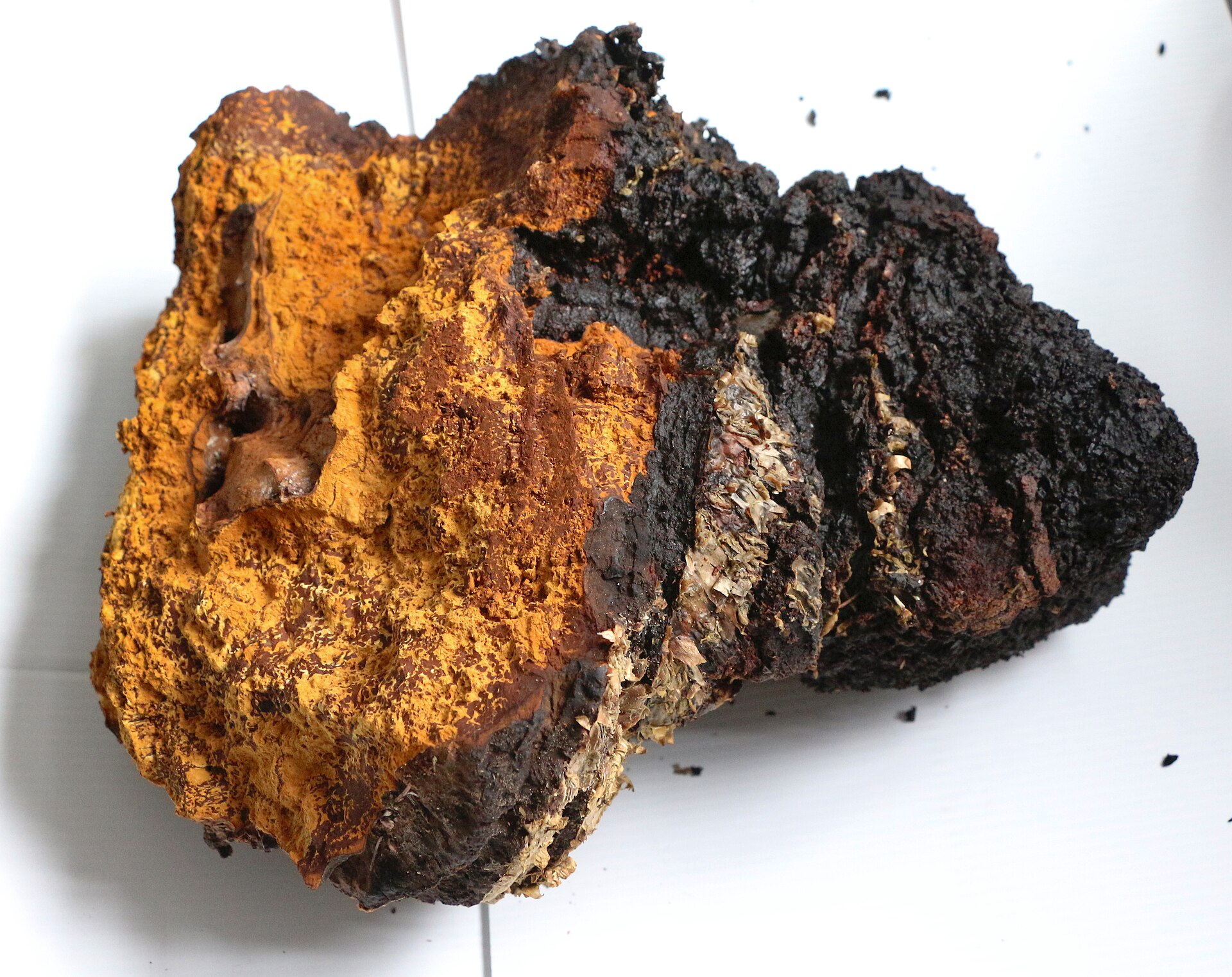
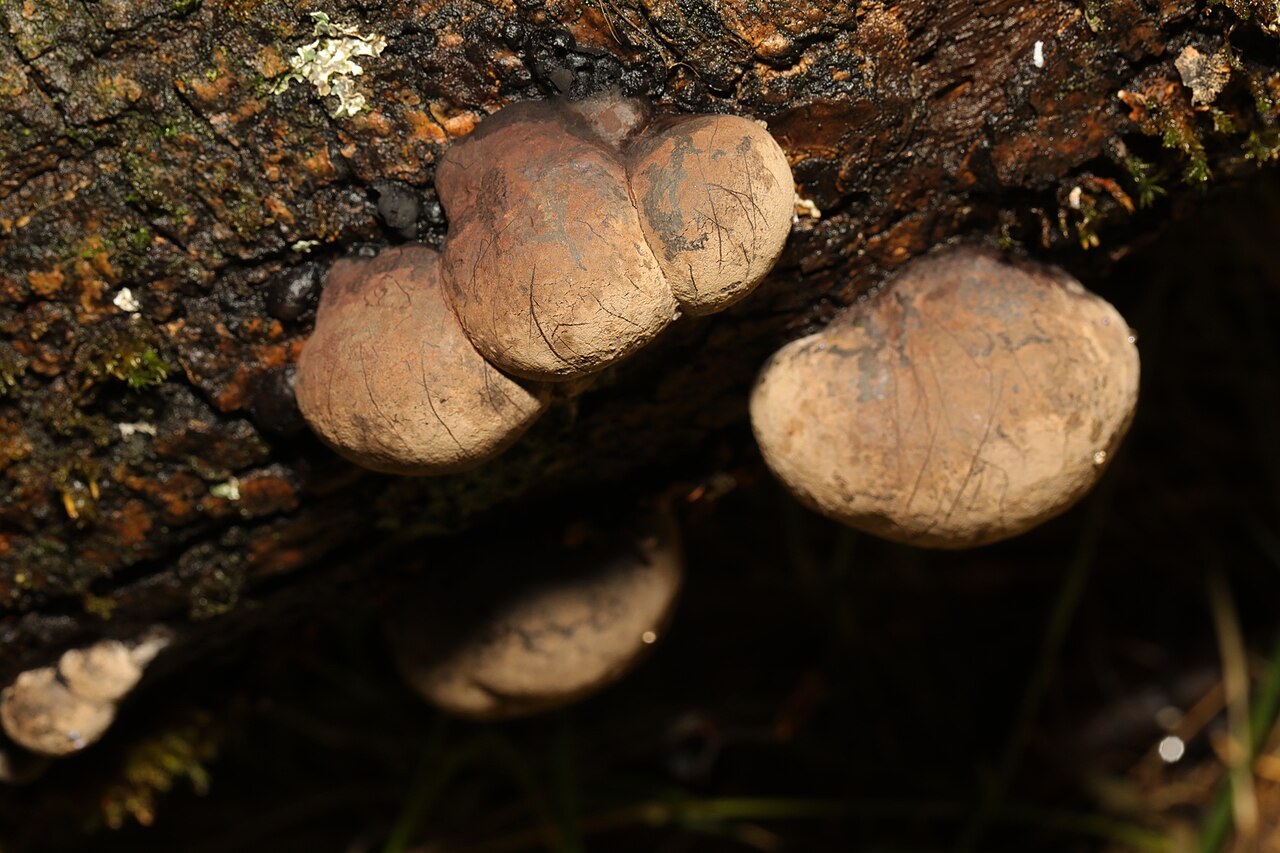
Not a mushroom cap at all — a black, deeply cracked, charcoal-like mass bursting through birch bark, with a burnt-orange interior.
Grows almost exclusively on living birch in cold northern forests. The true fruiting body is a rare grey crust almost never seen; what we harvest is the sterile conk. Extremely slow-growing — a harvestable mass takes years to form.
🌿 Traditional uses & research
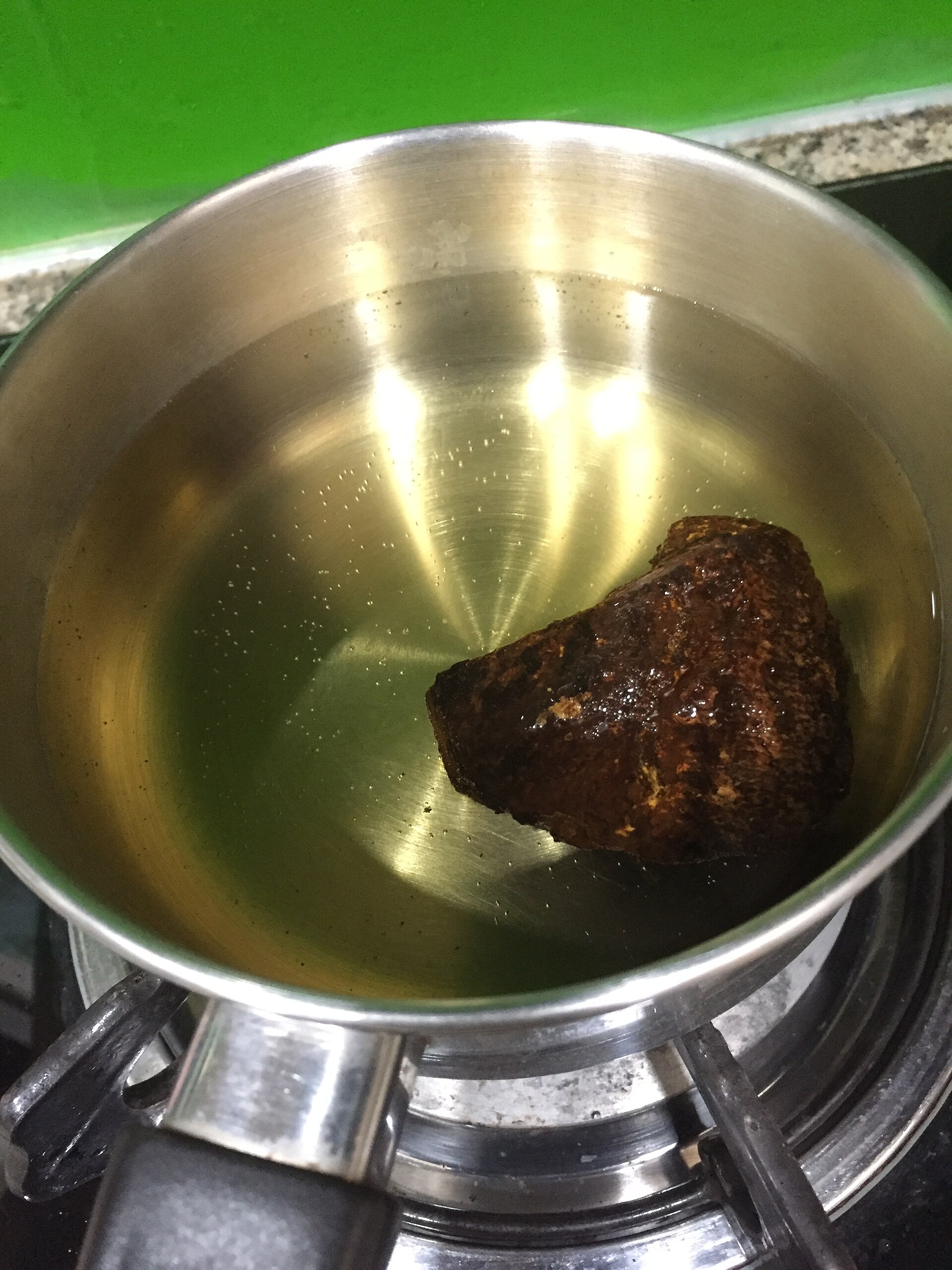
Brewed for generations across Siberia and northern Europe. Among the most antioxidant-dense natural substances measured, and a source of betulin drawn from its birch host. Traditionally taken as a long-steeped tea.
⚠️ Safety notes
High in oxalates — a genuine kidney-stone risk with heavy, long-term use; anyone with kidney issues should avoid it. May lower blood sugar and slow clotting — check with your provider if diabetic or on blood thinners. Because it grows so slowly, sustainable harvest matters.
🦠 The Wild Story
During World War II, when coffee rations ran dry, Finns turned to the forest: chaga brewed into a dark, coffee-colored drink they called tikka tea — tikka being Finnish for "woodpecker," a nod to the fungus's tree-destroying habits. And it is a destroyer. What looks like a burnt-black lump on a birch is no mushroom cap at all: it's a sterile conk, a mass of fungal tissue with no spores in it, built up over years while the real fungus works inside the living tree. Chaga slowly kills its host — the tree typically dies within 5 to 7 years — and only after the tree is dead does the true fruiting body, a rare grey crust, finally appear under the bark to release spores. The black mass we harvest is essentially the fungus's siege engine against the birch, built over a decade or more. No wonder it takes so long to grow — and why sustainable harvest matters.
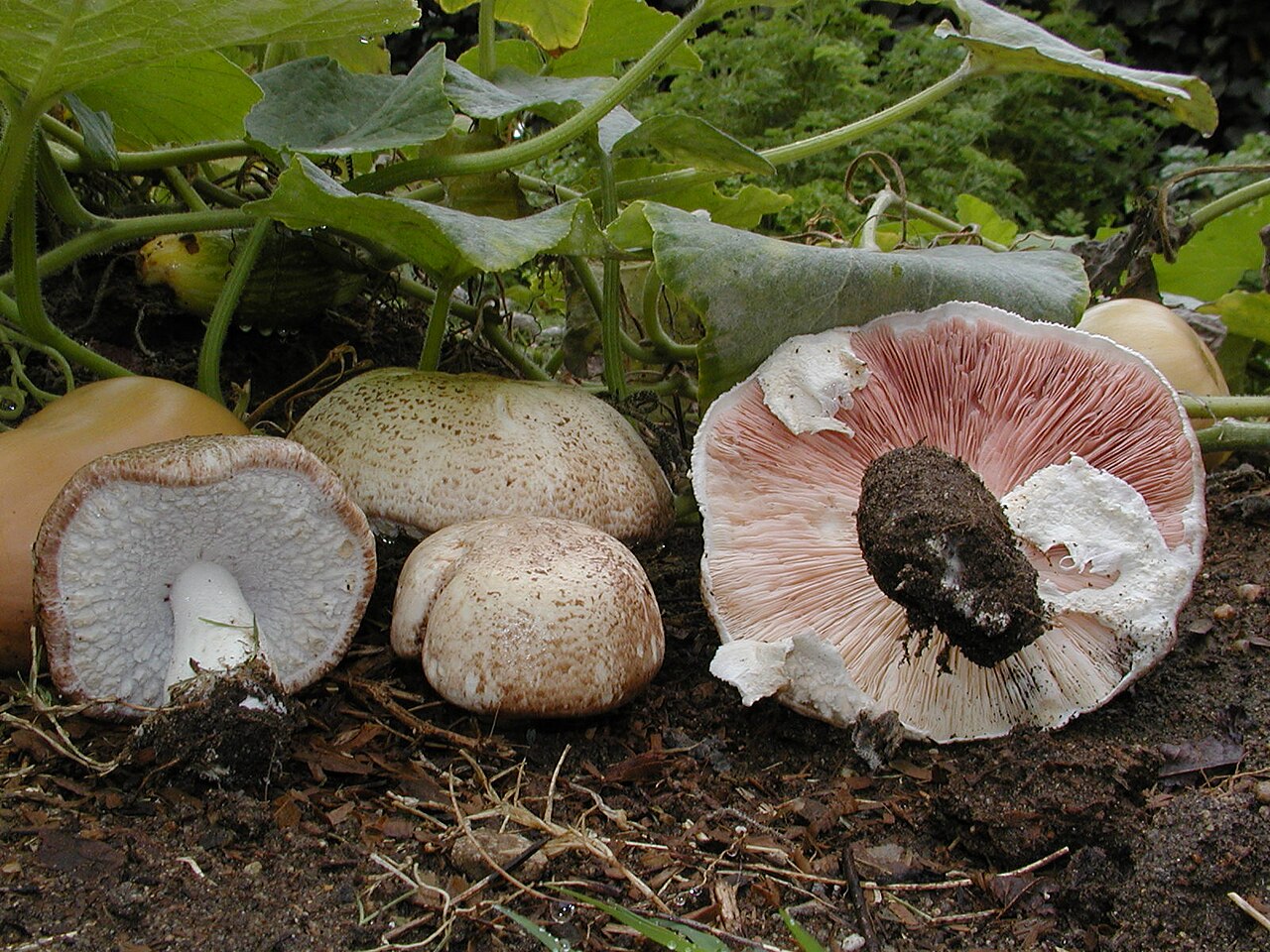
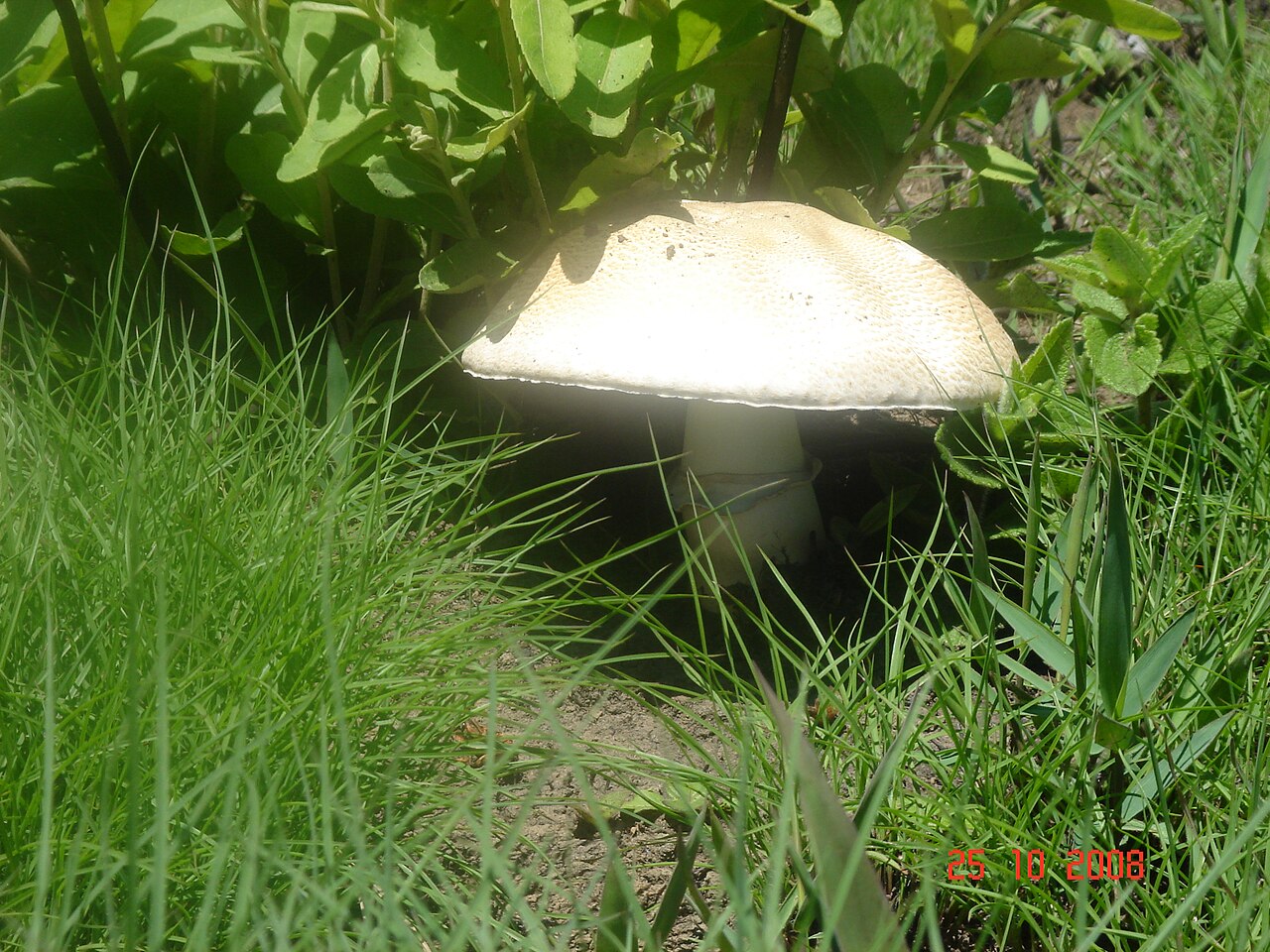
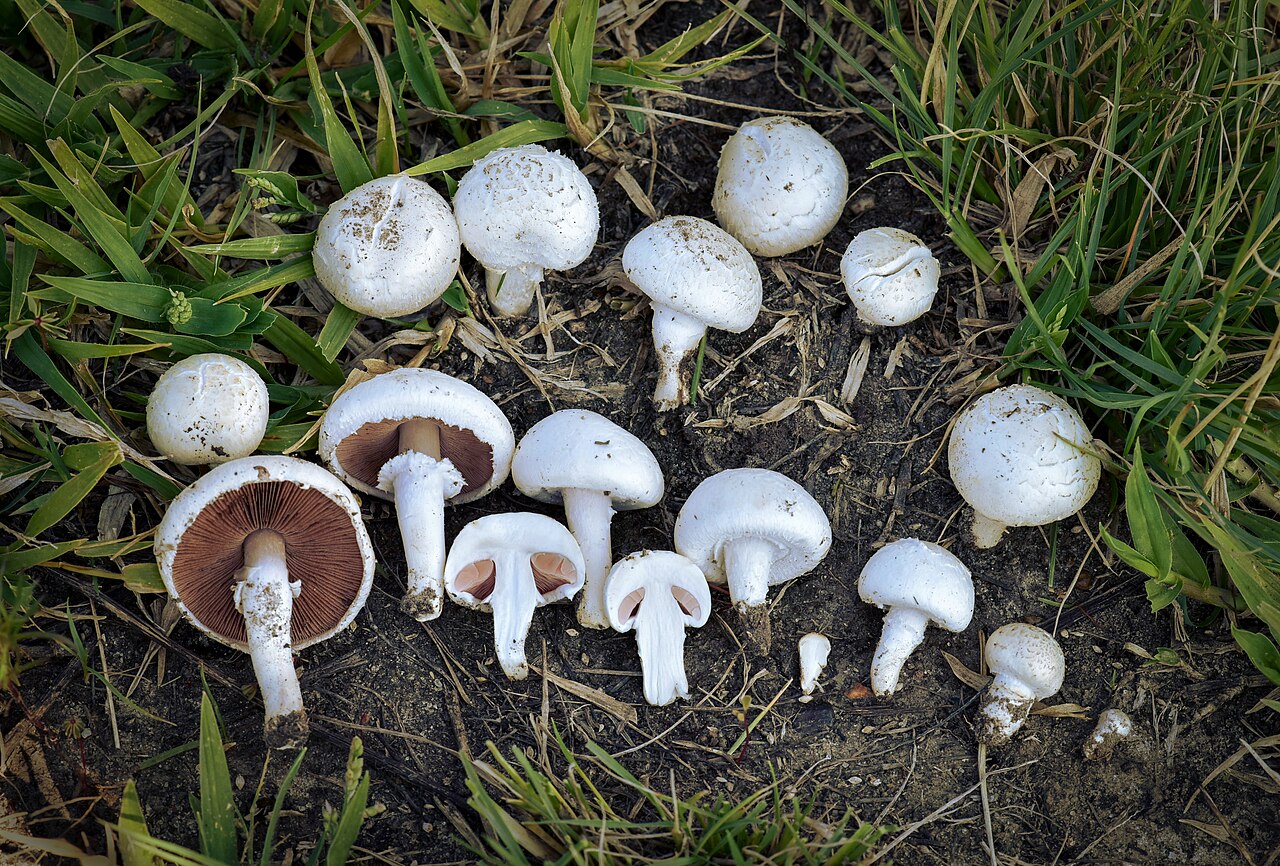
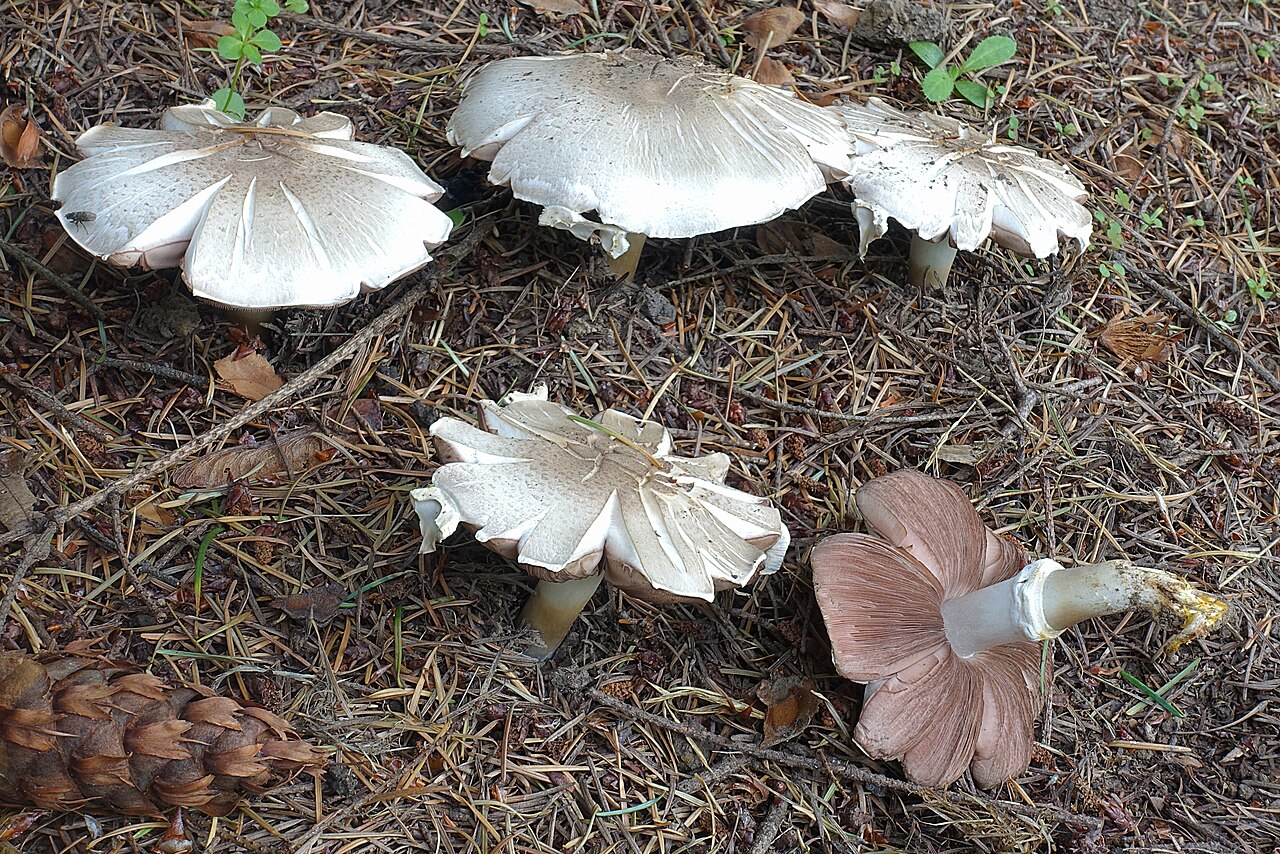
A field mushroom with a scaly tan-brown cap, pink gills maturing to chocolate brown, and a distinctive sweet almond scent.
Also sold as almond mushroom or himematsutake; a close cousin of the common button/portobello.
The almond fragrance is the key field mark — the toxic lookalike Agaricus xanthodermus smells harshly of phenol or ink instead.
🌿 Traditional uses & research
One of the most researched immune mushrooms in the world, famed for its beta-glucan content; a staple of the supplement aisle in Brazil and Japan, where most of the research originates. Also eaten fresh where cultivated.
⚠️ Safety notes
Never eat a wild Agaricus on looks alone: the yellow-staining Agaricus xanthodermus is toxic and common. Learn the almond-vs-phenol smell test, check every identification with an expert, and when in doubt buy cultivated.
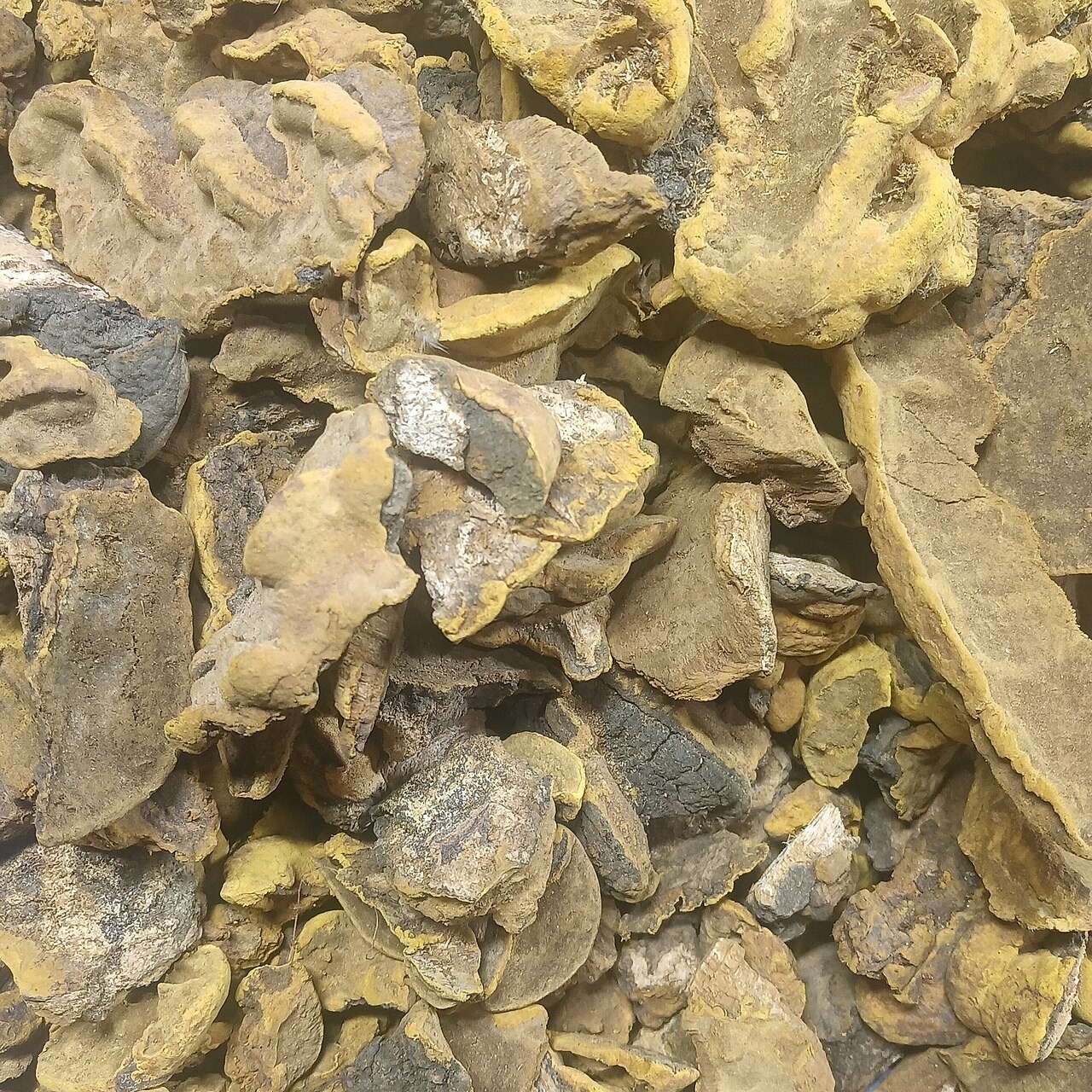
A woody perennial conk growing shelf-like on mulberry and other hardwoods — yellow-brown pore surface beneath a dark, cracked cap.
Grows for years like reishi, adding a new pore layer each season; related to the Phellinus species of traditional medicine.
Far too tough and woody to chew — this is a tea-and-extract mushroom, not a food mushroom.
🌿 Traditional uses & research
Prized in Korean, Japanese, and Chinese tradition and now studied for immune-supporting polysaccharides; commands high prices in Asian markets as a premium tonic mushroom.
⚠️ Safety notes
Not edible as food — use only as a prepared tea, decoction, or extract. Source carefully: wild conks can accumulate environmental contaminants, so buy from tested suppliers.
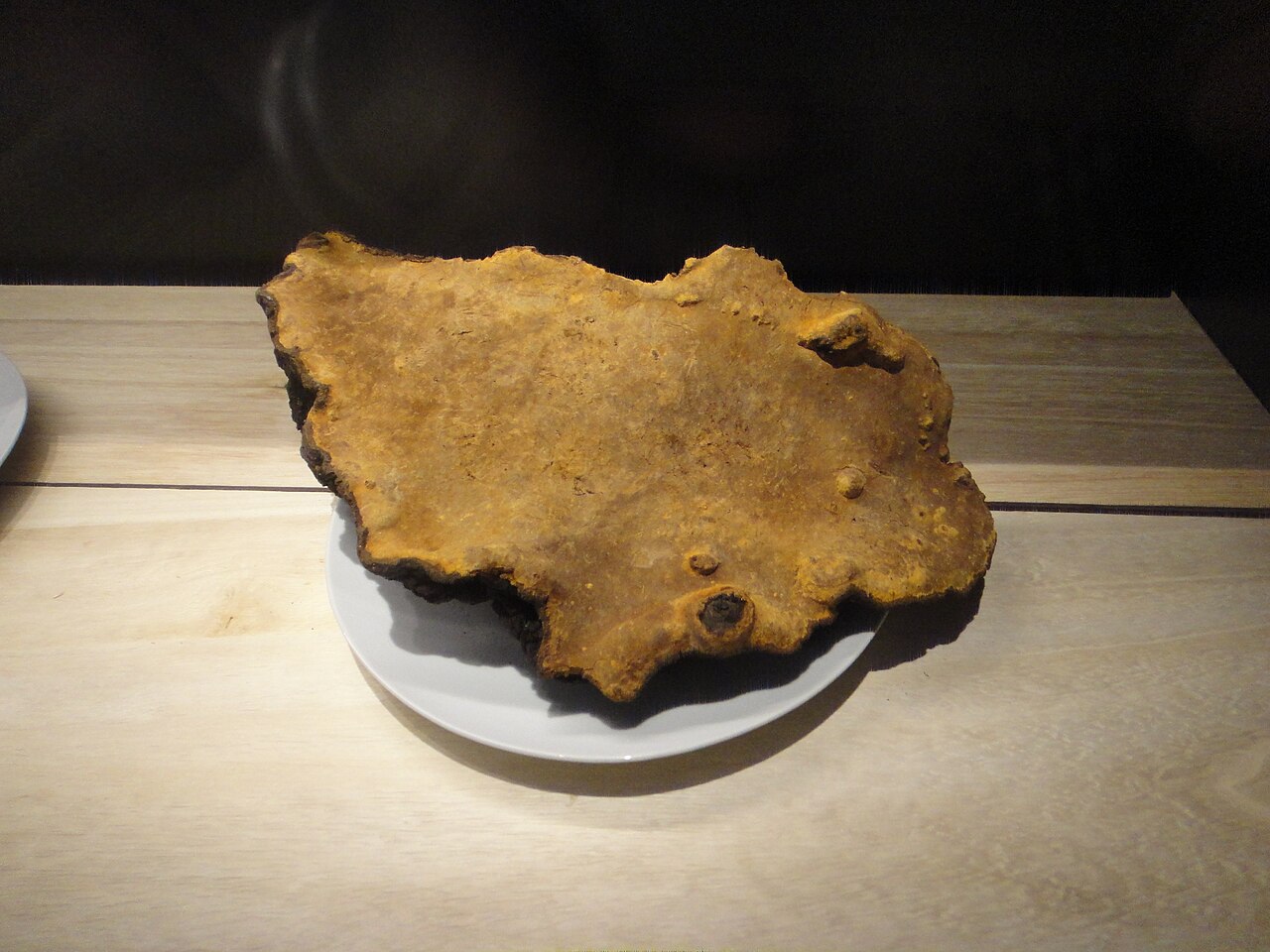
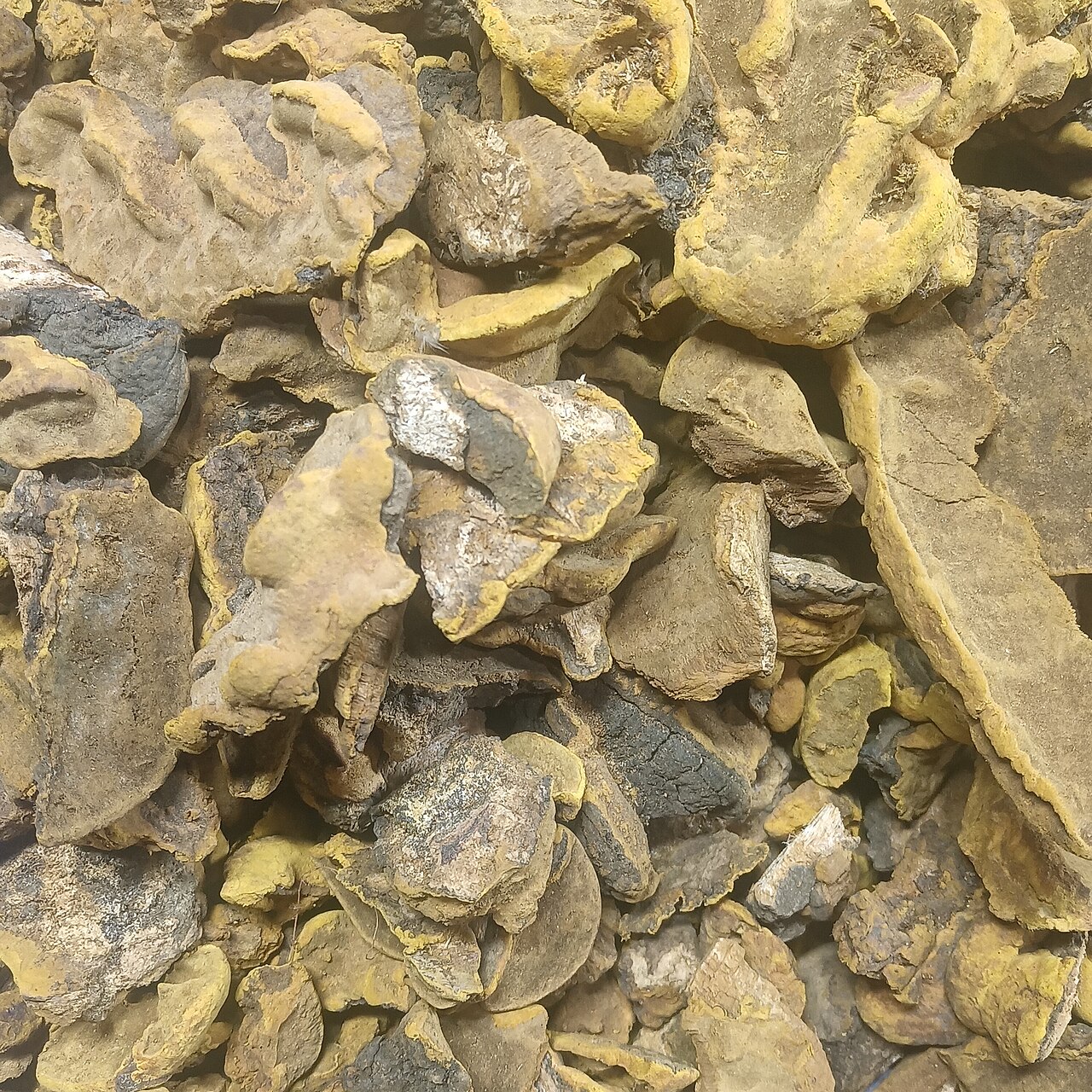
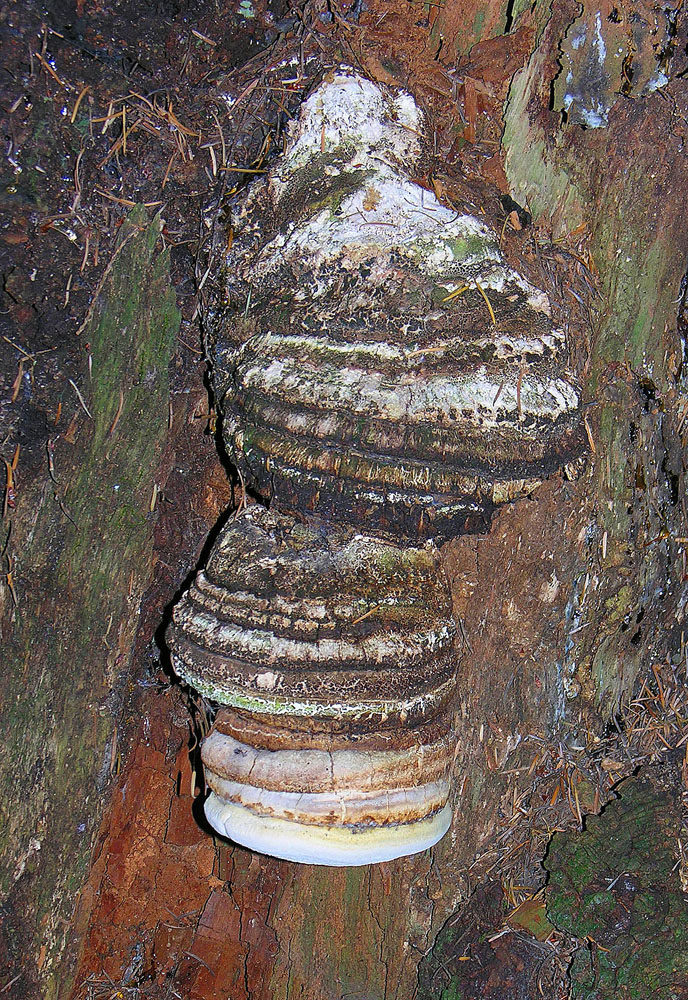
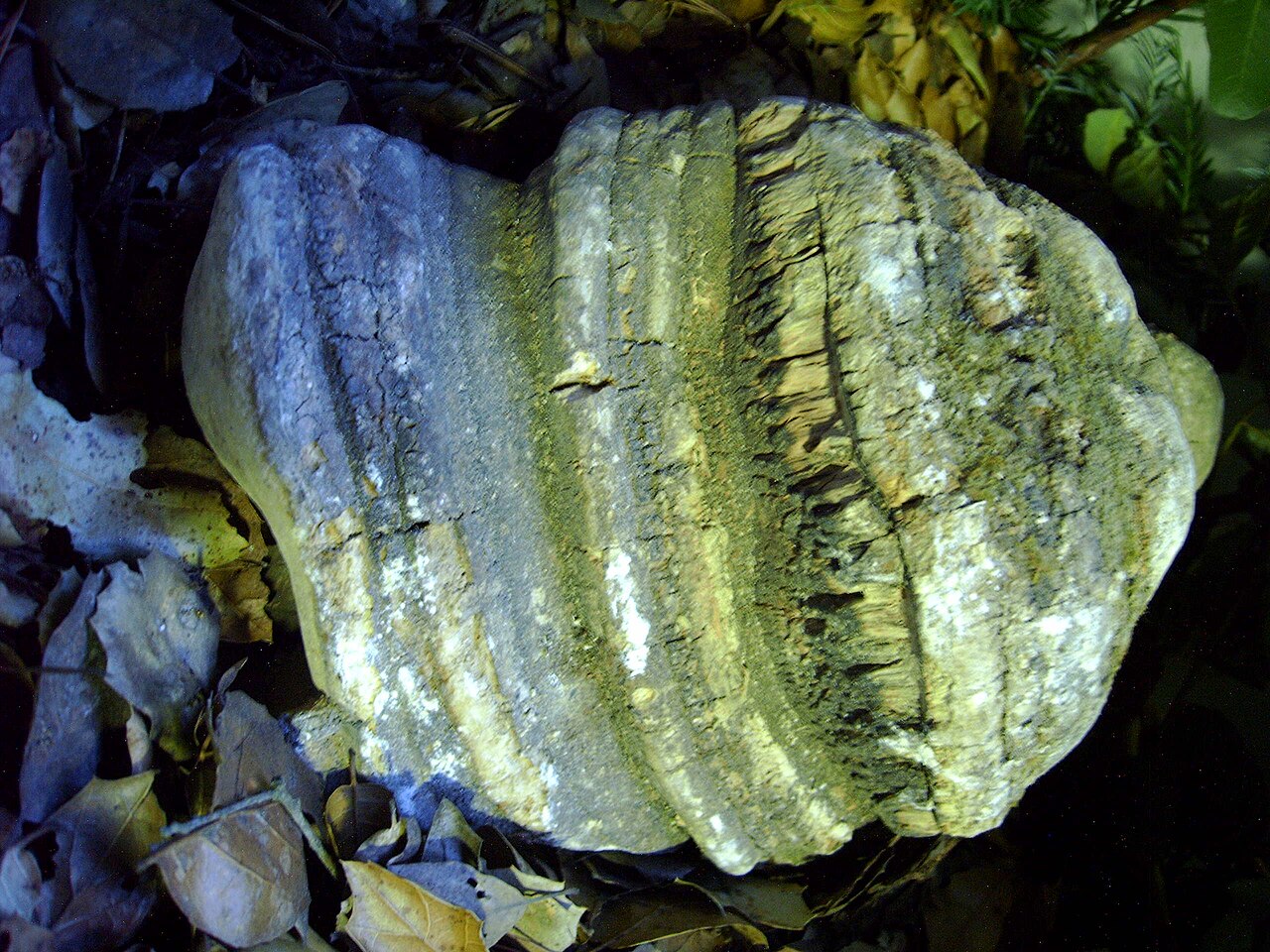
Massive beehive-shaped or columnar perennial conk, often 30–50 cm long, growing from living old-growth conifers such as Douglas-fir, larch, and cedar.
Chalky, mealy surface in whitish-cream to gray-brown, often cracked; cream-colored pore surface underneath.
Intensely bitter taste — nicknamed the "quinine conk," though it contains no actual quinine.
Adds a new growth ring each year; individual conks can live 75+ years, possibly the longest-lived mushroom known. Older books call it Fomitopsis officinalis.
🌿 Traditional uses & research
Traditionally used for thousands of years — the Greek physician Dioscorides described it in the 1st century AD, and Pacific Northwest coastal peoples carved the conks into ritual masks, calling it the "bread of the ghosts." Modern research has explored antimicrobial compounds in its mycelium through laboratory screening. It is now classified as Endangered on the IUCN Red List as old-growth habitat shrinks and unregulated harvesting has thinned populations — never harvest agarikon from the wild; cultivated mycelium is the only responsible source.
⚠️ Safety notes
Its extreme bitterness limits casual use and can upset the stomach in quantity. Drug interactions have not been well studied, so talk to a clinician before use. And conservation comes first: leave wild conks on their trees — this species is genuinely at risk.
Older field guides list it as Piptoporus betulinus — same mushroom. Unlike amadou, it is annual, smoother, and paler rather than a gray, zoned woody hoof.
🌿 Traditional uses & research
Traditionally used across northern Europe as a tea, and famously carried by Ötzi the Iceman — pieces of it were found threaded on a leather thong with his 5,300-year-old remains. Research has explored its anti-inflammatory and immune-related properties in laboratory settings, but evidence in people remains preliminary.
⚠️ Safety notes
A long folk history of tea use suggests general tolerability, though some people report nausea. Those with birch-pollen allergies should use caution, as a cross-reaction is theoretically possible. As with any functional mushroom, check with a clinician if you take regular medication.
🦠 The Wild Story
Ötzi the Iceman carried this one too — and researchers think his was a medicine kit. Alongside his tinder, he had pieces of birch polypore threaded onto leather thongs. When scientists examined his remains, they found he was infected with intestinal whipworms — and birch polypore contains compounds active against exactly those parasites. The leading theory is that Ötzi, suffering from worms, was dosing himself with the polypore as a remedy. Later generations found other uses for the same leathery fungus: cut into strips, it served as a razor strop for sharpening knives — and pieces of it turn up in archaeological sites across prehistoric Europe.
🌍 Native to: East Asia and southeastern North America
🔍 How to identify
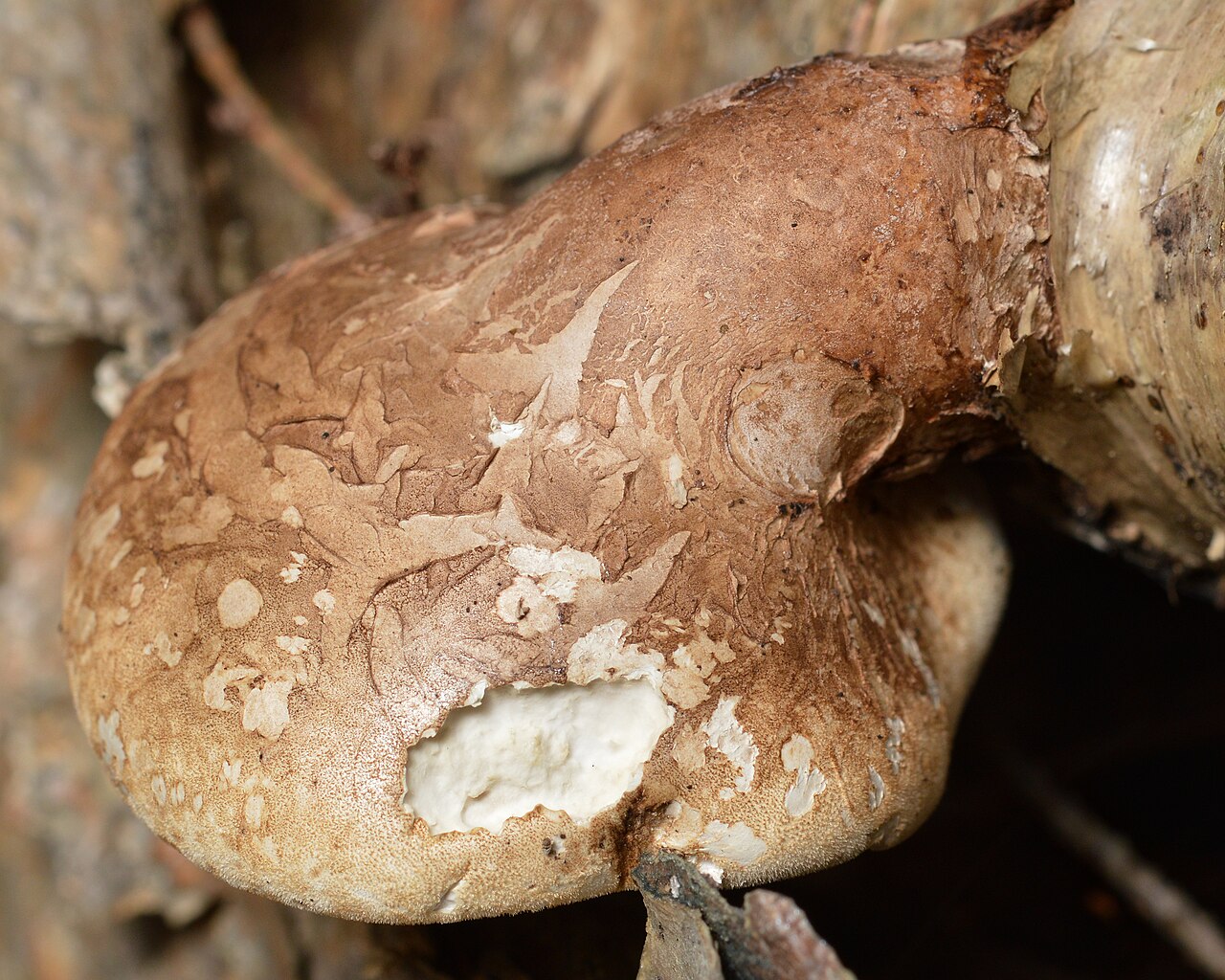
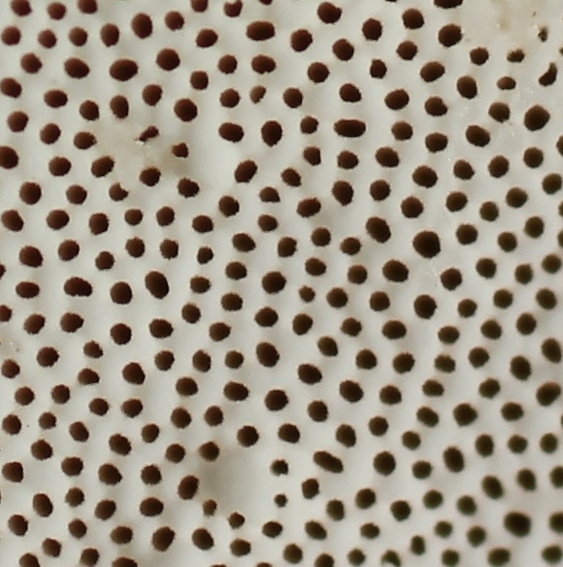
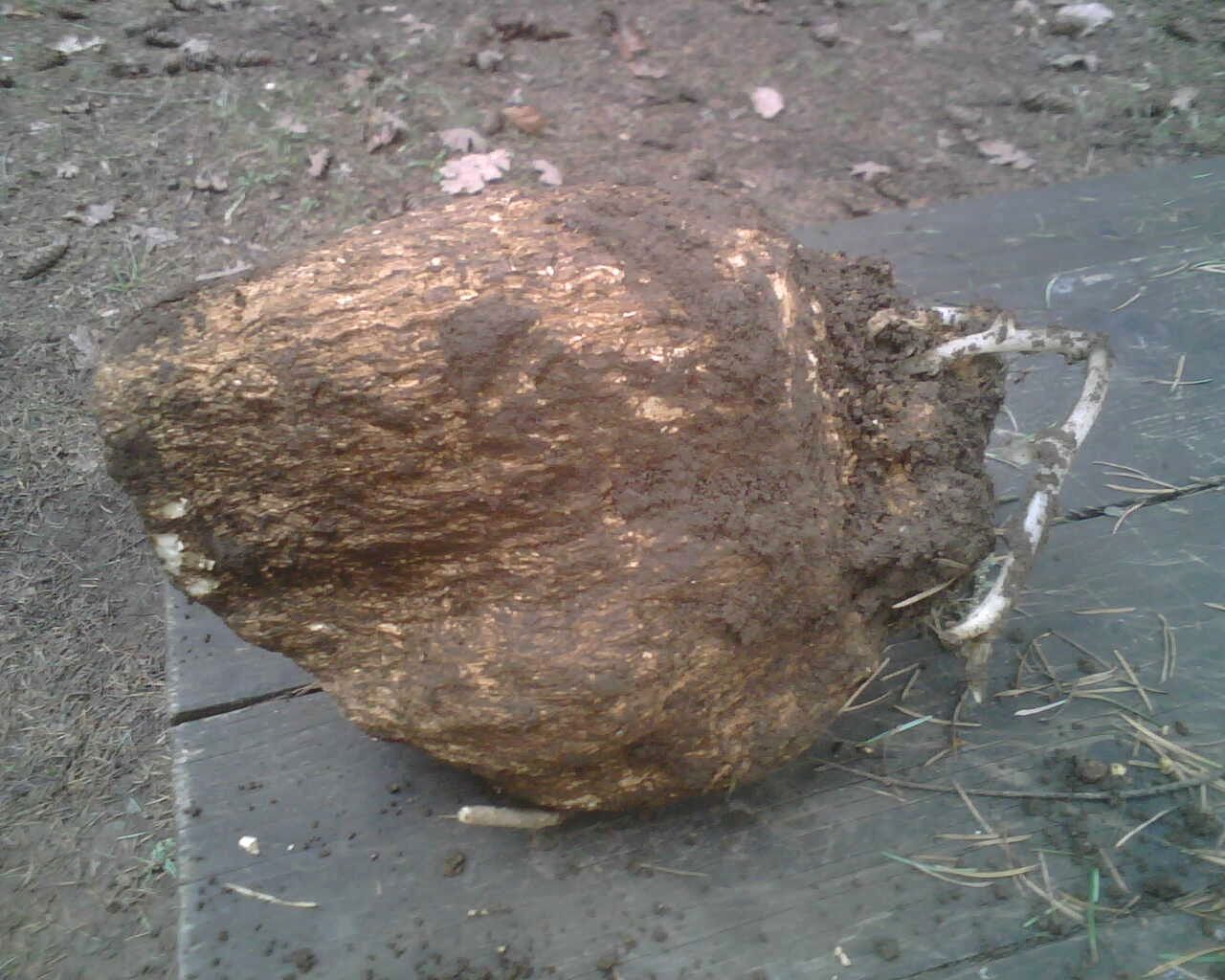
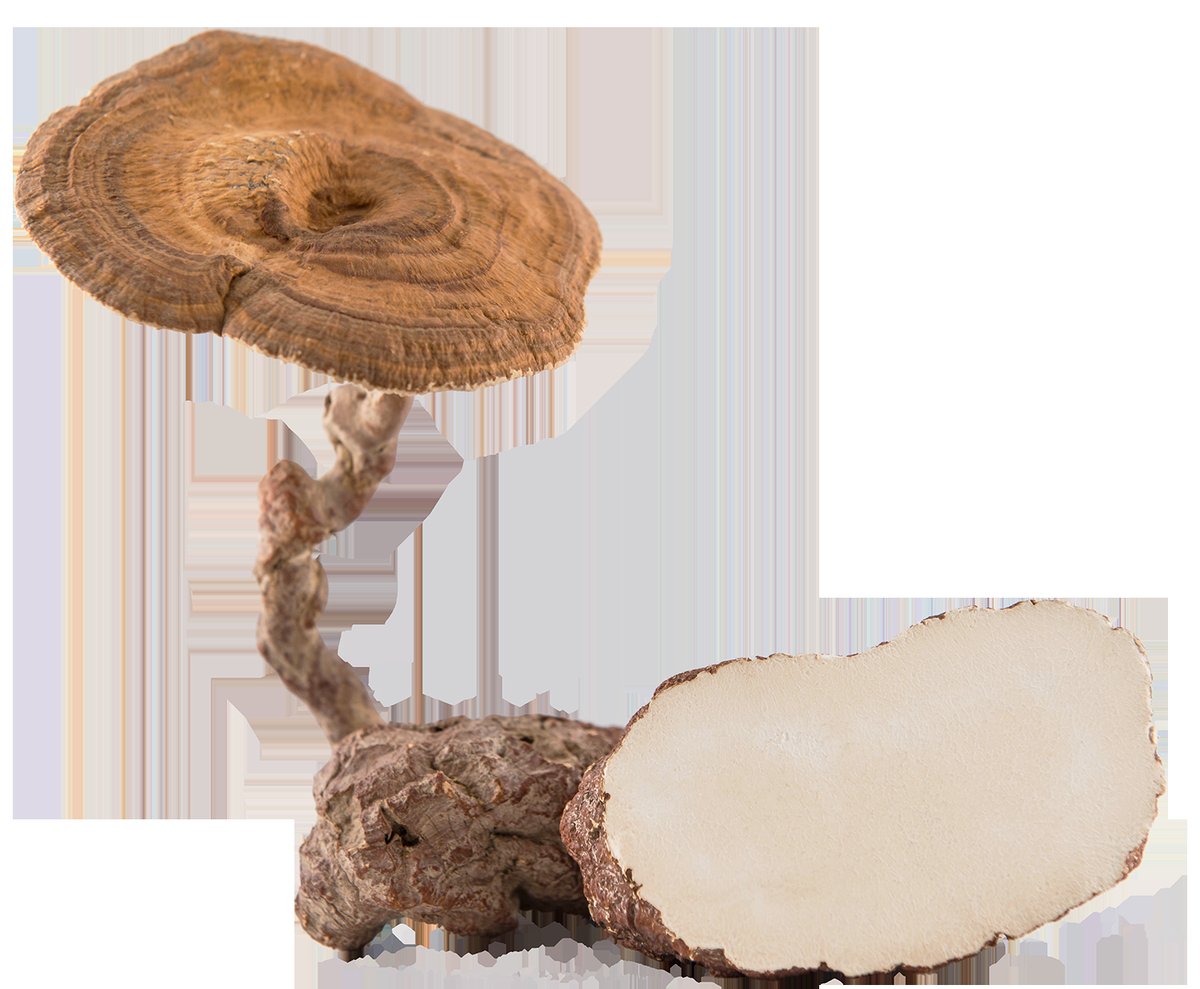
There is no classic mushroom cap — the useful part is the sclerotium, a dense underground mass that can be coconut-sized or larger, with a rough dark-brown rind and creamy-white flesh.
Grows wrapped around the roots of pine trees and is found by digging, not by spotting fruiting bodies.
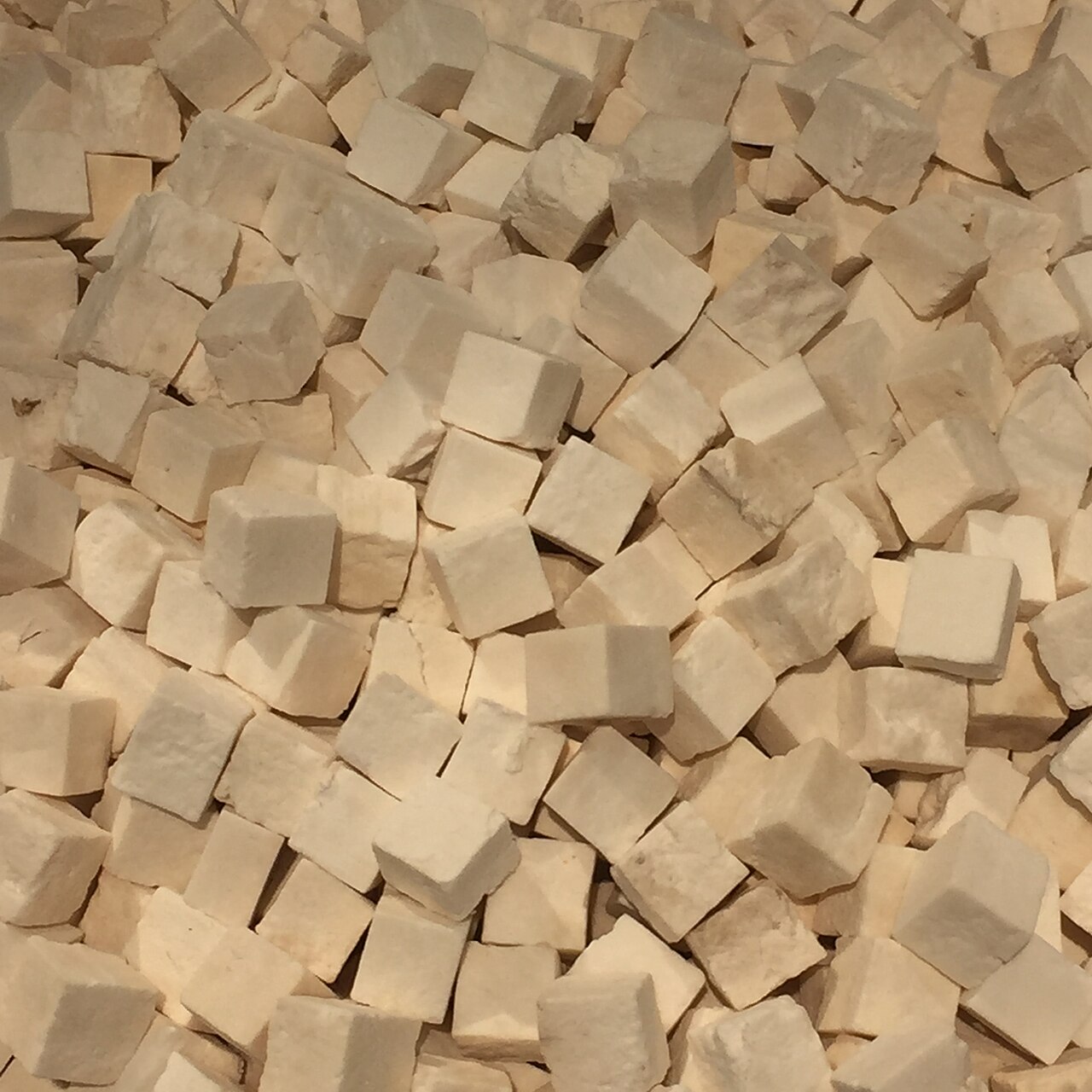
Sold cut into white cubes for the herb market, which dry to a slightly translucent finish.
Also known by the older name tuckahoe, and listed in some references under its synonym Poria cocos.
🌿 Traditional uses & research
Known as Fu Ling, it has been a staple of Chinese herbal formulas for centuries. Research has explored its immunomodulatory polysaccharides and the mild diuretic tradition that made it a classic formula ingredient, though clinical evidence remains early.
⚠️ Safety notes
Its centuries of use in traditional formulas point to general tolerability, but modern safety data is limited. Talk to a clinician if pregnant or nursing, taking diuretics, or on other medications — it is not a casual kitchen mushroom.
Small, bright orange-red to ruby-red fruiting bodies emerging from the decaying heartwood of the stout camphor tree (Cinnamomum kanehirae) — found only in Taiwan.
Firm, fleshy texture and an intensely bitter taste.
Wild specimens are vanishingly rare; nearly all material today is cultivated mycelium or wood-cultured fruiting bodies, which are considered comparable.
Listed in older sources as Antrodia cinnamomea. Its host tree is endangered, and demand has driven illegal hollowing of protected camphor trees — never buy wild-harvested antrodia.
🌿 Traditional uses & research
Known in Taiwan as niu-chang-chih, it was traditionally used by indigenous Taiwanese peoples for hangovers and stomach complaints. Research has explored liver-supportive and anti-inflammatory compounds unique to the species, such as antroquinonol — mostly in laboratory and animal studies so far, so human evidence remains preliminary.
⚠️ Safety notes
Its intense bitterness can upset the stomach, and human safety data is very limited. Talk to a clinician before use, especially with liver conditions or if you take medications. Choose only cultivated material — wild harvest threatens an endangered tree.
Hard, hoof-shaped perennial conk, 10–40 cm wide, on beech, birch, and other hardwoods — rock-hard when dry.
Gray, clearly zoned (banded) upper surface with a smooth, paler growing margin; brown pore surface underneath.
Adds one visible growth layer per year, so the zones can be read like tree rings.
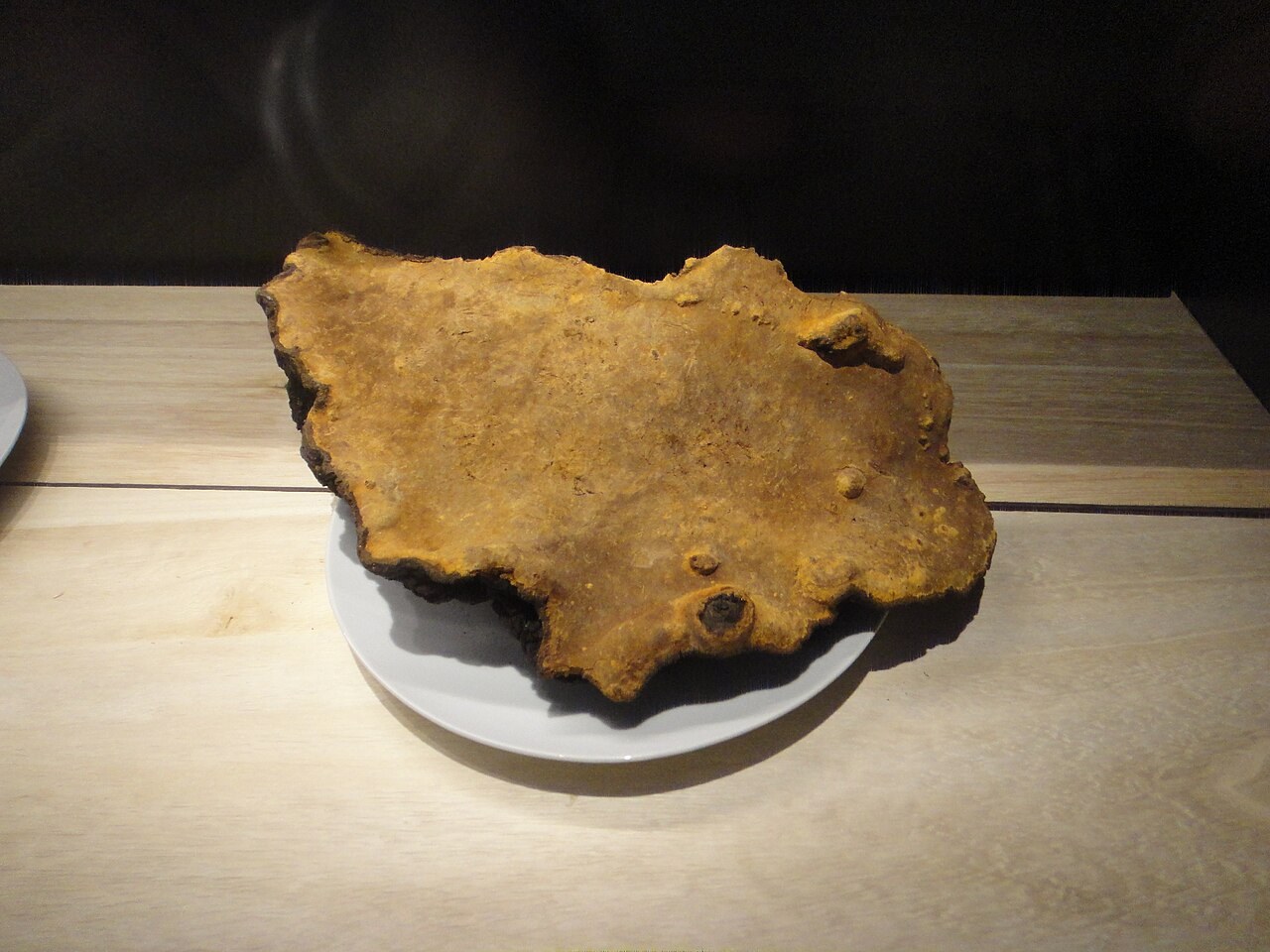
The soft inner trama is the "amadou" — a spongy, flammable felt that separates easily from the woody crust.
🌿 Traditional uses & research
Traditionally used as tinder — Ötzi carried it in his fire kit, and the trama catches a spark readily. Processed trama was made into amadou felt for hats, gloves, and fly-fishing fly-drying pads, and folk tradition used it as a styptic to staunch bleeding. Research has explored antimicrobial properties in laboratory screening.
⚠️ Safety notes
Rock-hard and completely inedible — this is a craft and traditional material, not food. The fine dust raised when working the trama can irritate the airways, so wear a mask when processing it.
🦠 The Wild Story
This mushroom is older than the pyramids in human history. When Ötzi the Iceman died in the Alps some 5,300 years ago, he was carrying four pieces of Fomes fomentarius — archaeologists concluded they were tinder. The felted inner layer of this hoof-shaped conk catches a spark and holds it like charcoal, and it was the fire-starter of choice across Europe for thousands of years: the very word "amadou" became the name for the prepared tinder itself. Greek physician Hippocrates, around 450 BCE, also classified it as a potent anti-inflammatory and used it to cauterize wounds. Long before it was a supplement ingredient, it was the thing that kept the fire lit.
A hard, woody shelf or fan on dead and dying hardwoods (sometimes conifers) — gray-brown, concentrically zoned top crust, often huge and perennial, adding a new layer each year.
The make-or-break field mark: the underside is creamy white with tiny pores, and it bruises brown the moment it's scratched — artists etch drawings and write on it like a natural canvas. Red reishi's pore surface doesn't mark this way.
Flesh is corky and intensely bitter — inedible as food; strictly a tea and extraction mushroom.
One of the most widespread conks on Earth; its perennial fruiting bodies can persist on a stump for decades.
🌿 Traditional uses & research
Reishi's humbler, far more abundant cousin — in the same Ganoderma genus, and traditionally prepared the same way as a bitter decoction for everyday vitality and calm. Modern interest centers on its triterpenes and beta-glucans, which research has explored in laboratory and animal settings for immune and antioxidant support. Human evidence remains preliminary — and since it's farmed nowhere, quality depends entirely on clean collection.
⚠️ Safety notes
Well tolerated as a tea or extract in traditional use. Very woody — never eat it fresh. As with reishi, its bitter compounds may slow blood clotting in theory, so anyone on blood thinners or preparing for surgery should check with their provider. Only gather from clean woodland; conks growing on treated or roadside timber are not for consumption.
A spectacular bouquet of dozens of small gray-brown funnel-shaped caps (each 1–4 cm) rising on white branching stems from a single base at the foot of hardwoods — like a miniature maitake colony.
The fruiting body sprouts from an underground sclerotium — a dark, irregular woody mass that is the part used in traditional practice, same as poria's, but the sclerotium of zhu ling is distinct and the umbrella-cap cluster is unmistakable. (See also our Poria entry.)
Grows summer to fall at the base of oaks and beeches; clusters can weigh several pounds.
No dangerous look-alikes when the full umbrella-cap cluster from a single base is observed — but always check with a local expert before collecting anything.
🌿 Traditional uses & research
Zhu Ling is one of the classic herbs of Chinese medicine, traditionally valued for water balance and healthy fluid metabolism — it's the diuretic-leaning counterpart to poria's gentler profile. Its beta-glucan polysaccharides have been explored in laboratory studies for immune-support activity; clinical evidence is still early-stage. Most material on the market is the dried sclerotium, now widely cultivated since wild digging depleted forests.
⚠️ Safety notes
Traditionally well tolerated. Because the sclerotium grows in soil, wild-collected material can carry heavy metals — buy from tested sources only. Its traditional action is on fluid balance, so anyone on diuretics or managing kidney function should talk to their provider first. Not a do-it-yourself medicine: identification plus testing both matter.
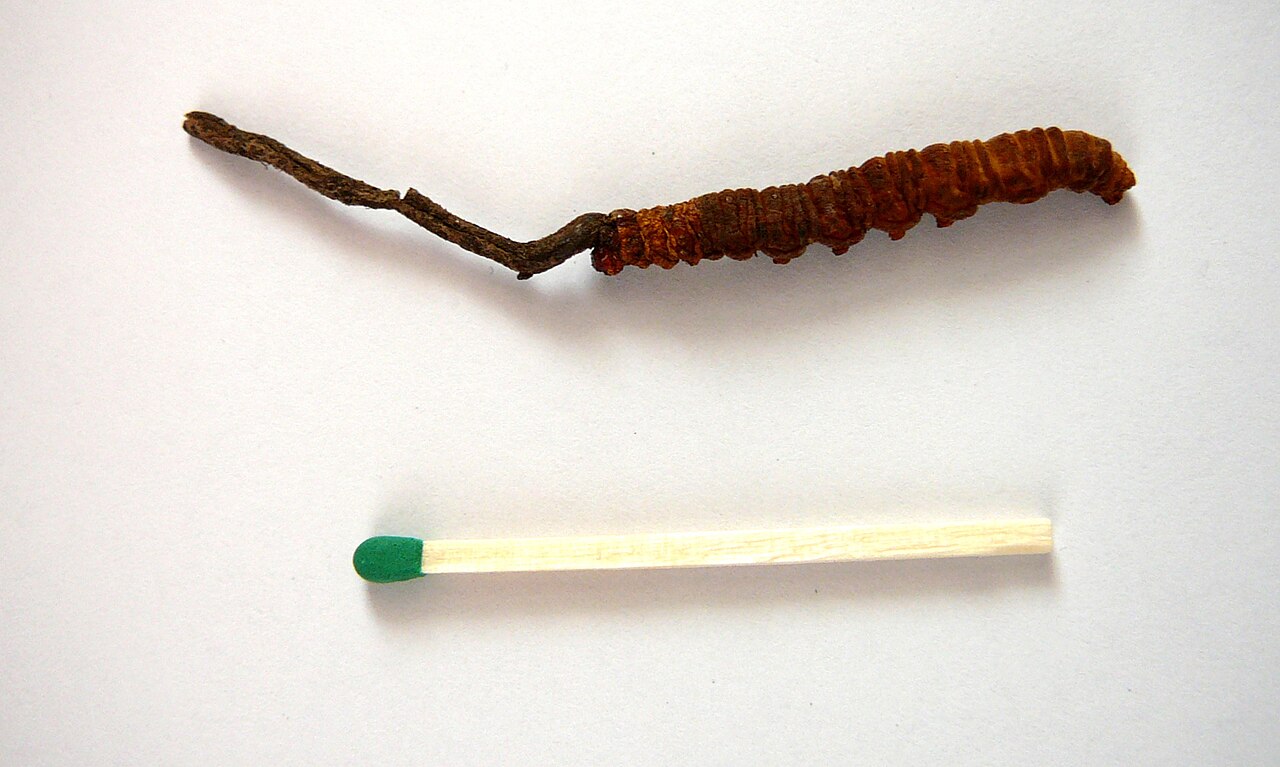
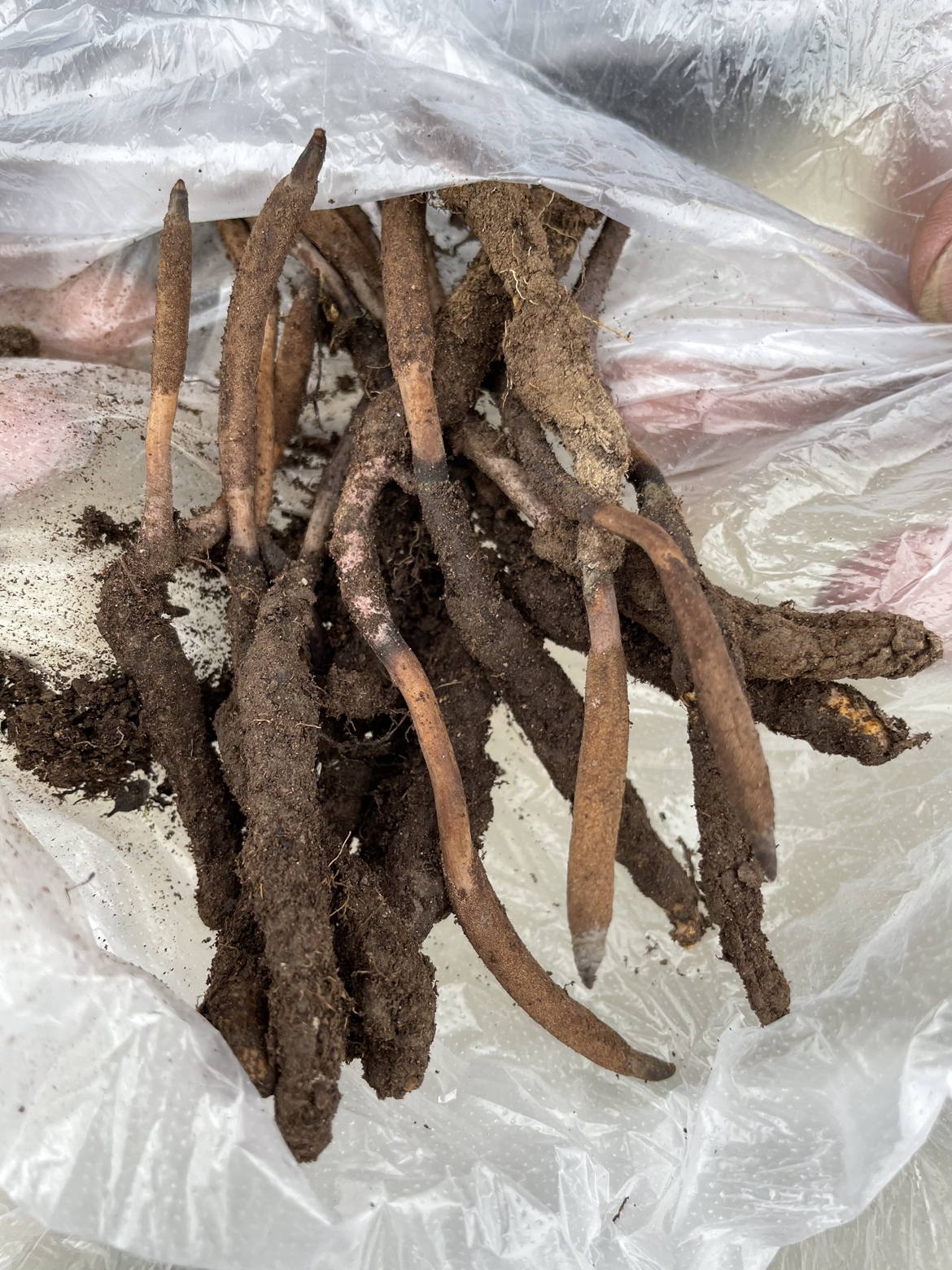
The wild caterpillar fungus: a yellow-brown caterpillar body (the ghost moth larva) with a dark, club-shaped fungal stroma growing out of its head — Tibetan harvesters call it yartsa gunbu, "summer grass, winter worm."
Found only in high alpine meadows (3,500–5,000 m) of the Tibetan Plateau, Himalayas, and southwest China; hand-dug in late spring before the spores release.
Not the same species as the cultivated cordyceps — our Cordyceps entry covers Cordyceps militaris, which is lab-grown on grain and actually the richer source of cordycepin. Wild sinensis carries prestige, not necessarily more active compounds.
One of the most expensive fungi on Earth — wild specimens have sold for tens of thousands of dollars per kilogram, which is why the market is flooded with fakes and cultured substitutes.
🌿 Traditional uses & research
Used in Tibetan and Chinese tradition for vitality, stamina at altitude, and resilience — research has explored its adenosine and polysaccharide content for energy metabolism and immune activity, mostly in animal and laboratory settings. Human evidence is limited and often extrapolated from cordyceps species generally. Meanwhile, wild populations face real pressure: overharvesting plus a warming plateau is shrinking harvests, and the fungus is the seasonal livelihood of highland communities — buy certified-cultivated if you buy at all.
⚠️ Safety notes
The price tag is the main hazard: adulteration and heavy-metal contamination in wild material are common — lab testing is non-negotiable. As with other cordyceps, mild digestive upset is possible and anyone on blood thinners or blood-sugar medication should check with their provider. Conservation note: this is not a species to forage casually — treat wild harvest as an ethical question, not just a legal one.
🦠 The Wild Story
This is the famous "summer grass, winter worm." Each autumn the fungus infects a ghost-moth caterpillar underground; through the winter it eats the caterpillar from the inside out, mummifying it. In spring a slender brown stalk grows out of the mummified caterpillar's head and pushes through the soil — and that tiny stalk is what thousands of harvesters crawl across the Himalayan meadows looking for every May and June. It only grows above about 3,500 meters, in a season of a few weeks, and demand for it in traditional medicine is so fierce that top grades have traded for over $100,000 per kilogram — several times the price of gold — earning nicknames like "Himalayan gold." Entire villages move to the alpine meadows for the harvest, and some families earn a year's income in weeks. That gold rush is exactly why the wild species is being over-harvested, and why cultivated Cordyceps militaris exists: the same family, without digging up a mountainside for it.
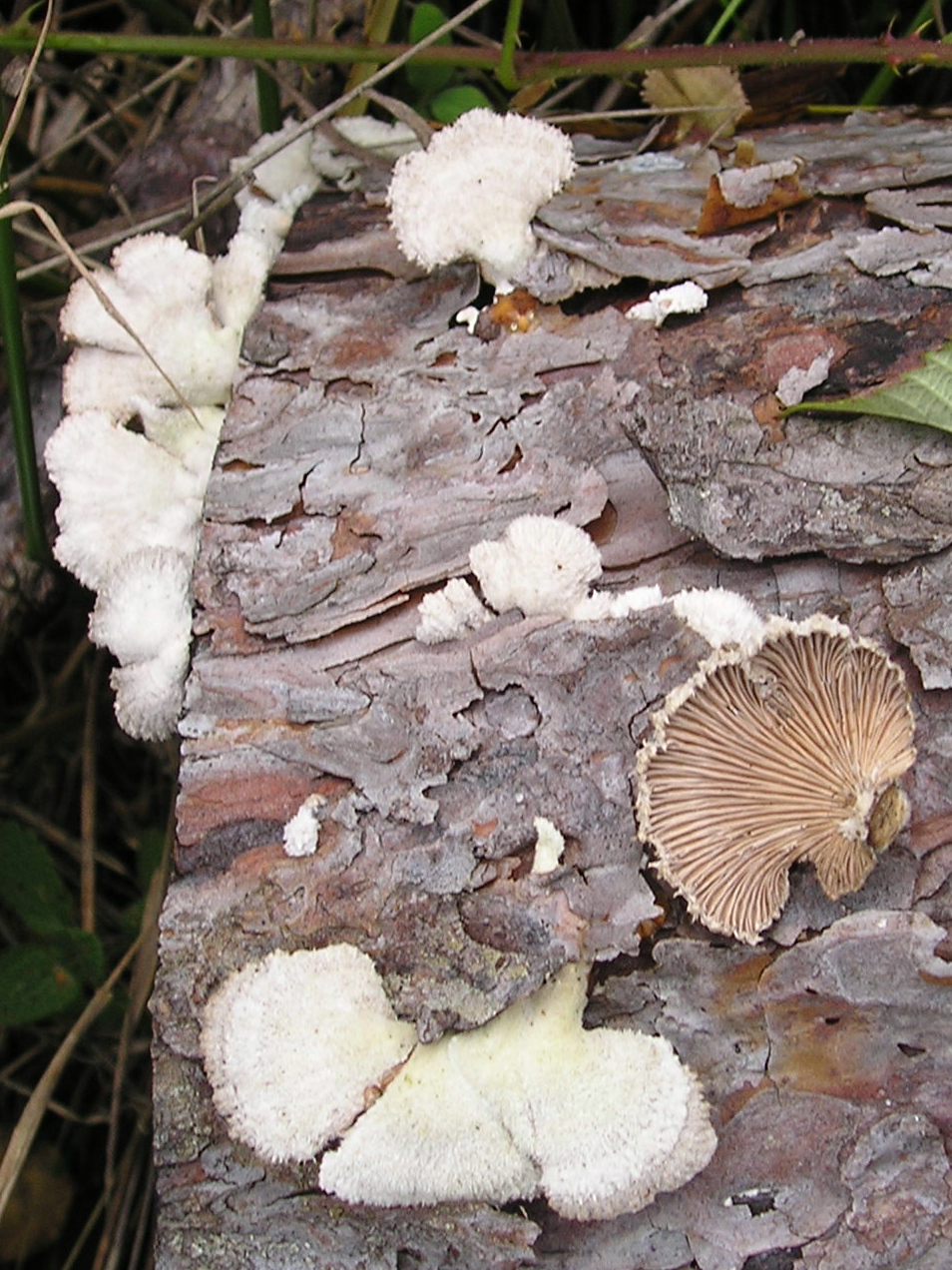
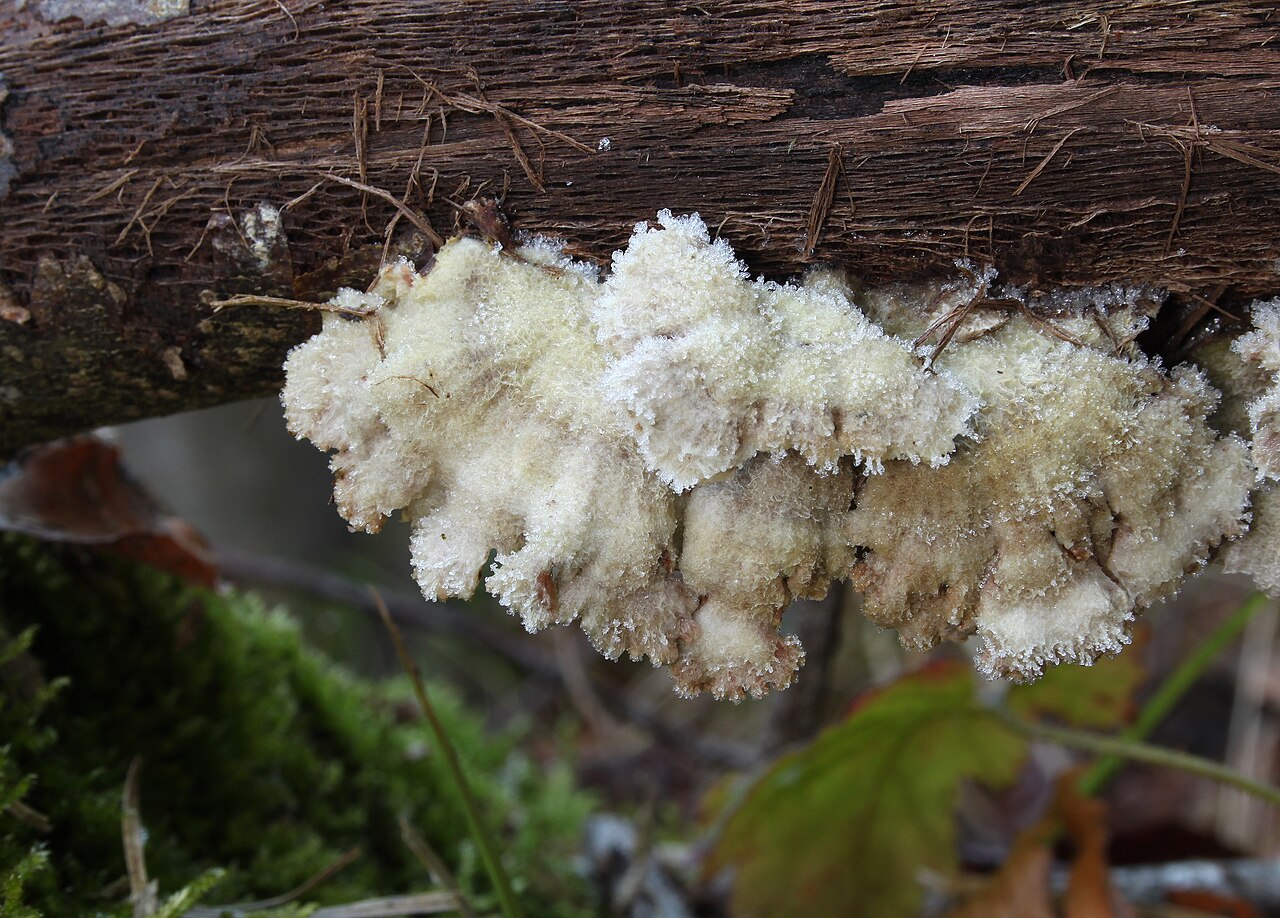
Tiny hairy white-gray fans (1–5 cm) overlapping on dead wood — one of the most widely distributed fungi on Earth, found on every continent except Antarctica, on hundreds of tree species.
The signature: its gills are split lengthwise down the middle, each half curling outward — visible with a hand lens, and they fold shut when dry, reopening with rain (a built-in drought survival trick).
Distinctive enough that it's rarely confused with anything poisonous; the closest visual neighbors are small oyster mushrooms, which are also edible.
🌿 Traditional uses & research
Eaten in Mexico, Southeast Asia, and Africa — chewy and savory when cooked well — and used in folk traditions across the tropics. Its standout research story is schizophyllan (sizofiran), a beta-glucan studied in Japan for immune activity; research has explored it in laboratory and clinical settings as an immune-support compound. Human evidence is early and evolving, but this little bracket punches far above its size in the literature.
⚠️ Safety notes
Honesty matters here: split gill is also a documented rare opportunistic pathogen — it has caused sinus, lung, and in very rare cases brain infections, almost exclusively in people with weakened immune systems. Healthy people handle it as food without issue, and spores are everywhere anyway — but immunocompromised readers should know this before experimenting with any wild-harvested preparation. Eat only well-cooked specimens from clean sources; never inhale spore dust from dried brackets.
🦠 The Wild Story
The humble split gill holds one of the strangest records in biology. While humans get by with two sexes, Schizophyllum commune has more than 23,000 mating types — Guinness World Records lists it as the most sexually compatible organism on Earth, and some mycologists put the real number above 28,000. Any two individuals of different mating types can reproduce together, which practically guarantees outcrossing and genetic diversity — probably a big reason this little mushroom grows on wood on every continent except Antarctica. It also has a darker claim to fame: it is one of the very few mushrooms documented growing inside people. In a handful of rare cases, mostly in children or immunocompromised patients, it has been found fruiting in human sinuses — in one case described by mycologist Tom Volk, growing up through the roof of a child's mouth and forming actual tiny mushrooms inside her sinuses. Extraordinary, but not a reason to fear the forest: these cases are vanishingly rare and never happened in healthy people.
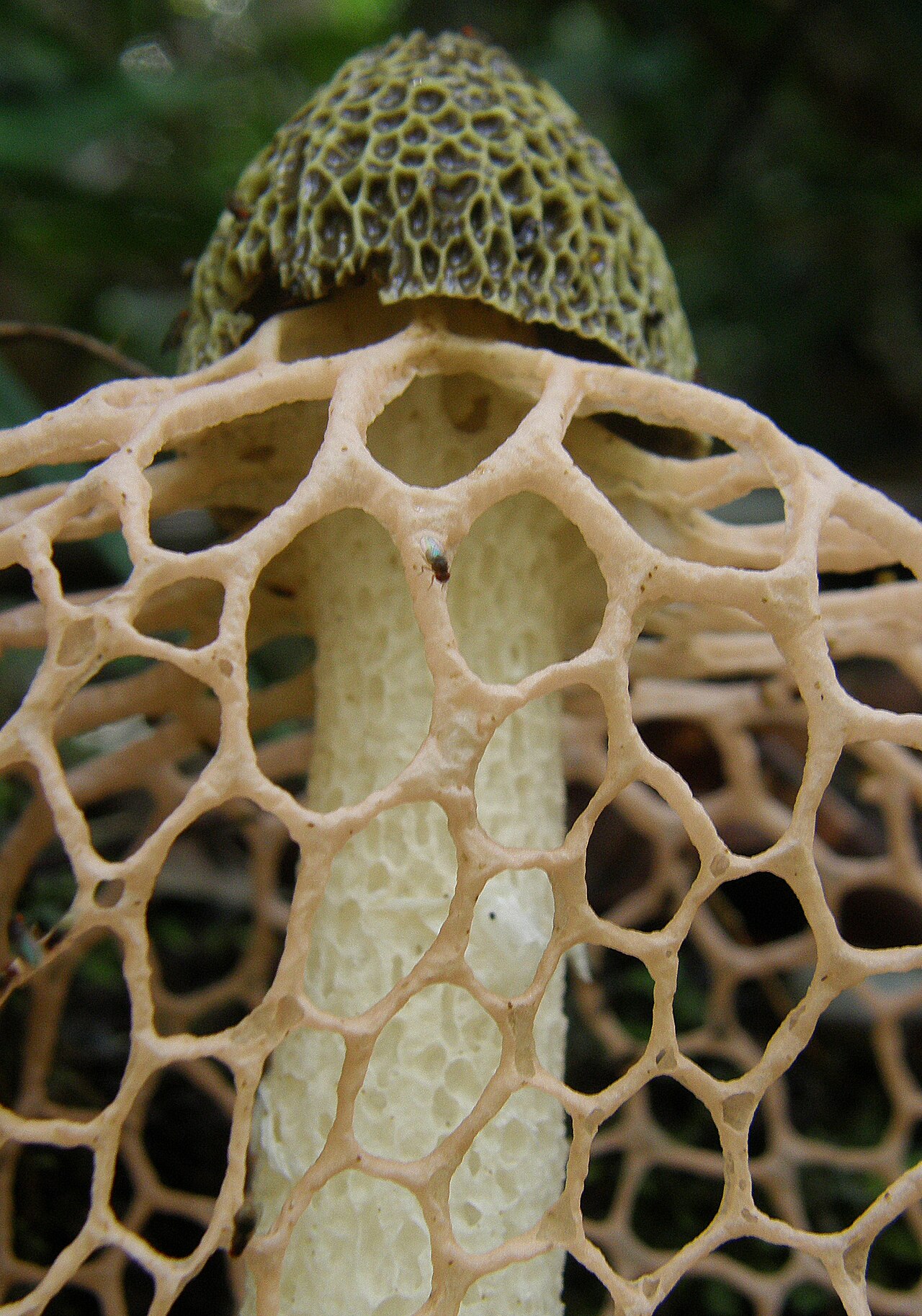
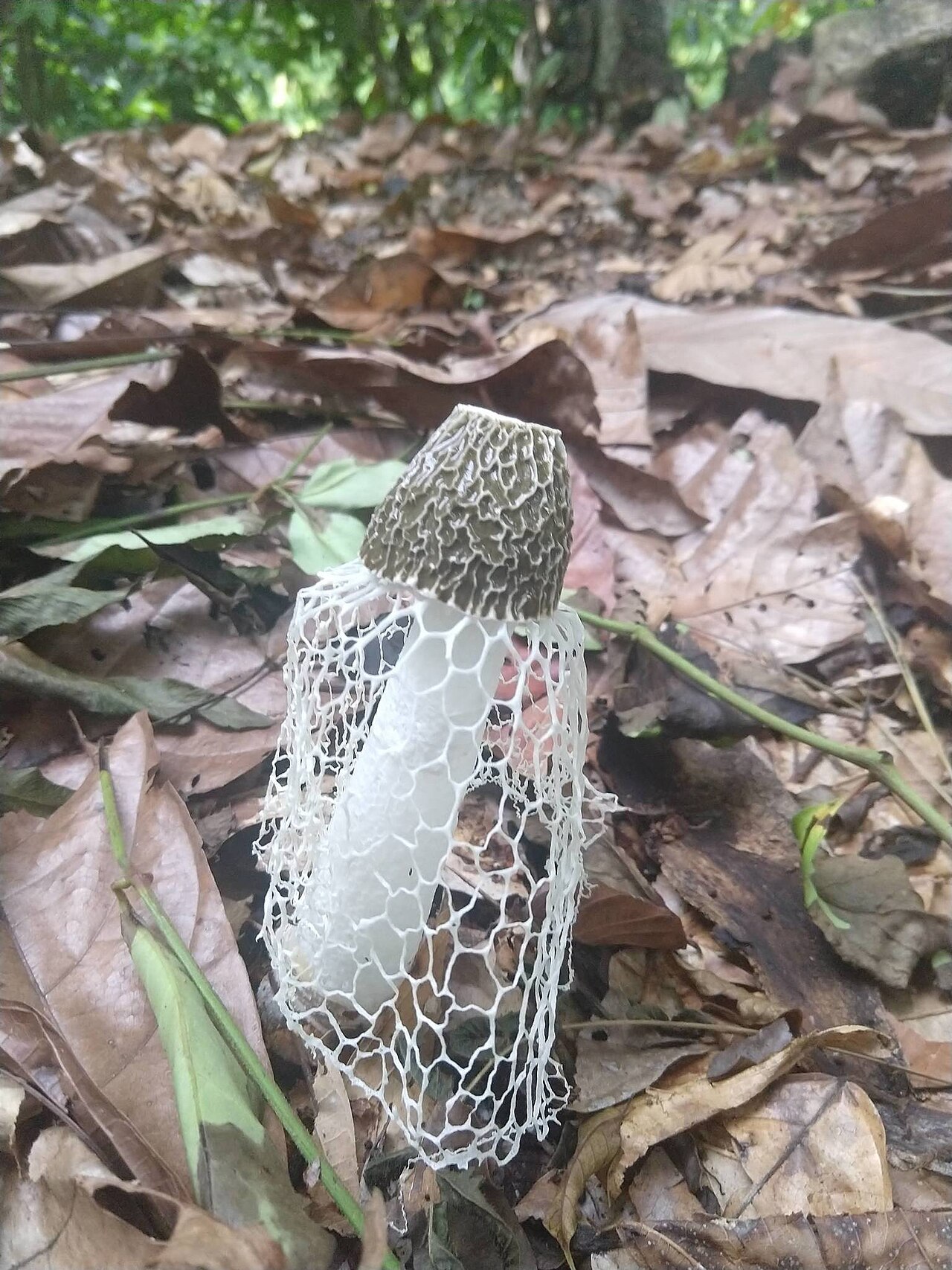
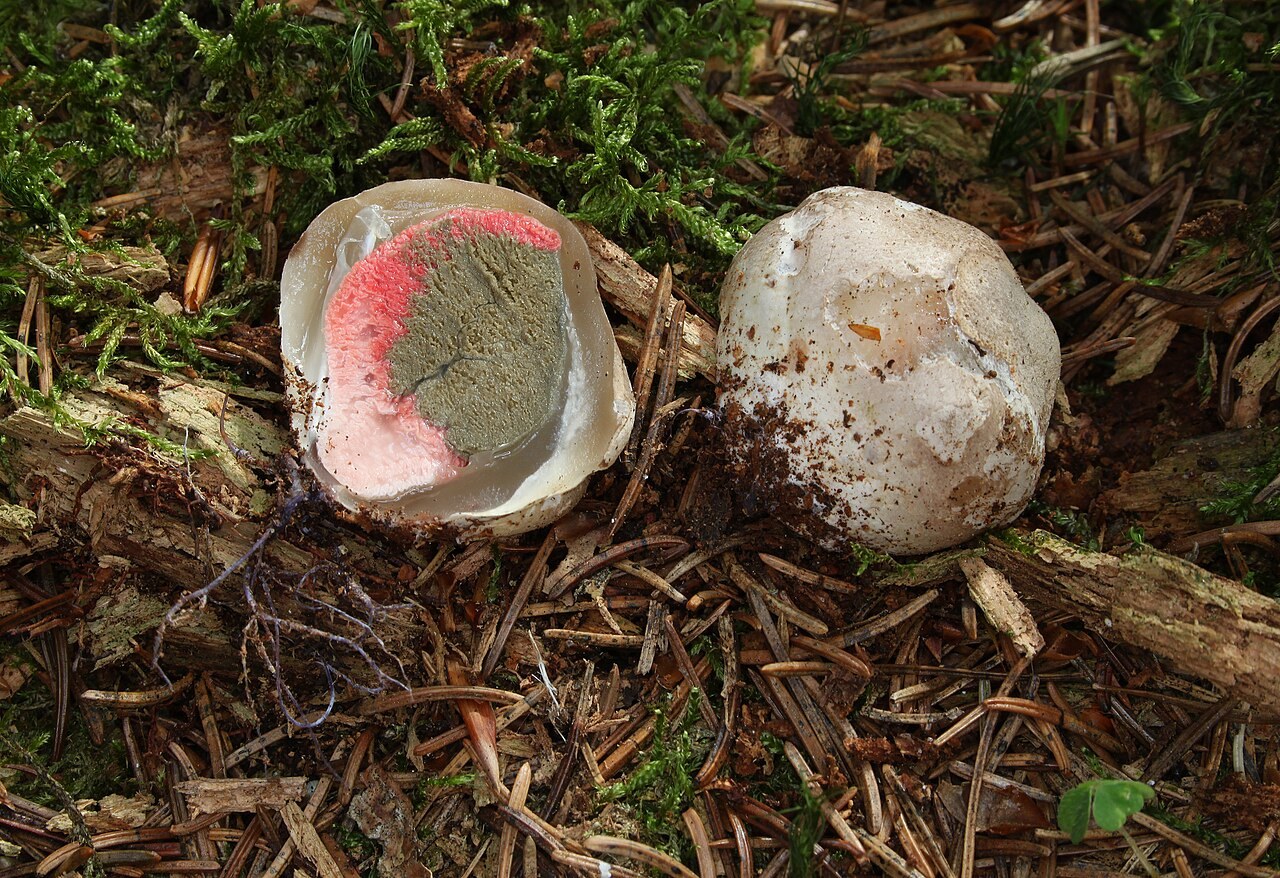
The "queen of mushrooms": a white spongy stinkhorn stem rising from a white egg, crowned by a netted honeycomb cap and trailing a delicate lacy skirt (indusium) nearly to the ground — the most beautiful stinkhorn on Earth.
Like all stinkhorns, the cap is coated in a foul olive gleba — slime that smells of rot and is eaten by flies, which carry the spores away. In the kitchen the gleba is always rinsed off first.
Found in bamboo groves and tropical woods across Asia; now widely cultivated in China (often labeled 竹荪, zhu sun) — wild ones are a luck-of-the-day find.
🌿 Traditional uses & research
A banquet-table delicacy in Chinese cuisine — silky in soup, prized at weddings and feasts — and a traditional remedy for gut and respiratory comfort. Research has explored its polysaccharides and dictyophorines in laboratory settings for antioxidant and nerve-support activity; human evidence is preliminary. Most of what's sold is cultivated, which is the safe way to eat it.
⚠️ Safety notes
Only eat cultivated bamboo fungus or expertly identified specimens: only the white stem and veil are eaten — the gleba must be removed, and wild stinkhorns have inedible relatives. As a soup ingredient it's gentle and well tolerated; if you react to mushrooms generally, skip it. Keep to reputable dried-goods sources, since imported wild product can carry heavy metals.
🦠 The Wild Story
The veiled lady is a stinkhorn, and stinkhorns don't do wind — they do flies. Instead of firing spores into the air like a gilled mushroom, the bamboo fungus coats its cap in gleba: a sticky, olive-green spore slime with a sharp, sickly-sweet smell of carrion, detectable from a considerable distance through the forest. Flies, carrion beetles, and even stingless bees come to feed on the slime, get spores stuck to their feet and bodies, and then deposit them elsewhere in their droppings — the mushroom's entire travel agency runs on insect digestion. The famous lacy white veil (the indusium) may help: researchers think it visually entices insects that the smell alone wouldn't attract, and it works as a ladder for crawling insects to climb up to the gleba. The whole performance is over fast — the fruiting body erupts overnight and collapses within one to three days. Beauty, stench, and an exit, all in a weekend.
This one breaks the mold: the valued part is the sclerotium — a dense, tuber-like underground mass — not a cap-and-stem mushroom. It looks like a congealed whitish lump in the soil.
Legend says it sprouts wherever a tigress's milk touched the forest floor — hence the name, and Malaysia's national-heritage regard for it.
Native to the tropical rainforests of Malaysia, Indonesia, Thailand, and southern China. Wild specimens are rare and hard to find; it's now produced by cultivation.
🌿 Traditional uses & research
For generations, Malaysia's Orang Asli (indigenous) communities prepared the sclerotium in traditional remedies for coughs, fevers, and respiratory complaints — that is tradition, not proof. Malaysian researchers learned to cultivate it in the early 2000s, and early lab studies have since screened its extracts for anti-inflammatory and antioxidant compounds. Human clinical evidence is still limited, so treat the tradition with respect and the research as early.
⚠️ Safety notes
Only use products from reputable cultivated sources — don't dig up wild sclerotia on a guess, and talk to a clinician before using any functional mushroom as a supplement. Confirm every identification with an expert.
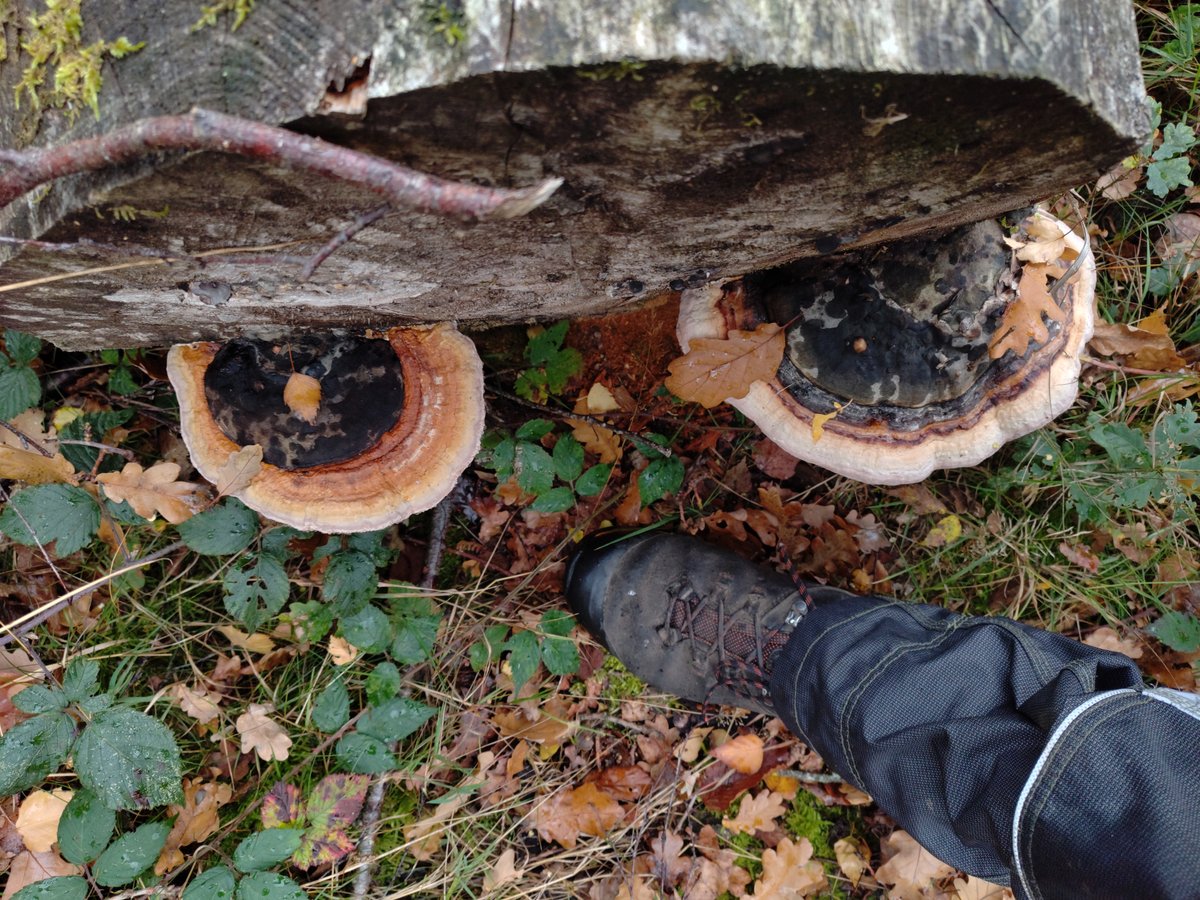
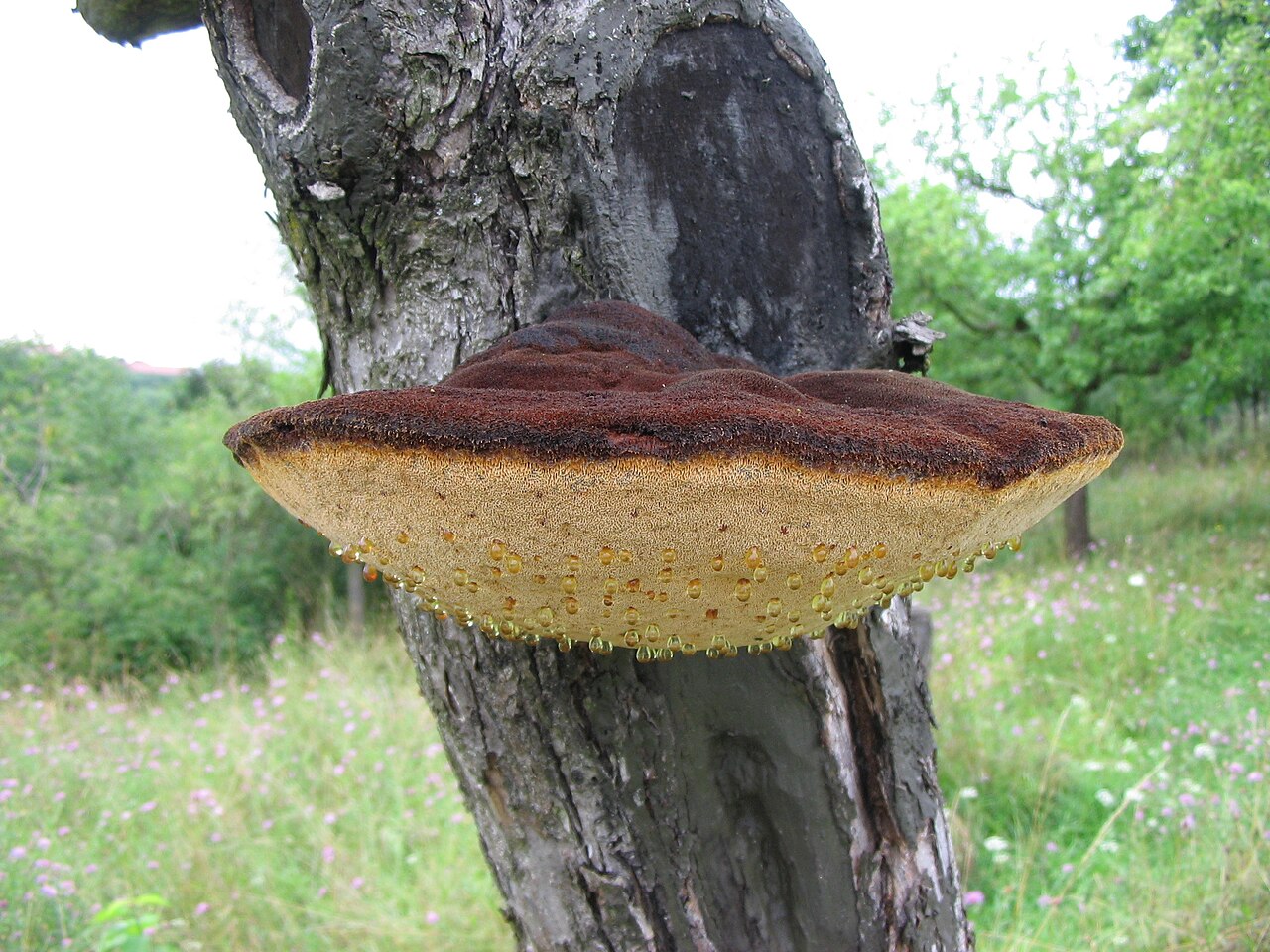
Bracket with red band on coniferPore surface underside
Red-Belted Conk
Fomitopsis pinicola
🌍 Native to: North America, Europe and Asia
🔍 How to identify
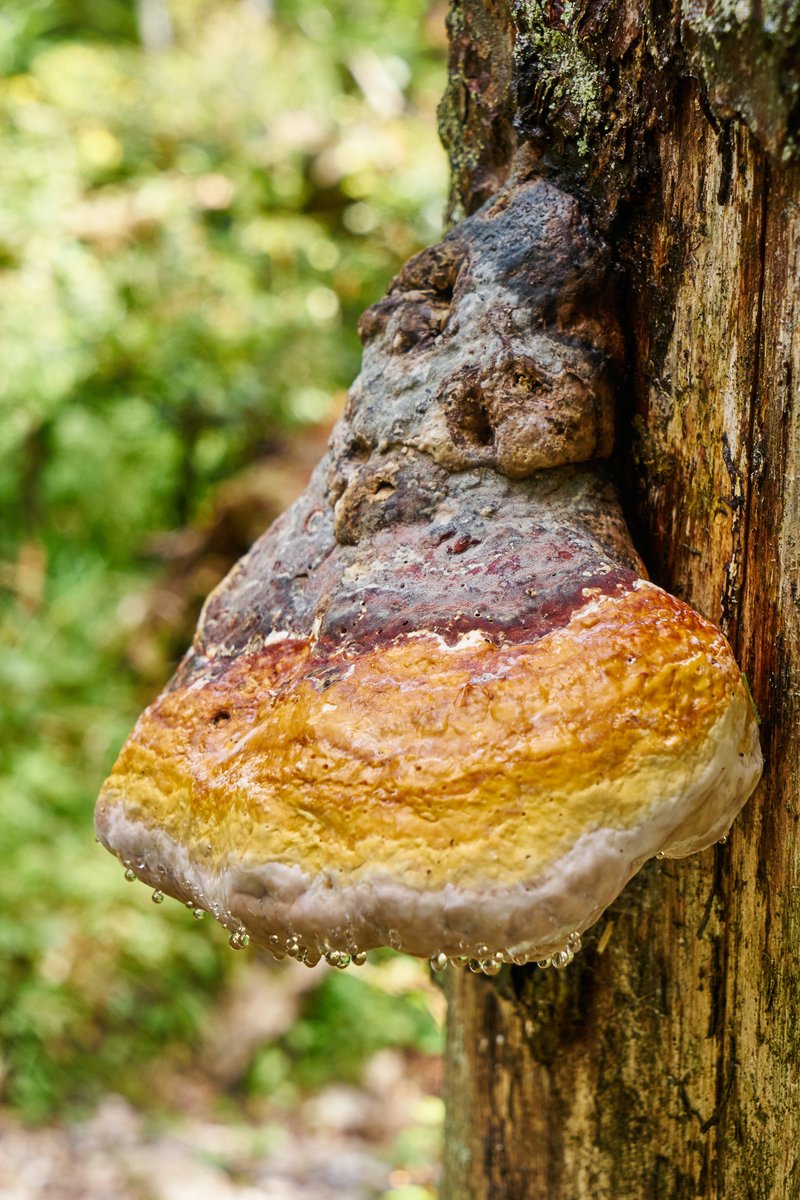
A perennial woody shelf or hoof on conifer trunks, with a hard, lacquered surface zoned in brown, black, and gray — and the namesake red-to-orange band near the white growing margin.
Creamy-white pore surface underneath (tiny pores, no gills); no stem. It adds a new pore layer each year, so old conks can persist for decades.
Common on conifers — pine, fir, spruce — across northern forests, year-round. It is abundant, not rare or endangered.
🌿 Traditional uses & research
Woody and intensely bitter, this is a tea-and-tincture mushroom, never a food. The genus name nods to the tinder-conk tradition — the related Fomes fomentarius is the true amadou — and Indigenous groups including the Cree and Blackfoot used this conk in fire-carrying and other practices. Modern labs have screened its extracts — rich in polysaccharides, triterpenoids, and phenolic compounds — for antioxidant and antimicrobial activity in vitro. Early research only; if you harvest, take modestly and leave plenty for the forest.
⚠️ Safety notes
Resembles the hoof fungus (Fomes fomentarius, which never has the red band) and young reishi-like Ganoderma species — confirm with an expert. Bitter and woody by nature, not for the frying pan.
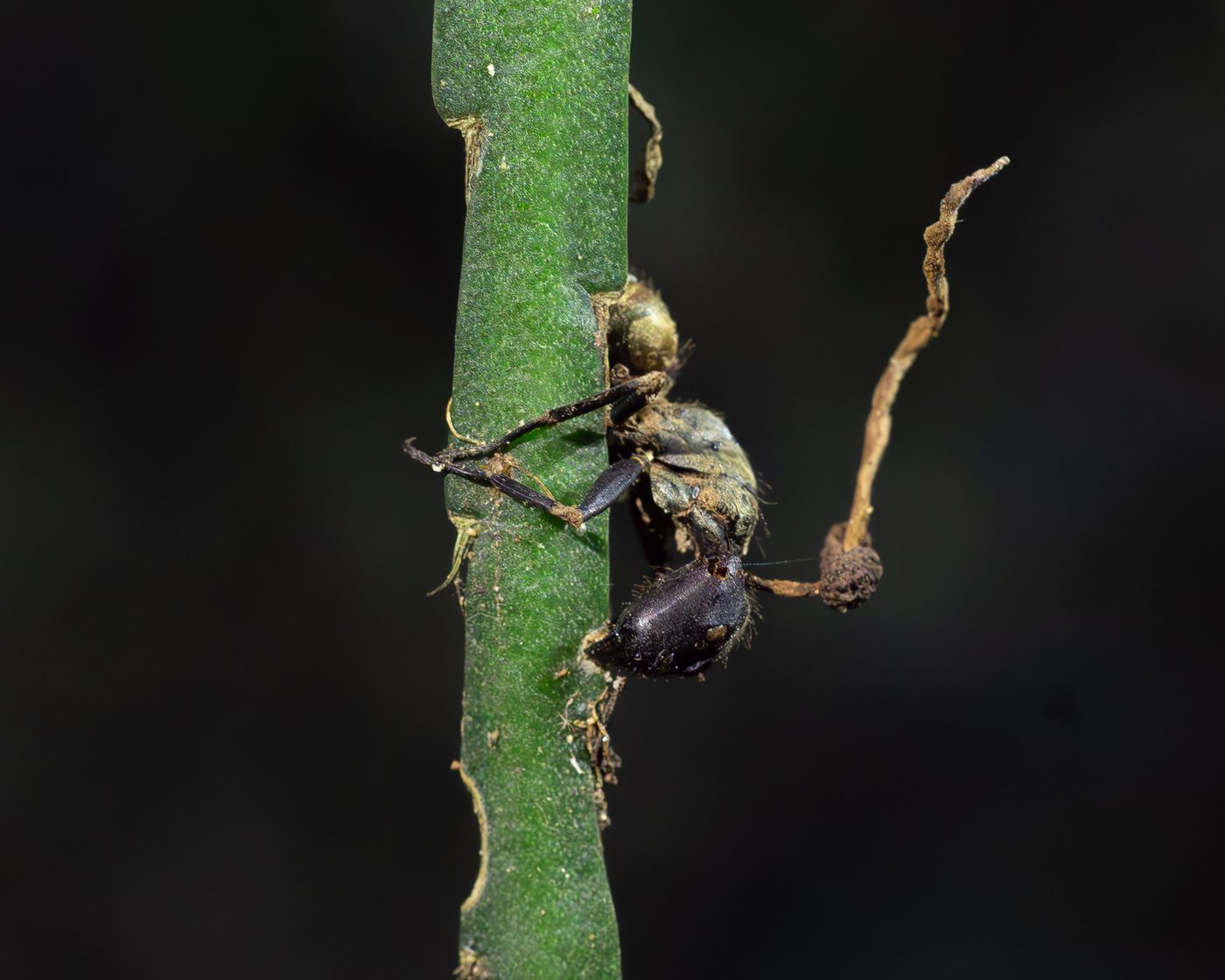
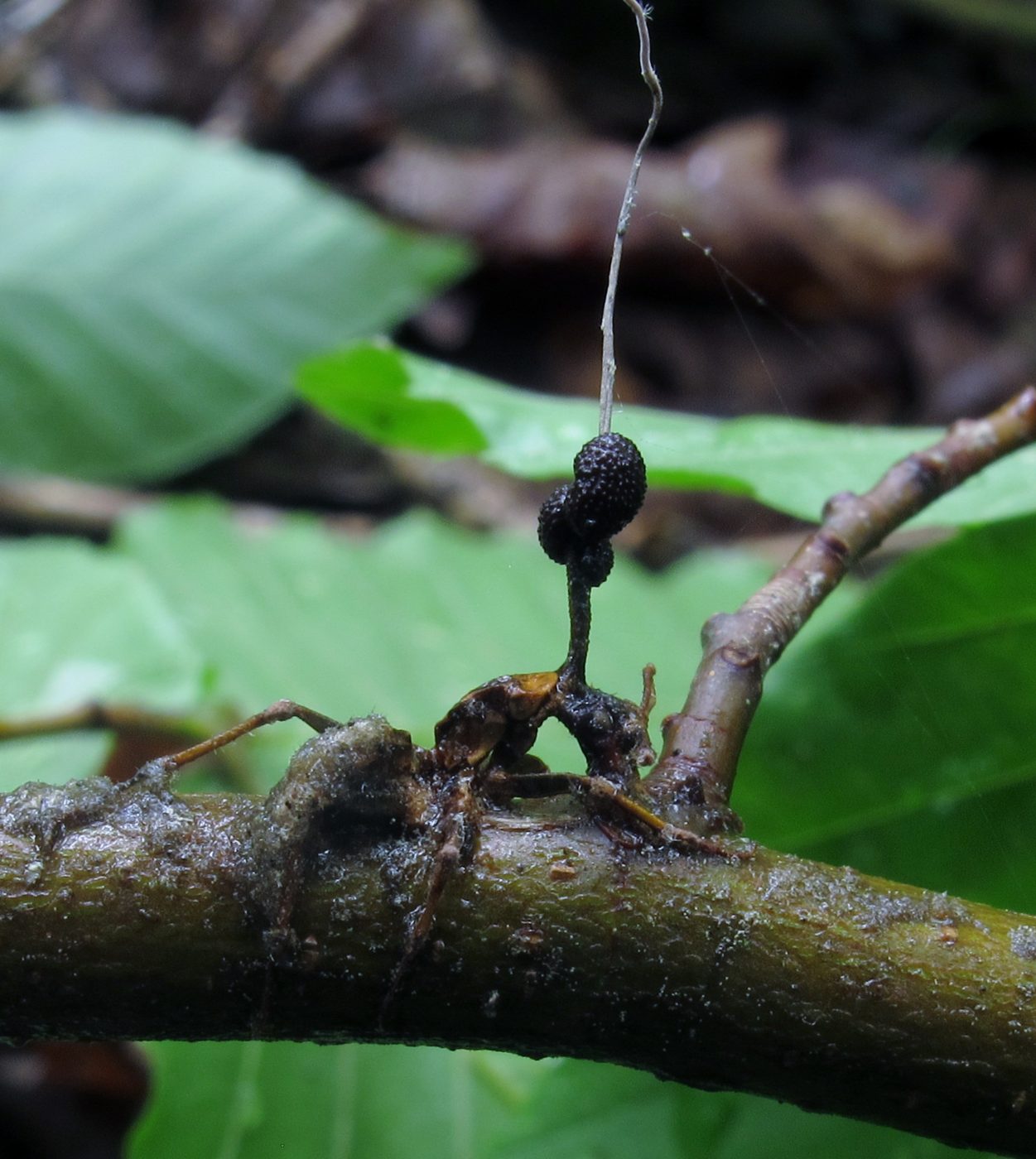
Death grip on vegetationFruiting stalk from the ant
Zombie-Ant Fungus
Ophiocordyceps unilateralis (species complex)
🌍 Native to: Tropical regions worldwide
🔍 How to identify
A single wiry, darkly pigmented stalk (stroma) rising from the dorsal neck region of a dead ant, with tiny spore-bearing perithecia clustered just below its tip.
The ant is almost always found in the same position: clamped by its jaws onto the underside of a leaf vein or twig, about 25 centimeters (around 10 inches) above the forest floor.
First described from specimens collected by naturalist Alfred Russel Wallace in 1859. What we call O. unilateralis is really a complex of closely related species, each tuned to its own ant host — usually a carpenter ant (Camponotus).
🌿 The wild story
It starts with a spore. When a carpenter ant brushes one, the spore germinates and the fungus grows through the ant's body — not by invading the brain, as early reports guessed, but by weaving a three-dimensional network of fungal cells through the ant's muscles. Researchers at Penn State found the fungus surrounds and invades muscle fibers throughout the whole body, and that network may be what lets it collectively pull the ant's strings. The infected ant stops following trails and starts wandering erratically, suffering convulsions that knock it from the canopy to the cooler, damper understory. Then comes the strangest part: around solar noon, infected ants are driven to climb vegetation and sink their mandibles into the underside of a leaf vein — and lock. Multiplying fungal cells force the jaw muscles into a "lock jaw" that holds even after the ant dies. Days later, a stalk erupts from the ant's head and showers spores onto the foraging trails below, where the next generation of ants is walking. Infected ants pile up in the same patches — researchers call them "graveyards" — where the humidity is just right for the fungus. The ant's behavior becomes, in the researchers' words, an extended phenotype of the fungus: fungal behavior expressed through an ant's body.
🌿 Traditional uses & research
This is a wild entomopathogen — a curiosity of natural history, not a product. David Hughes' lab at Penn State studies it to understand how parasites hijack animal behavior, and has explored whether such fungi could one day help control pest insects. It has no place in a supplement bottle.
⚠️ Safety notes
NOT edible and NOT a medicinal mushroom. This entry is here for the story alone — the zombie-ant fungus is a relative of the cordyceps family, not a food or a supplement.
Hoof-shaped perennial conk on mulberryGolden-brown pore surface beneath
Sanghuang
Sanghuangporus sanghuang
🌍 Native to: East Asia
🔍 How to identify
A hard, hoof-shaped perennial polypore with a dark, cracked, almost black upper surface and a rich golden-brown pore layer underneath. It adds a new pore layer each year, so old specimens look stacked and weathered.
The true sanghuang grows on living mulberry trees. Close relatives in the same family grow on willow, poplar, and other hardwoods — and for centuries they were all sold under one name.
Wild in East Asia (China, Korea, Japan). You will not find this one in North American woods; nearly all material in trade is cultivated on mulberry logs or sawdust.
🌿 Traditional uses & research
Sanghuang is one of the most prized medicinals in Chinese and Korean tradition — decocted as a bitter tea for generations and recorded in classical materia medica. Modern research focuses on its polysaccharides and polyphenols, screened for immune-modulating and antioxidant activity in cell and animal studies, and it's a staple ingredient in East Asian functional blends. That research is early, not proof of benefit — and because wild sanghuang is slow-growing and scarce, it's now farmed to meet demand.
⚠️ Safety notes
The sanghuang name covers a whole complex of look-alike species, and mislabeled products are common — buy from suppliers who name the species and host tree. This is a cultivated/trade mushroom, not a foraging target. As with other functional polypores, check with your provider if you're on medication, and confirm any wild polypore identification with an expert.
Cascading white branches, hanging spinesFrozen-waterfall clusters on a log
Coral Tooth
Hericium coralloides
🌍 Native to: North America, Europe and Asia
🔍 How to identify
A white, cascading cluster of fine branches, each tipped with short hanging spines — like a frozen waterfall or a piece of branching coral. No cap, no gills: the spines are where the spores are made.
Grows on dead hardwood logs and stumps (oak, beech, maple) in late summer and fall. Fresh specimens are bright white, softening and yellowing slightly with age.
It's lion's mane's wilder cousin — same genus, completely different architecture. Lion's mane is one solid pom-pom; coral tooth is all branches.
🌿 Traditional uses & research
Coral tooth is both a choice edible when young and a research mushroom: as a Hericium, it produces the same families of compounds (hericenones and erinacine relatives) that made lion's mane famous, and labs have screened its extracts for antioxidant and nerve-growth-factor-stimulating activity in cell models. In the kitchen it's delicate and mild — sauté it gently and it eats like a cross between crab and cauliflower.
⚠️ Safety notes
Few lookalikes cause trouble: other white Hericium species are also edible, and the main confusion is with crown-tipped coral (Artomyces pyxidatus), a true coral fungus with tiny crown-shaped branch tips that upsets some stomachs. Coral tooth's spines hang from the branch undersides like icicles — check that, harvest only fresh white specimens, and confirm your first finds with an expert.
Long icicle spines on hardwoodBranched cluster, side view
Bear's Head Tooth
Hericium americanum
🌍 Native to: Eastern North America
🔍 How to identify
The largest Hericium in North America: big branched clusters (often 6–12 inches across) draped with long, icicle-like spines, commonly 1–4 cm — noticeably longer than coral tooth's.
Fruits on dead and dying hardwoods — oak, maple, beech — from late summer into fall, mostly east of the Rockies. Young clusters are pure white; older ones cream over.
Rule of thumb for the tooth fungi: lion's mane = one unbranched ball, coral tooth = many fine branches with short spines, bear's head = branches with long, dramatic spines.
🌿 Traditional uses & research
A forager's prize that's firm, meaty, and shreds like crab or lobster — arguably the best eating of the tooth fungi. Like its cousins, it's studied for Hericium compounds of interest in nerve and cognitive research, though nearly all of that lab work is early-stage and focused on lion's mane. On the plate, no research is needed: brown it in butter and it sells itself.
⚠️ Safety notes
All three common North American Hericium species are considered edible, and there is no poisonous tooth fungus that closely matches a big white branched cluster on hardwood. Harvest fresh, white, bug-free material only — old clusters sour — cook thoroughly, and confirm every wild identification with an expert before eating.
Varnished red-brown caps in the wildBranching antler-form fruiting body
Antler Reishi
Ganoderma multipileum
🌍 Native to: East and Southeast Asia
🔍 How to identify
A tropical Asian reishi relative with glossy, lacquered red-brown caps — and a party trick: grown in still, CO₂-rich air with low light, it skips the cap entirely and reaches upward in branching, antler-like fingers.
Wild in Taiwan, China, and Southeast Asia on dead hardwood. The antler form is almost entirely a cultivator's creation — environment, not genetics, decides the shape.
Like other reishis: woody and bitter, white pore surface that bruises brown, and far too tough to eat as food.
🌿 Traditional uses & research
In its home range, G. multipileum is used the way red reishi is used elsewhere in Asia — sliced and decocted into bitter teas and tonics. Researchers have profiled its ganoderic acids and polysaccharides alongside the better-known G. lucidum complex (this species was only separated from it in 2009). Growers also prize the antler form as a living sculpture — it's the one reishi people keep as an ornamental.
⚠️ Safety notes
Not a North American wild mushroom — anything you buy should be cultivated and labeled to species, because "reishi" on a label can mean several different Ganoderma. Reishi-family mushrooms can interact with blood thinners and blood-pressure or diabetes medication; check with your provider before regular use.
Black coal-like balls on dead ashConcentric rings inside a cut fruitbody
King Alfred's Cakes
Daldinia concentrica
🌍 Native to: North America, Europe and Asia
🔍 How to identify
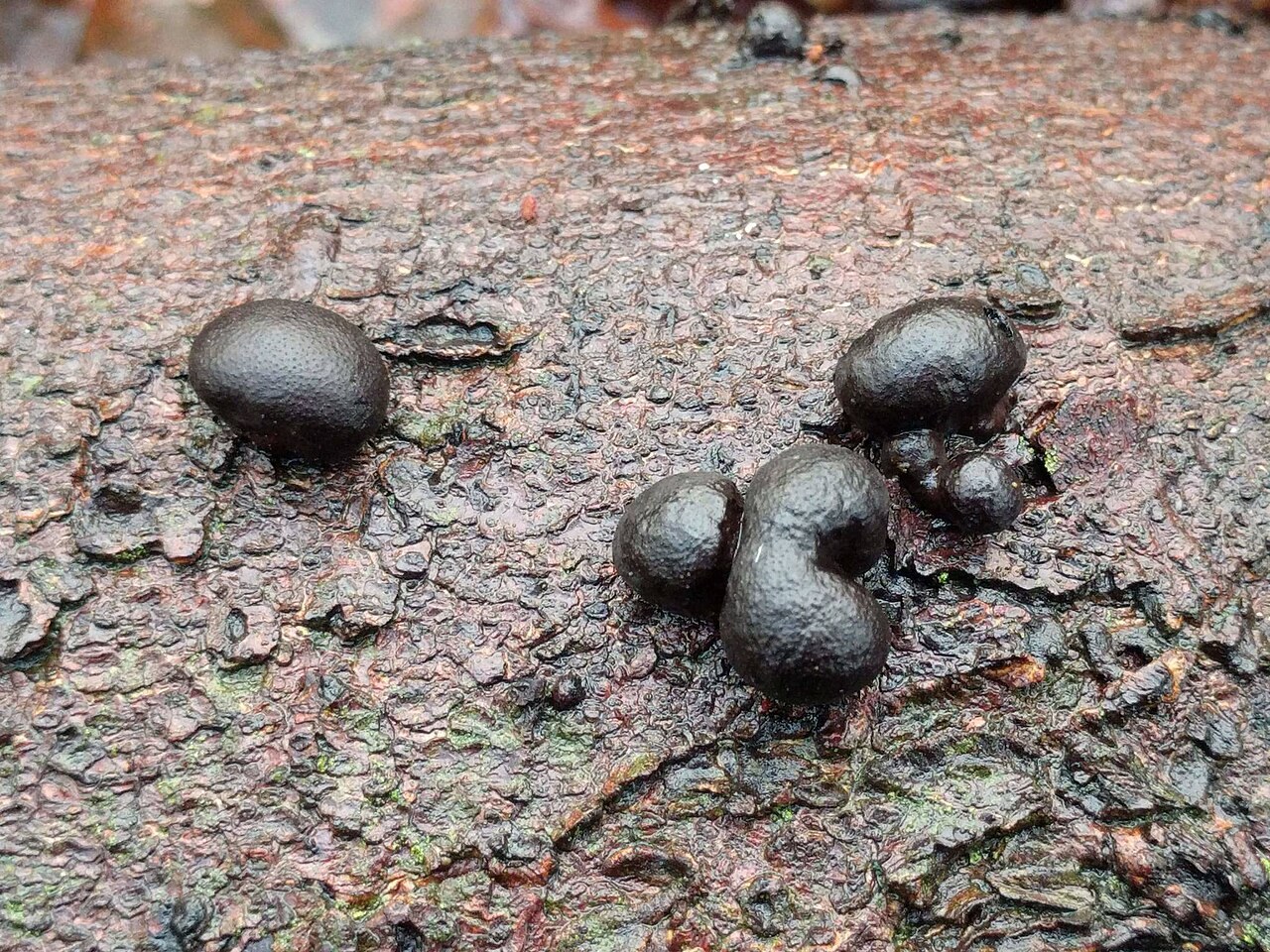
Hard black balls, 2–8 cm across, that look exactly like lumps of coal or burnt buns stuck to a dead branch. Young ones start reddish-brown and darken to charcoal.
Cut one open: the inside shows concentric silver-grey and black rings, one for each season of growth — no other common fungus looks like this inside.
Most faithful to dead ash (and a close companion of ash dieback in Europe), but also on beech, oak, and other hardwoods, year-round.
🌿 Traditional uses & research
The name comes from the legend of King Alfred, hiding from the Vikings, who let a farmwife's cakes burn — this fungus looks like the evidence. Its real folk career was as a fire tool: a dried cake catches a spark and smoulders slowly for hours, the original portable ember, carried between camps long before matches. It was also pocketed as a "cramp ball," a folk charm against cramps and stitches. Not food — it's tough as cork — but few fungi carry more folklore per gram.
⚠️ Safety notes
Inedible — woody, bitter, and not for the table or the teapot; the folklore is about fire, not eating. There are no dangerous lookalikes once you've seen the ringed interior, but treat all hard black wood fungi as look-don't-eat, and confirm identifications with an expert before using any wild fungus for anything.
Varnished red shelf on hemlockGlossy cap, white growing edge
Hemlock Reishi
Ganoderma tsugae
🌍 Native to: Eastern North America
🔍 How to identify
A lacquered, kidney-shaped shelf with a shiny mahogany-red to almost black cap and a bright white growing edge — it looks varnished, because in a sense it is: the crust is a natural resin.
Almost always on dead or dying eastern hemlock (occasionally other conifers) in cool, damp forests of eastern North America and the Great Lakes. Annual — fresh shelves appear in late spring and toughen by fall.
White pore surface underneath that bruises brown. The southern lookalike on hardwoods is a different species; host tree is a real clue with reishis.
🌿 Traditional uses & research
North America's own reishi. Where Asian traditions decoct Ganoderma lucidum, eastern North American herbalists have long sliced and simmered this hemlock species the same way — a bitter, woody tea taken as a general tonic. It carries the family's signature chemistry (ganoderic-acid triterpenes and beta-glucan polysaccharides), and lab studies have profiled its extracts alongside the classic red reishi. With hemlock woolly adelgid killing its host trees across the East, the mushroom is riding a boom-and-bust tied to a dying forest — harvest modestly.
⚠️ Safety notes
Far too bitter and woody to eat — decoction only, and strain well. Reishi-family mushrooms can interact with blood thinners and blood-pressure or diabetes medication; check with your provider before regular use. Confirm the host tree and the lacquered crust before calling any shelf a reishi, and confirm every wild identification with an expert.
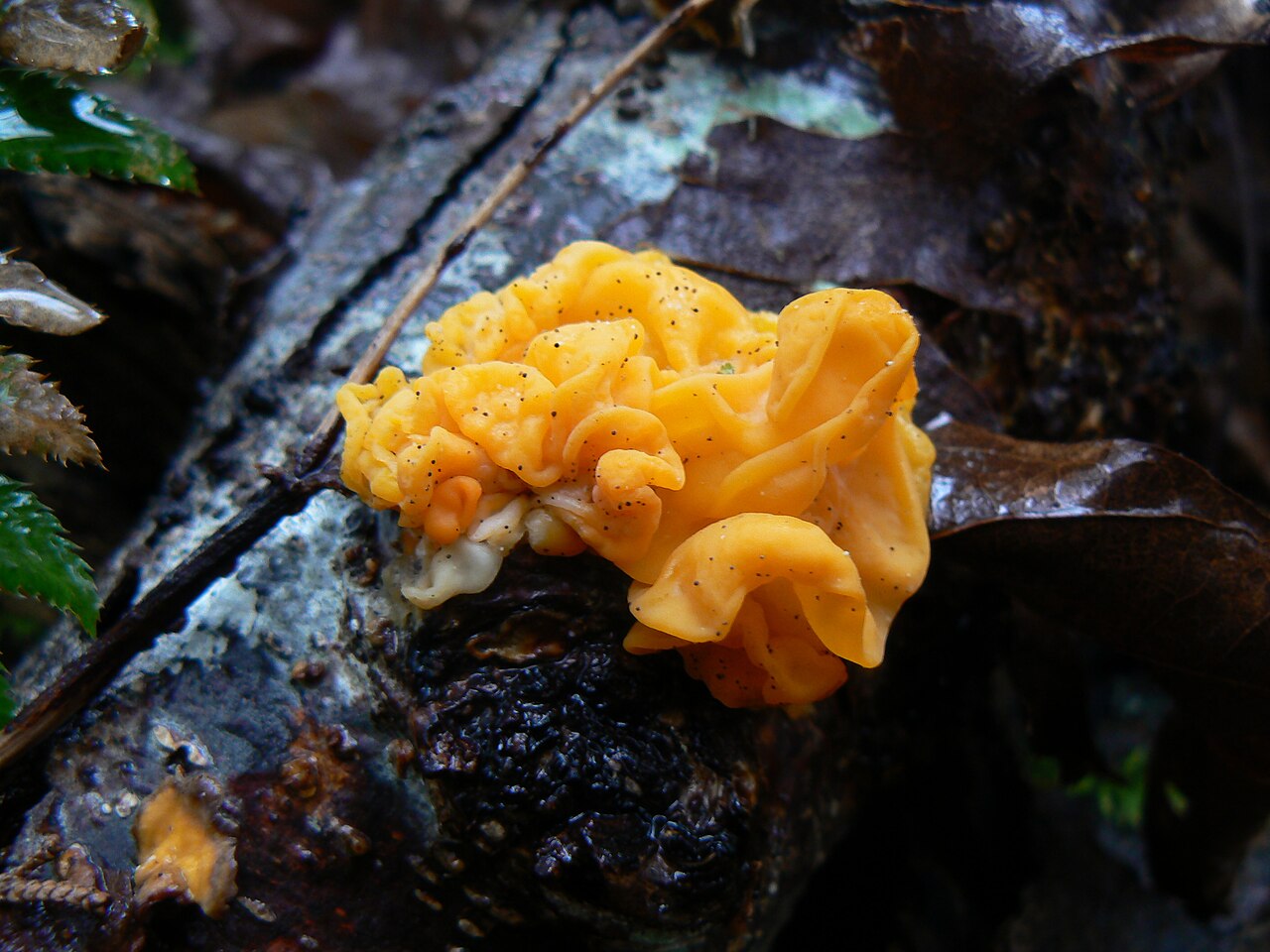
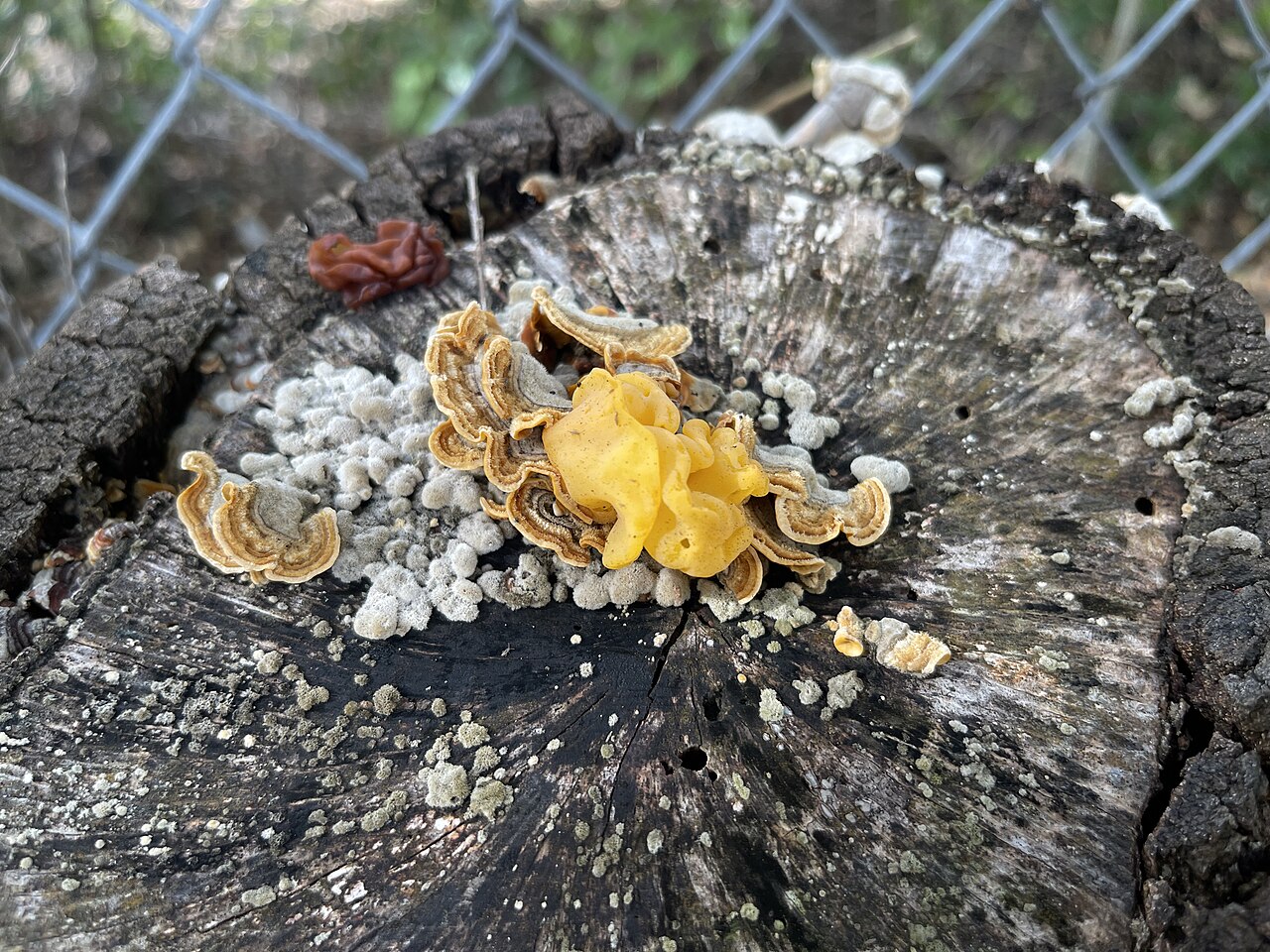
A bright golden-orange jelly fungus shaped like a small brain or a pile of scrambled eggs, lobed and wrinkled, rubbery-gelatinous to the touch. It dries hard and dark, then revives and re-jellies after rain.
Always on dead oak — but the secret is that it isn't eating the oak. It's a parasite of another fungus: it grows out of the crusty Stereum mycelium inside the wood, which is why you often find golden ear and false turkey tail on the same log.
Scattered across North America and Asia wherever oaks fall. Most likely after wet weather in spring and fall.
🌿 Traditional uses & research
In China, golden ear (jin er) is the golden counterpart to silver ear (tremella), simmered into sweet dessert soups and tonic drinks prized for skin and "moistening" qualities. It's cultivated commercially in Asia on oak logs — always alongside its Stereum host. Researchers have profiled its polysaccharides (glucuronoxylomannans similar to tremella's) in antioxidant and immune-model studies. In the kitchen it's nearly flavorless on purpose: a silky, gelatinous texture carrier for whatever it soaks in.
⚠️ Safety notes
The jelly fungi as a group are benign, but golden ear's orange color invites confusion with witch's butter (Dacrymyces) and orange jelly (Dacrymyces chrysospermus) on conifers — check the host wood (oak vs. pine) and remember golden ear rides on Stereum-infected hardwood. Cook before eating, try a small amount first, and confirm every wild identification with an expert.
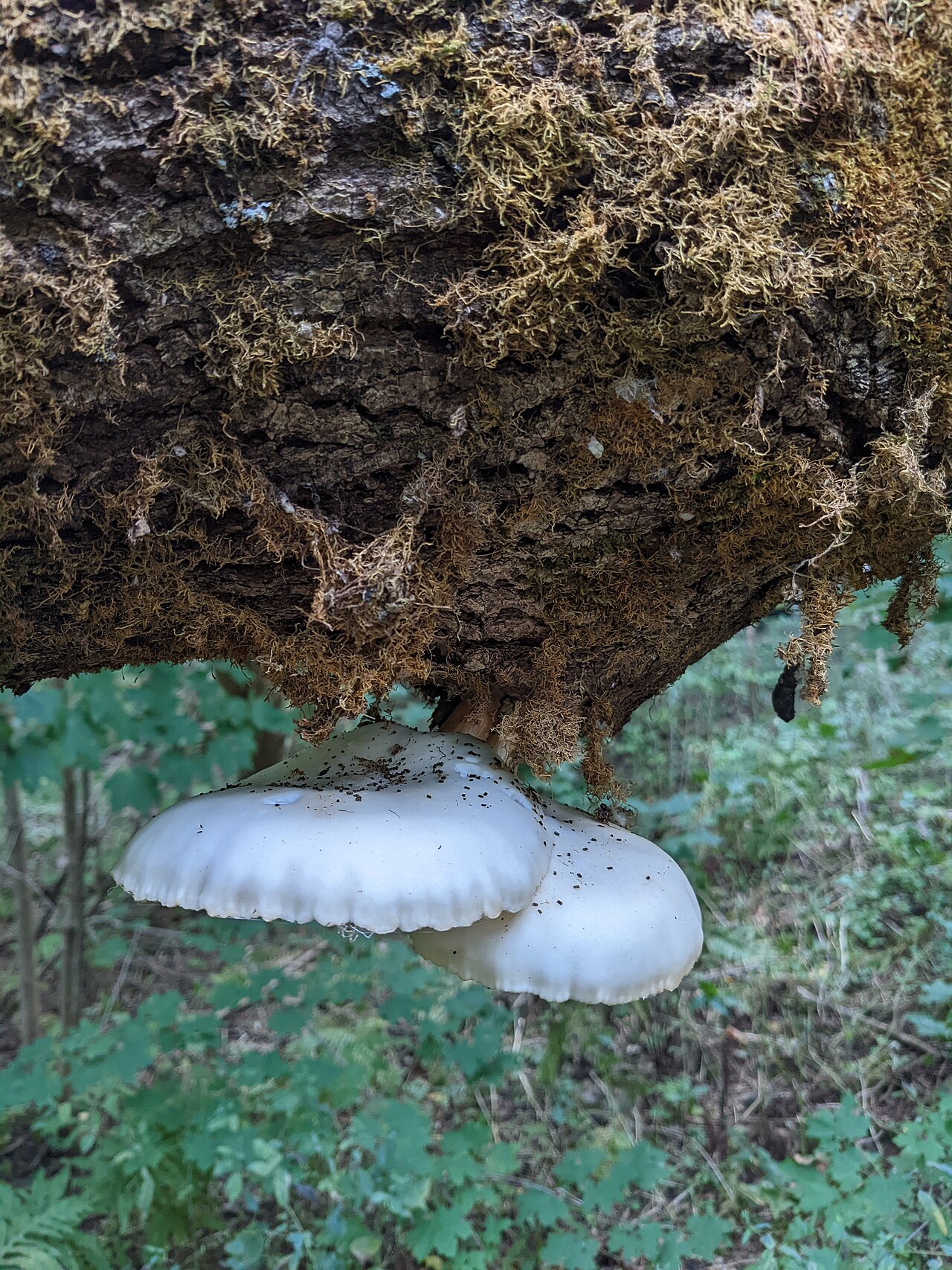
Violet, toothy undersideOverlapping shelves on dead hardwood
Violet-toothed Polypore
Trichaptum biforme
🌍 Native to: North America, Europe and Asia
🔍 How to identify
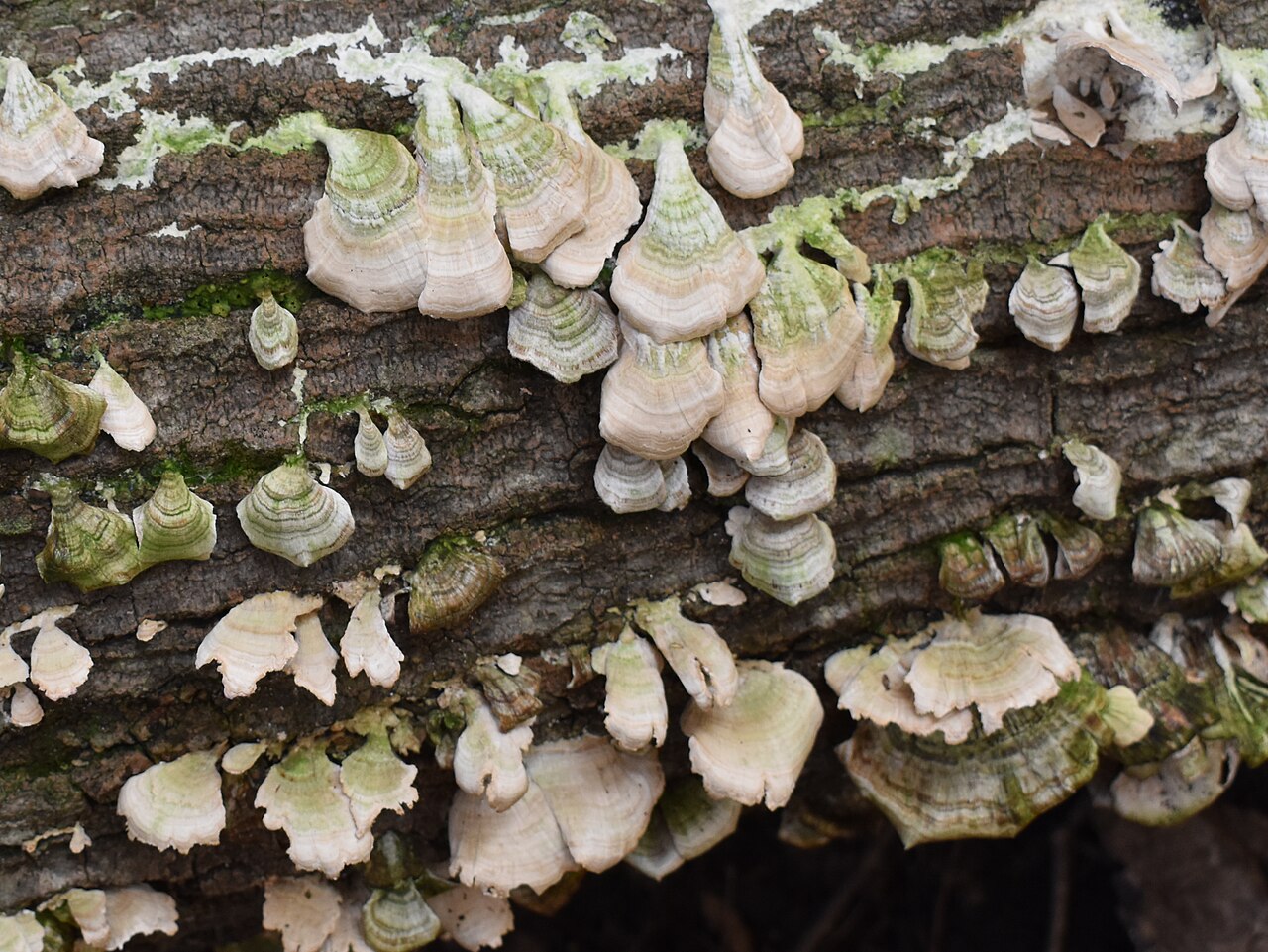
Small, thin, leathery shelves in dense overlapping clusters on dead hardwood sticks and logs — grey-brown and zoned on top like a miniature turkey tail, but flip one over: the underside is a startling violet, made of tiny teeth that split and fray with age.
The violet fades to brown as the fruitbody matures and dries, so the youngest shelves at the cluster's edge show the color best.
One of the most common fungi in eastern North American hardwood forests — if you've walked past a stick covered in little shells, you've probably walked past this.
🌿 Traditional uses & research
Not a traditional medicine of the reishi-and-chaga kind — its functional story is ecological. Trichaptum biforme is a white-rot workhorse, one of the fungi that turns dead hardwood back into soil, and it's studied by mycologists as a model for wood decay and enzyme production. It earns its place in this section as a reminder that "functional" cuts both ways: some fungi function for us in a teapot, and some function for the entire forest. Naturalists also use it as a teaching fungus for pore-surface types.
⚠️ Safety notes
Inedible — paper-thin, tough, and bitter; admire it, don't eat it. Because it mimics turkey tail from above, it's one of the classic reasons the rule is "always check the underside": true turkey tail has smooth white pores, never violet teeth. Confirm every identification with an expert before consuming any wild polypore.
Pale clusters high on a trunkThick stems, crowded gills
Elm Oyster
Hypsizygus ulmarius
🌍 Native to: North America, Europe and East Asia
🔍 How to identify
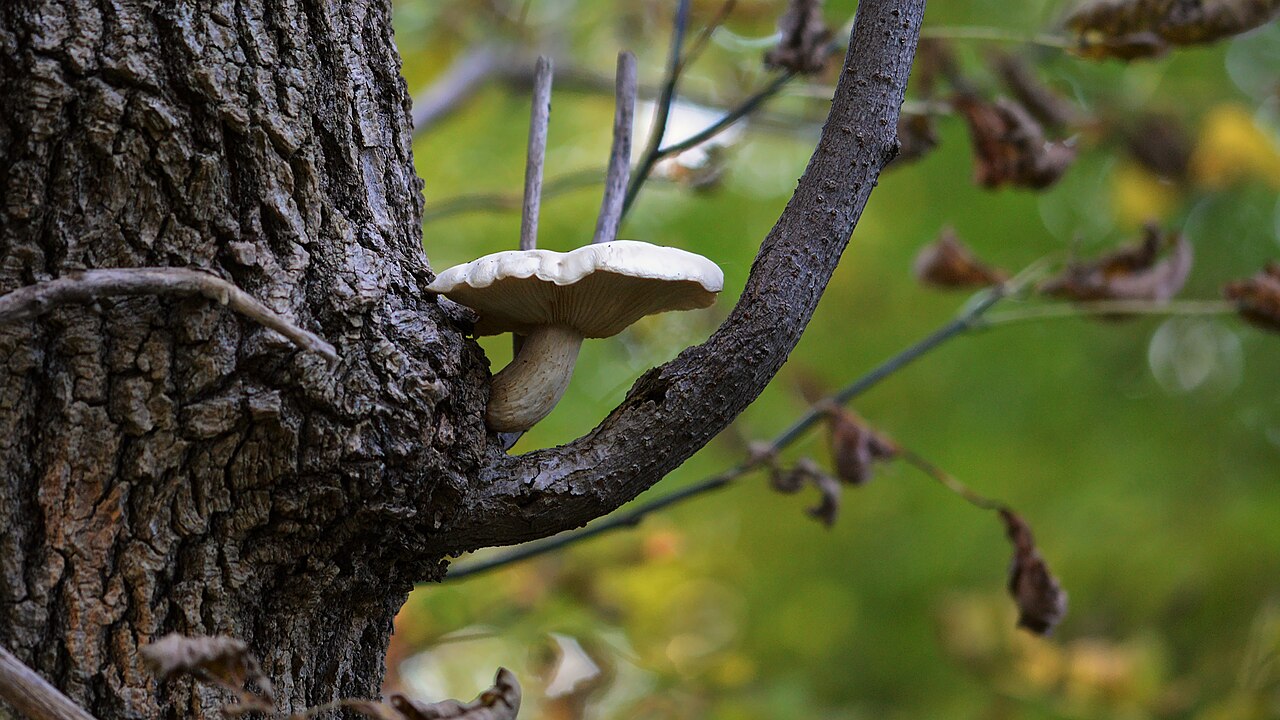
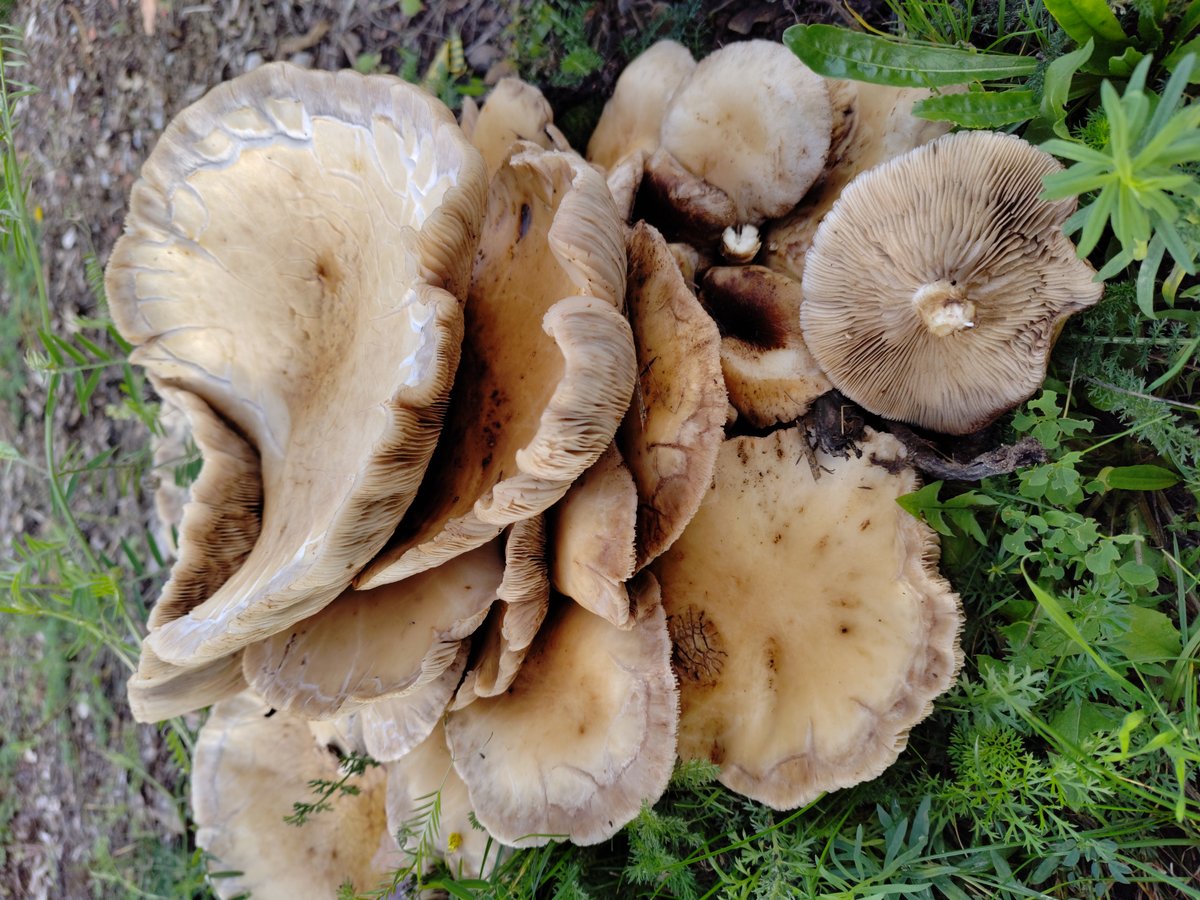
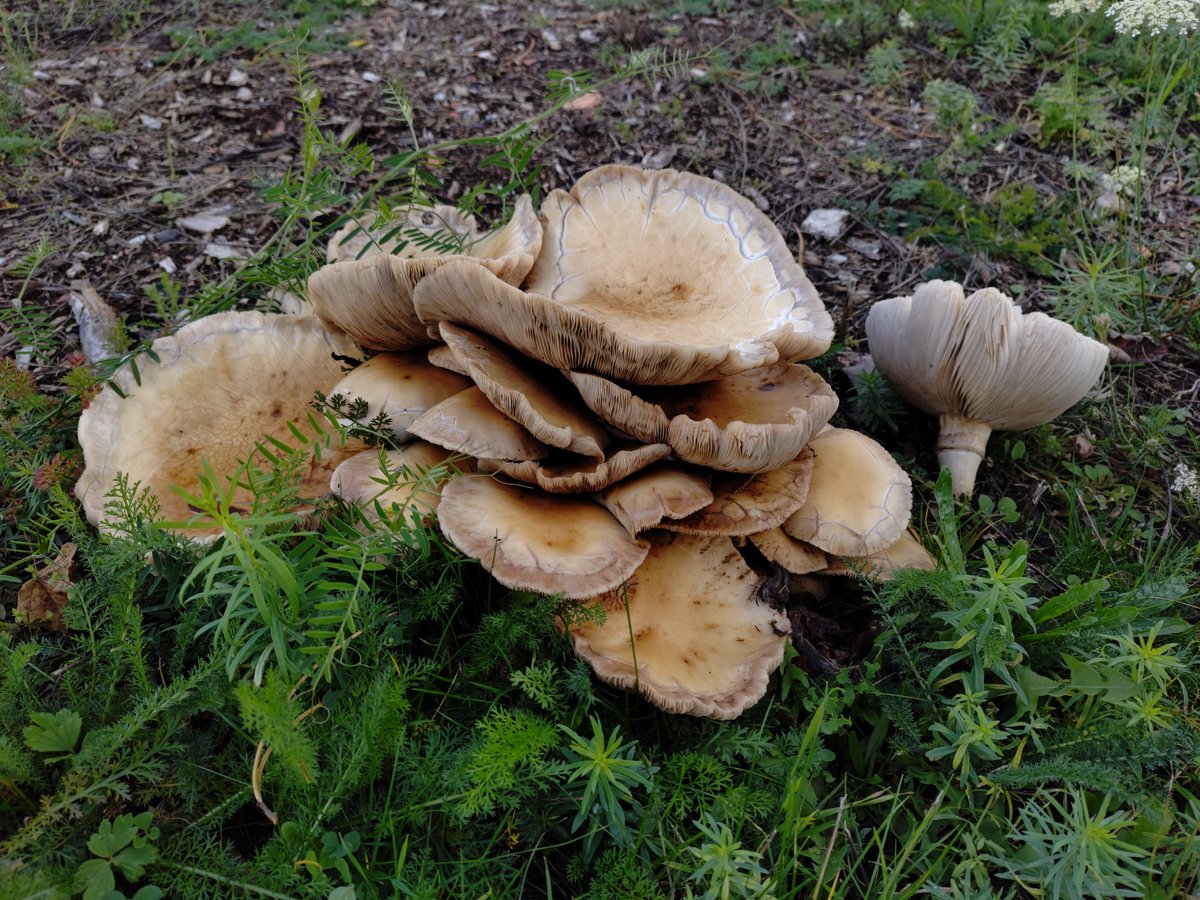
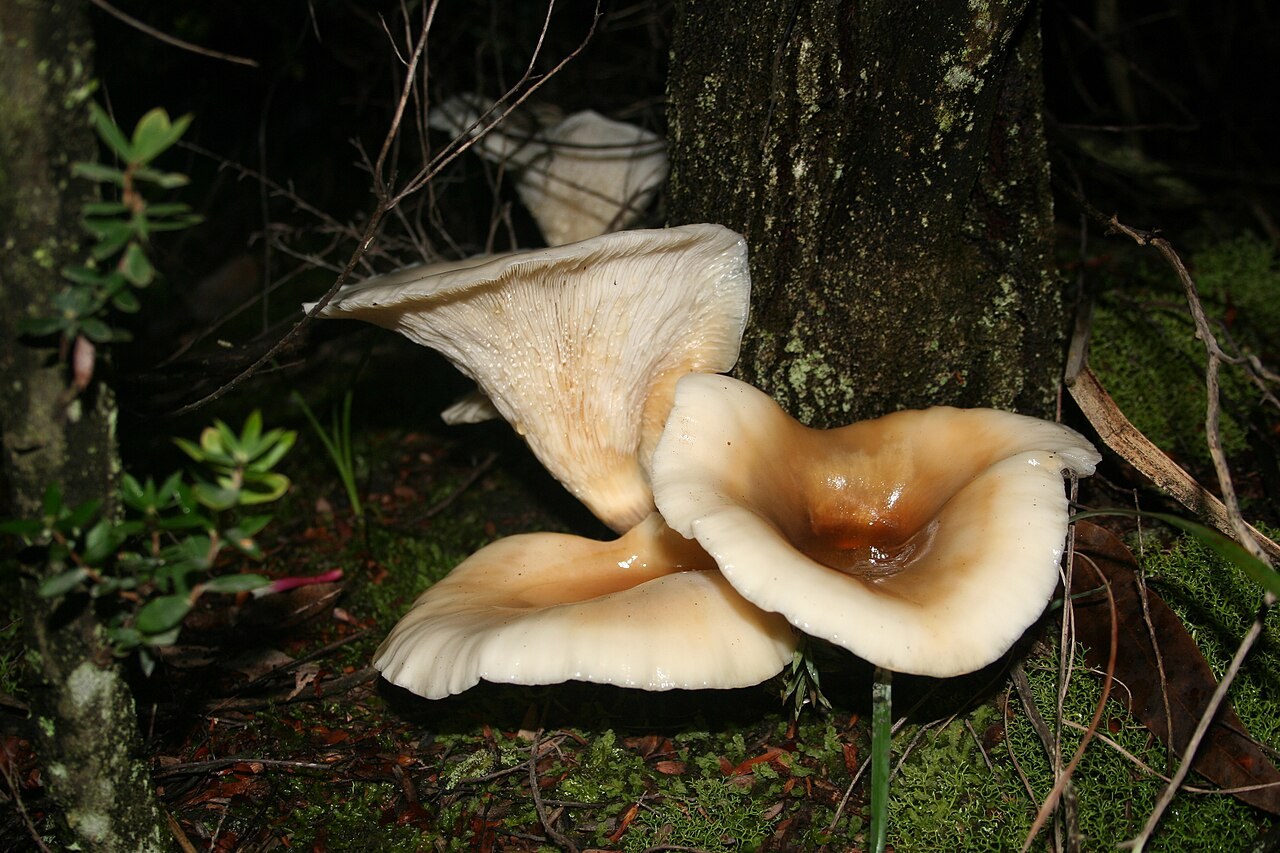
A big, pale oyster relative that fruits in clusters from wounds and branch scars high on living elms — and, as elms have declined, on box elder and other maples. Caps are cream to light tan, often cracking into a patchwork pattern as they expand.
Stems are thick, solid, and usually off-center, with crowded white gills. It looks like an oyster mushroom that went to the gym — stockier and denser than Pleurotus.
Late summer through fall in eastern and central North America. Same genus as shimeji, grown commercially on sawdust where it's sometimes sold as a specialty oyster.
🌿 Traditional uses & research
Elm oyster sits in this section because growers treat it as both food and functional: it's cultivated like its shimeji cousin and studied for the same polysaccharide fractions, while chefs prize it as a meaty, long-keeping oyster alternative that doesn't go slimy in the pan. The flavor is mild and sweet, the texture firm — it grills, roasts, and holds up in soups where true oysters would dissolve. For home growers it's an approachable sawdust-block species with forgiving yields.
⚠️ Safety notes
The serious lookalike is the elm's other tenant: jack-o'-lantern is orange with a glow-in-the-dark twist and is poisonous — always check for elm oyster's pale cap, white spore print, and growth from an upper trunk wound. True oysters and elm oyster are both white-spored; when in doubt, spore-print it, and confirm every wild identification with an expert before eating.
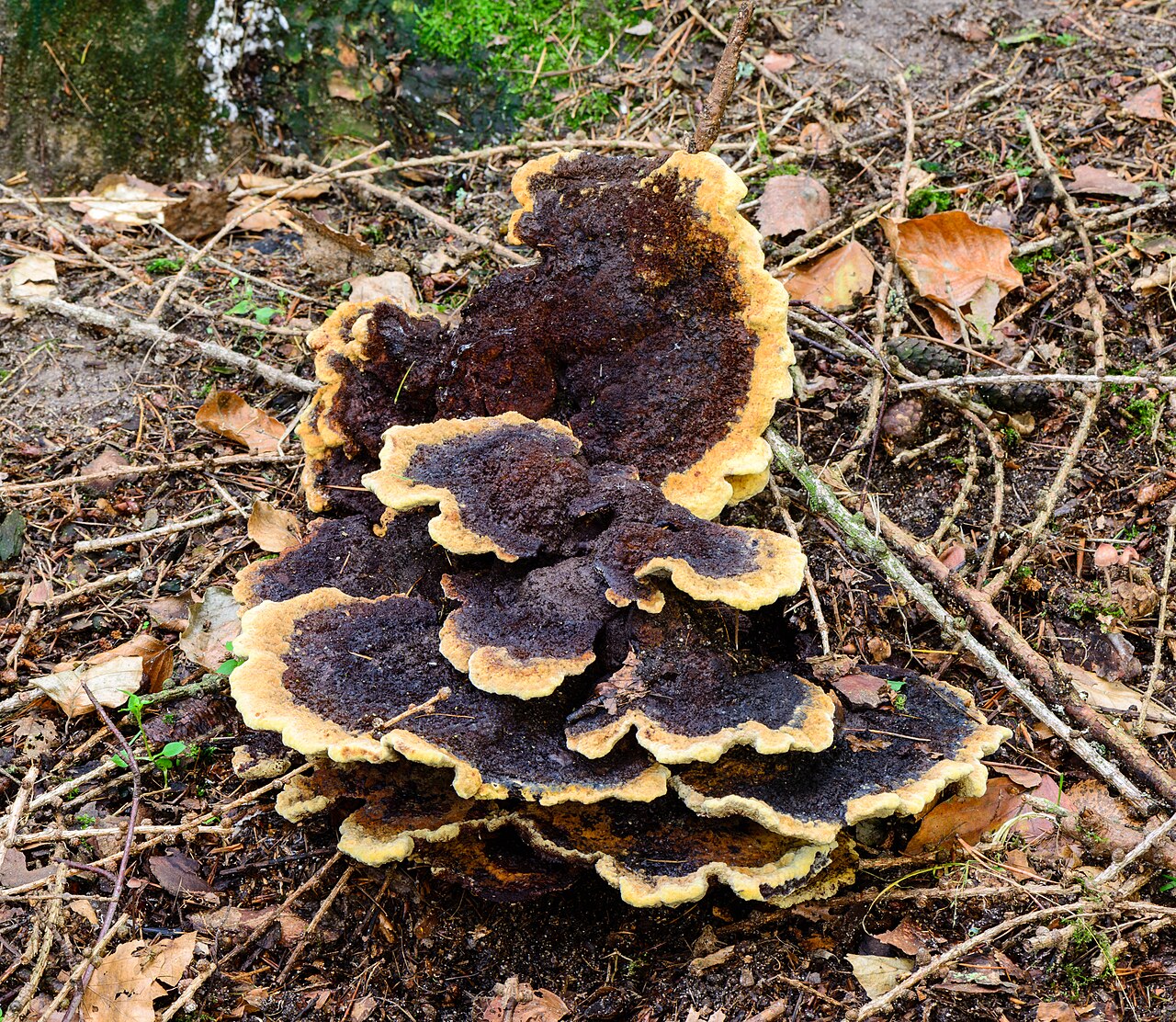
Golden ruffled fans on a logSmooth underside — no pores
False Turkey Tail
Stereum ostrea
🌍 Native to: North America and Southeast Asia
🔍 How to identify
Golden-orange, ruffled fans that imitate turkey tail so well they're named for the deception — concentric zones of rust, ochre, and cream on a wavy, shell-like cap, often in big overlapping tiers on oak logs.
The tell is underneath: completely smooth and pore-less, orange-buff, sometimes weeping amber droplets when fresh. A turkey tail's underside is white and covered in pin-prick pores. That one flip settles it.
Year-round on dead oak across eastern North America and the tropics; in Asia it's so common it's called the golden curtain. Also the secret host behind golden ear — find one, look for the other.
🌿 Traditional uses & research
False turkey tail has no real career as a medicine or food — and that's precisely why it's in this section. Every season, foragers brew "turkey tail tea" from Stereum by mistake, making this the most important ID distinction in the whole functional shelf: the functional chemistry people want lives in Trametes versicolor, not here. Stereum species do produce their own compounds (the genus gives the antibiotic-related stereum chemistry its name), but for the forager, this mushroom's function is as a warning sign shaped like a fan.
⚠️ Safety notes
Not considered edible — thin, leathery, and not for tea. Never consume a "turkey tail" you haven't flipped over: pores underneath, white and fine = true turkey tail; smooth and orange = false. When in doubt, throw it out, and confirm every wild identification with an expert.
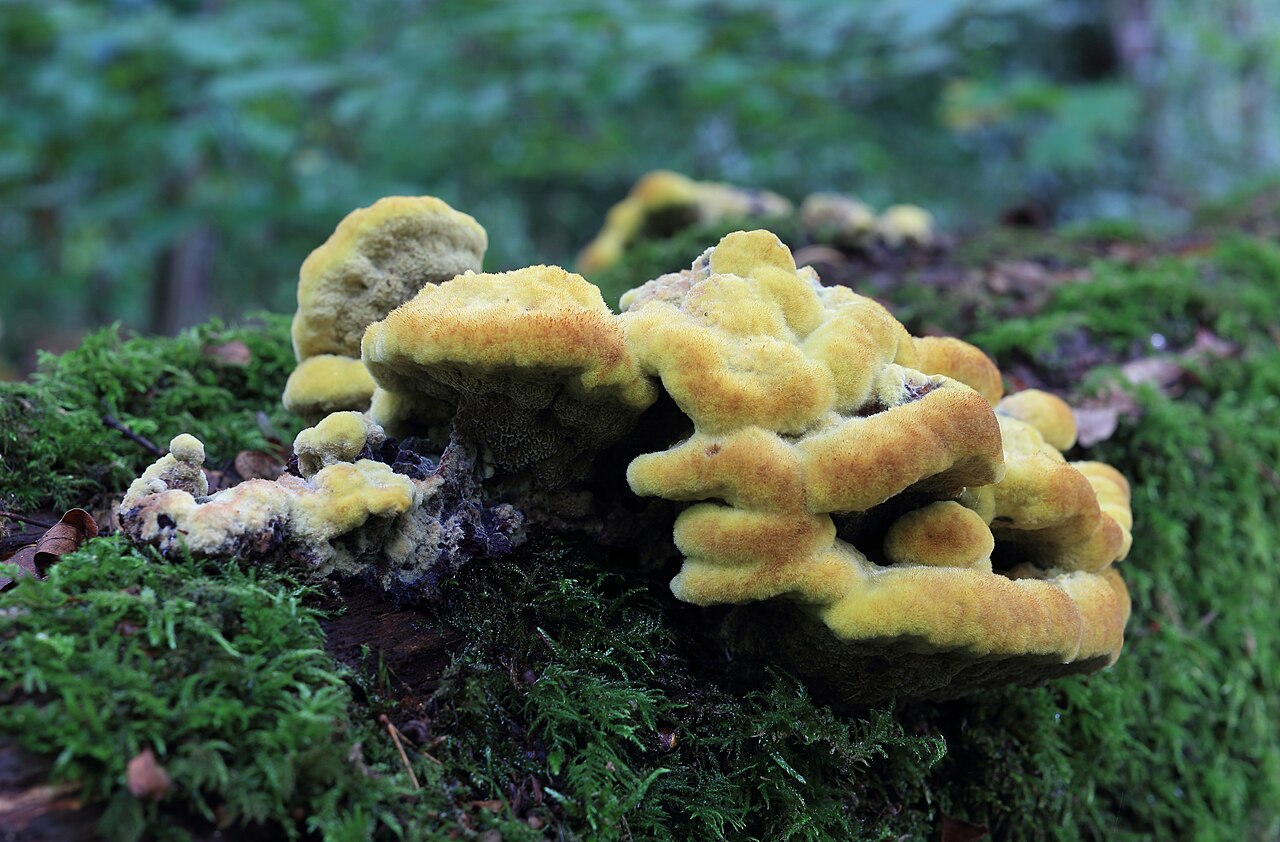
Brown rosette, yellow rimYoung and yellow-green
Dyer's Polypore
Phaeolus schweinitzii
🌍 Native to: North America, Europe and Asia
🔍 How to identify
Velvety brown rosettes at the base of conifers, often fused into a mass a foot or more across, with a bright yellow-green growing margin when young.
Yellow-green pores underneath that bruise brown when pressed.
A short, stubby stem or none at all — it grows right out of the tree's base or roots.
Causes brown butt rot in conifers (pines, Douglas fir). Fruits in late summer and fall; very common in California conifer forests.
🌿 Traditional uses & research
The dyer's mushroom — one of the most famous natural-dye fungi in the world. Depending on the mordant, it yields golds, greens, and deep browns on wool and silk, and fiber artists seek it out every fall. Not a food, but a workshop staple.
⚠️ Safety notes
Not edible — tough and bitter. Don't confuse it with chicken of the woods: that one is bright orange with no brown velvet, and grows in overlapping shelves higher up the trunk.
On a living oakYoung and orange
Shaggy Bracket
Inonotus hispidus
🌍 Native to: North America, Europe and Asia
🔍 How to identify
A large rusty-brown bracket, 4–12 inches across, with a distinctly hairy, shaggy top surface — run a finger across it and it feels like coarse fur.
Young brackets are bright orange and often weep amber drops of liquid.
Brown pores underneath; the flesh is yellow-brown and fibrous.
Grows on living oaks and other hardwoods in late summer and fall. A sign the tree has white heart rot.
🌿 Traditional uses & research
Studied for its hispidin compounds — antioxidants researched for various bioactivities — and used in traditional medicine in parts of Asia and Europe. Also a dye mushroom, giving warm browns. Not a food: far too tough and bitter.
⚠️ Safety notes
Not edible. If you find one on a yard oak, it's worth knowing the tree's heartwood is being decayed — an arborist can tell you whether the tree is still sound.
Edible Gourmet Mushrooms
Choice edibles — the culinary mushrooms worth knowing, foraging, and growing.
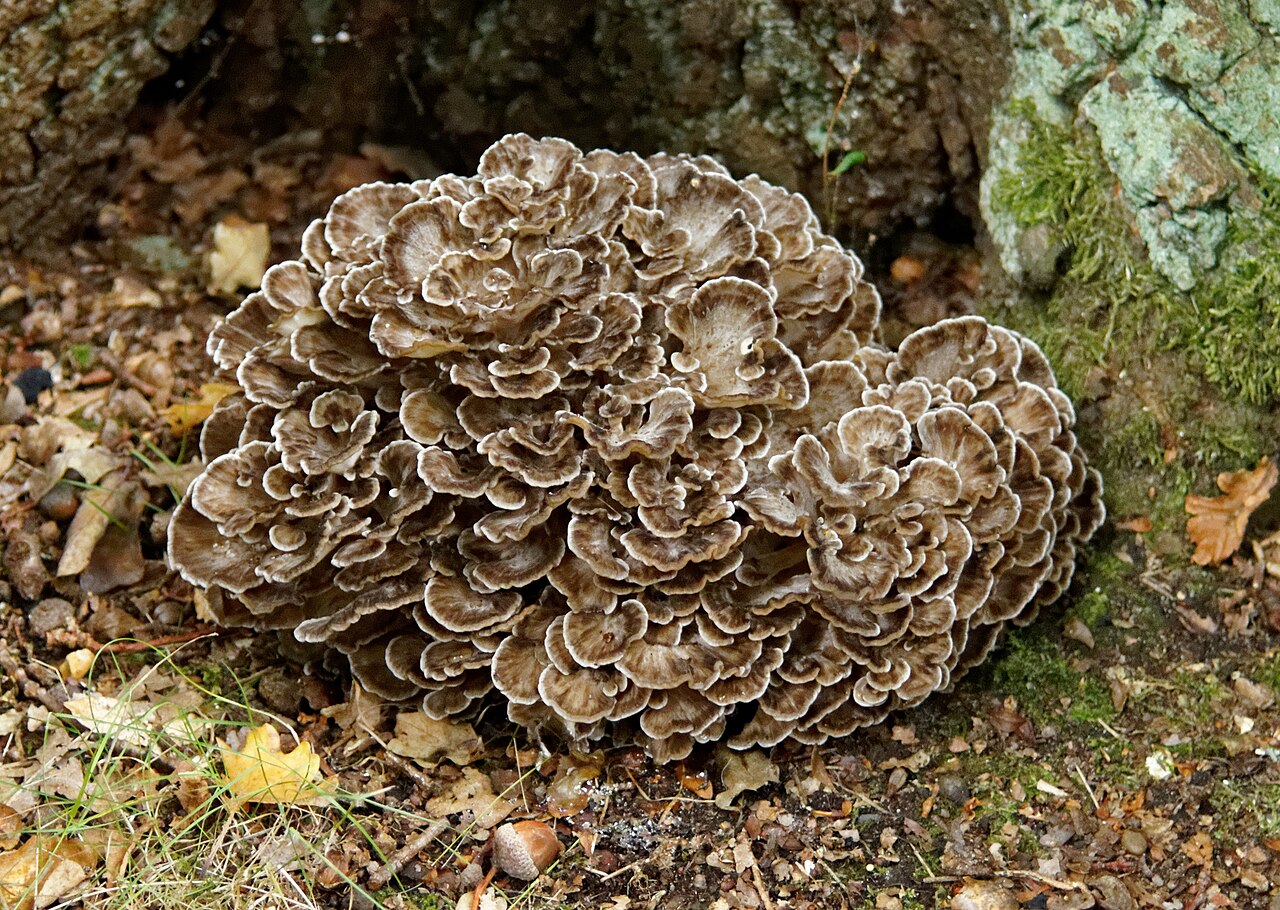
Wild clusterClose-up
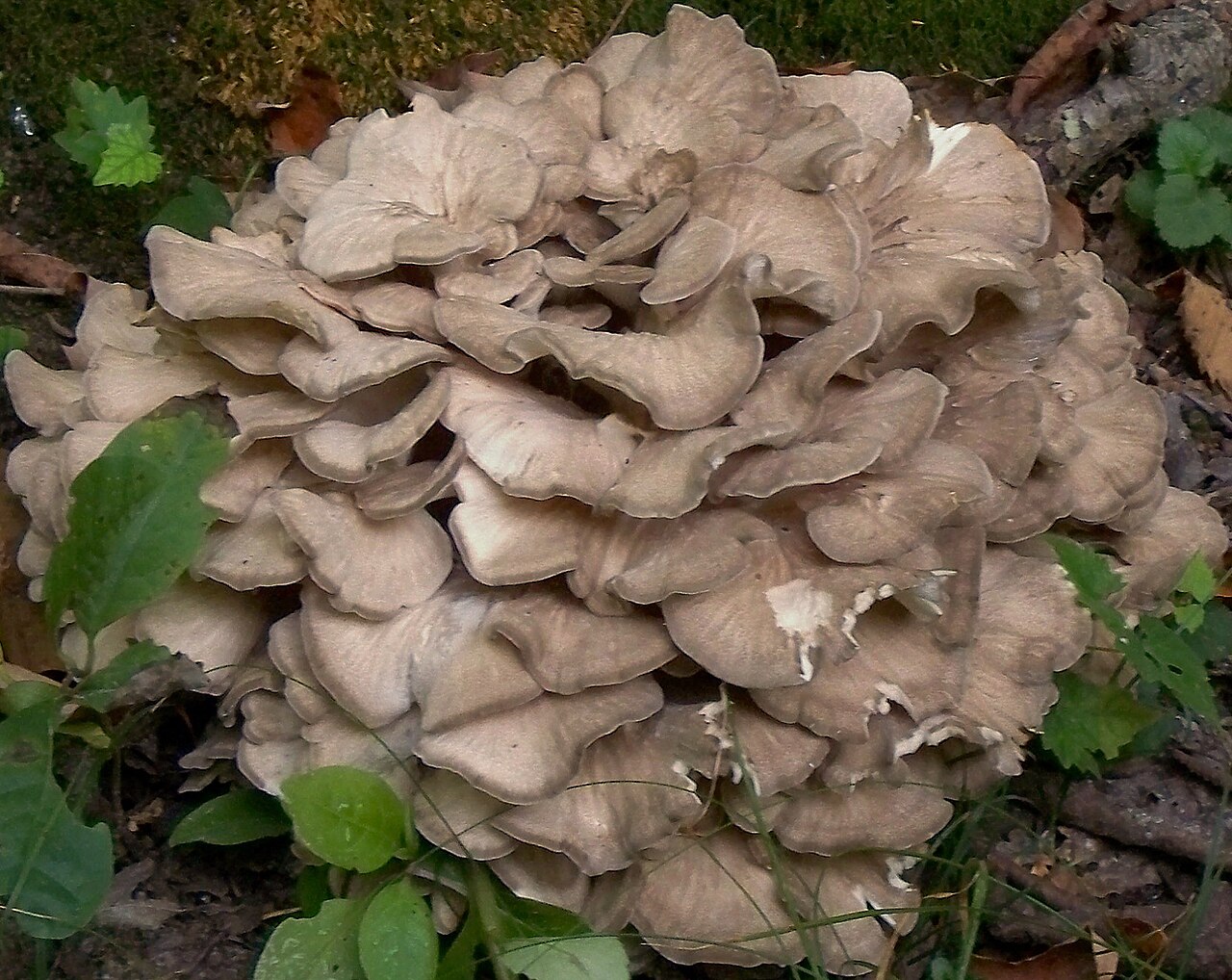
Maitake
Grifola frondosa
🌍 Native to: North America, Europe and East Asia
🔍 How to identify
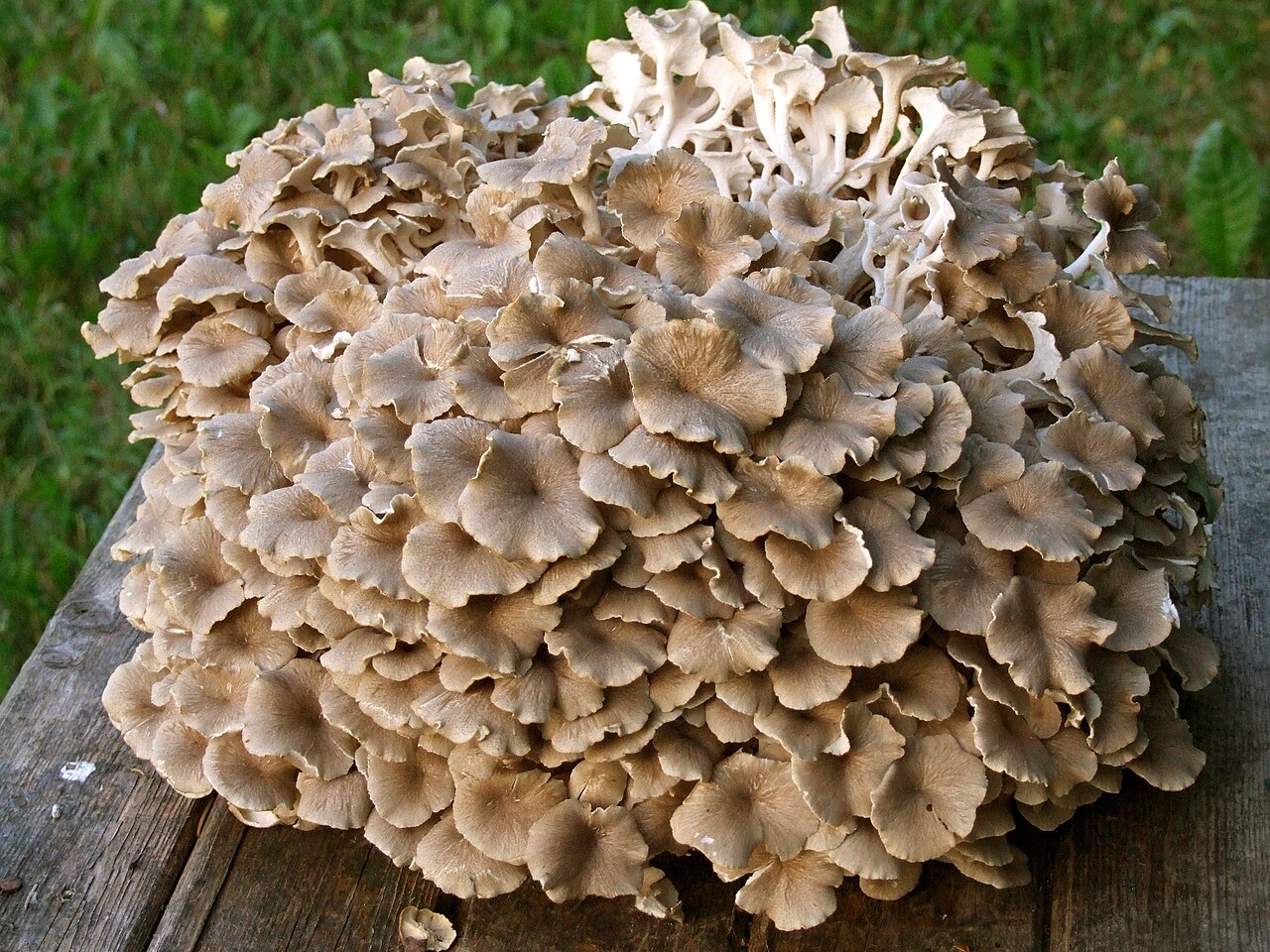
A giant ruffled cluster of overlapping gray-brown caps — like a hen's fluffed feathers — all growing from one base. The Japanese name means 'dancing mushroom.'
Found at the base of oaks and other hardwoods in fall; a single cluster can weigh 20 pounds or more.
Underside is white with tiny pores, never gills. Tender and choice when young, tougher with age.
🌿 Traditional uses & research
Prized in Japanese tradition as both food and folk remedy. Modern interest centers on its beta-glucans — including the well-known D-fraction — studied for immune support and healthy blood-sugar balance.
⚠️ Safety notes
A choice edible with a long history of safe use. May lower blood sugar — anyone on diabetes medication should check with their provider. Safety data in pregnancy is limited.
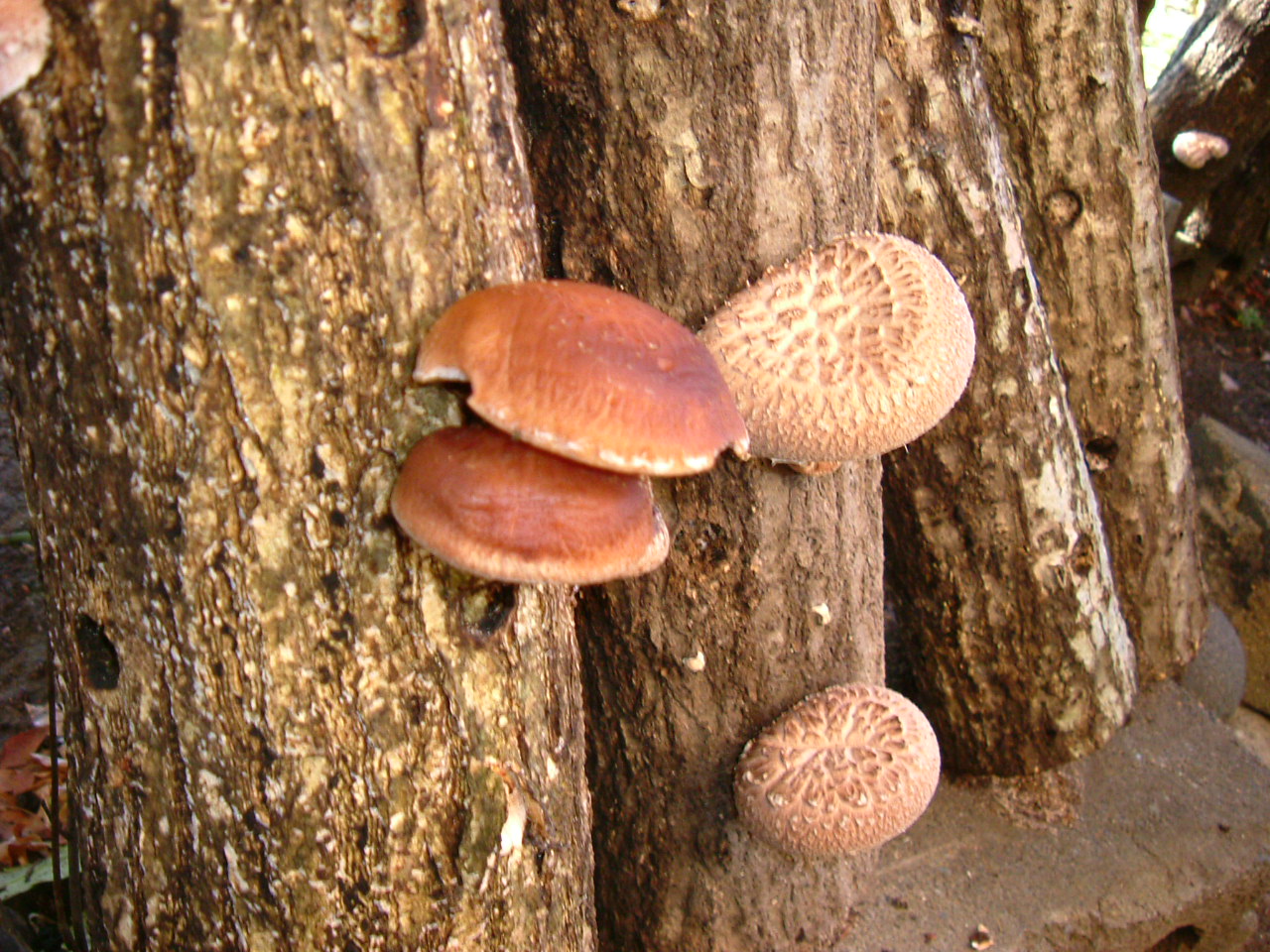
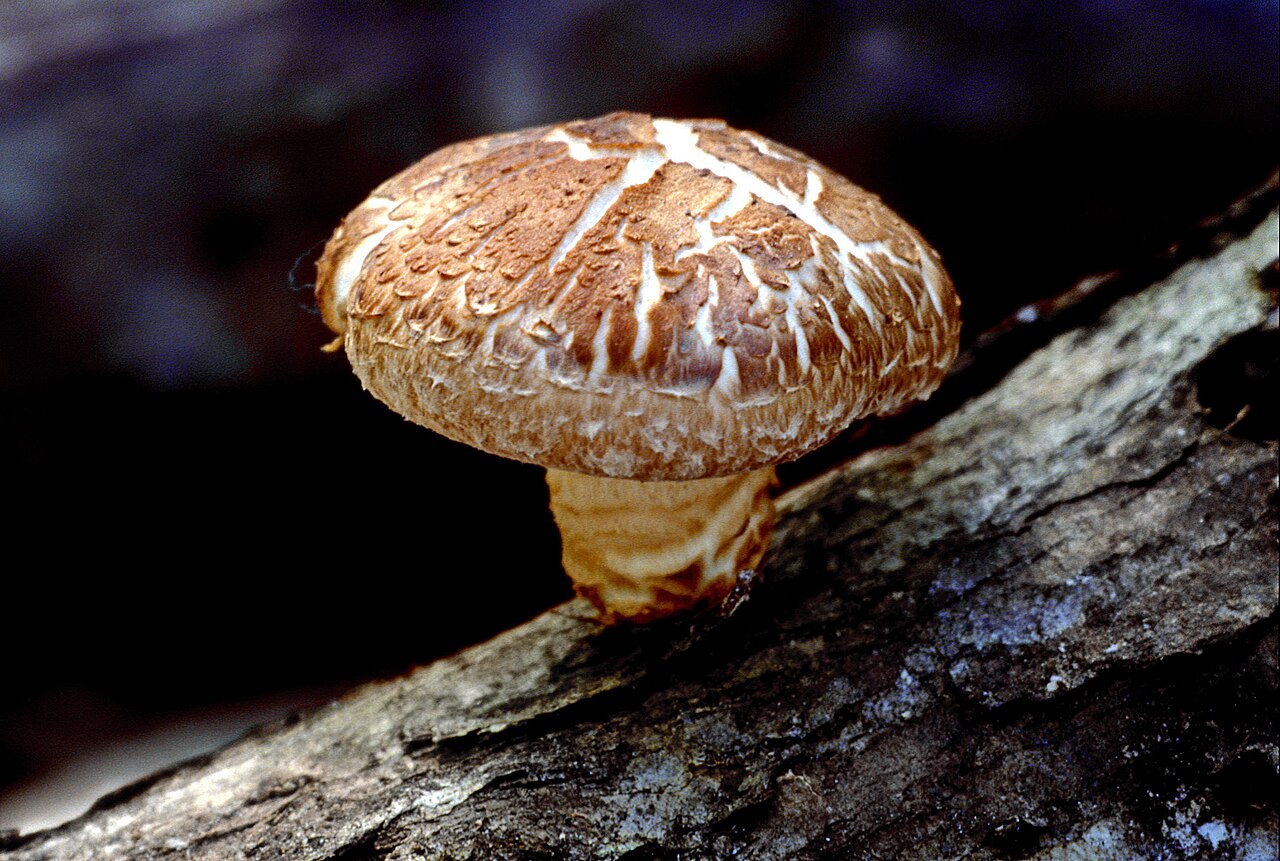
The classic brown umbrella cap — often flecked or cracked white on top when young — over white gills and a sturdy stem.
Grows on dead hardwood, especially oak; cultivated on logs and sawdust blocks for centuries.
One of the most cultivated mushrooms on Earth — if you've bought mushrooms at a grocery store, you've met this one.
🌿 Traditional uses & research
A culinary staple elevated to functional status: its lentinan polysaccharides are studied for immune support, and it naturally contains eritadenine, researched in relation to healthy cholesterol levels.
⚠️ Safety notes
Safe and widely eaten cooked. Note: raw or undercooked shiitake can cause 'shiitake dermatitis' — an itchy striped rash that fades on its own. Always cook shiitake thoroughly. Allergic reactions are possible as with any mushroom.
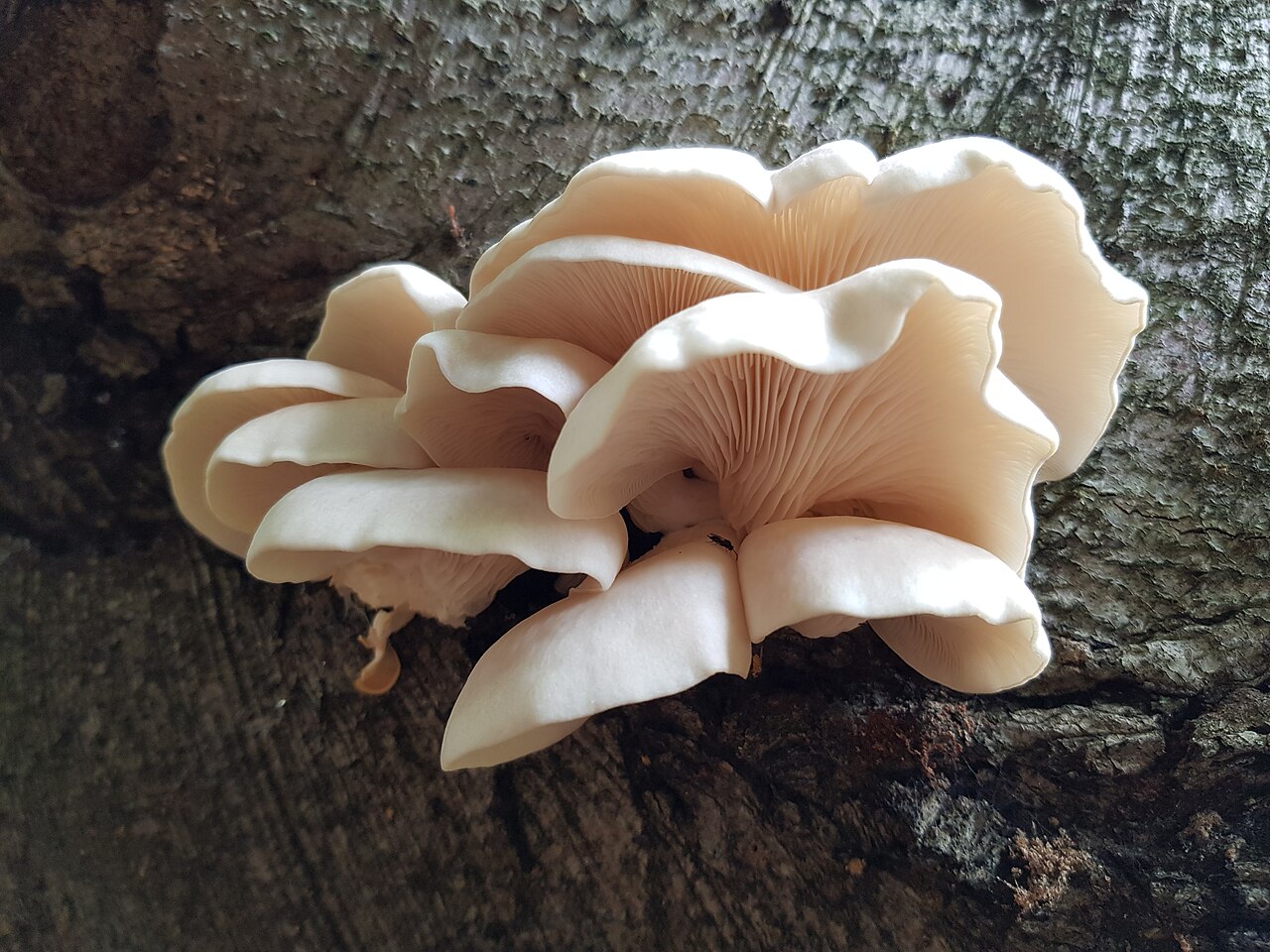
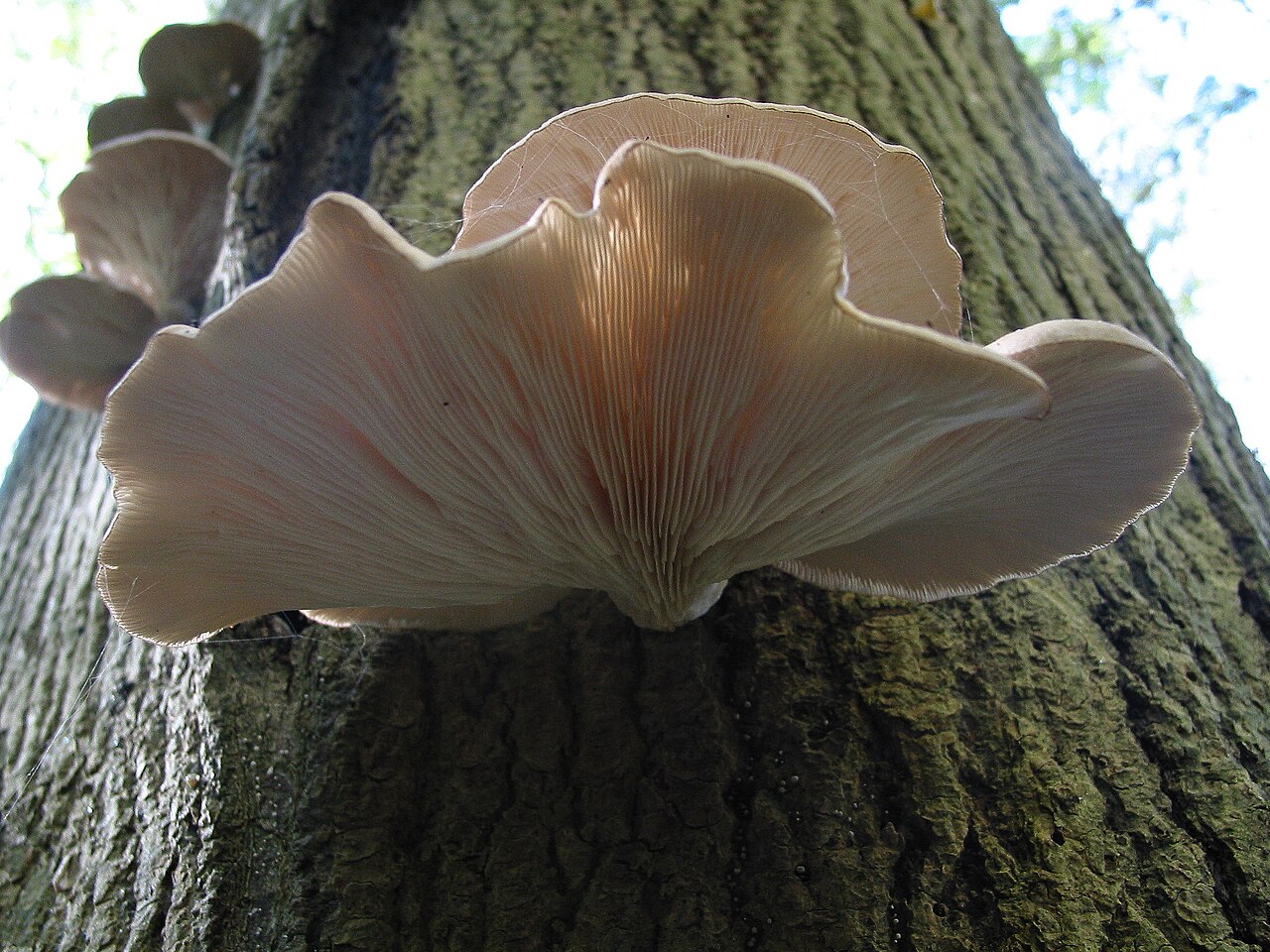
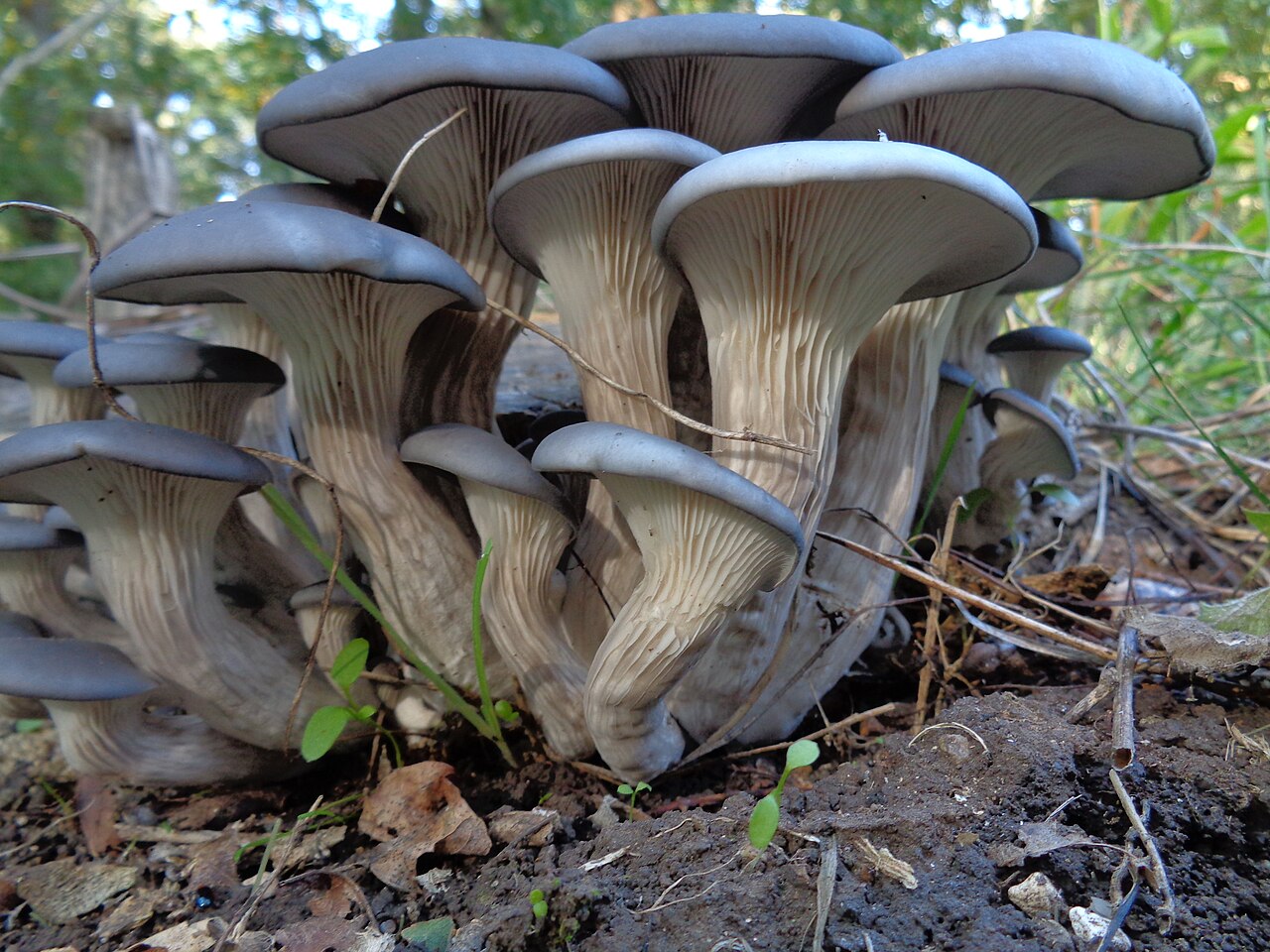
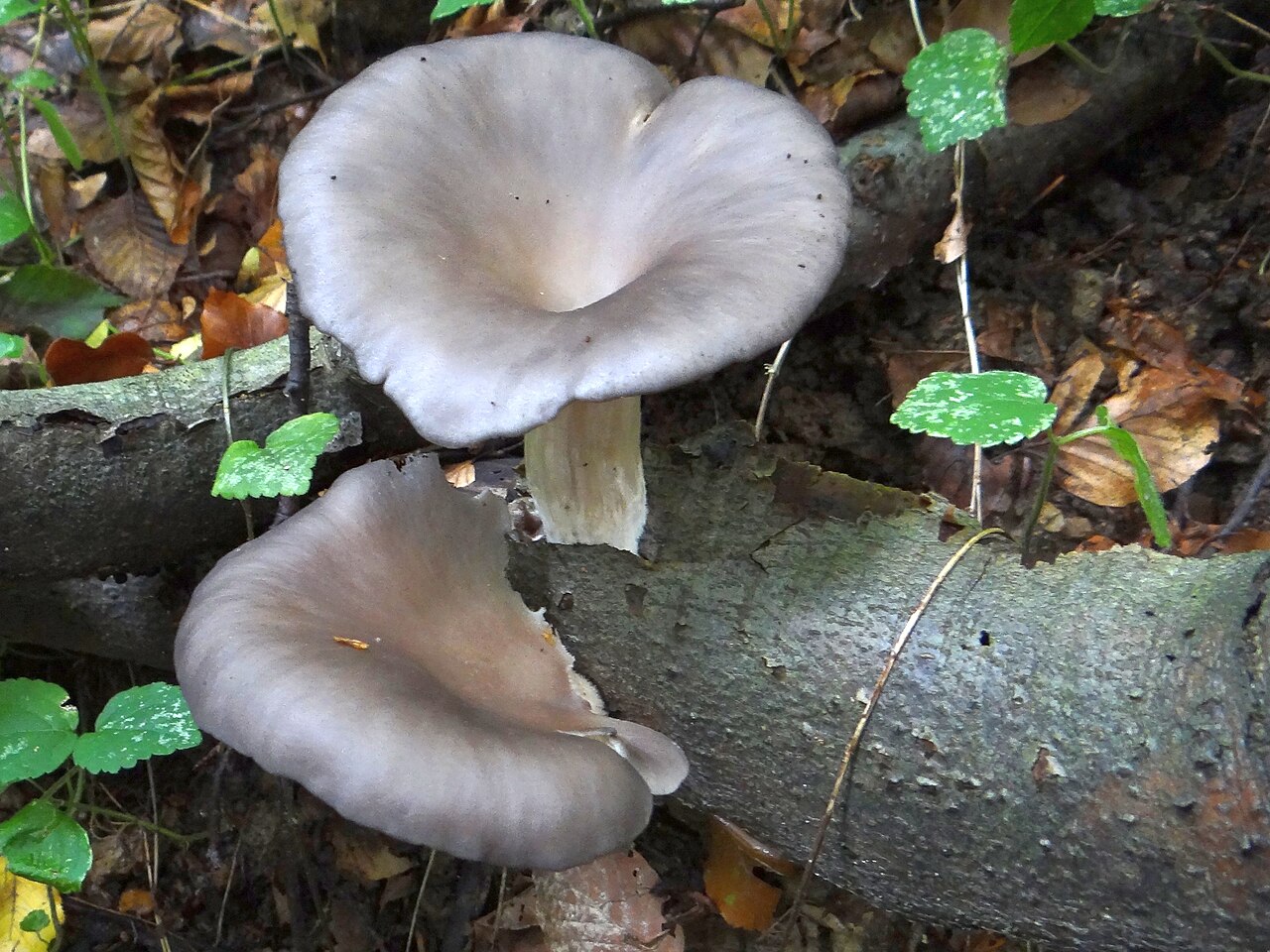
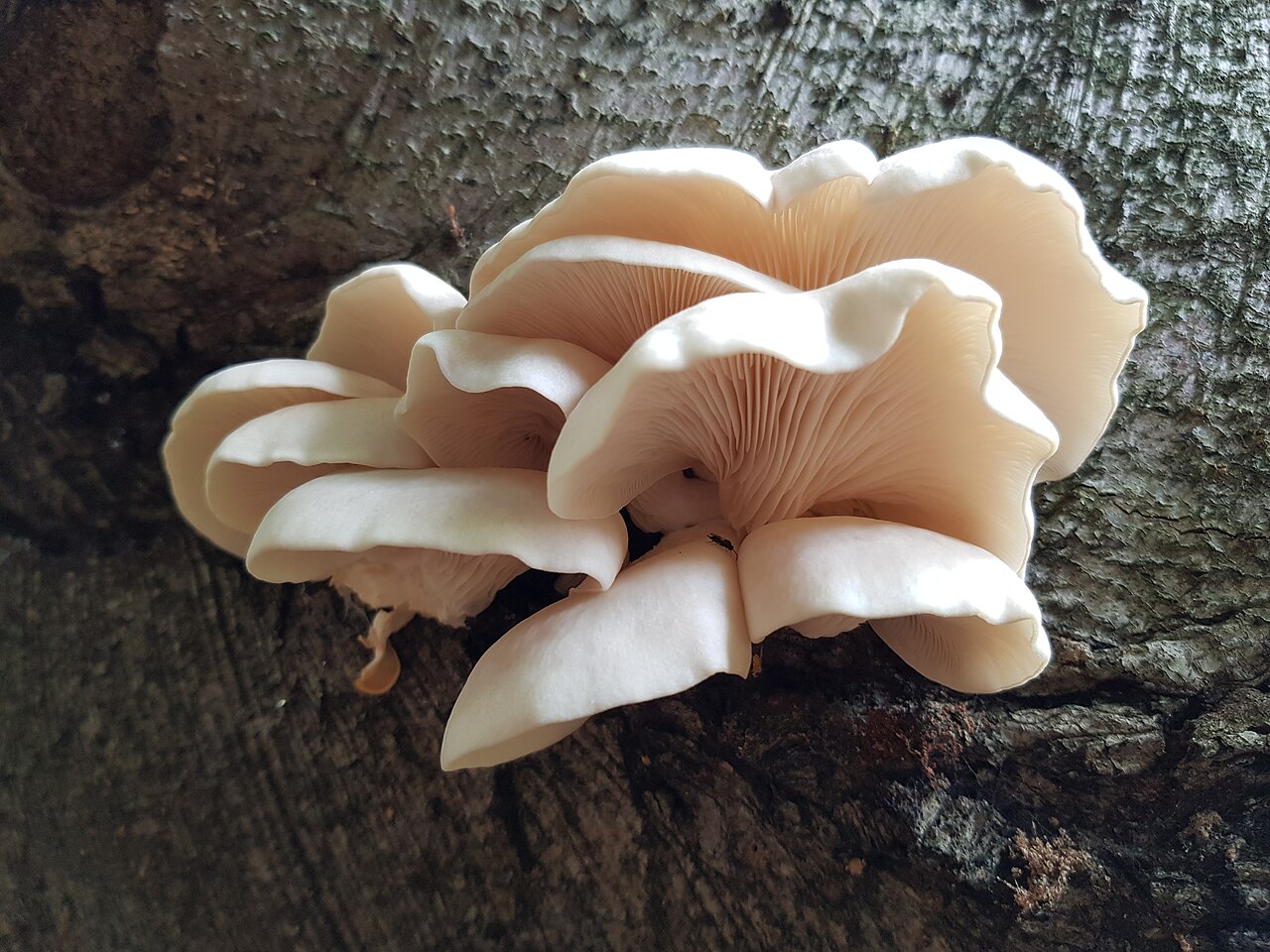
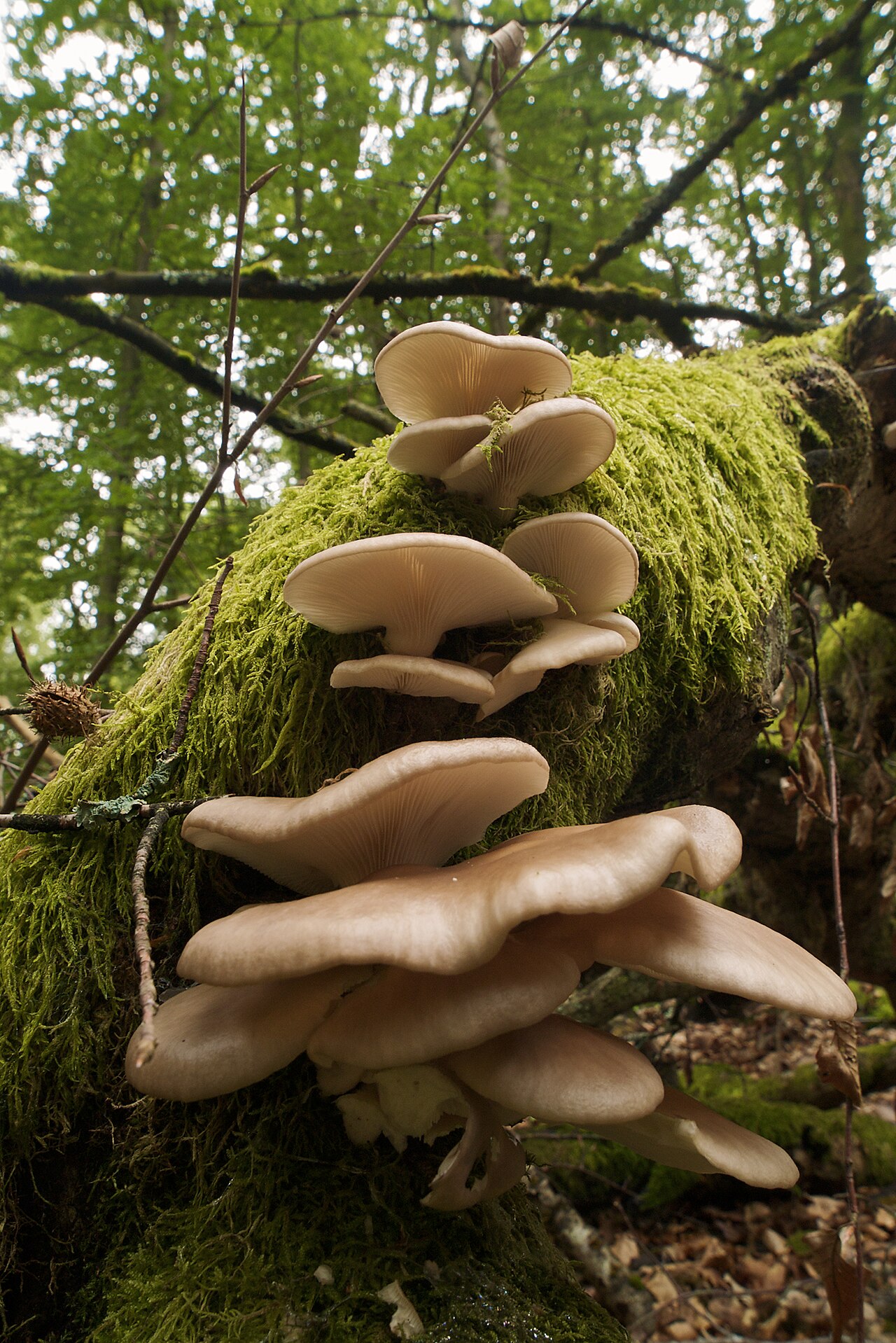
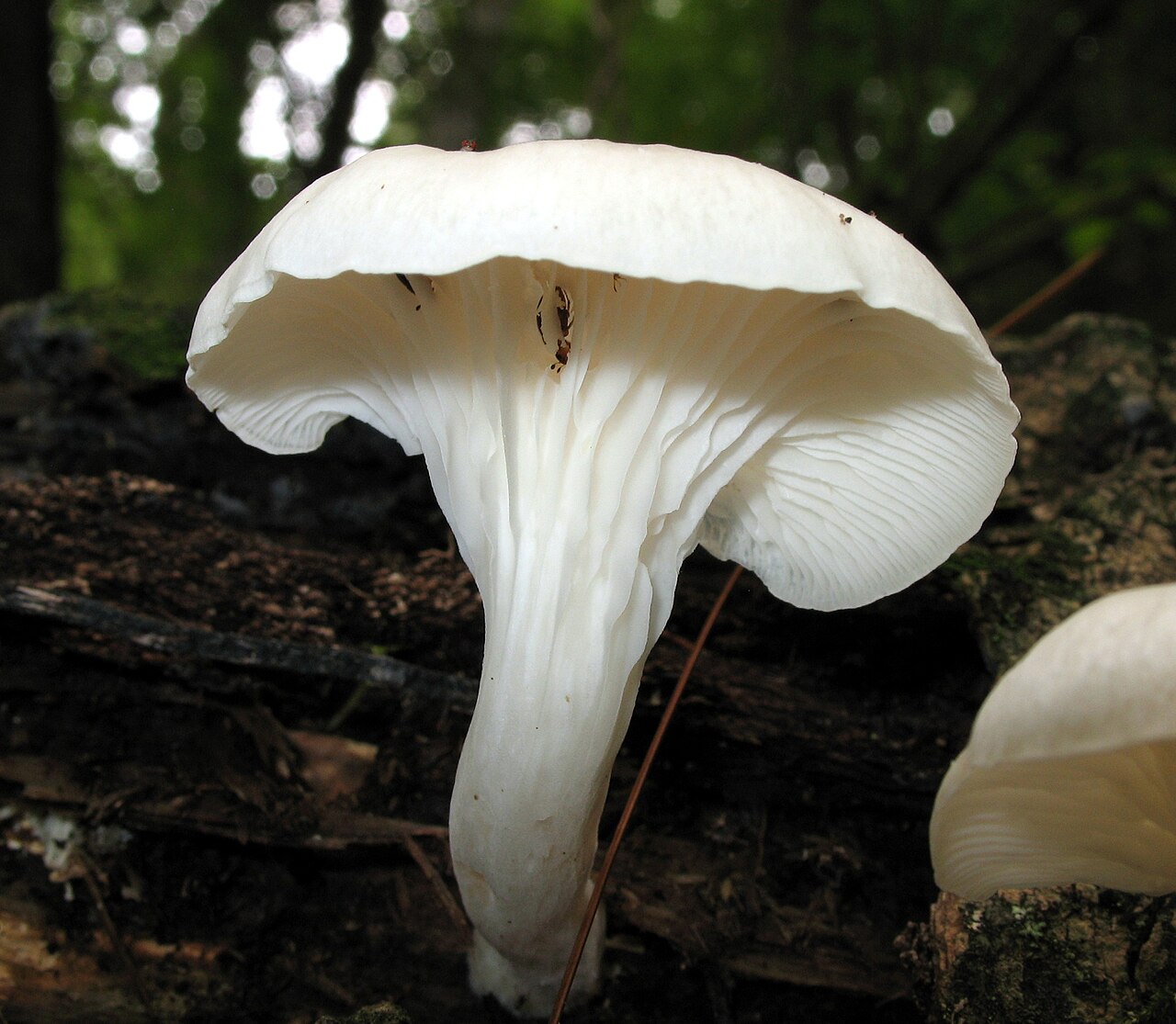
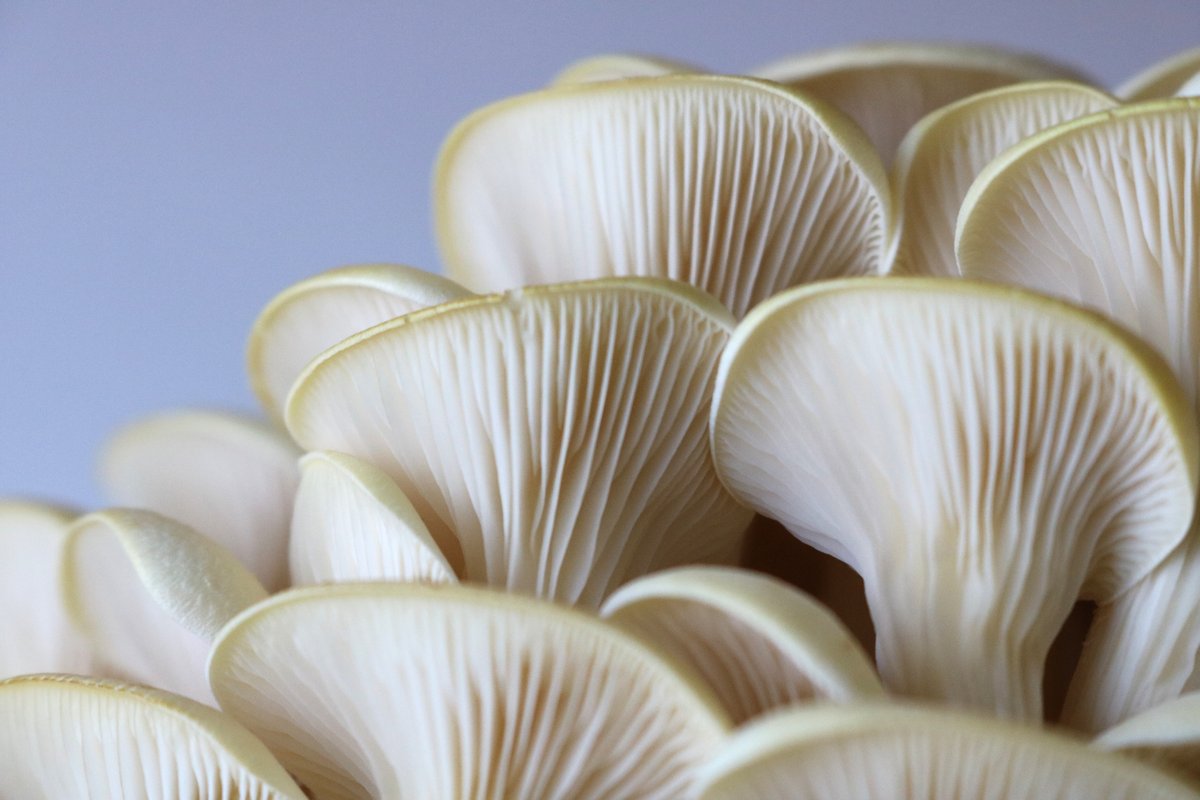
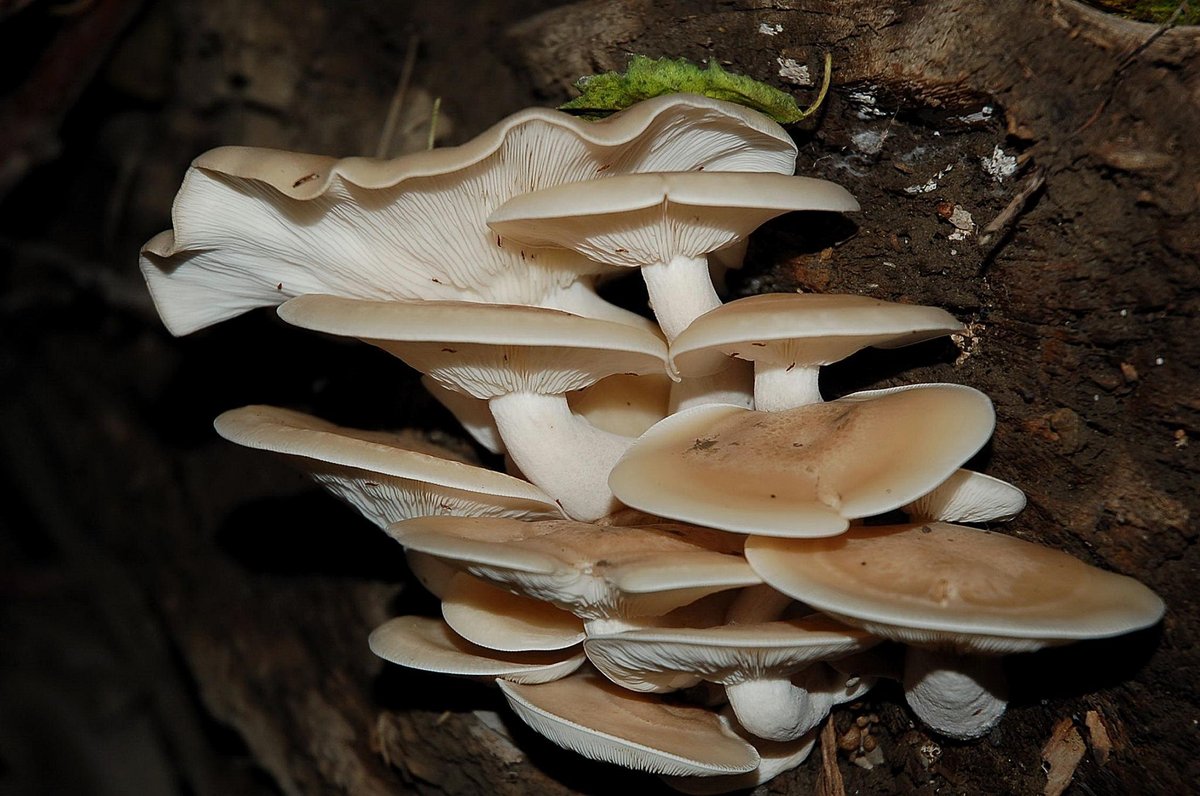
Fan- or oyster-shell-shaped caps growing in overlapping shelf-like clusters on dead hardwood.
The gills run down the short, off-center stem (decurrent) — a hallmark of the oyster family.
Cap color ranges from white to gray-brown; spore print is white to pale lilac.
🌿 Traditional uses & research
The world's most cultivated oyster mushroom and a global culinary staple. Studied for immune-supporting beta-glucans; oyster mushrooms naturally contain lovastatin, researched in relation to healthy cholesterol levels.
⚠️ Safety notes
Cook thoroughly and harvest young — the flesh turns tough and acrid with age. Growers note: heavy spore loads in enclosed grow spaces can sensitize airways over time, so ventilate well. As with any mushroom, allergies are possible.
In our grow: Pearl oyster — our culture fruits at 60–70°F and is in liquid culture now.
King oyster — one parent of the hybridOyster cluster — the hybrid's fruiting habit
Black Pearl King
Pleurotus ostreatus × P. eryngii (hybrid)
🌍 Native to: None — cultivated hybrid
🔍 How to identify
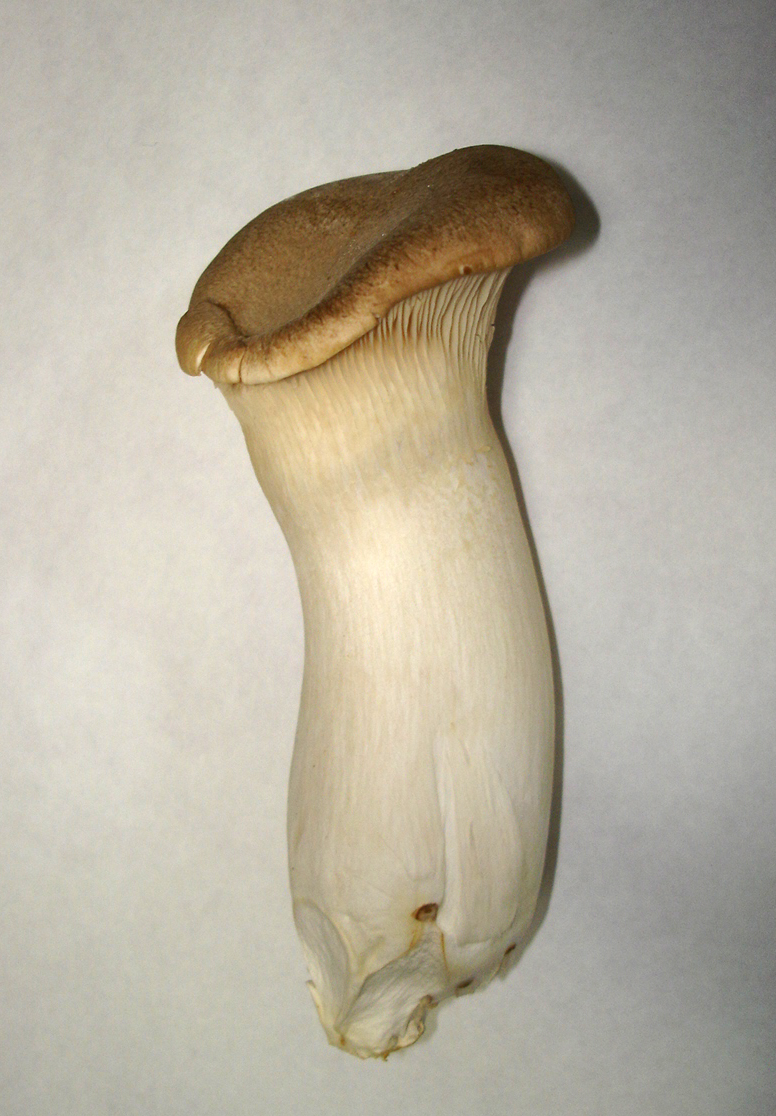
A cultivated hybrid, not a wild species: thick, meaty white stems like a king oyster topped with dark brown-black caps, fruiting in oyster-like clusters.
Dense, hearty texture — the best of both parents in a single mushroom. Photos show the parent species behind the cross.
Fruits in the cool range, like a classic oyster.
🌿 Traditional uses & research
A premium culinary mushroom — the thick stems sear and grill beautifully, making it a favorite for plant-based cooking and market tables.
⚠️ Safety notes
Treat like other oyster mushrooms: cook thoroughly and harvest before the caps flatten and toughen.
In our grow: Black Pearl King — our culture fruits at 50–65°F and is in liquid culture now.
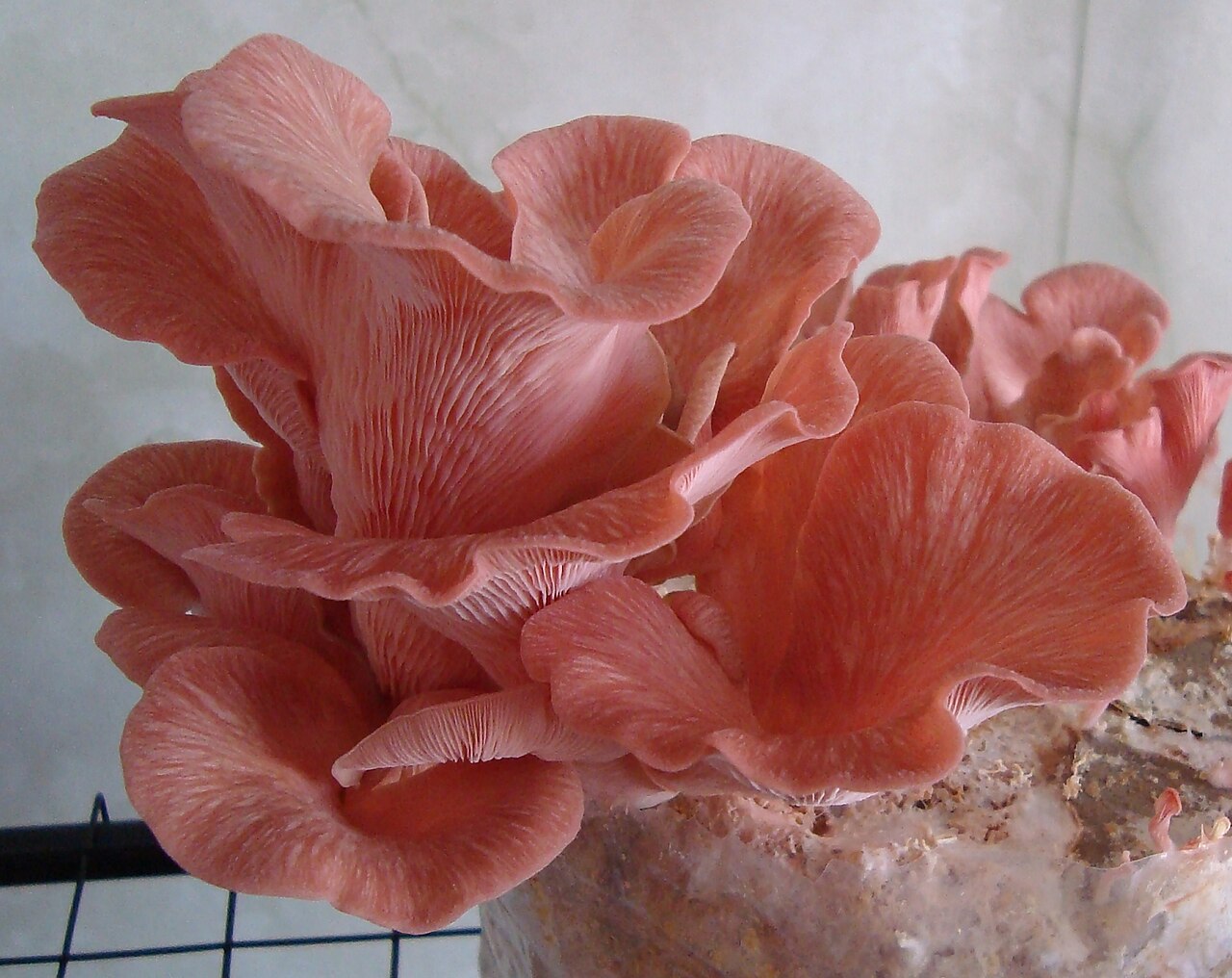
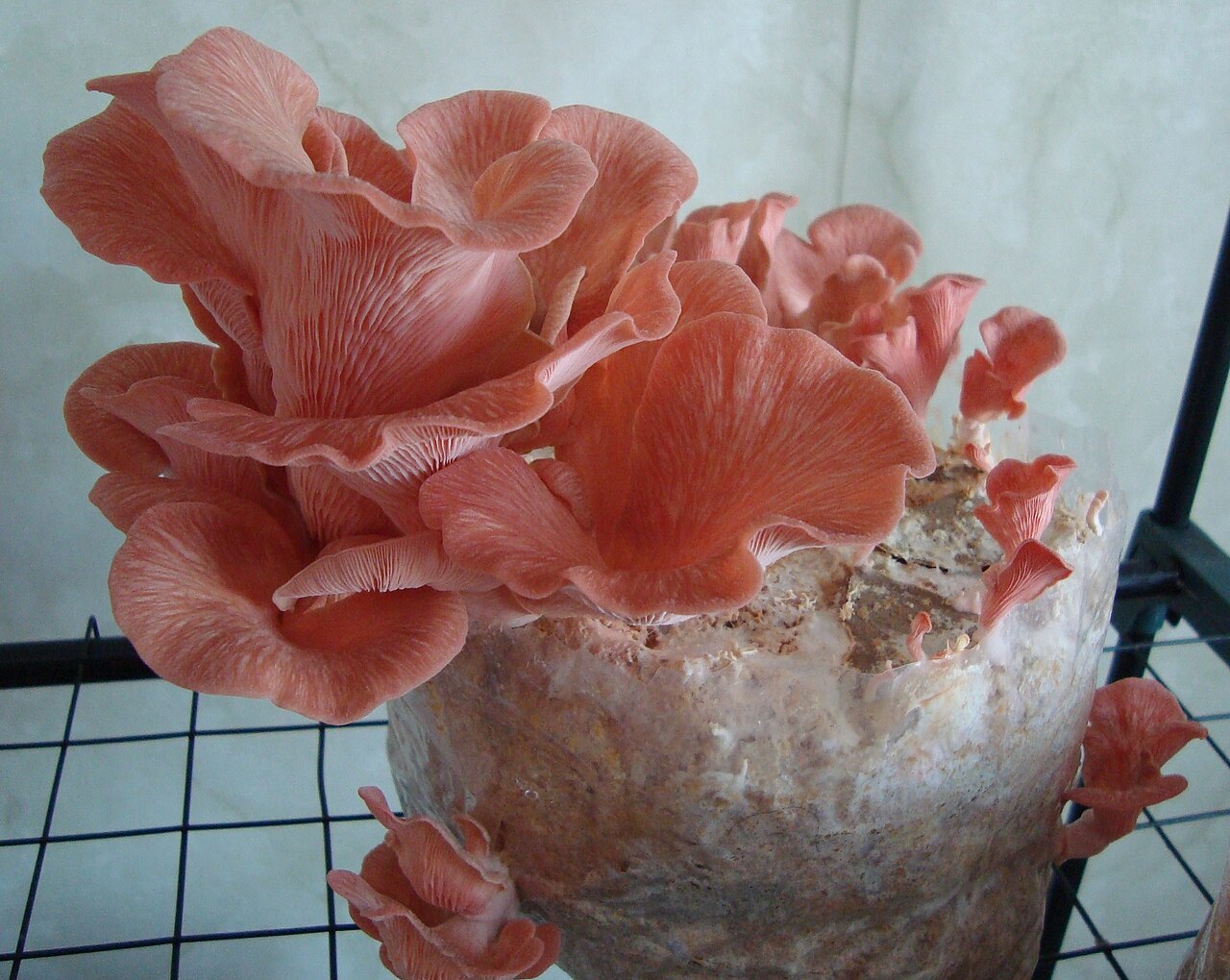
Unmistakable bright pink to salmon-pink fan-shaped caps in ruffled clusters — the showiest oyster by far.
The color fades toward tan as the mushroom ages; a tropical species that loves heat.
Decurrent gills like all oysters; fruits readily from straw and other farm substrates.
🌿 Traditional uses & research
A stunning market mushroom with a delicate texture, and one of the fastest oysters to colonize and fruit in warm conditions.
⚠️ Safety notes
Cook thoroughly. Pink oysters are fragile and spoil faster than other oysters — use within a day or two of harvest. The usual grow-space ventilation cautions apply.
In our grow: Pink oyster — our culture fruits at 70–95°F; banked in the fridge until warm weather.
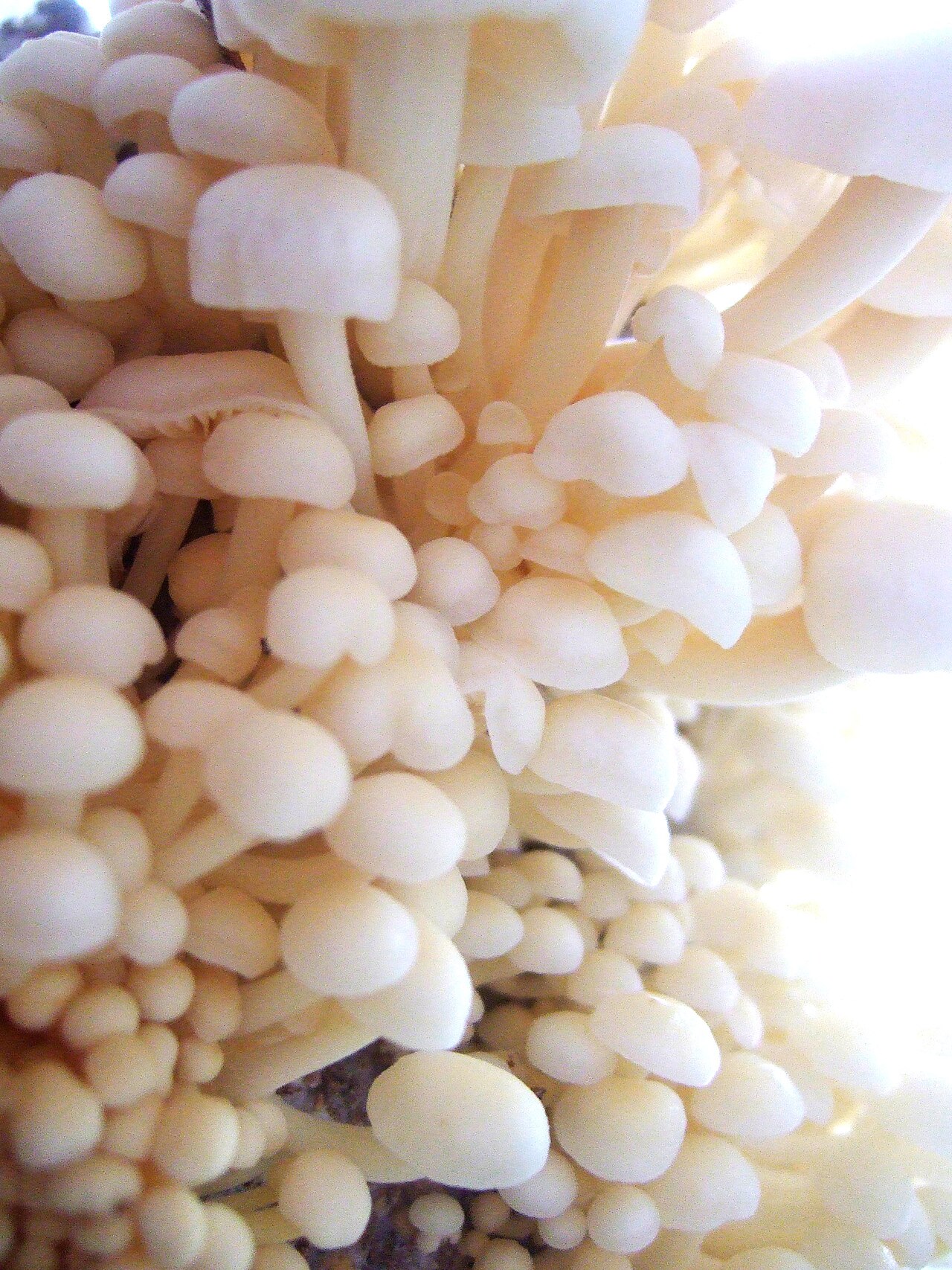
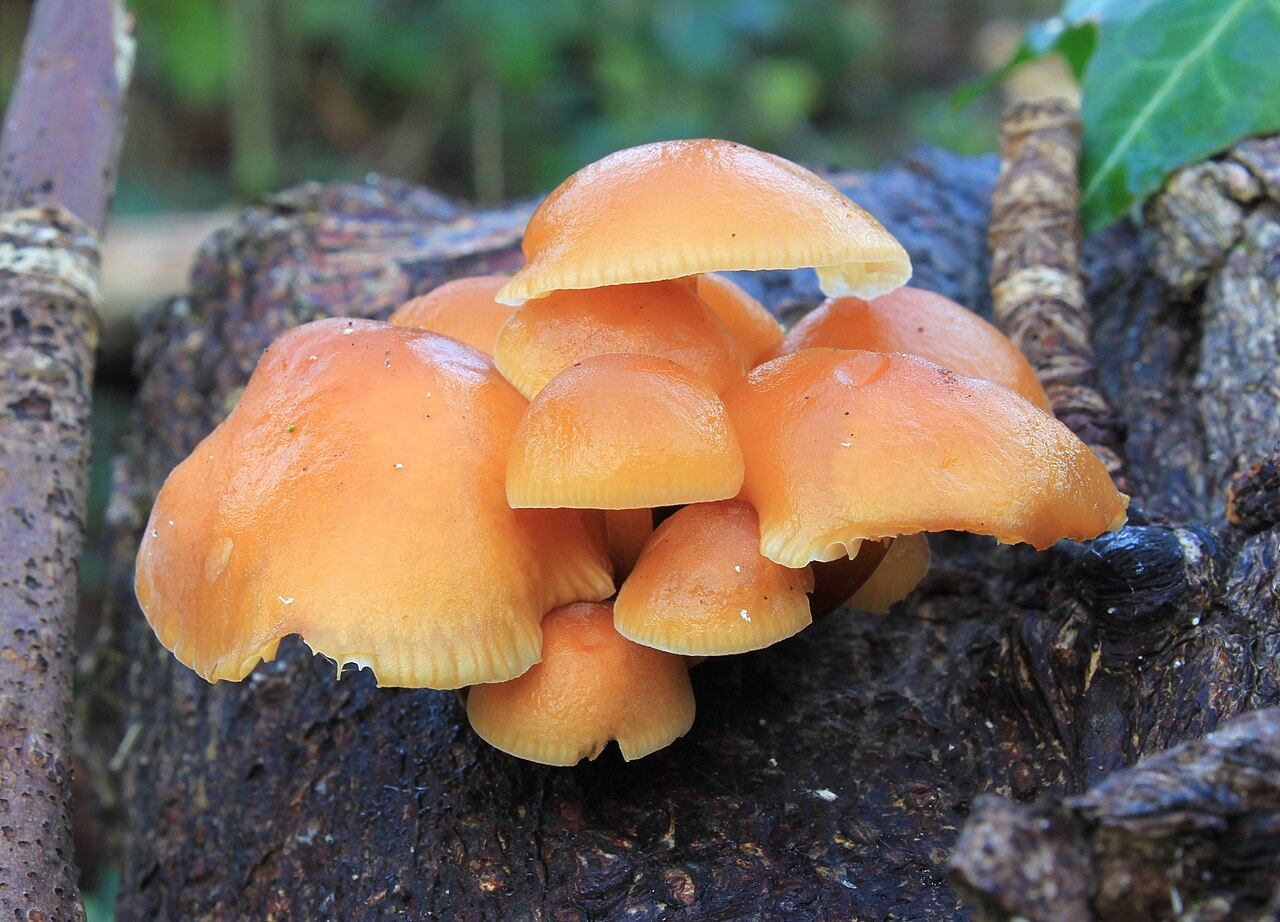
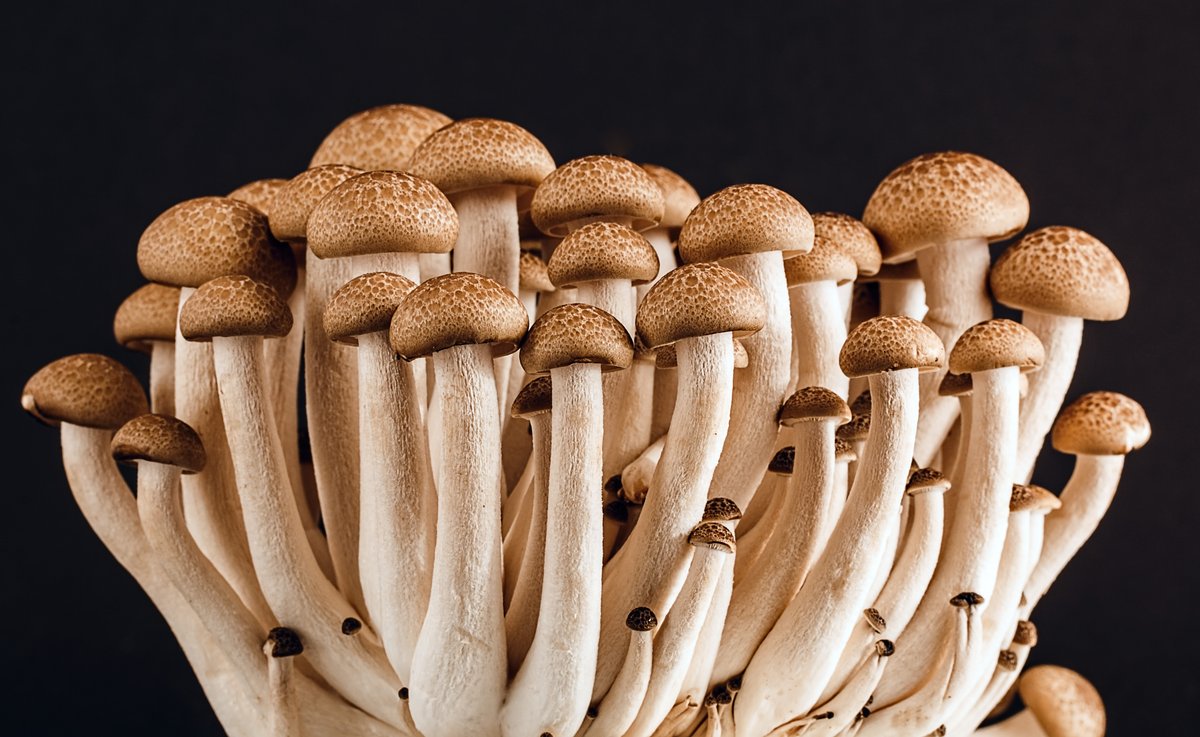
Two faces of one species: cultivated enoki is the familiar bundle of long white needle-like stems from the grocery store; wild enoki (velvet shank) is a small honey-brown winter mushroom with a velvety dark stem.
Wild enoki fruits in cold weather on dead hardwood — one of the few mushrooms that prefers winter.
White spore print. The cultivated form looks nothing like its wild self because it's grown in darkness without light.
🌿 Traditional uses & research
Beloved in Japanese and Korean cooking — hot pots, soups, salads — for its crisp texture and mild sweetness. Studied for immune-supporting polysaccharides including flammulin.
⚠️ Safety notes
Cook thoroughly. Wild enoki has a deadly lookalike, the Galerina marginata — small brown mushrooms on wood. The rule is absolute: never eat wild enoki unless an expert confirms it. Cultivated enoki from the store is the safe bet.
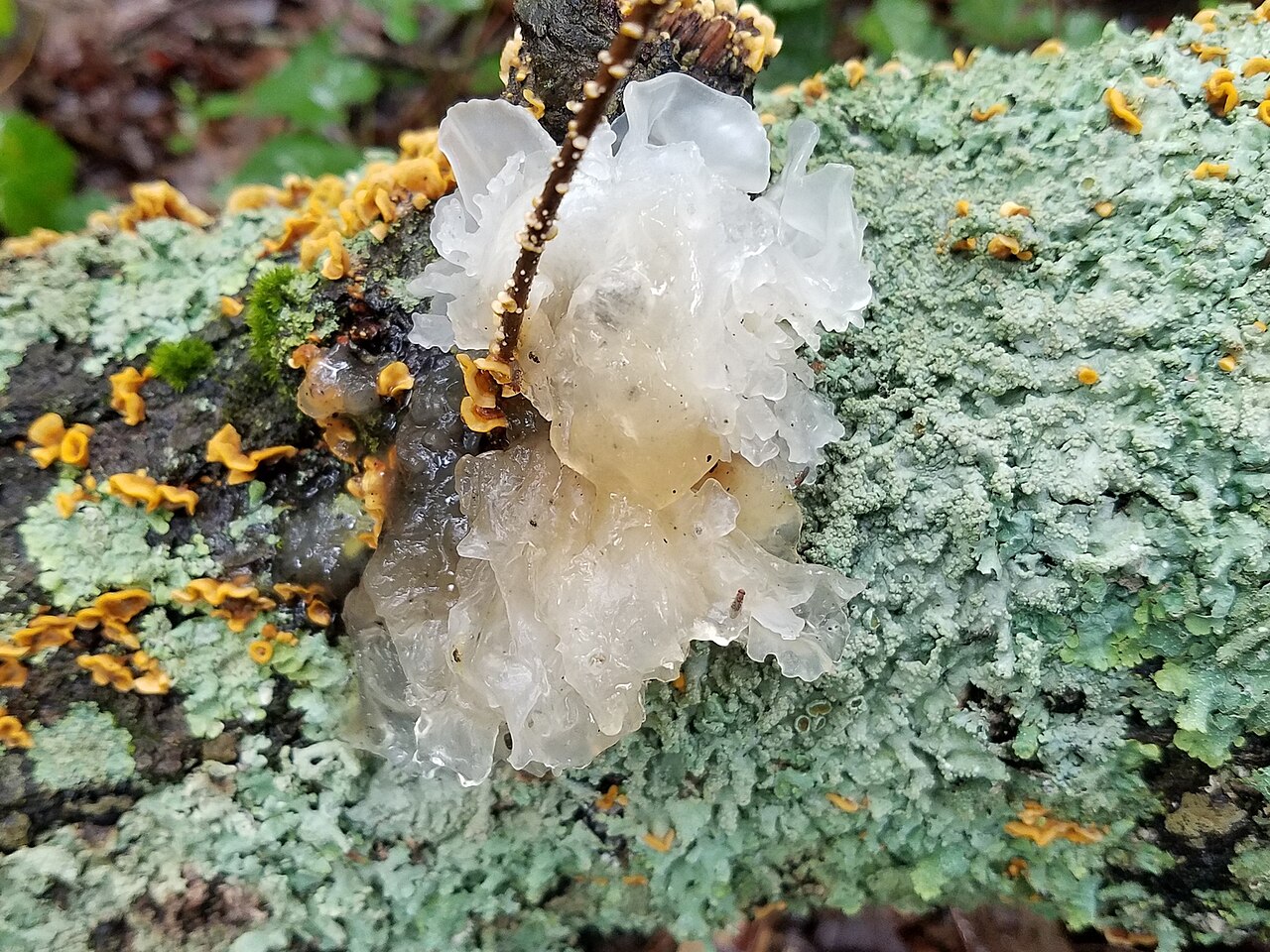
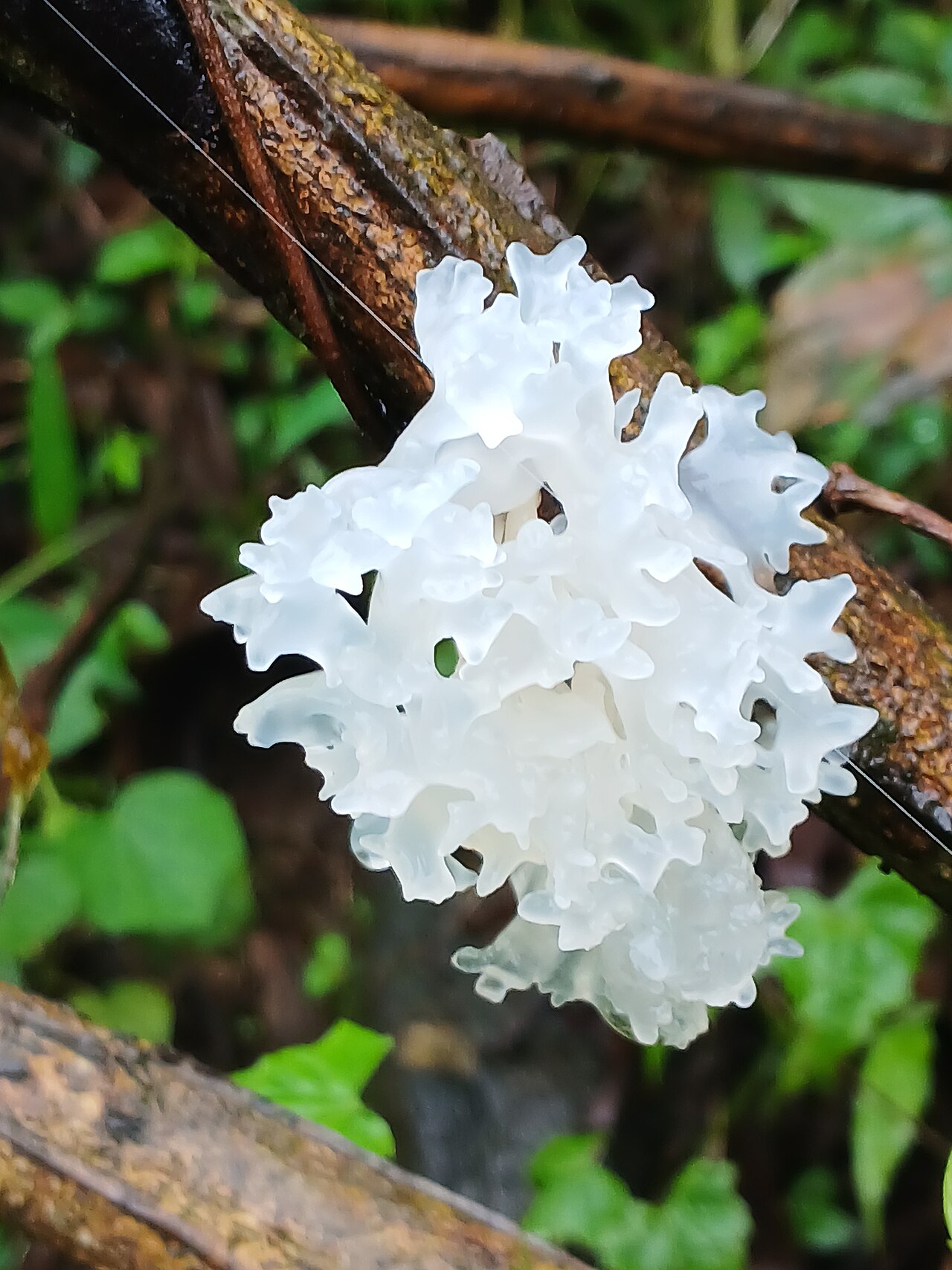
A translucent white jelly fungus with ruffled, brain-like folds — like a small white chrysanthemum made of gelatin.
Grows on dead hardwood, technically as a parasite on other fungi; dries to a crisp and rehydrates beautifully.
Turns yellowish with age; the prized specimens are snow-white.
🌿 Traditional uses & research
A classic of Chinese sweet soups and desserts, and a darling of the beauty world: its polysaccharides can hold many times their weight in water, and it's studied for skin-hydration and immune support.
⚠️ Safety notes
Generally safe as food. Rinse well — the jelly folds trap bark and debris. As with any mushroom, allergies are possible.
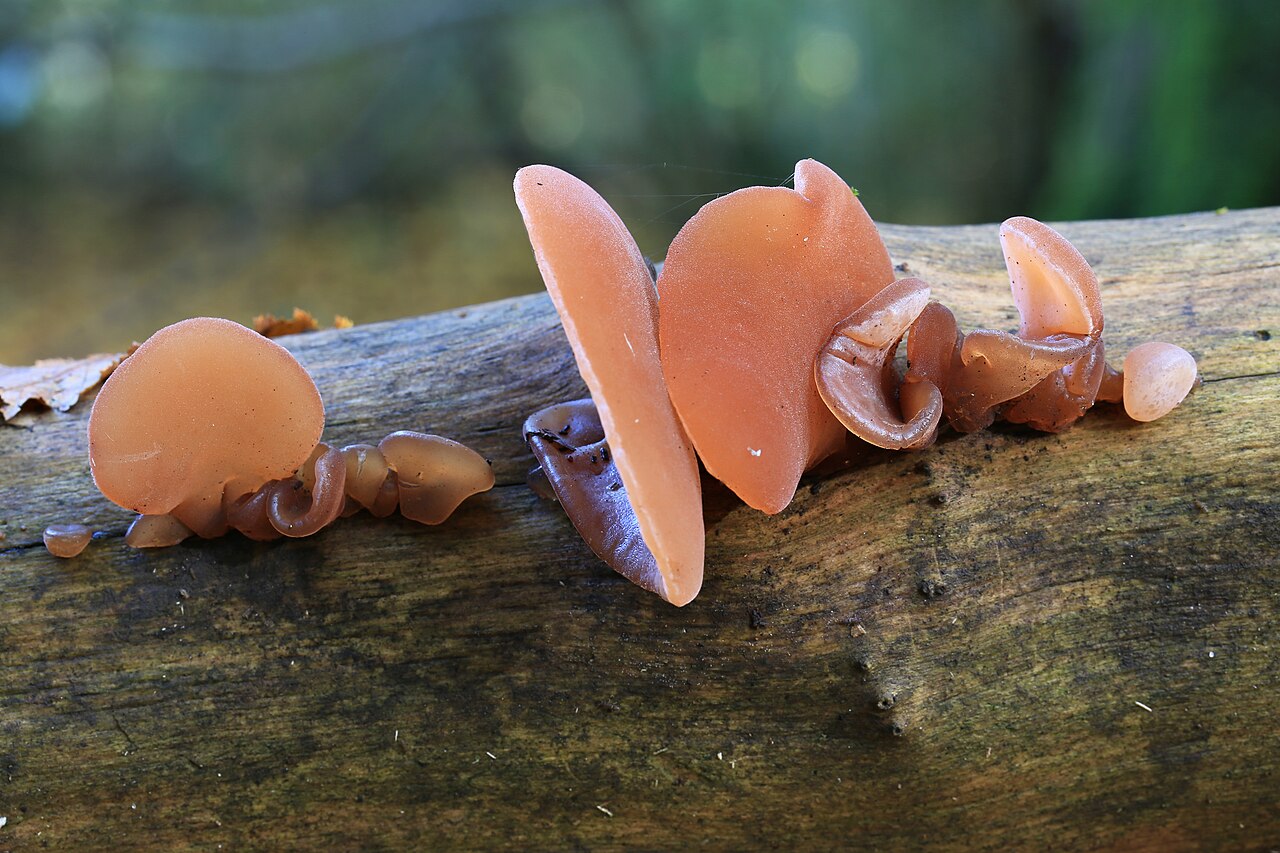
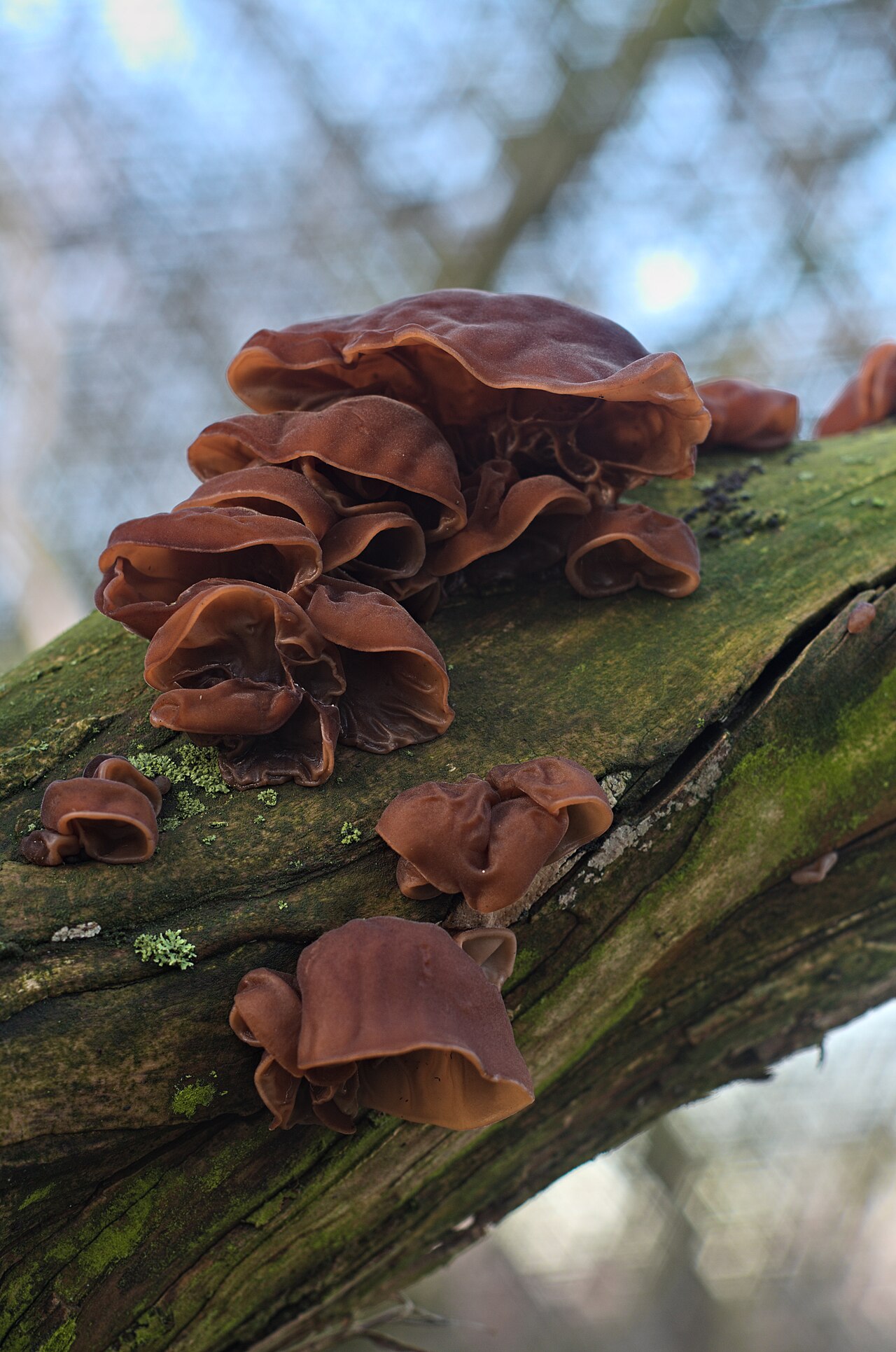
Rubbery, ear-shaped jelly fungus growing on dead wood — brown, translucent, and unmistakable once you've seen it.
Texture is the giveaway: firm jelly that snaps back when bent, unlike any gilled mushroom.
Common on elder and other hardwoods; one of the most eaten wild mushrooms in the world.
🌿 Traditional uses & research
A staple of Chinese cooking — hot and sour soup wouldn't be itself without it — valued for its crunchy-chewy texture. Studied for compounds researched in relation to healthy circulation; rich in fiber and iron.
⚠️ Safety notes
Cook thoroughly and clean well. Few dangerous lookalikes, but confirm every wild identification with an expert as always.
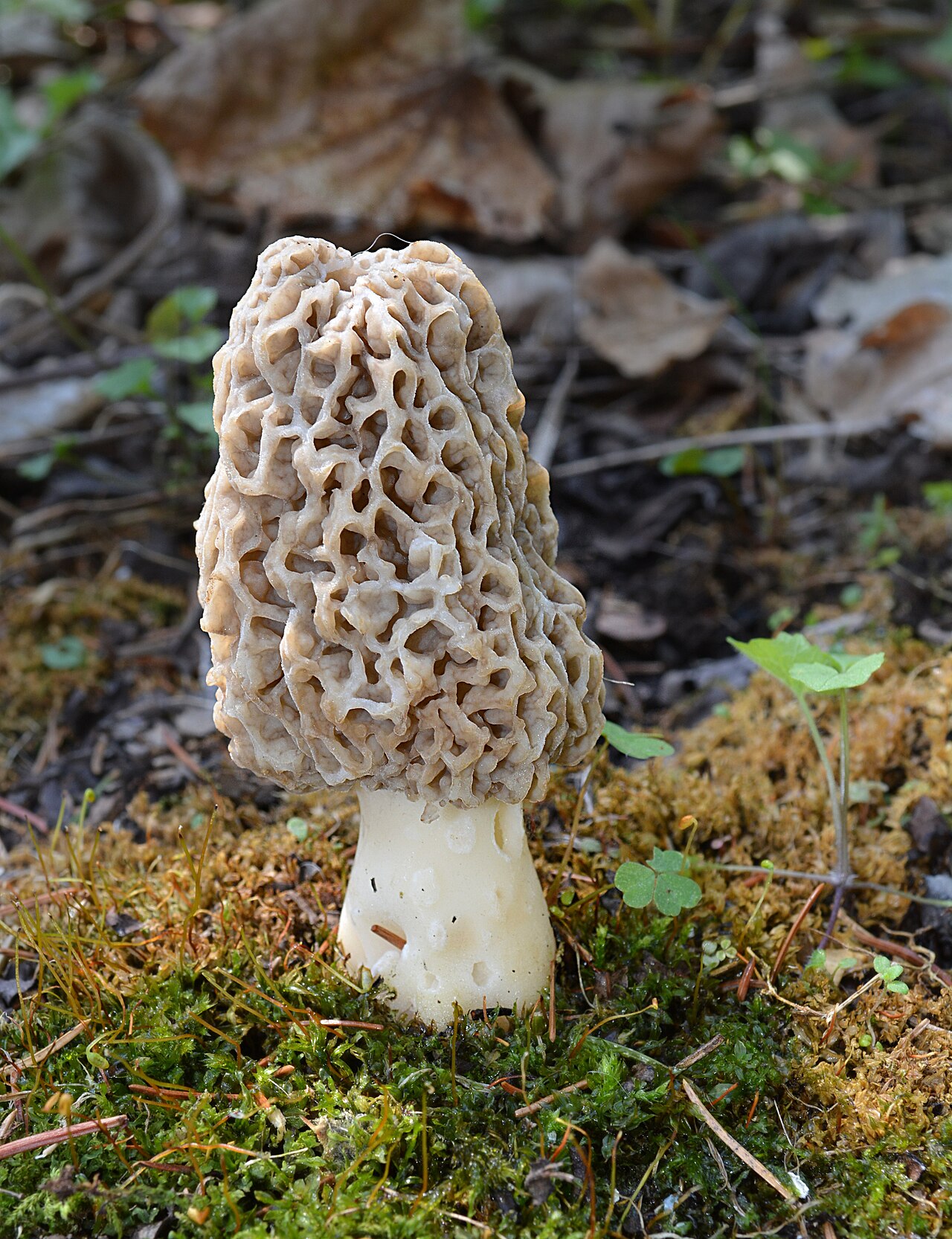
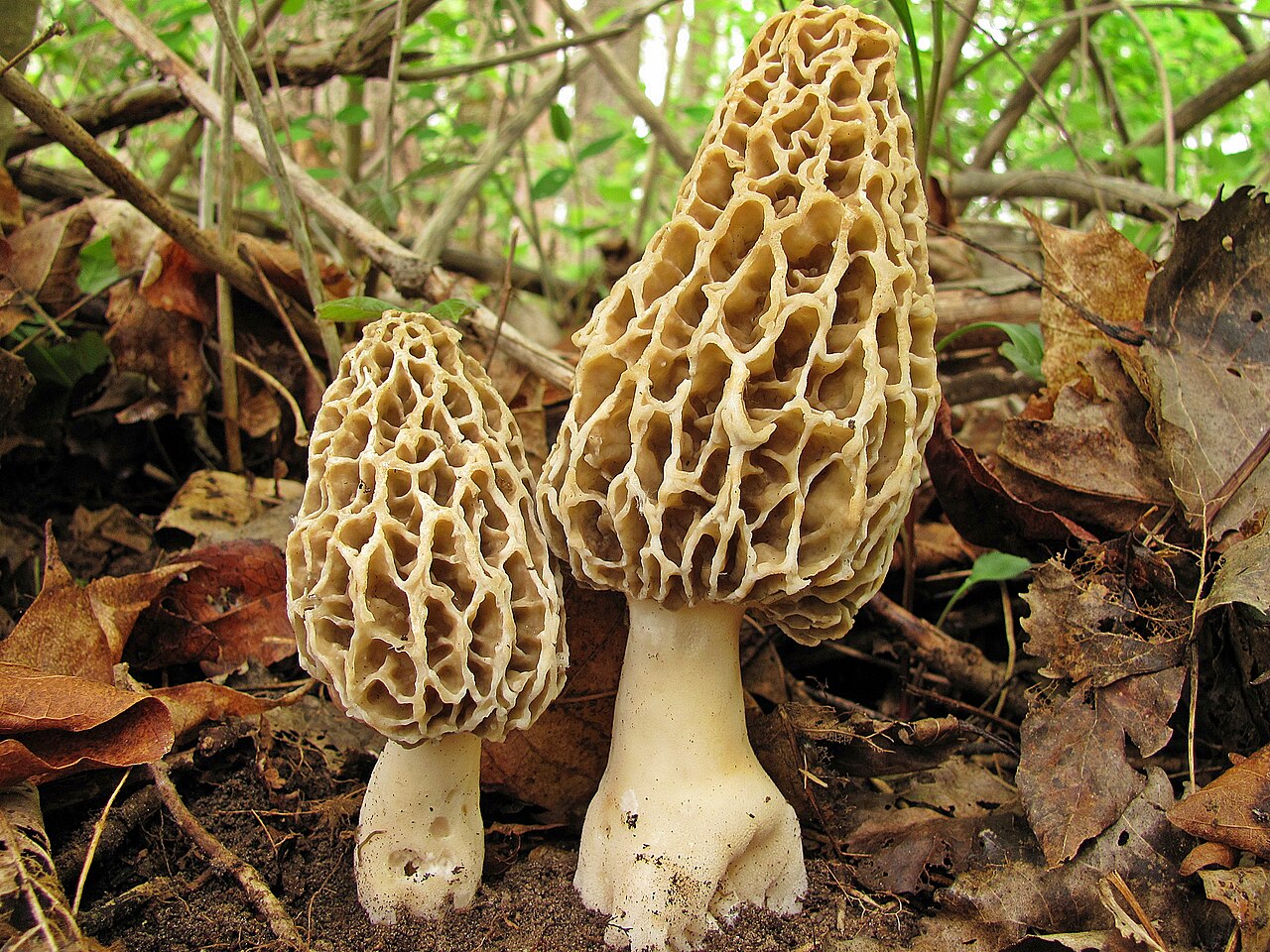
The honeycomb cap is the giveaway: tan-to-brown pitted ridges like a sponge, attached to a pale stem.
Slice it top to bottom — a true morel is completely hollow, one continuous cavity from cap tip to stem base.
Spring fruiter. Watch burn scars in California: morels fruit heavily the first spring after wildfires.
🌿 Traditional uses & research
One of the most prized wild edibles on earth, eaten across the Northern Hemisphere for centuries. Studied for antioxidants and vitamin D content; almost impossible to cultivate reliably at scale, which is why wild harvest season is an event.
⚠️ Safety notes
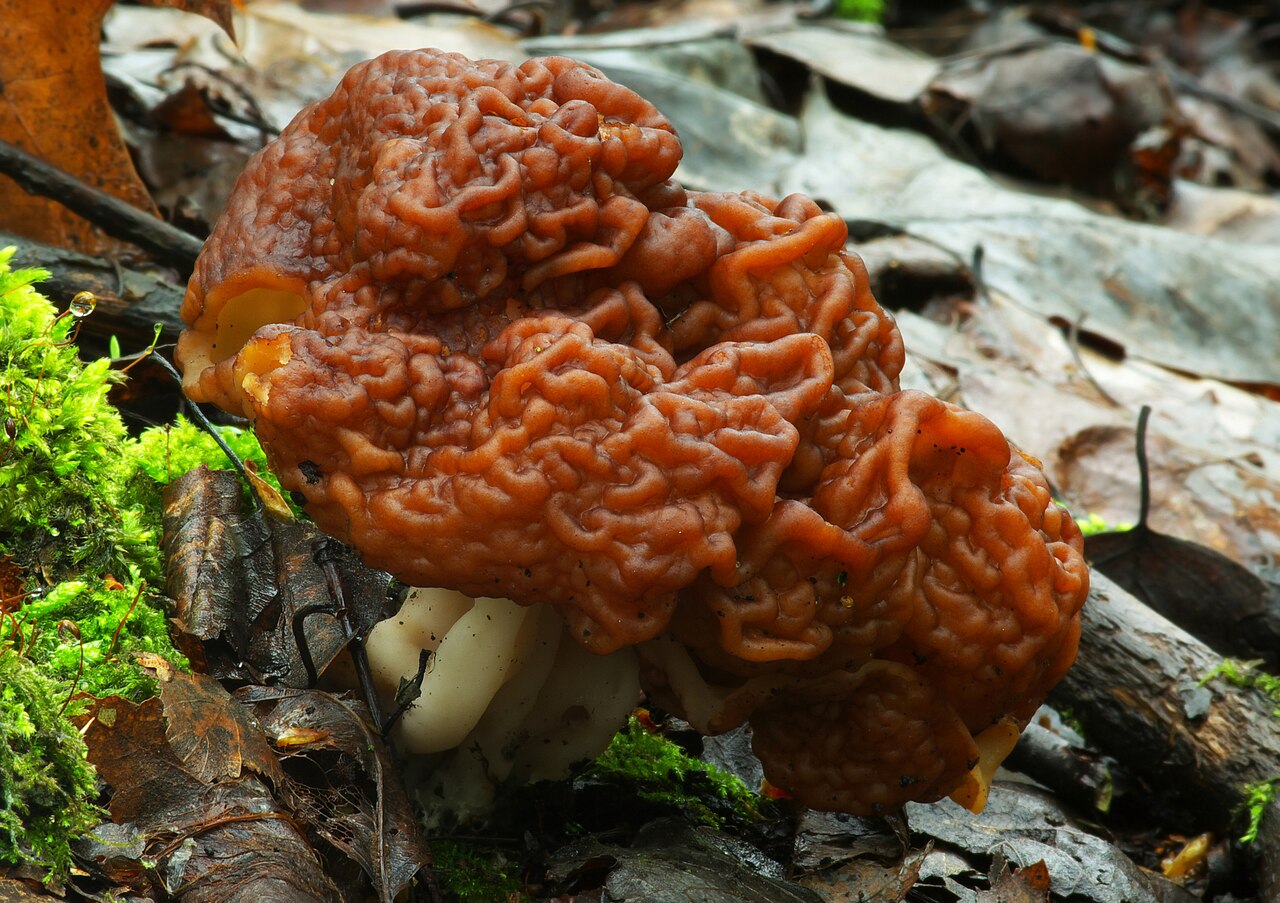
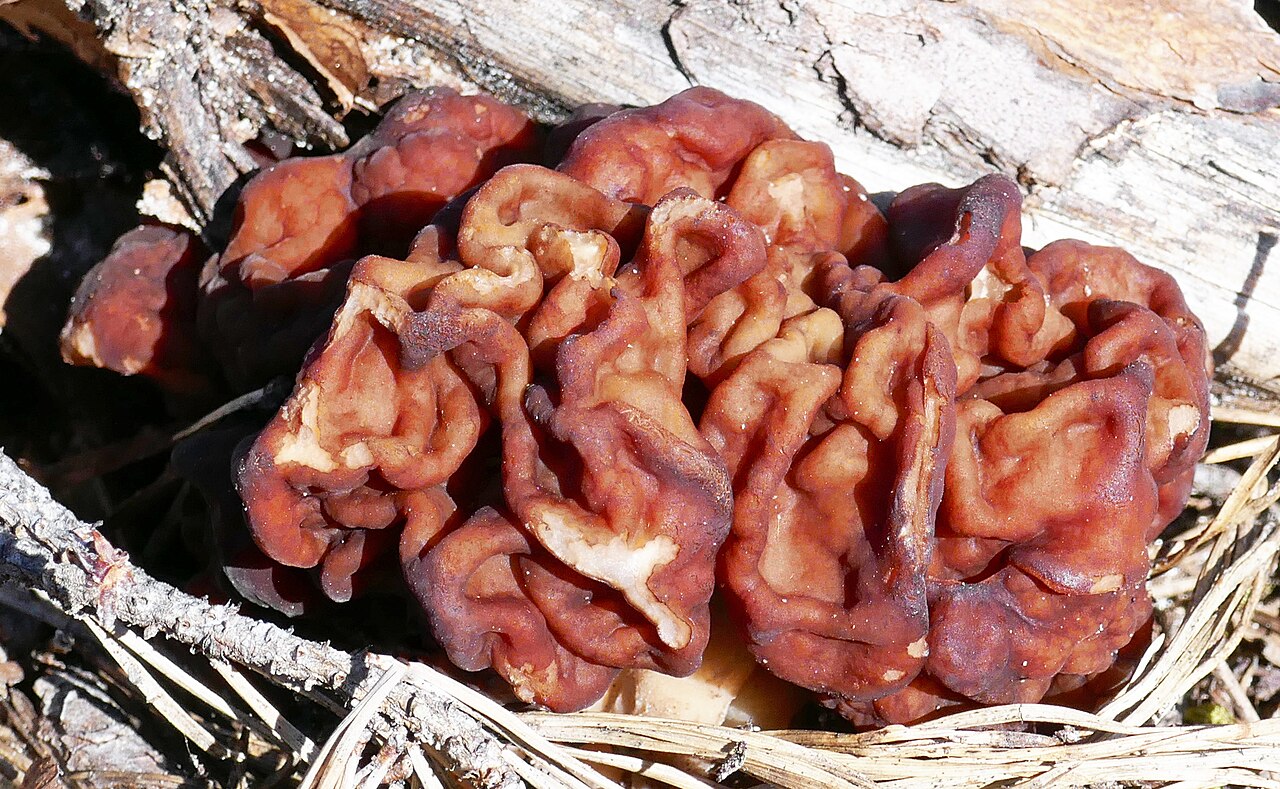
Never eat morels raw — cooking breaks down the hydrazinic compounds that can make you sick. The hollow test is life-or-death: false morels (Gyromitra) look brain-wrinkled and are stuffed or chambered inside, never hollow — they can be lethal. If it's not hollow, it's not a morel.
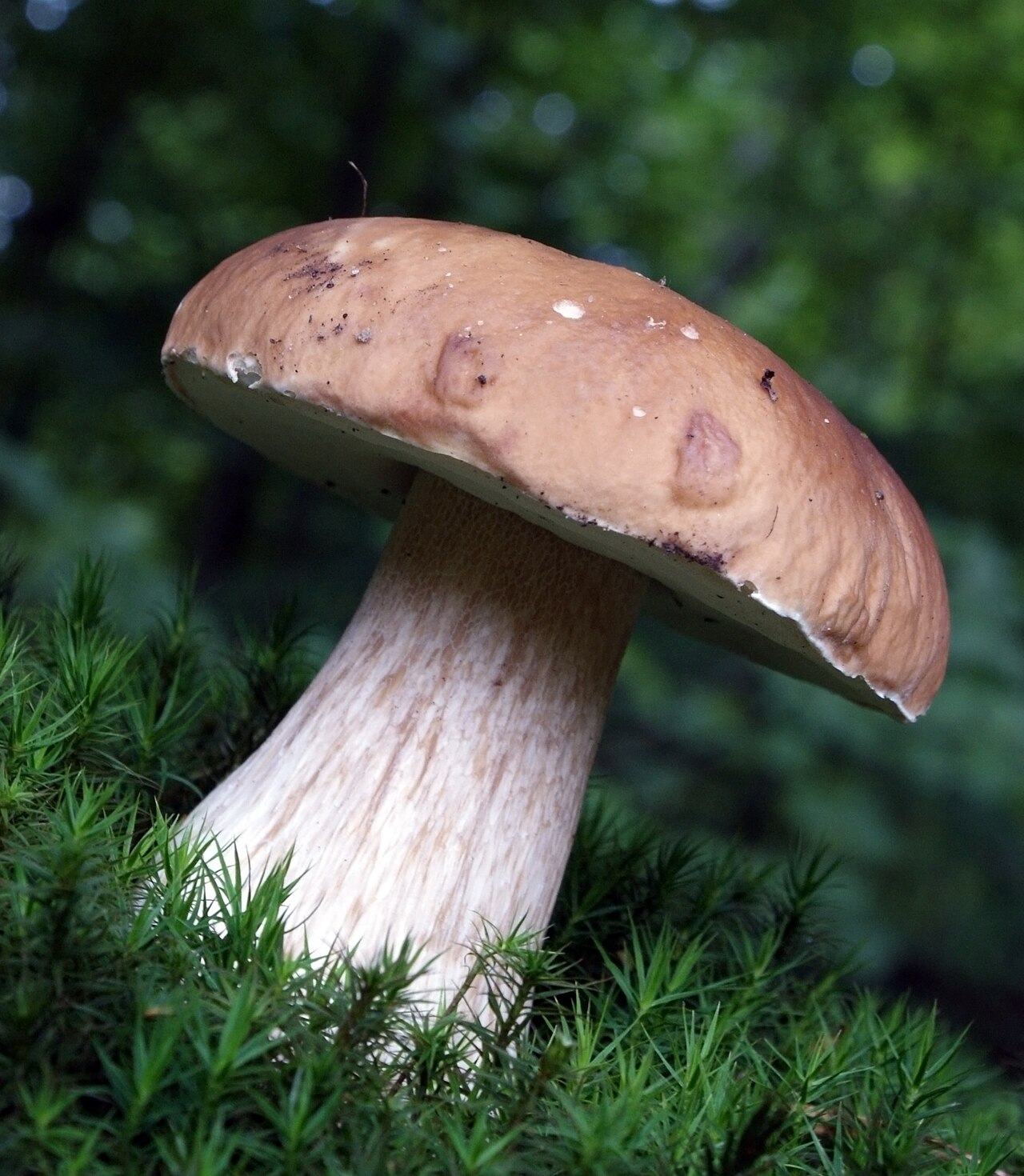
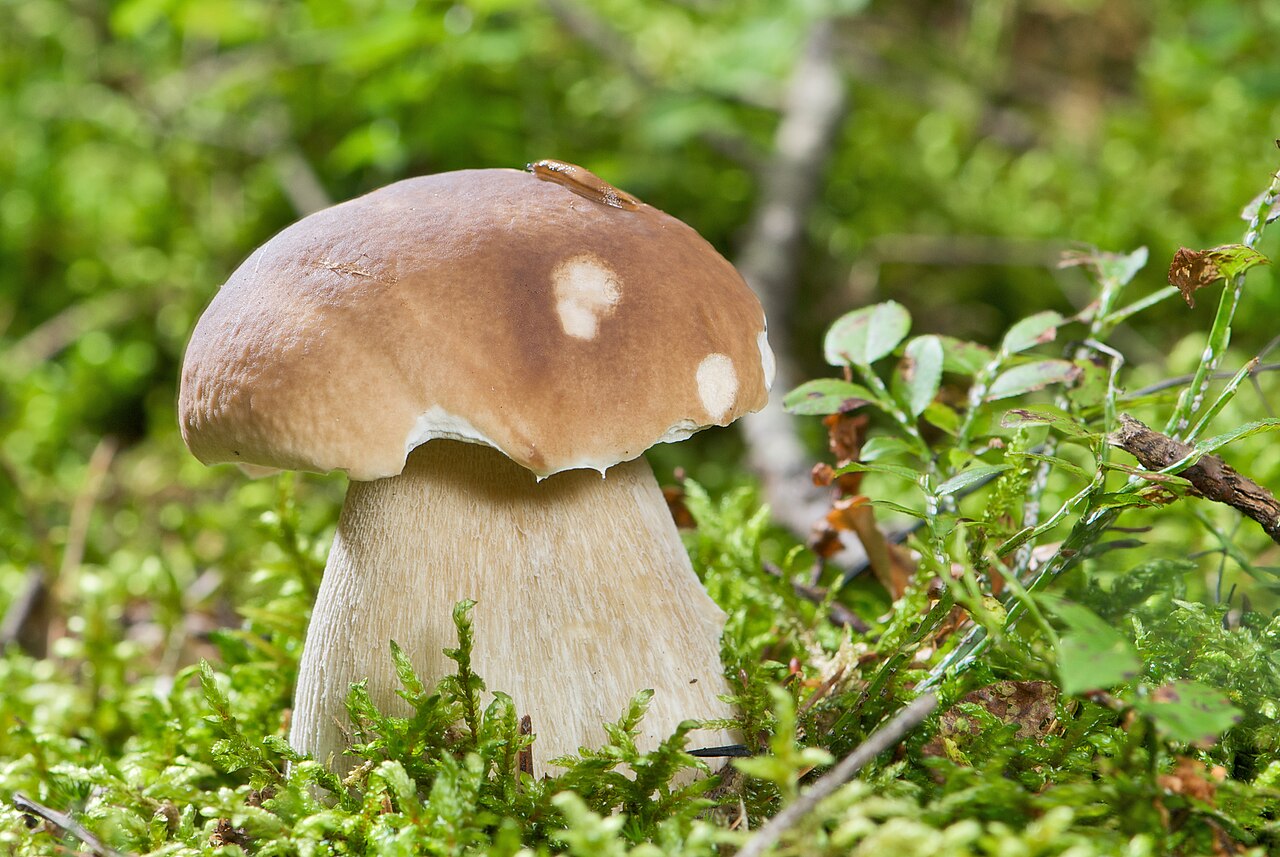
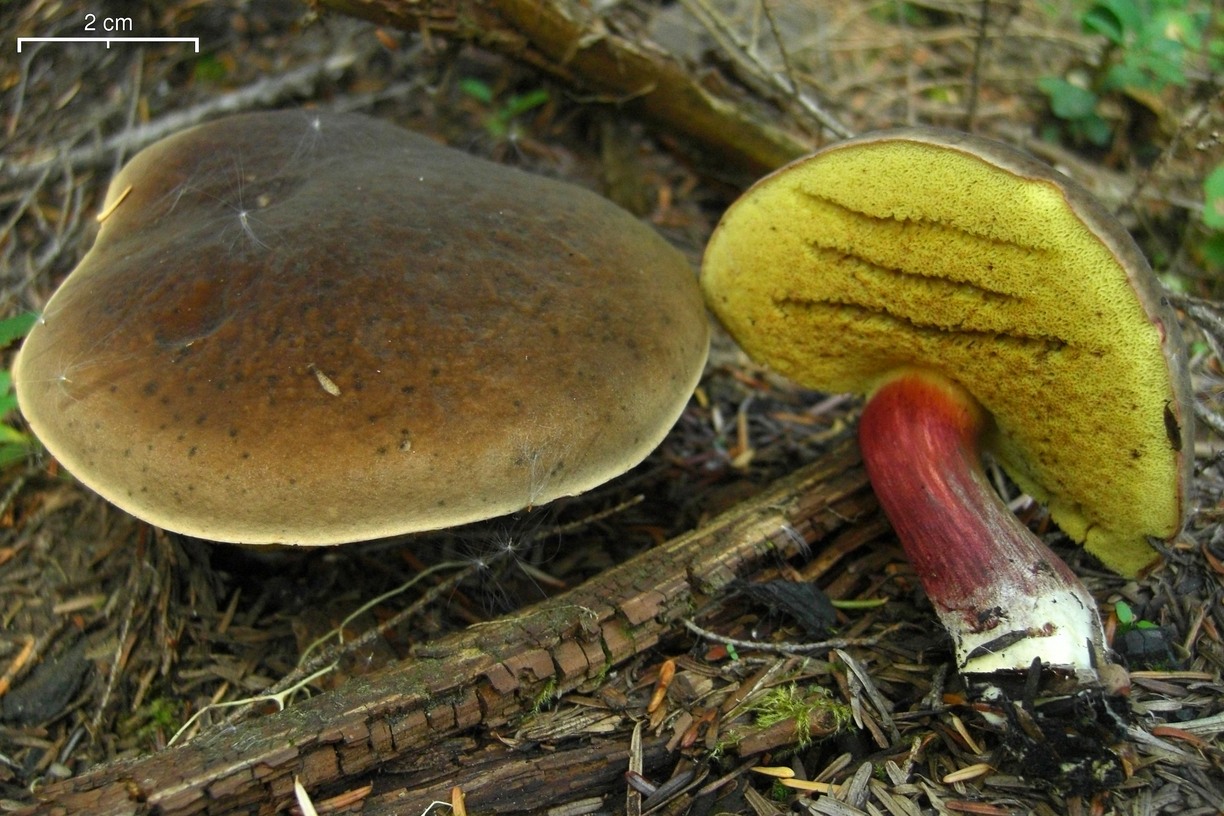
A bolete: brown bun-like cap with white sponge-like pores underneath instead of gills, on a thick pale stem.
Look for fine white netting (reticulation) on the upper stem — the king bolete's signature mark.
Flesh stays white and never stains blue when cut. Fruits late summer into fall under conifers and oaks.
🌿 Traditional uses & research
The king of boletes and a pillar of European cooking — risottos, sauces, and dried porcini, which concentrates its nutty, meaty flavor. Studied for ergothioneine and antioxidant compounds; one of the few wild mushrooms traded as a global commodity.
⚠️ Safety notes
The main lookalike is the bitter bolete (Tylopilus felleus): pink pores, dark brown netting, and — the tell — a tiny nibble tastes intensely bitter (spit it out). Blue-staining boletes are a red flag for beginners. Confirm every identification with an expert.
Stacked shelves on a trunkClose-up of fresh shelves
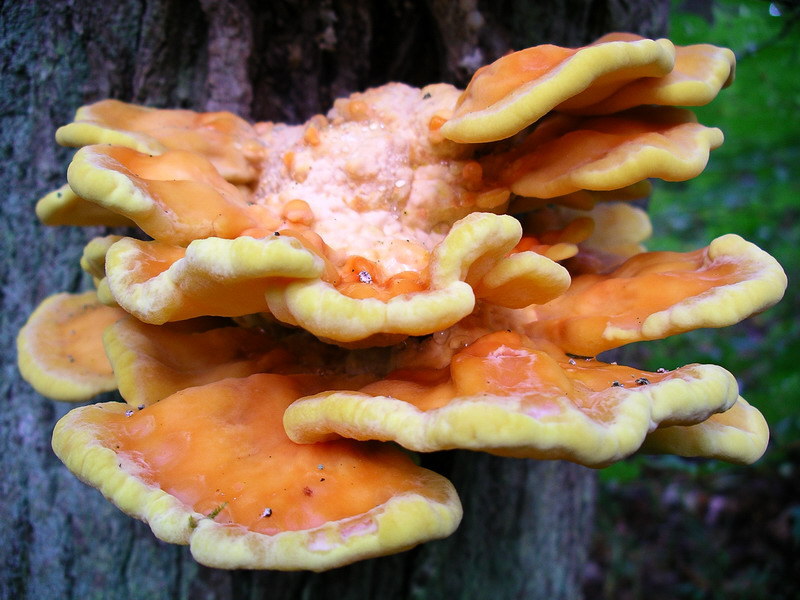
Chicken of the Woods
Laetiporus sulphureus
🌍 Native to: Europe and North America
🔍 How to identify
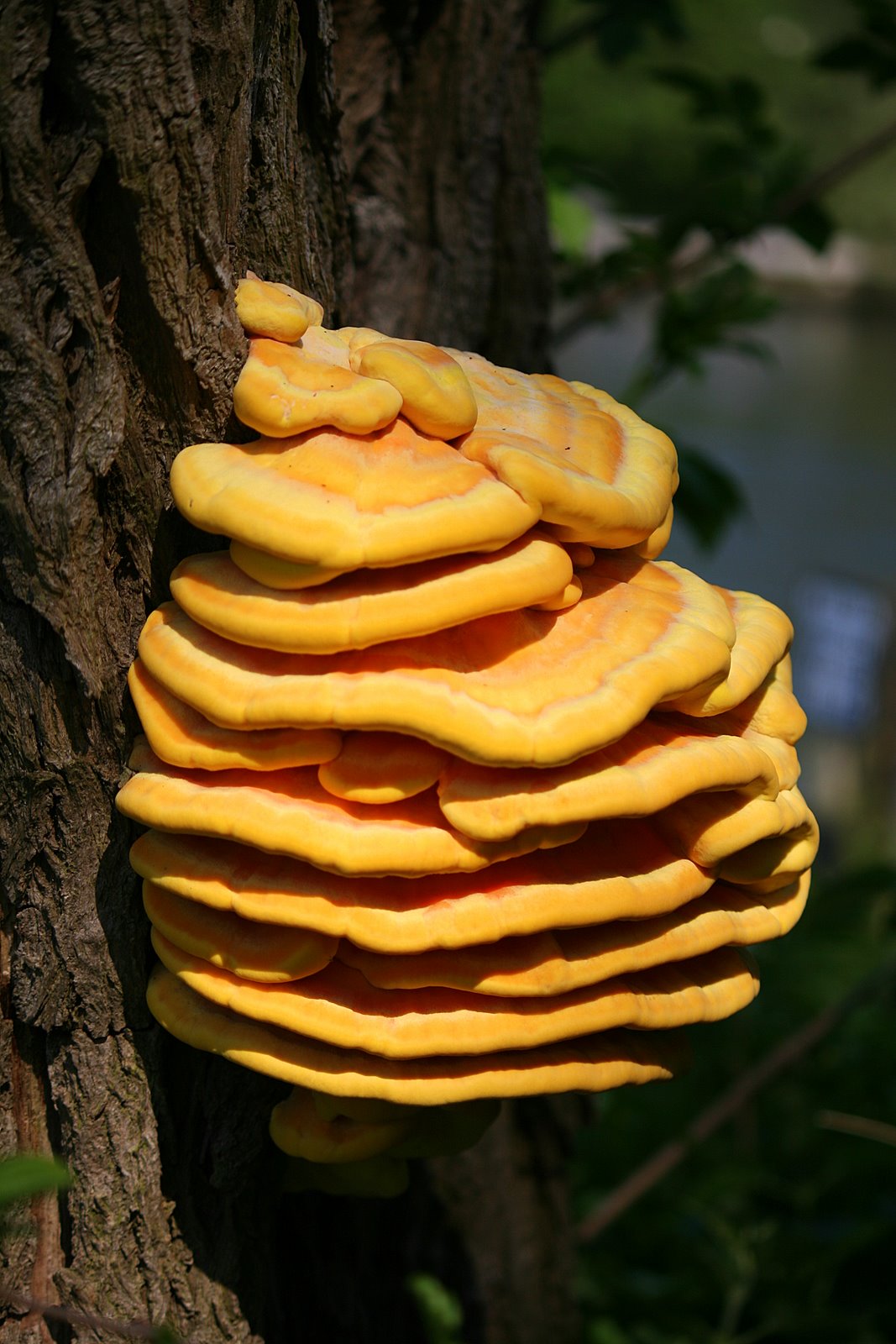
Brilliant orange-yellow overlapping shelf brackets growing straight out of wood — no stem, no gills, unmistakable.
The underside is yellowish pore surface. Young margins are soft and meaty; old shelves turn chalky, pale, and tough.
Fruits from late spring through fall on oaks and other hardwoods. Eat only the young, tender outer edges.
🌿 Traditional uses & research
A favorite meat substitute with an uncanny chicken-like texture when young and well cooked. Studied for antimicrobial compounds and lanostane-type triterpenes researched for various bioactivities. A true beginner-friendly find — few things look like it.
⚠️ Safety notes
Avoid specimens growing on conifers, yew, or black locust — some foragers react to those. Cook thoroughly, and eat only a small portion the first time: a minority of people react even to hardwood specimens. Never eat old, pale, chalky shelves.
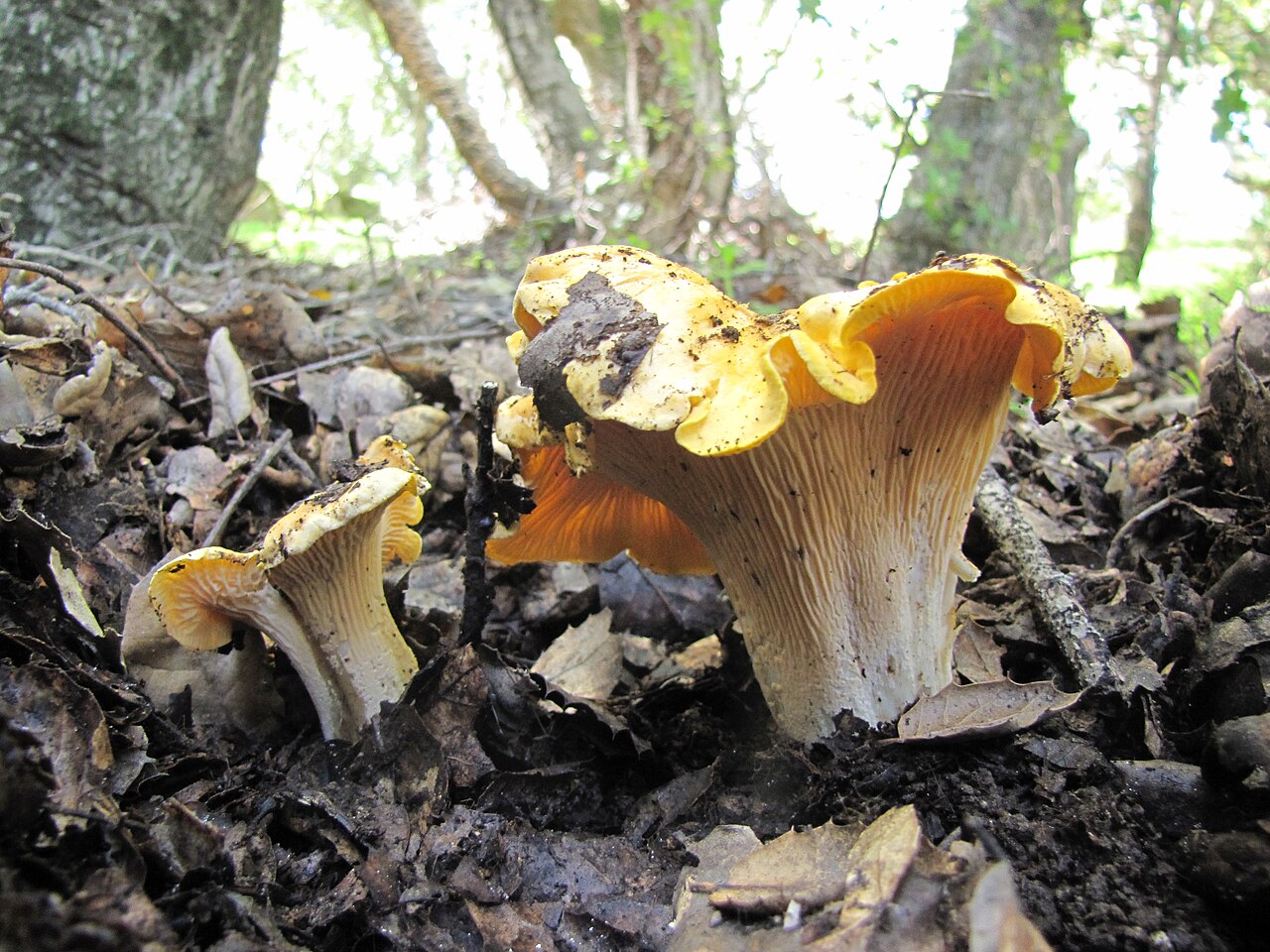
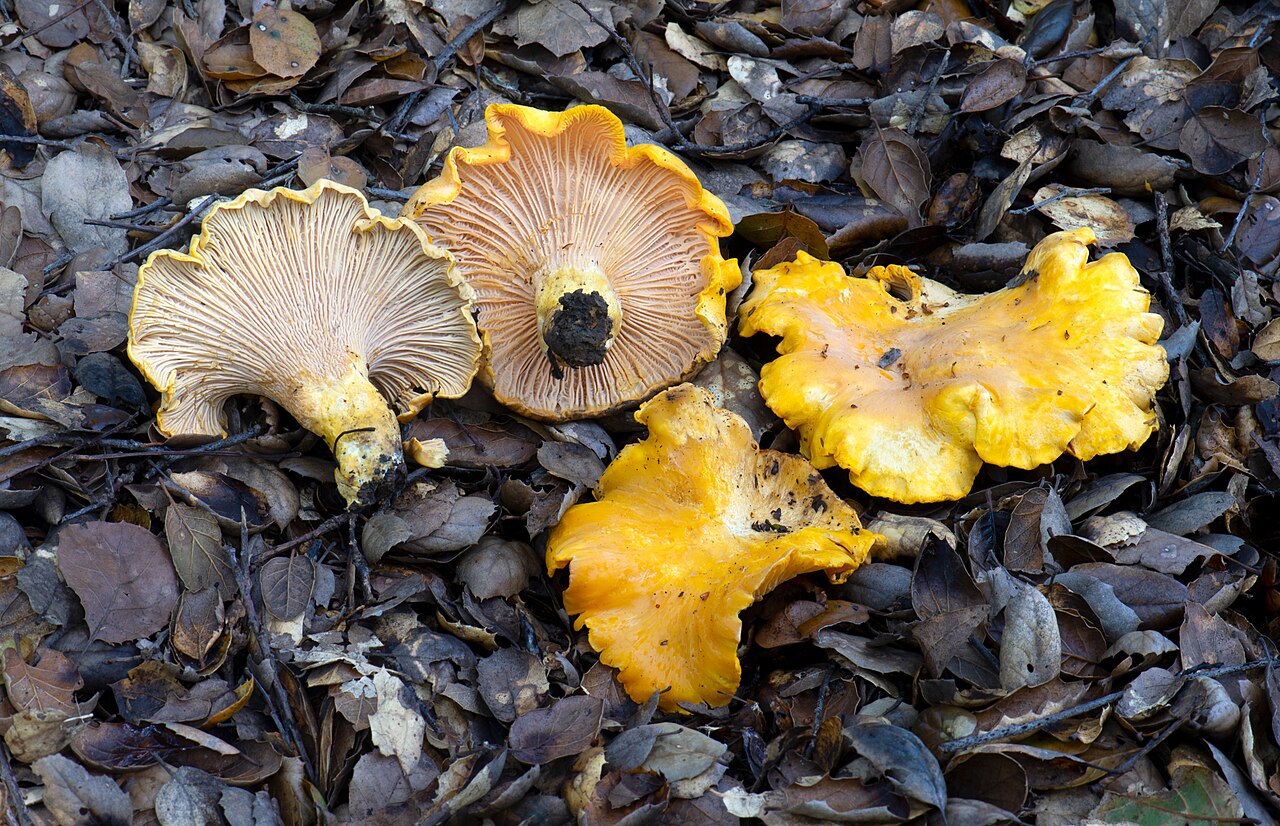
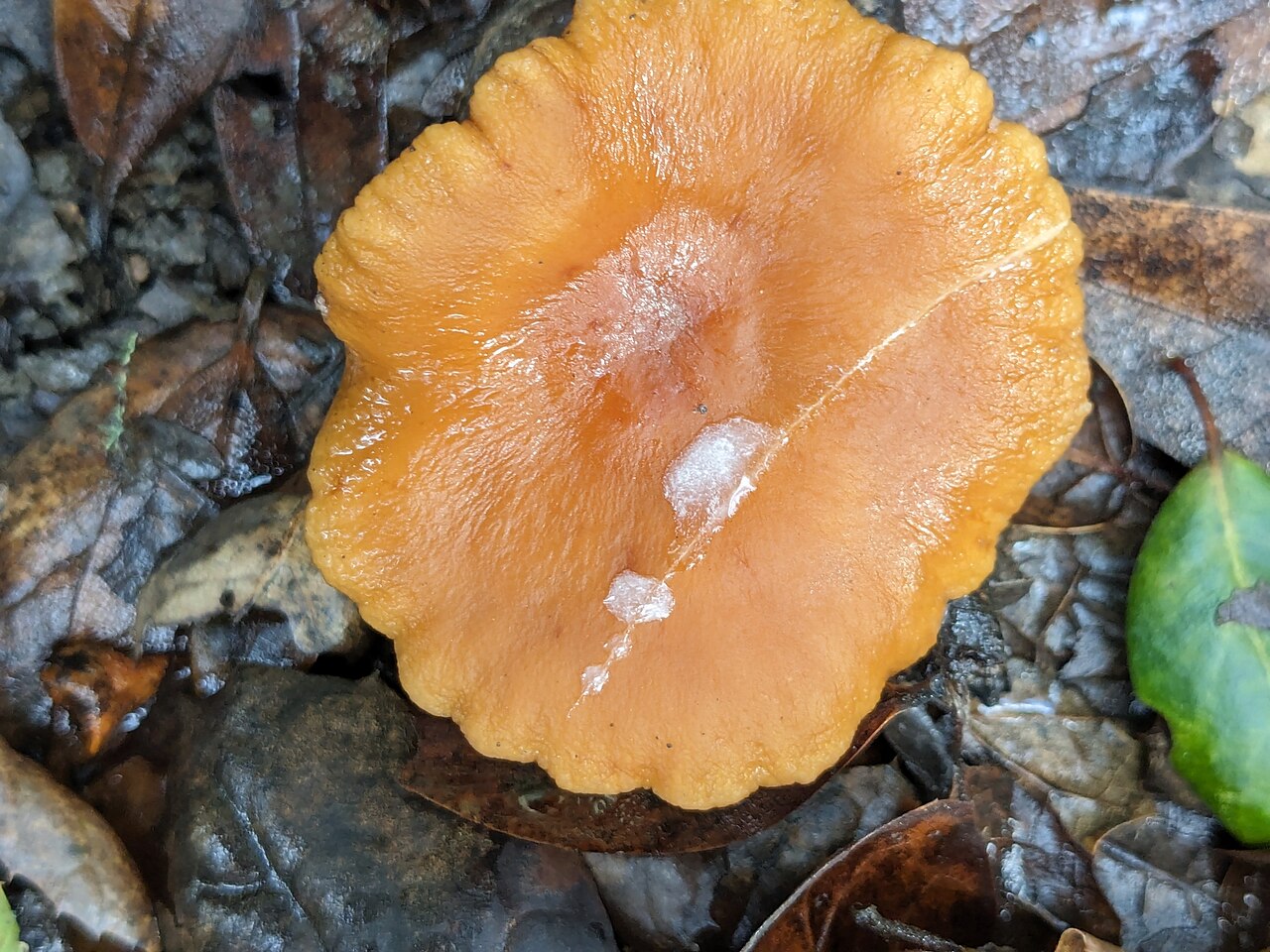
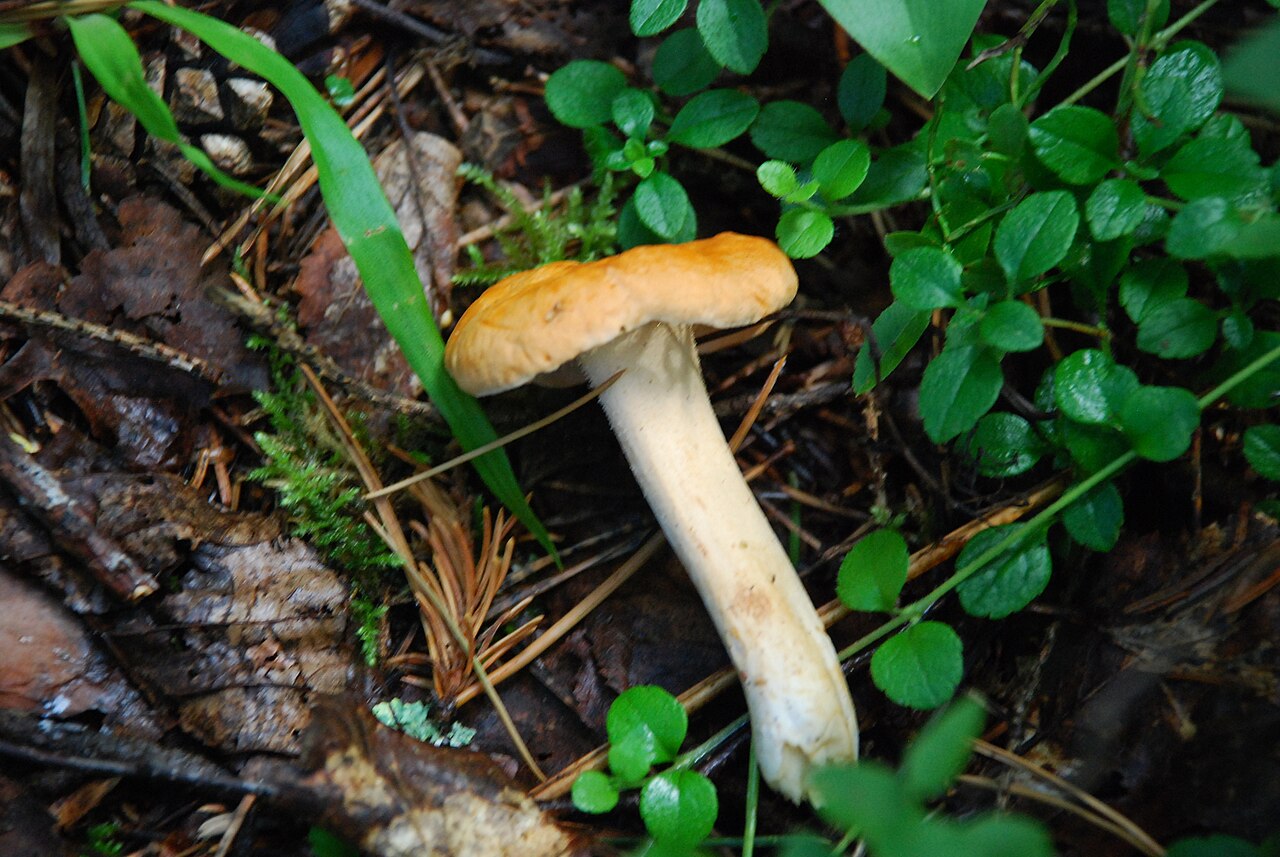
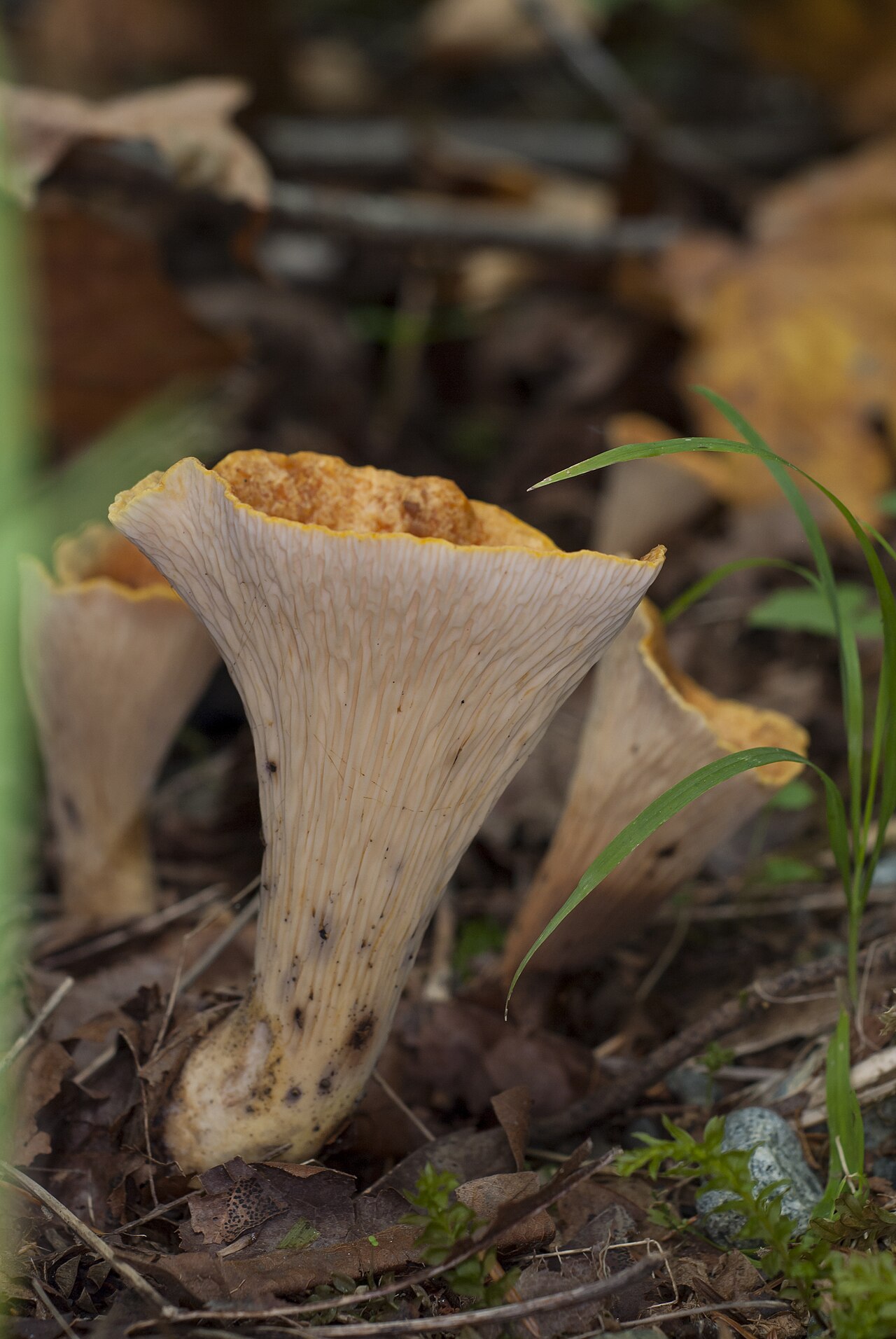
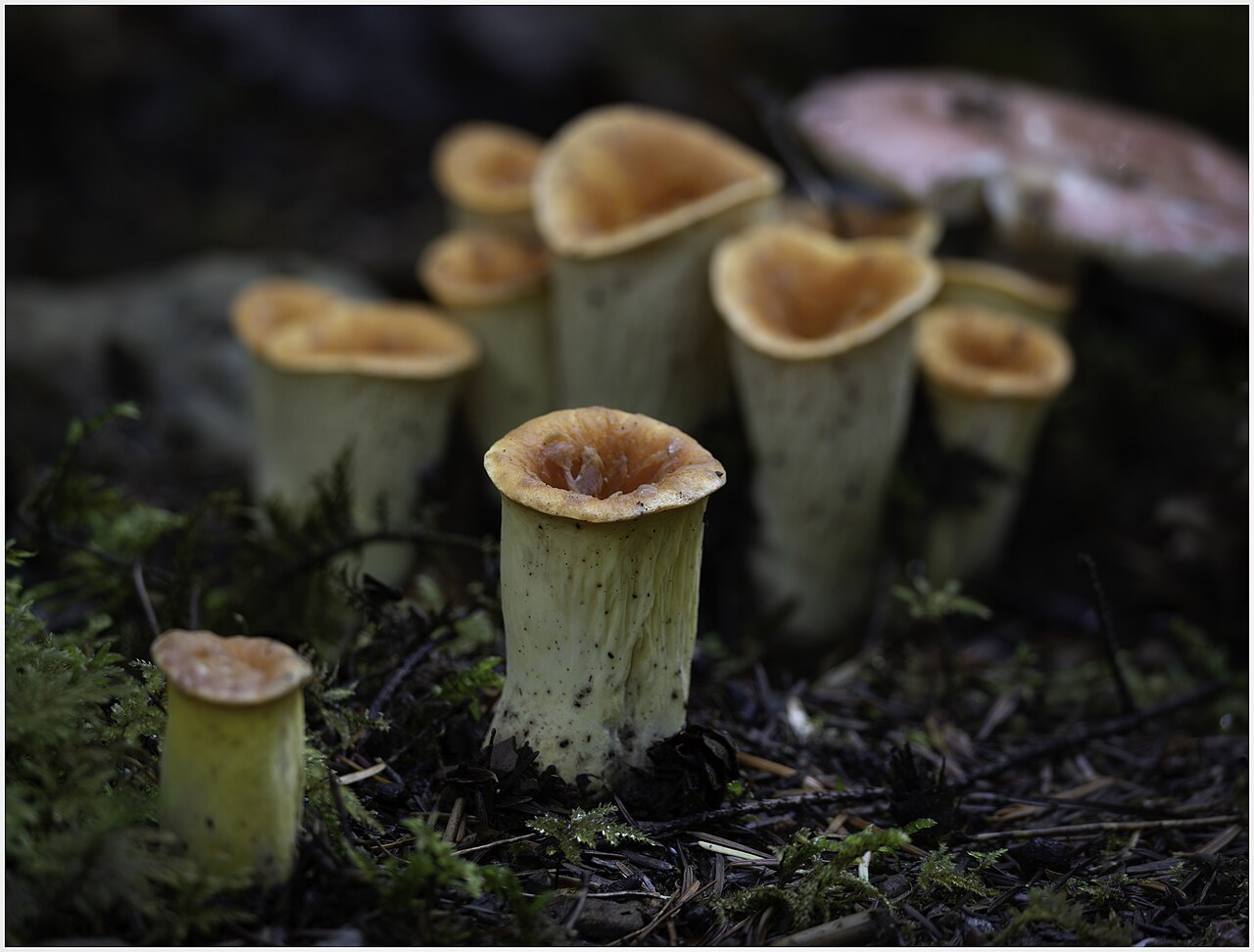
Cantharellus spp. — in California, the oak chanterelle (Cantharellus californicus)
🌍 Native to: North America, Europe and Asia
🔍 How to identify
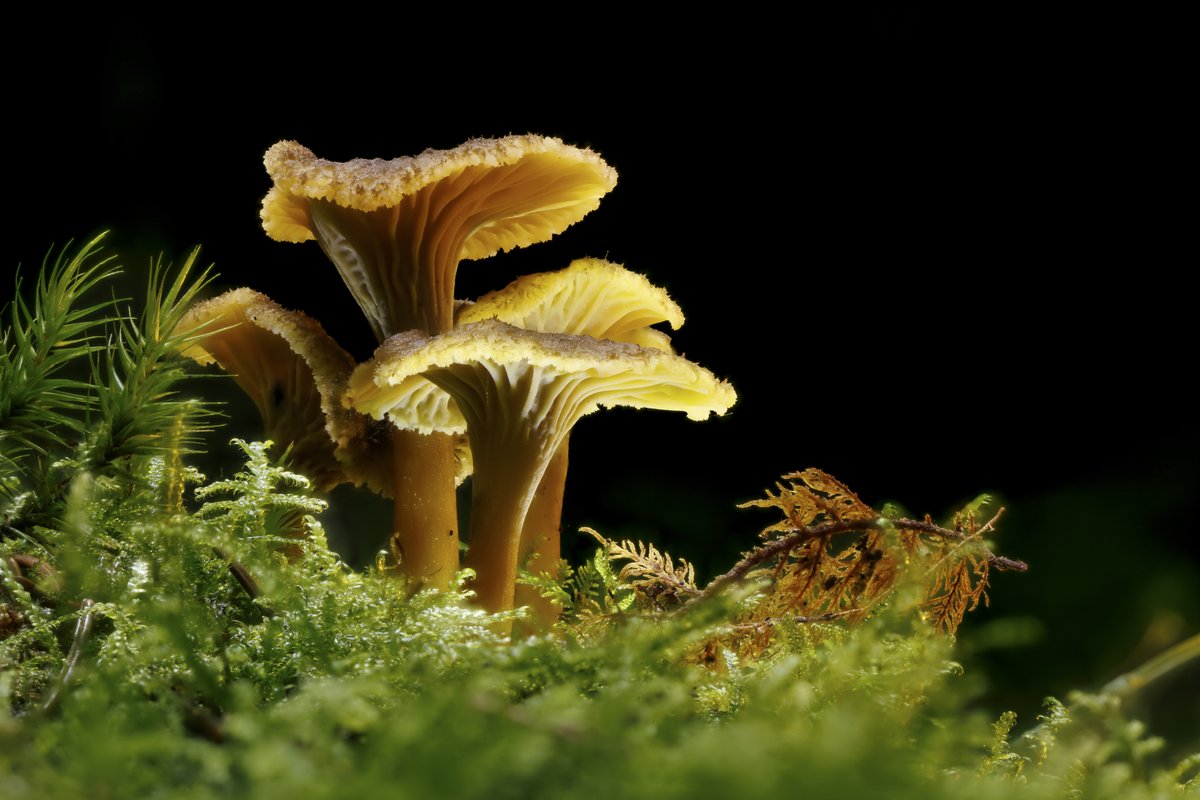
Egg-yolk yellow to orange, funnel-shaped — and underneath, blunt forked ridges that look like melted gills, not true blade-like gills. Run a finger across them: ridges are rounded and cross-veined.
Sniff it: true chanterelles smell faintly of apricots. The flesh is white inside, never orange through and through.
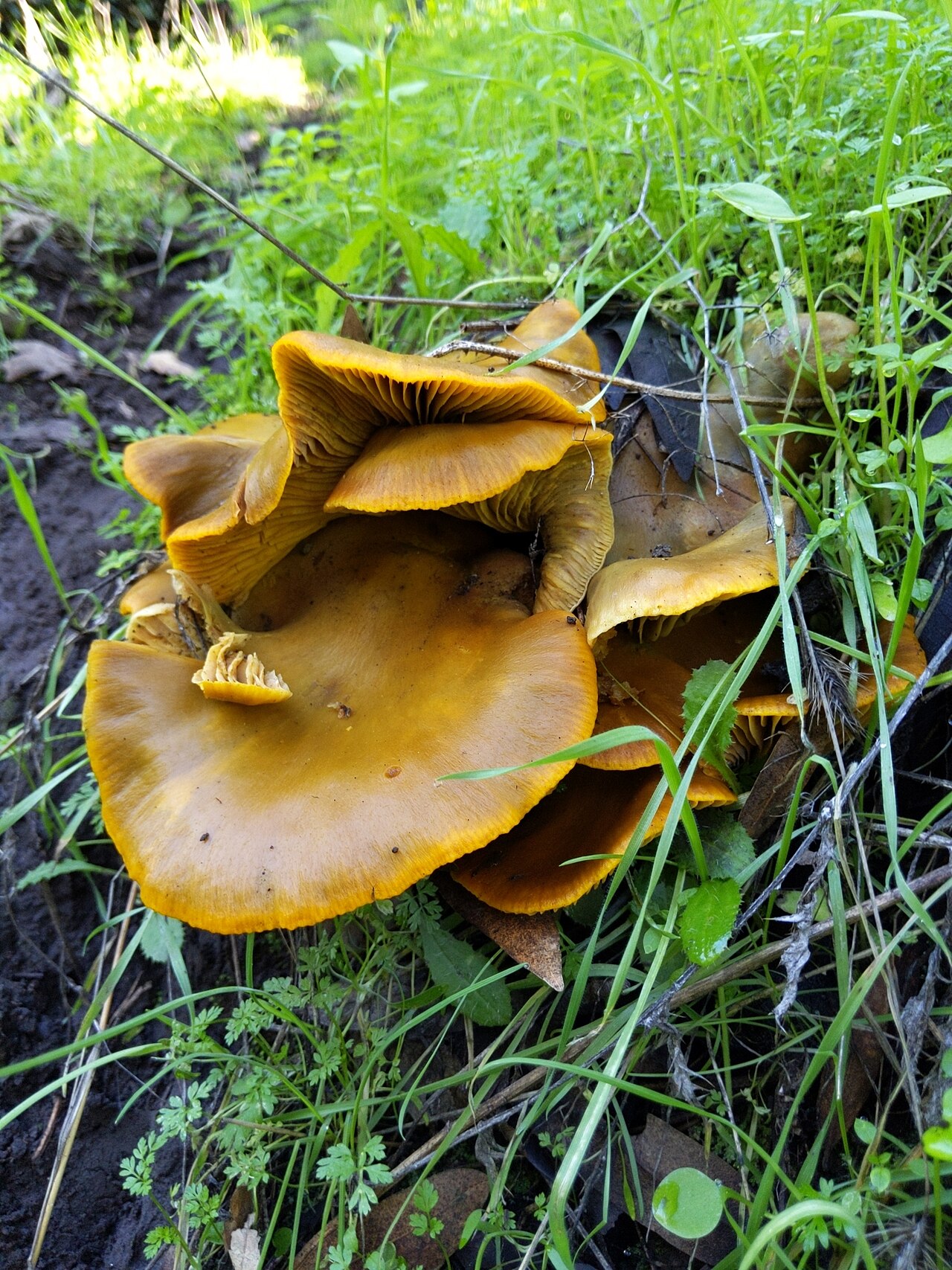
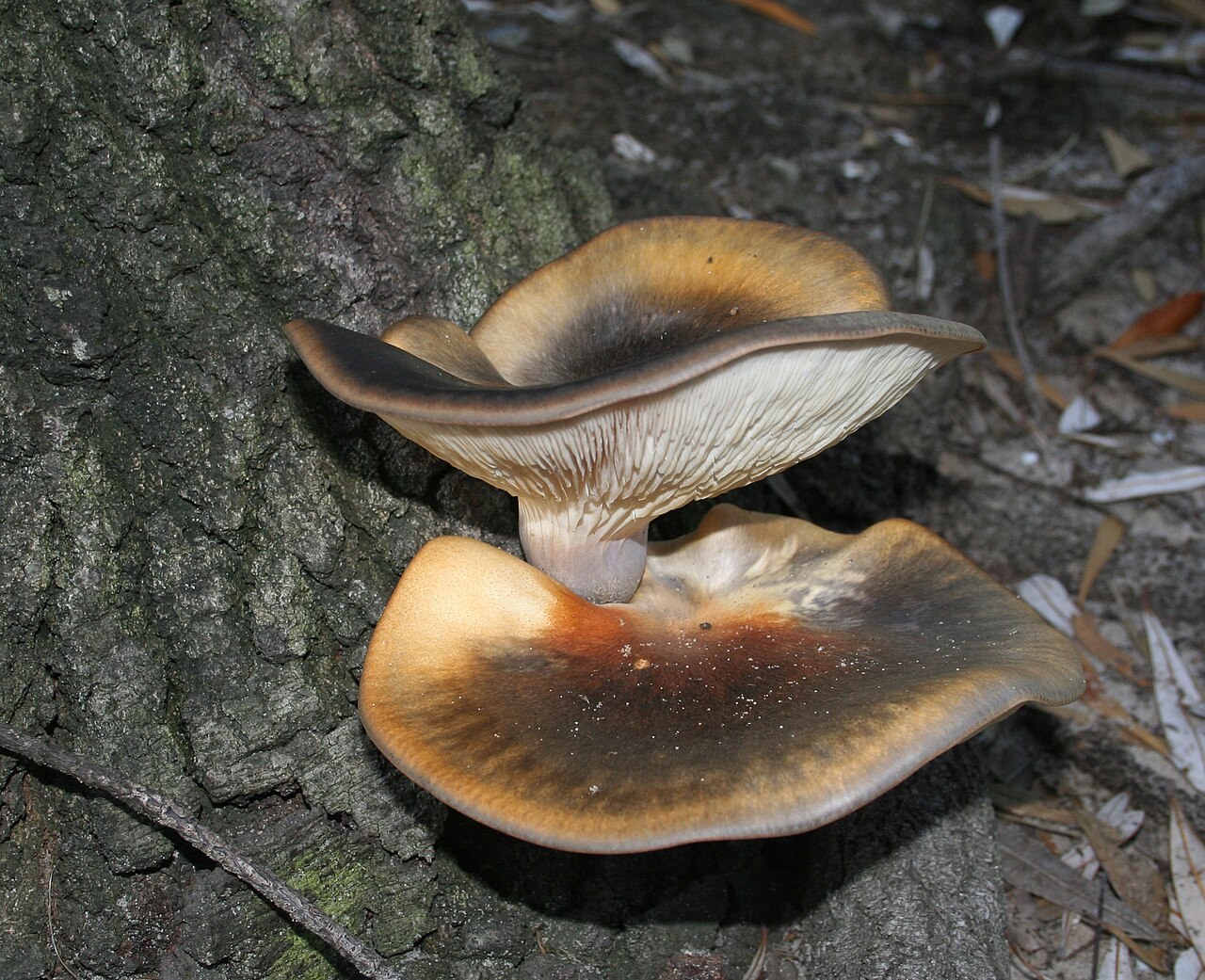
Deadly serious lookalike — the jack-o'-lantern (Omphalotus): grows in dense clusters directly on wood, has sharp true gills, and causes violent GI poisoning. The false chanterelle (Hygrophoropsis) has thin, bright-orange true gills and a flimsier feel.
California's oak chanterelle is one of the largest chanterelles on earth, partnering with coast live oak from late fall into winter.
🌿 Traditional uses & research
The darling of the fall foraging season on both coasts — sautéed in butter, they're peppery, fruity, and deeply savory. Chanterelles have been studied for their vitamin D2 content (it rises when they're sun-dried, like most mushrooms) and for carotenoids behind that golden color. In California, a good rain year under the oaks is an event worth planning your week around.
⚠️ Safety notes
Always cook chanterelles — raw ones can upset your stomach. Learn the jack-o'-lantern cold: if it grows in a big cluster on a stump or buried wood with sharp true gills, walk away. Eat only a small portion your first time, and go easy on big servings — even true chanterelles can be heavy for some stomachs in quantity.
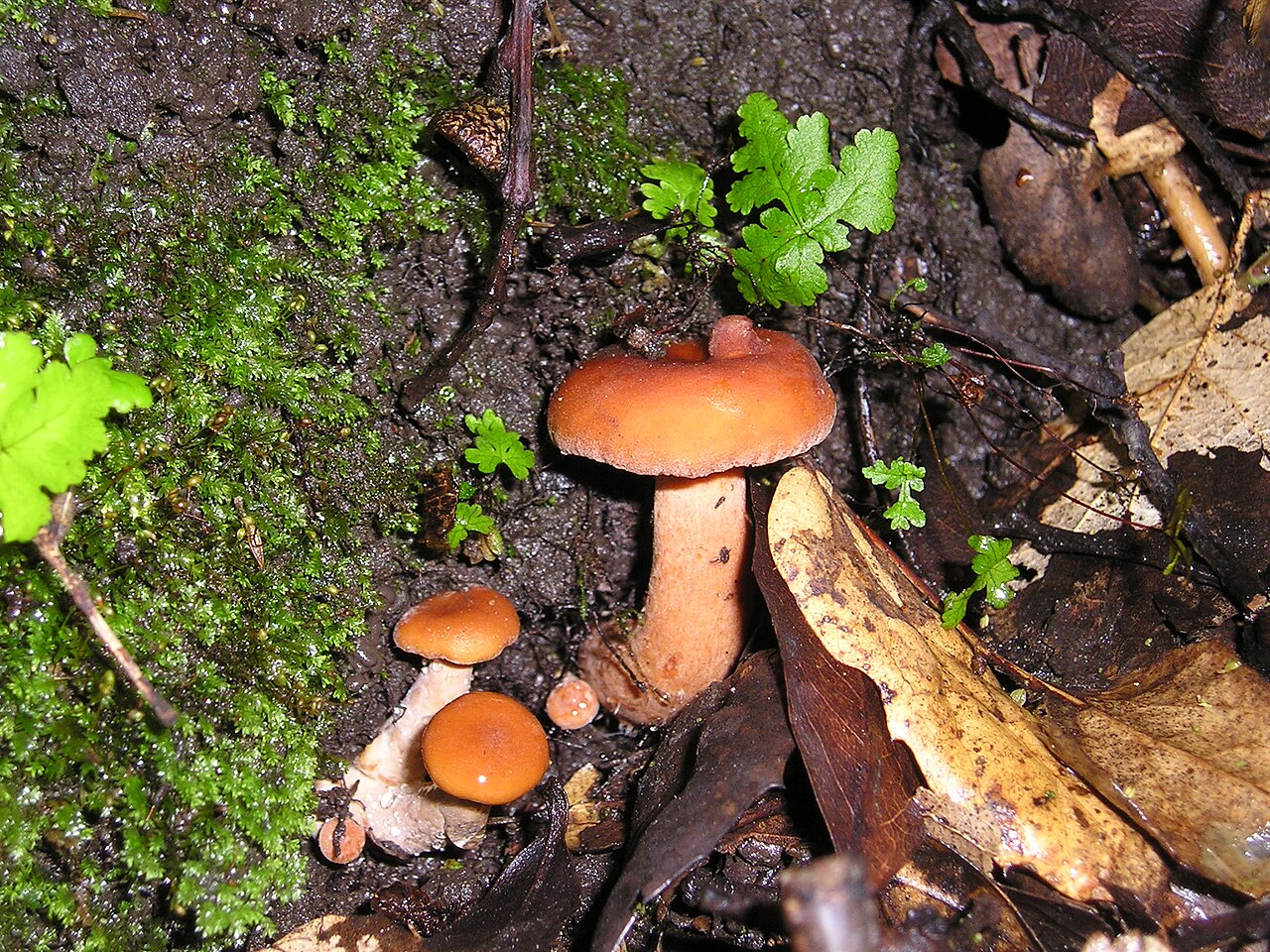
Small caramel-brown caps (2–6 cm) with flesh that snaps like chalk — brittle, crumbly, never fibrous. Nick the gills and white milky latex beads out: that's the milk-cap signature.
The magic only appears when dried: a strong maple-syrup / fenugreek smell (from the compound sotolon) that fresh specimens barely hint at. No syrup smell when dry, no candy cap.
Hot lookalikes: other orange Lactarius species bleed latex that tastes intensely peppery or bitter — a tiny nibble-and-spit test (safe with milk caps) separates the mild candy cap from the acrid impostors.
These are little brown mushrooms, so respect the category: deadly Galerina also grows small and brown on wood — but Galerina is not a milk cap, has a ring on the stem, and never smells like syrup. When in doubt, throw it out.
🌿 Traditional uses & research
The mushroom world's strangest dessert ingredient: dried candy caps go into ice cream, custards, and cookies, where that sotolon gives a genuine maple-syrup note. California chefs made them famous — the Bay Area's candy-cap ice cream is a foraging-culture icon. The aroma chemistry has been studied to identify exactly which compounds survive the drying process.
⚠️ Safety notes
Eat candy caps dried or thoroughly cooked — fresh ones are bland and can be unpleasant. Never rely on the syrup smell alone for identification: confirm the brittle flesh, the milky latex, and the mild taste first, with an expert. And keep them far away from any small brown Galerina — if you're not certain it's a milk cap, it isn't dinner.
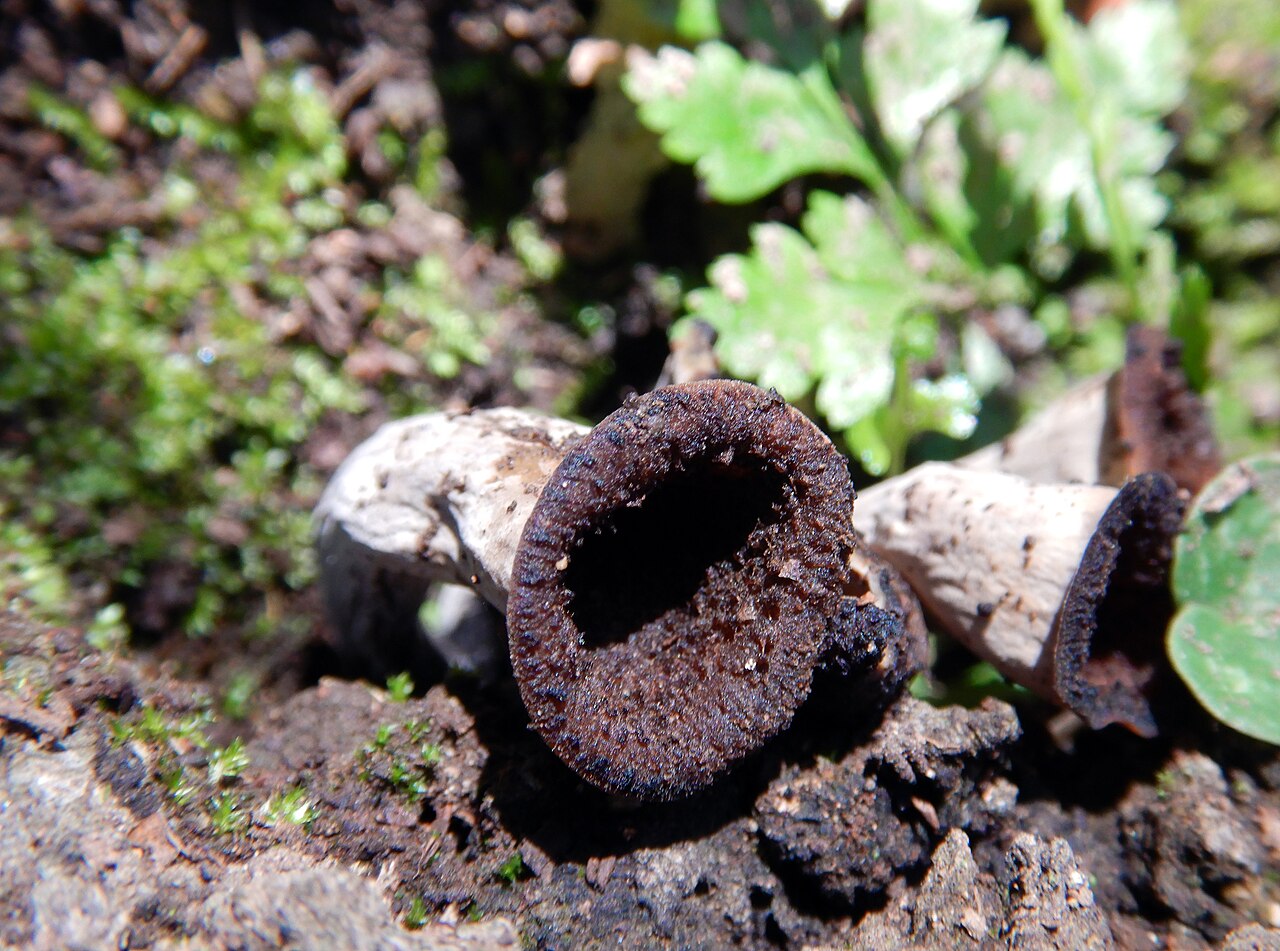
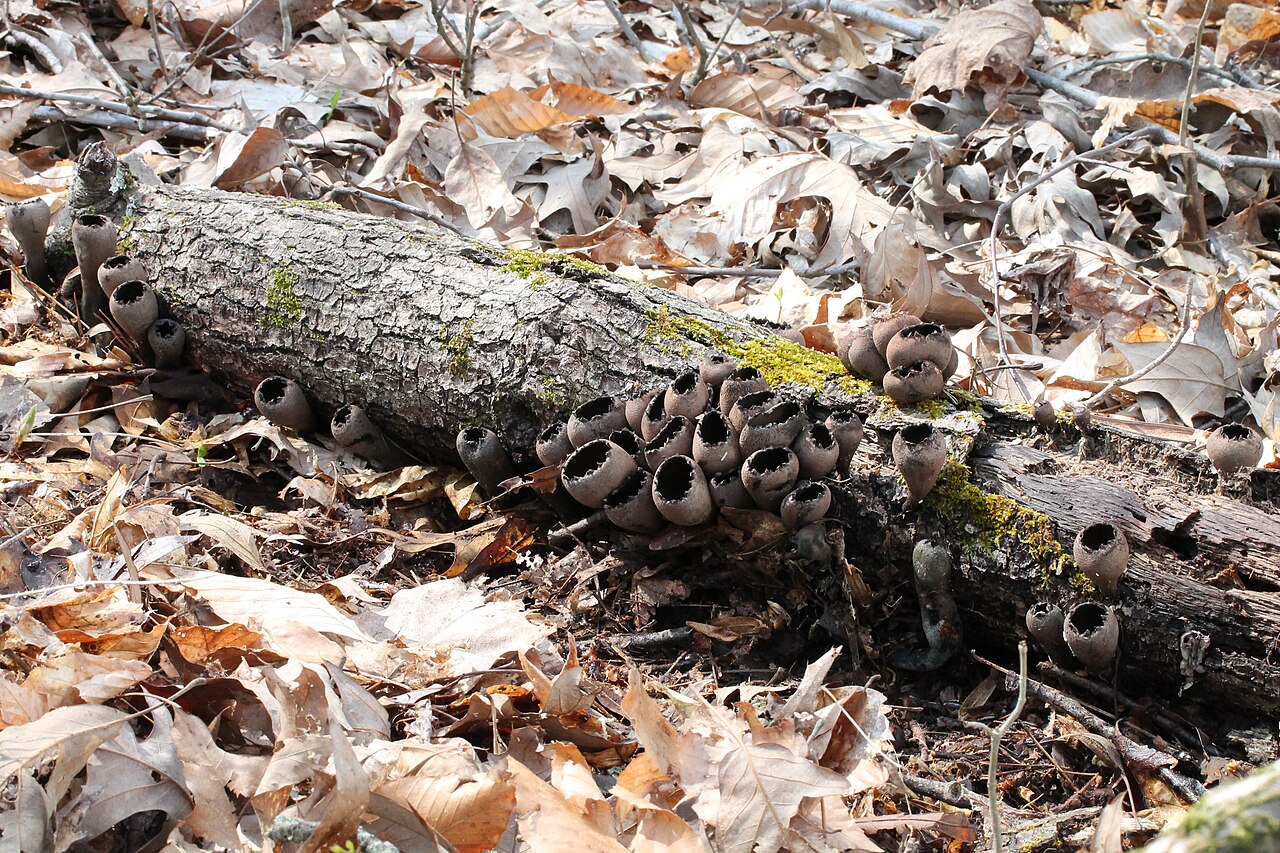
Craterellus cornucopioides (eastern North America's lookalike is C. fallax)
🌍 Native to: Europe and Asia
🔍 How to identify
A hollow, thin-fleshed funnel in smoky gray to near-black — the "horn of plenty." The underside is smooth or wrinkled, never true blade-like gills; the whole mushroom is hollow down through the stem.
Masters of camouflage: in leaf litter they vanish, so foragers hunt on hands and knees. They fruit in troops under hardwoods — especially oaks — from summer into fall.
The main lookalikes are other Craterellus species, all harmless and edible. The jack-o'-lantern shares only a vague funnel shape — it's bright orange with sharp true gills and is seriously toxic, so beginners should learn the two cold.
🌿 Traditional uses & research
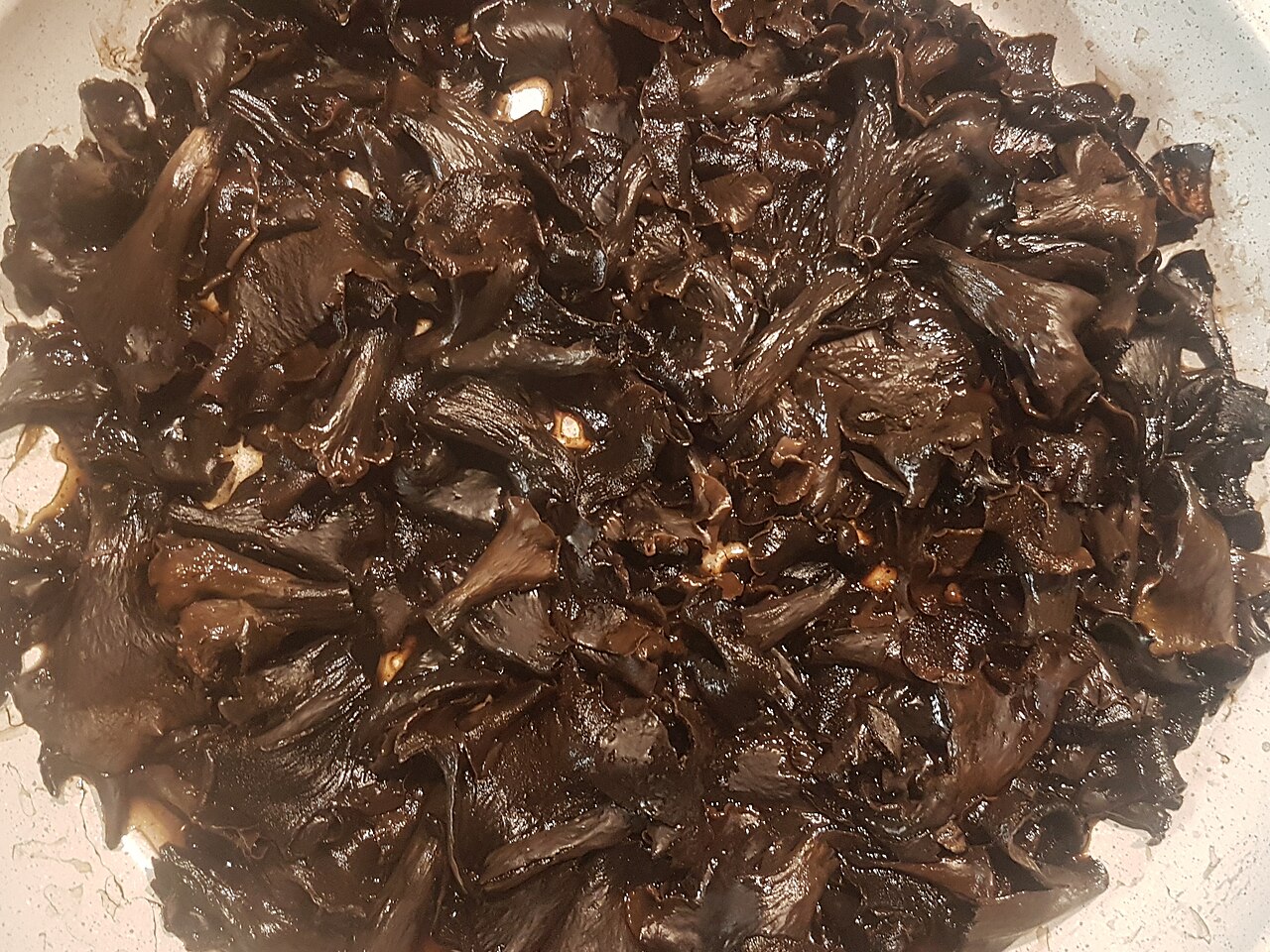
The French call it trompette de la mort — "trumpet of the dead" — for its dark color, and it's one of Europe's most prized wild edibles. Rich, smoky, and meaty, it concentrates beautifully when dried: dried black trumpets rehydrate into something almost truffle-like for risottos and sauces. A good oak woodland after late-summer rain is worth crawling through on your knees.
⚠️ Safety notes
Always cook black trumpets — never eat them raw. Shake out every funnel before the bag: grit and tiny debris collect inside the cups. As with all wild mushrooms, eat a small portion first and confirm every identification with an experienced local mycologist.
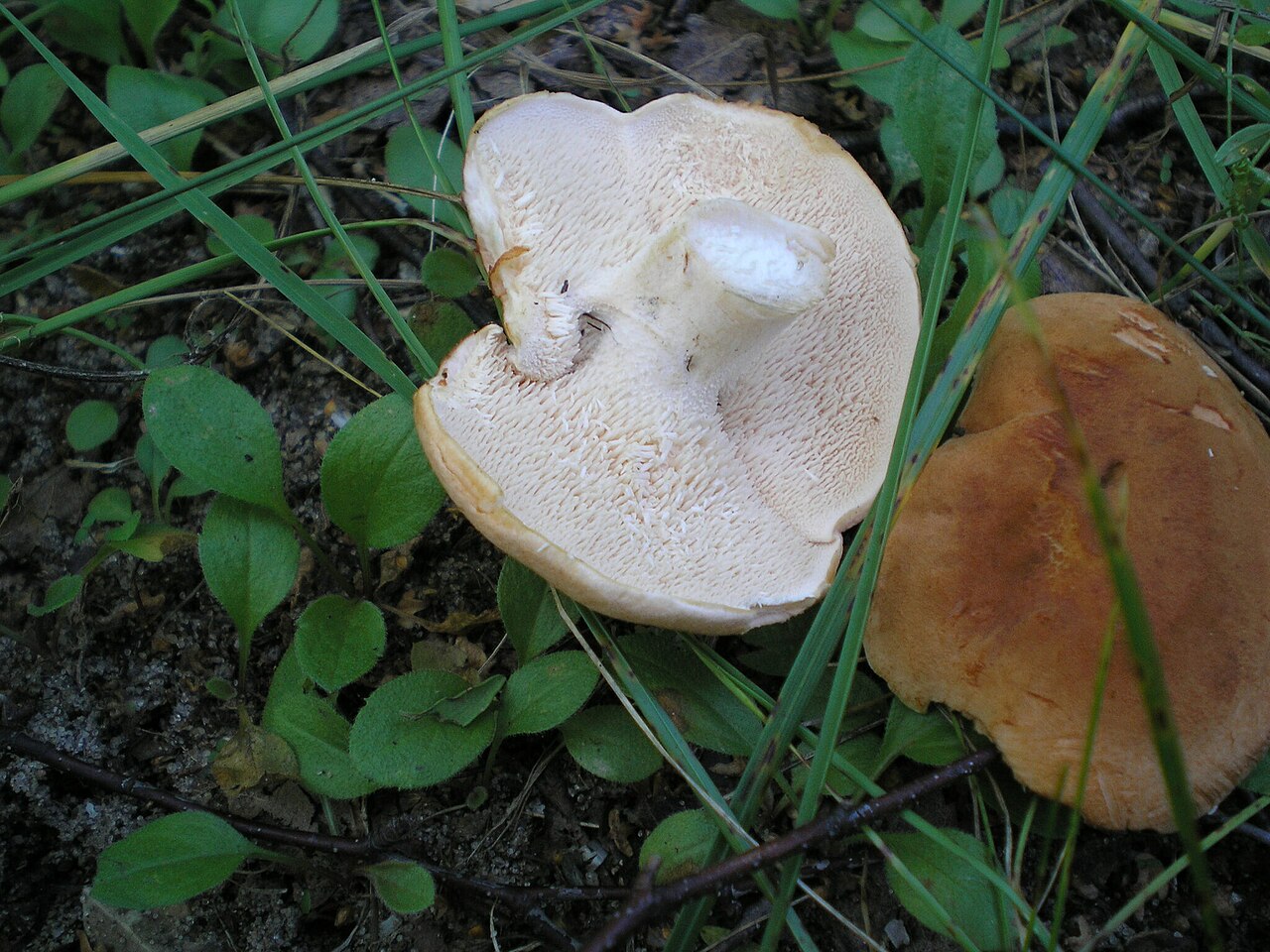
Hydnum repandum (a species complex — several North American lookalikes share the name)
🌍 Native to: North America, Europe and Asia
🔍 How to identify
A pale orange-tan to cream cap with soft white TEETH hanging underneath instead of gills — little icicle spines that crumble if you brush them. No other beginner-safe mushroom does this.
Irregular, sometimes lobed caps that can fuse into clusters; smells faintly sweet, tastes mildly nutty when young.
One of the safest beginner mushrooms: there are no poisonous toothed mushrooms. Skip old specimens — they turn bitter with age, and bitter hedgehogs go straight in the compost.
🌿 Traditional uses & research
A classic European woodland edible, sweet and nutty, that holds its shape beautifully in a hot pan — sautéed hard with butter, it's one of the finest textures in the fall woods. Fruits late summer into fall under hardwoods and conifers, and it's forgiving to pick: the teeth break off in the bag but the cap stays perfect.
⚠️ Safety notes
Always cook hedgehogs. Bitter with age means bitter in the pan, so taste a tiny cooked crumb if you're unsure — spit it if it's unpleasant. Confirm every identification with an experienced local mycologist before your first meal.
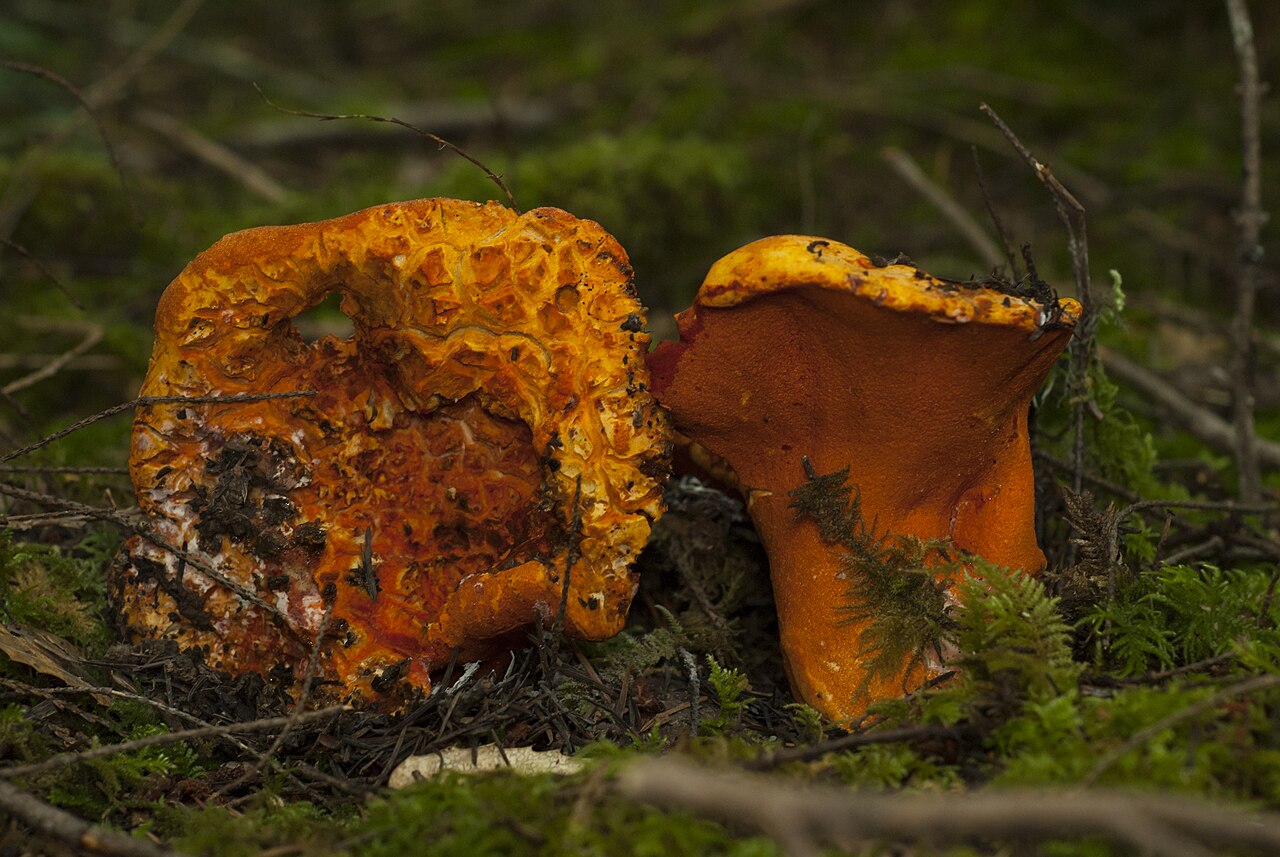
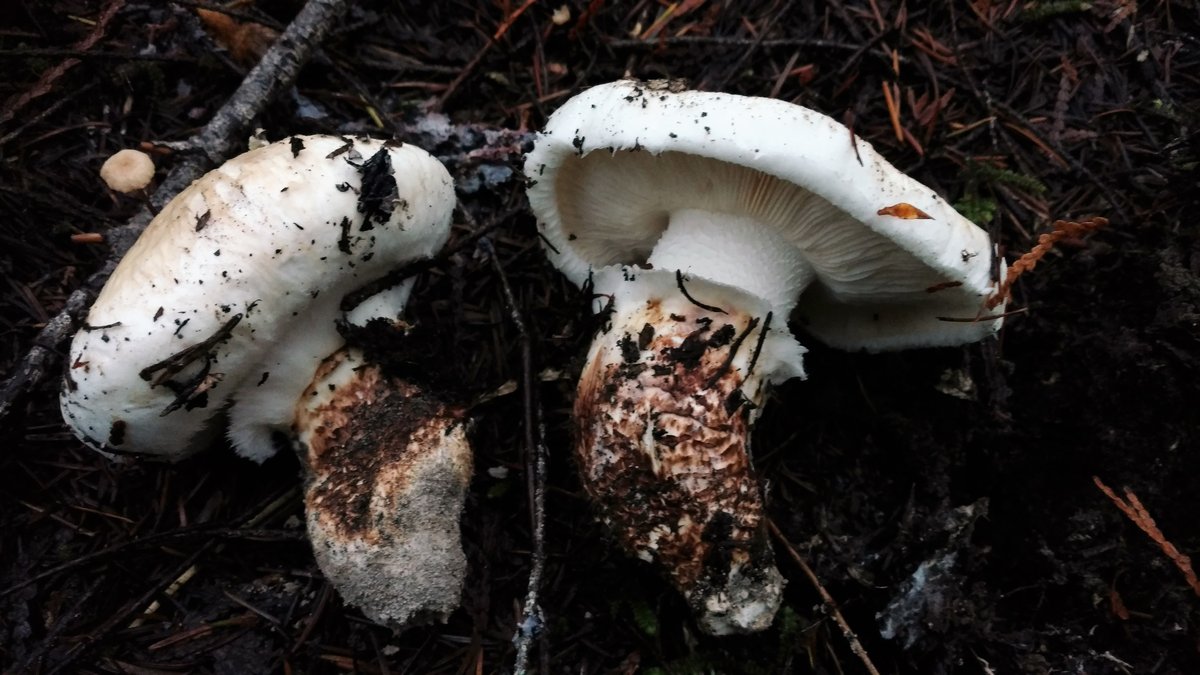
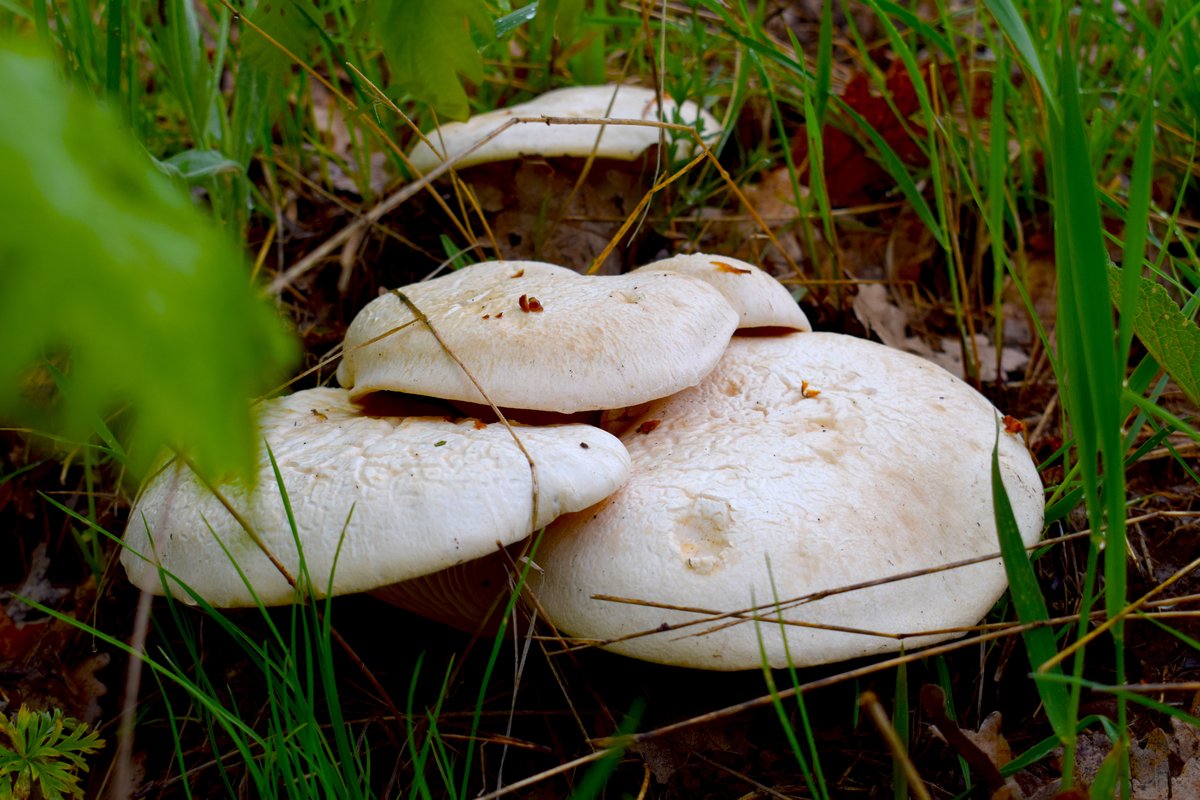
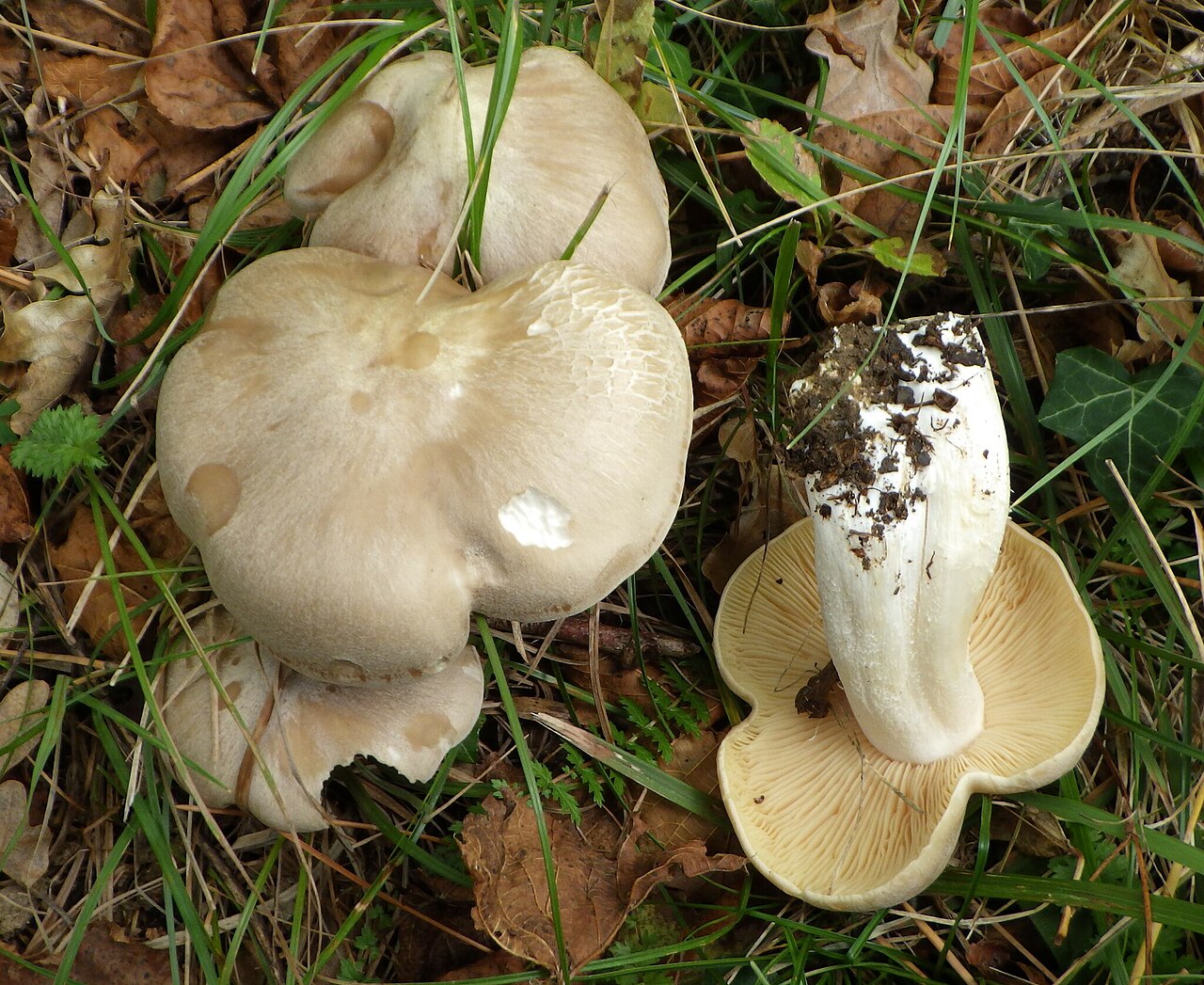
Hypomyces lactifluorum, parasitizing Russula brevipes (the short-stemmed russula)
🌍 Native to: North America
🔍 How to identify
Not a species of mushroom at all — a parasitic mold that takes over its host and turns it a brilliant seafood orange-red. The transformation is total: bright red outside, firm white flesh inside, with a faint seafood smell.
The usual host is the short-stemmed russula, a big white mushroom that is bland and unremarkable on its own. The parasite reshapes it into something unmistakable — there is nothing else in the woods this color.
Only eat lobsters that are fully transformed — uniformly orange-red with no white patches or visible gills remaining. If the host mushroom underneath can't be confirmed, don't eat it.
🌿 Traditional uses & research
The signature wild mushroom of the Pacific Northwest and northern California coast — dense, meaty, and genuinely shellfish-like when cooked well. The parasite is the point: it converts a bland russula into a firm, sweet delicacy that holds up in chowders and pasta. A late-summer-through-fall icon of the coastal redwoods.
⚠️ Safety notes
The host matters: Hypomyces can parasitize other mushrooms, some of them not so friendly — only eat fully transformed lobsters where the host can be confirmed as a short-stemmed russula. Never eat specimens that are only partly red or still show gills. Cook thoroughly, and keep a whole raw specimen in the fridge until you've confirmed you tolerate it.
🦠 The Wild Story
There is no such species as the lobster mushroom. What you pick up in the woods is a crime scene: a parasitic ascomycete, Hypomyces lactifluorum, has attacked an ordinary, unremarkable host mushroom — usually the short-stemmed russula, Russula brevipes, a brittle white mushroom nobody would get excited about. The parasite wraps the host in a bright orange crust, flattens its gills into blunt ridges, distorts its shape, and rewrites its chemistry so thoroughly that DNA tests show the "mushroom" is mostly parasite, with only traces of the original host left. Some writers call it mycological cannibalism. And it works: the plain russula becomes dense, meaty, seafood-scented, and delicious — a delicacy built by one fungus devouring another.
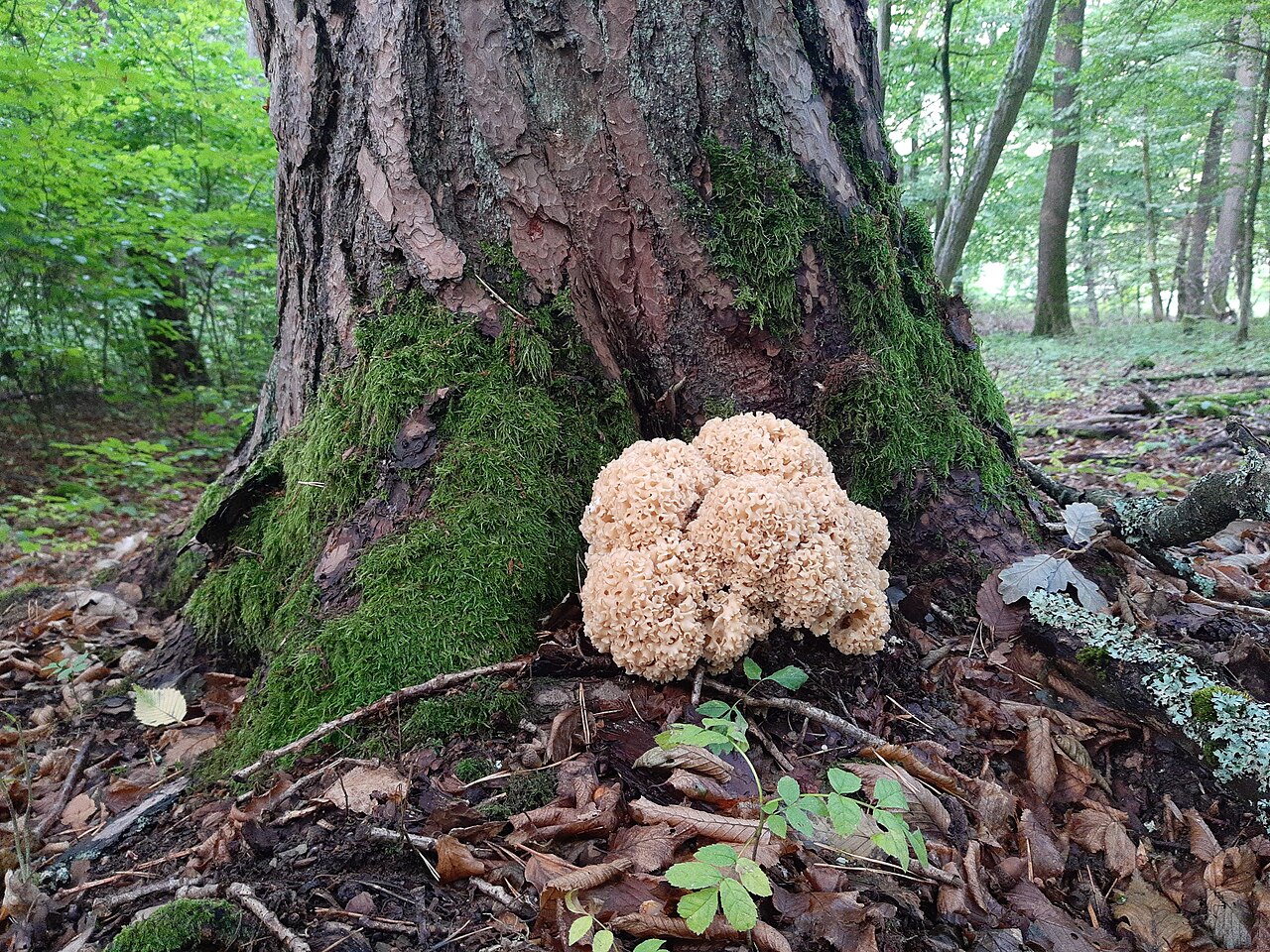
Sparassis crispa (Eurasian; North America's western species is usually called S. radicata)
🌍 Native to: Europe and Asia
🔍 How to identify
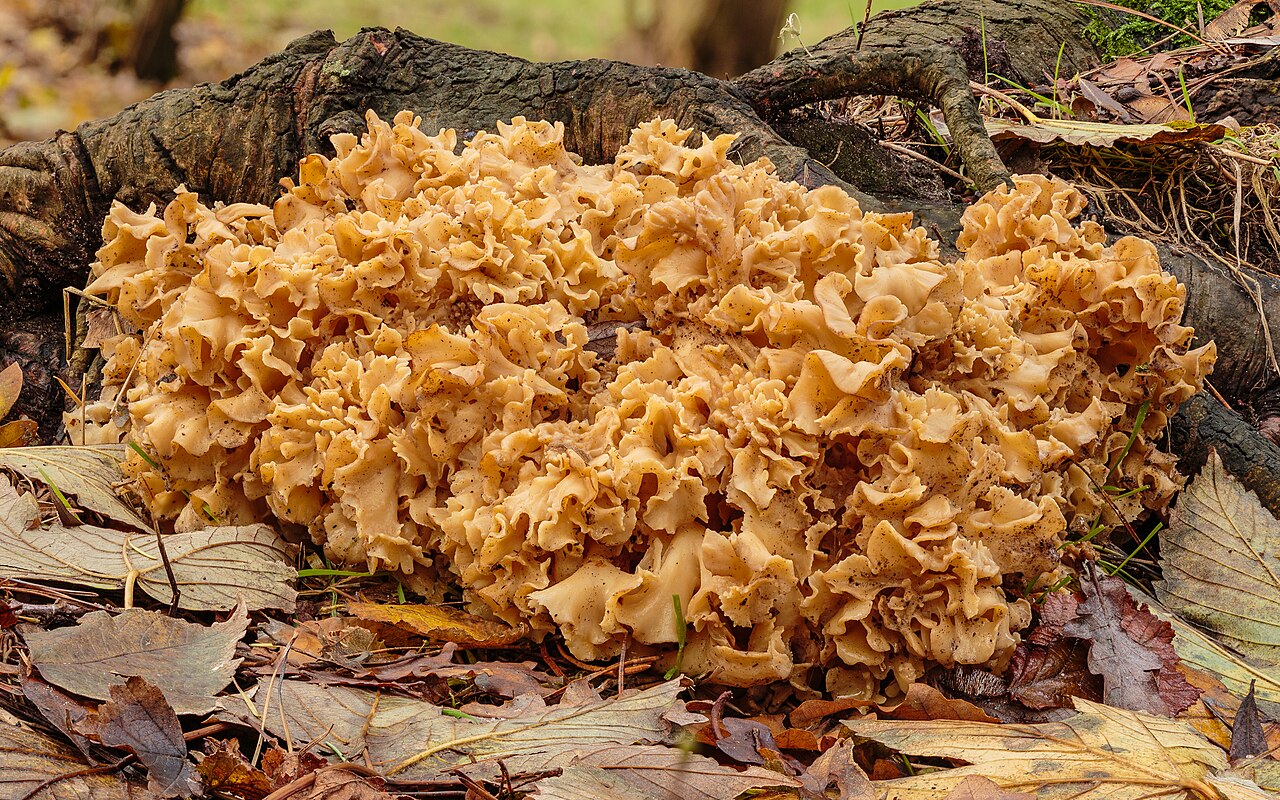
A huge, unmistakable cluster of layered, wavy cream-colored folds — like a giant brain or a head of cauliflower — growing at the base of pines and other conifers. A single specimen can weigh several pounds.
The thin, noodle-like layers are fragile and brittle when fresh. The name on the label varies by continent: true Sparassis crispa is Eurasian, and western North America's version usually gets called S. radicata — same giant, same kitchen.
No dangerous lookalikes share the cauliflower form at this scale. Pick whole clusters young; clean the layers meticulously, because grit, pine needles, and tiny insects hide between the folds.
🌿 Traditional uses & research
A beloved edible across Europe and Asia — cultivated commercially in Japan and Korea, where it's studied for its beta-glucans. The layered structure is the feature: it shreds into noodle-like strands that soak up broth like nothing else, making it one of the great soup mushrooms. One find feeds a family.
⚠️ Safety notes
Clean it relentlessly — rinse the folds repeatedly and inspect for insects, because everything that lives in the forest hides in a cauliflower mushroom. Cook thoroughly; old, yellowing specimens turn bitter. Confirm every identification with an experienced local mycologist.
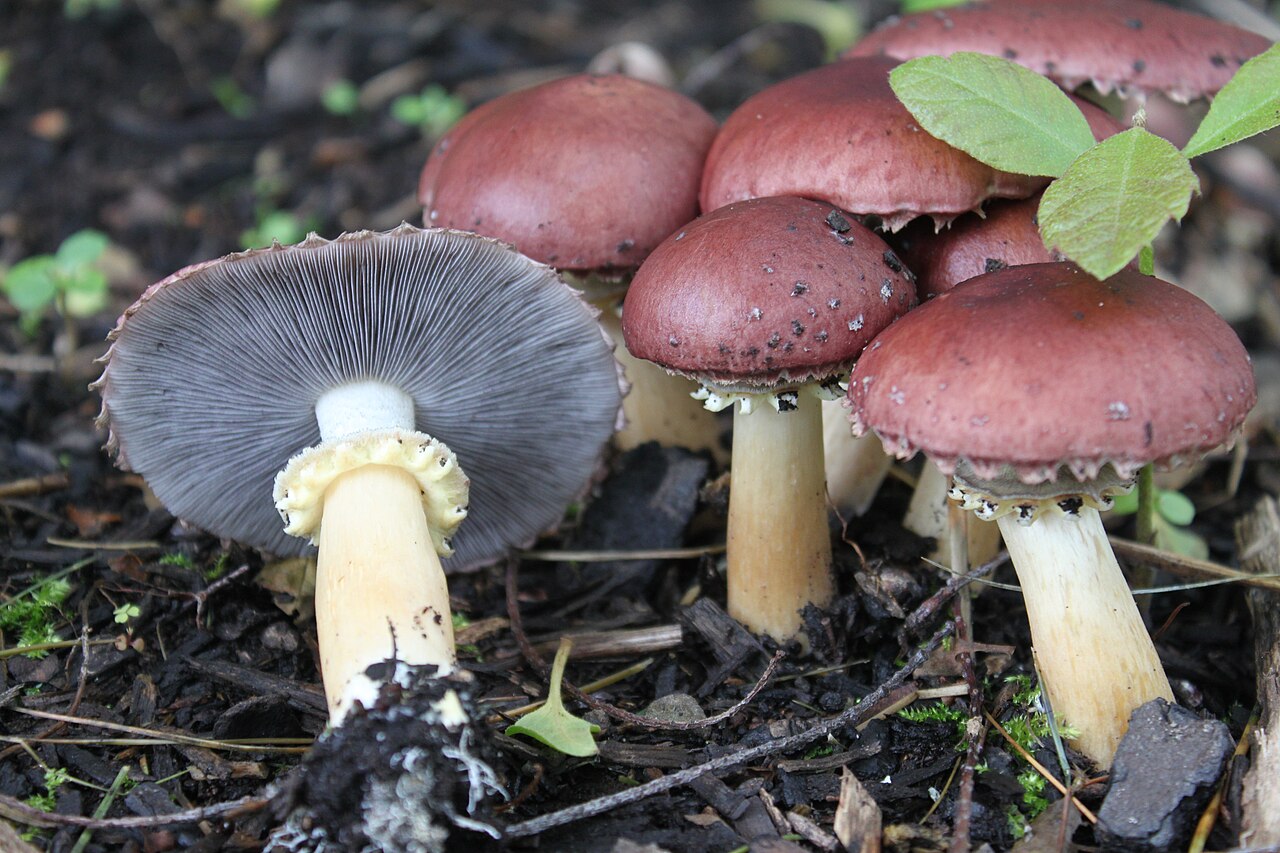
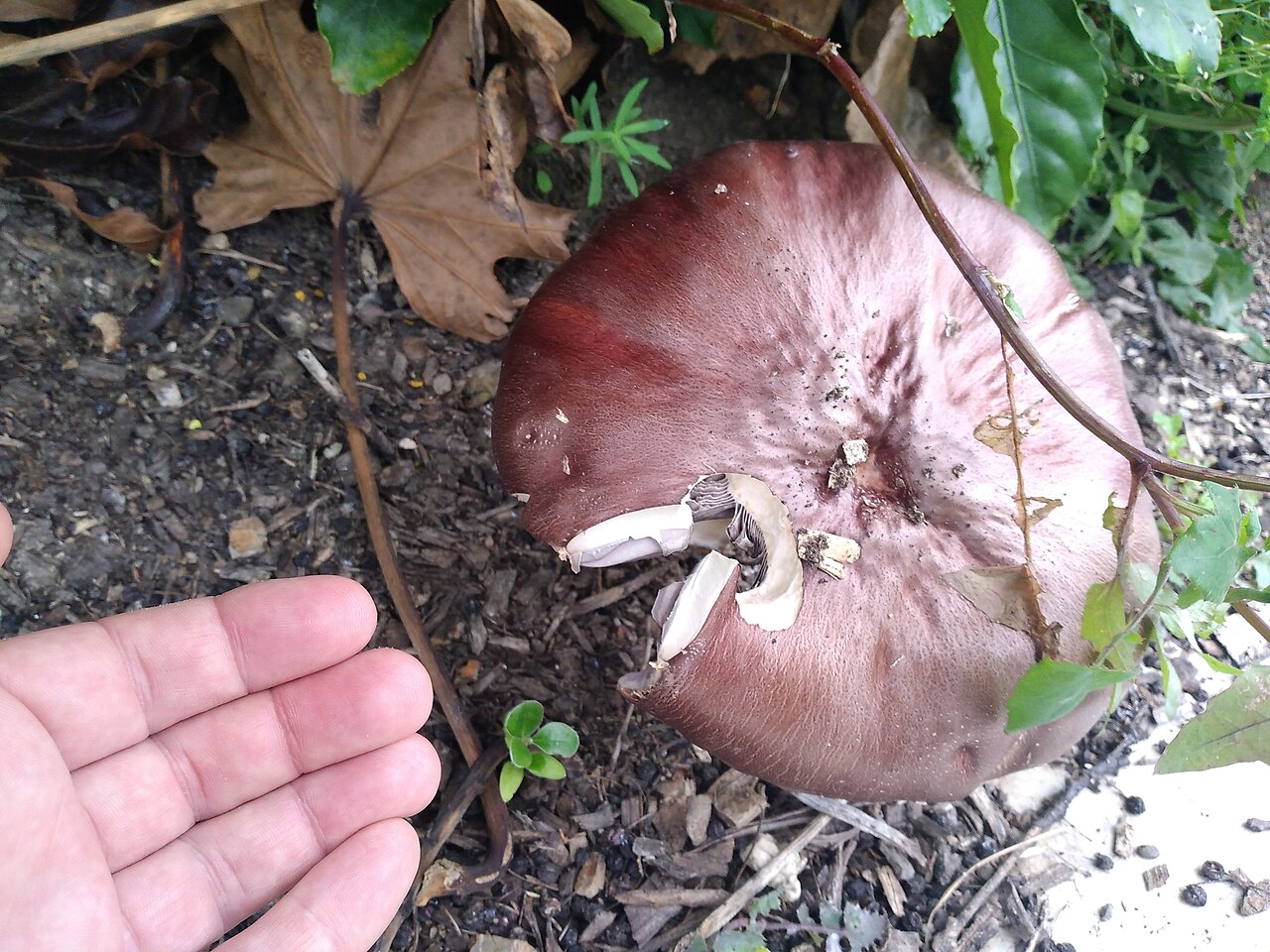
A big, handsome mushroom with a burgundy-wine-red cap that fades toward tan with age, growing from wood chips, mulch beds, and garden paths. The ring (annulus) on the stem is the signature: shaggy, with a cogwheel or star pattern on its upper surface.
Gills start gray and darken toward purple-black; the spore print is a very dark purple-black. Fruits spring and fall, often in impressive flushes.
The backyard grower's mushroom — spread fresh hardwood chips in spring and wine caps often colonize on their own. Confirm with the spore print and the star-ringed annulus: young buttons can resemble toxic species, so never eat a button-stage mushroom you can't fully key out.
🌿 Traditional uses & research
The easiest gourmet mushroom to grow at home — no logs, no lab work, just hardwood chips in a shady bed. Meaty, mild, and abundant, it's a favorite of permaculture gardeners, and it's been studied as a soil remediator since it thrives on fresh wood chips. A shady corner of the yard can become a mushroom bed for years.
⚠️ Safety notes
Always cook wine caps — like all wild mushrooms, raw ones can upset your stomach. Verify the dark purple-black spore print and the distinctive ring before eating. Don't gather from mulch of unknown origin: urban mulch can carry contaminants, and dyed or treated wood chips are not for mushroom beds.
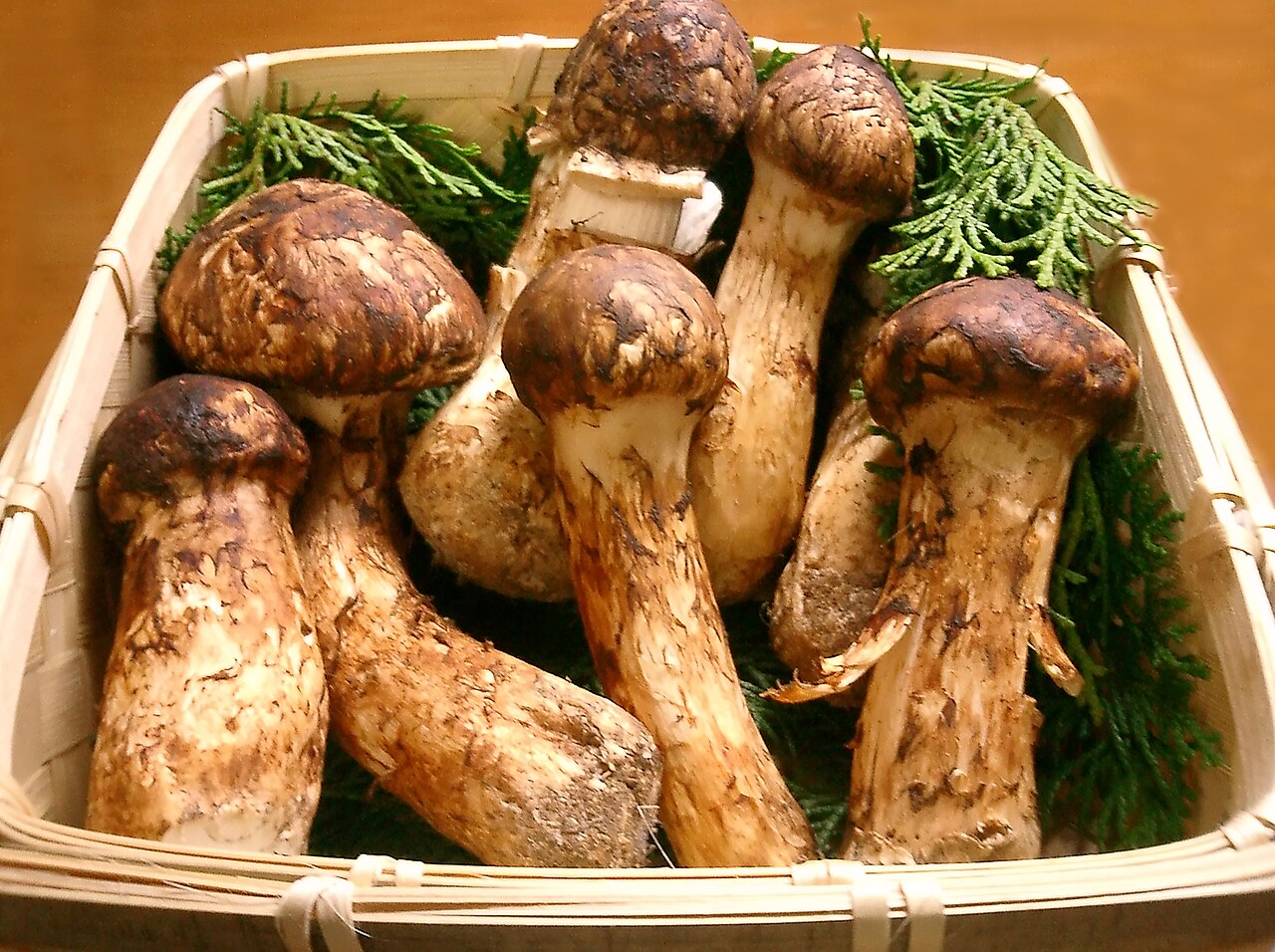
Cluster emerging in pine duffCap with brown scales and ring
Matsutake
Tricholoma magnivelare
🌍 Native to: North America (Japanese matsutake: East Asia)
🔍 How to identify
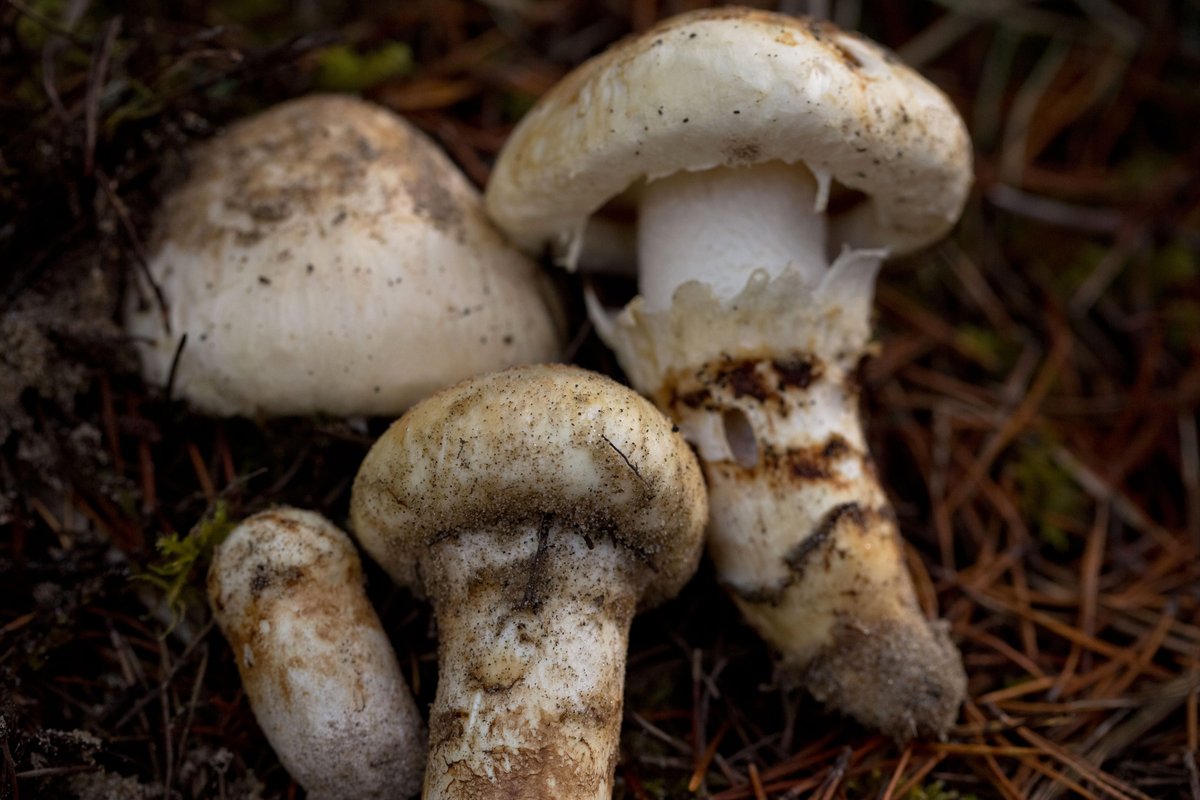
Stout and sturdy: a whitish cap (2–8 inches) with brown fibers and flat scales, a thick stem with a cottony, flaring ring, white gills, and a white spore print. Often half-buried in forest duff.
The giveaway is the smell — a strong, spicy odor like cinnamon mixed with something a little funky. Use it to back up your ID, never as the whole test.
This is the eastern North American matsutake. It belongs to the matsutake group (Tricholoma section Caligata) — three sibling species that share a common ancestor and split apart millions of years ago: Japan's T. matsutake (East Asia and northern Europe), the western American T. murrillianum, and this eastern one, T. magnivelare. DNA work in 2017 confirmed the western and eastern American mushrooms are distinct species. The American species are native here, not introduced from Japan — see the Japanese Matsutake.
Mycorrhizal with pines and hemlock; fruits in fall into early winter.
🌿 Traditional uses & research
Matsutake is a cornerstone of Japanese cuisine — grilled over charcoal, folded into rice, or floated in clear soup — with a firm, meaty texture that stands up to heat. Top specimens sell for hundreds of dollars per pound, making it one of the world's priciest wild mushrooms. In the lab, researchers have isolated polysaccharides from its mycelium and screened them for antioxidant and immune-supporting activity in cell and animal models. That's early research, not proof of any benefit — here it's a food first.
🌲 From the forest to Tokyo
Every matsutake sold anywhere is wild-harvested — commercial cultivation has never been cracked. The fungus needs a living host tree, and the only trials ever to produce a fruiting body used pine seedlings infected with matsutake mycelium, planted out and left for six years or more. So the whole trade runs on the fall harvest. Each autumn, from September into November, pickers work the national forests of Oregon, Washington, and northern California — this is the western species, T. murrillianum, the one the trade runs on. Matsutake gets its own permit rules: on the big Oregon forests, you need a permit to pick it at all, even for personal use, and the season opens the day after Labor Day and runs sixty days. In prime years, mushroom camps spring up in the forests; pickers sell the day's harvest to buyers at camp, who grade it — tight, closed buttons are worth the most — and the fresh mushrooms ship to Tokyo, with Japan as the main market. Japan buys so much American matsutake because its own harvest collapsed, from thousands of tons a year in the 1940s to a few dozen tons today, mostly because pine wilt nematode has killed the Japanese red pines the mushroom partners with. The result is a multimillion-dollar trade in a mushroom nobody has ever learned to farm.
⚠️ Safety notes
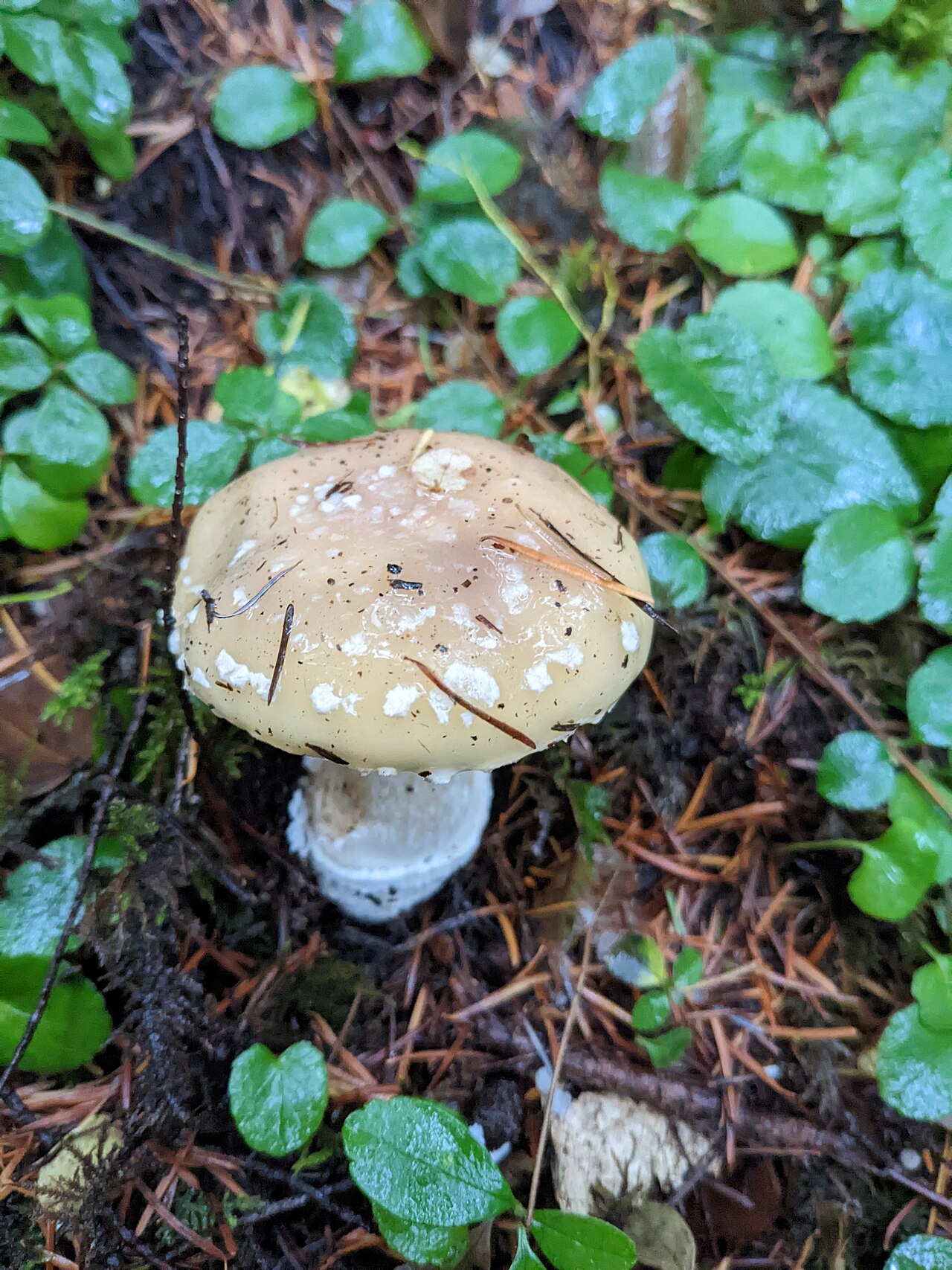
This one is high-stakes. Deadly Amanita species share the same woods — including Smith's amanita in the Pacific Northwest — and young buttons can look confusingly similar. Matsutake has no volva (cup) at the stem base and carries a persistent cottony ring plus the spicy scent, but smell alone is not a safe test. Always dig up the whole base and confirm every identification with an expert.
Thick stems with small tan capsSliced stem showing meaty flesh
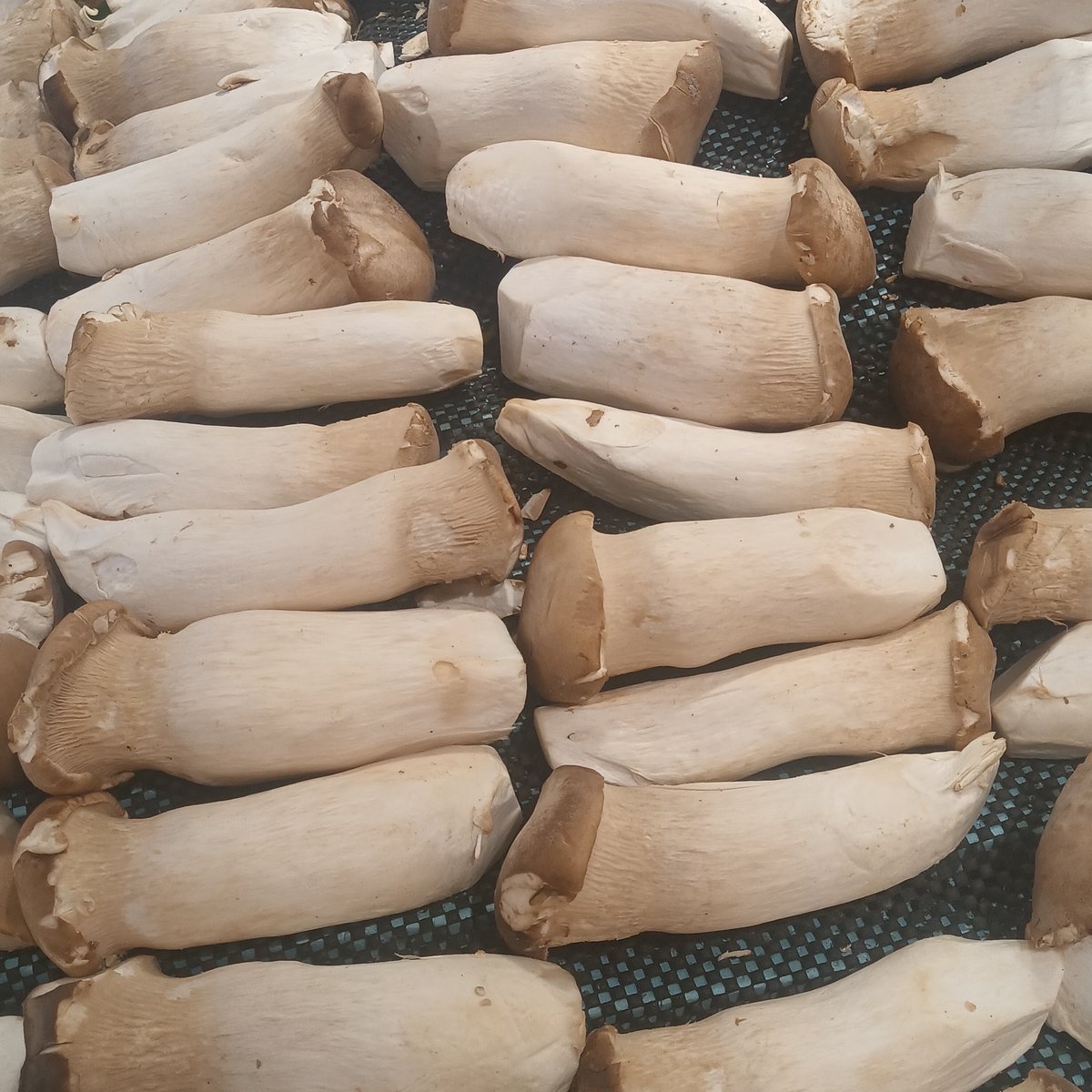
King Trumpet
Pleurotus eryngii
🌍 Native to: Europe, Central Asia and North Africa
🔍 How to identify
Hard to mistake: a thick, meaty white stem topped with a small tan-to-brown cap. It's the largest species in the oyster mushroom genus, shaped more like a trumpet than a shelf.
Unlike most oysters, wild king trumpets grow from the roots of herbaceous plants (Eryngium and its carrot-family relatives), not from wood.
Native to Mediterranean Europe, North Africa, and the Middle East. Nearly every one you see for sale is cultivated on straw, sawdust, or grain.
🌿 Traditional uses & research
The stem is the star — sliced into medallions and seared, it eats like a scallop or a little steak, which is why chefs call it the "vegan scallop." It's popular in Korean and Chinese cooking, roasted, grilled, or braised, with a mild, nutty, umami flavor. Lab studies have screened king trumpet extracts for ergothioneine, beta-glucans, and other antioxidant compounds — early-stage work, and in the kitchen it's simply a great meat substitute.
⚠️ Safety notes
Cultivated king trumpets are unmistakable and safe to buy with confidence. Wild ones are a Mediterranean forager's mushroom — if you're picking anything yourself, confirm every identification with an expert.
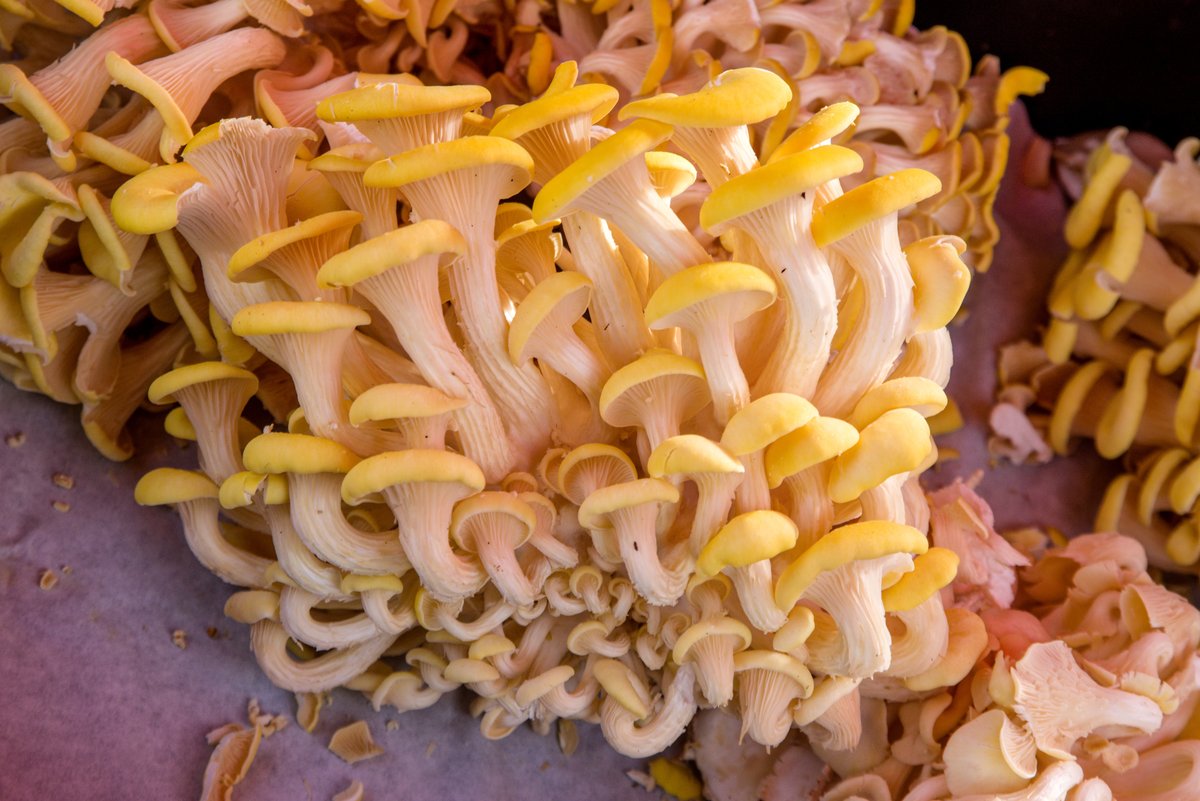
Bright yellow clustered capsDecurrent gills on fused stems
Golden Oyster
Pleurotus citrinopileatus
🌍 Native to: East Asia
🔍 How to identify
Bright yellow, funnel-shaped caps in big overlapping bouquets — nothing else common in the woods wears that color.
White gills that run down the stem (decurrent), short stems often fused at the base, pale spore print.
Grows in clusters on hardwood logs and stumps — elm is a favorite — in summer into early fall. A fast, aggressive colonizer; native to East Asia and now naturalized in parts of North America as an escaped cultivar.
🌿 Traditional uses & research
Thinner and more delicate than other oysters, with a sweet, nutty flavor that shines in stir-fries and soups — but cook it soon after picking, since the delicate caps dry out fast. Researchers have screened golden oyster extracts for antioxidant activity and β-glucan content, with results on par with or better than other oysters. Early lab work, not a health claim; on the plate it's prized for taste and looks.
⚠️ Safety notes
That bright yellow color means no poisonous mushroom is a close lookalike — the main confusion is with other, paler oyster species, which are also edible. Still, confirm every wild find with an expert before eating.
Troop in mossy conifer duffHollow yellow stem, split view
Winter Chanterelle
Craterellus tubaeformis
🌍 Native to: North America, Europe and Asia
🔍 How to identify
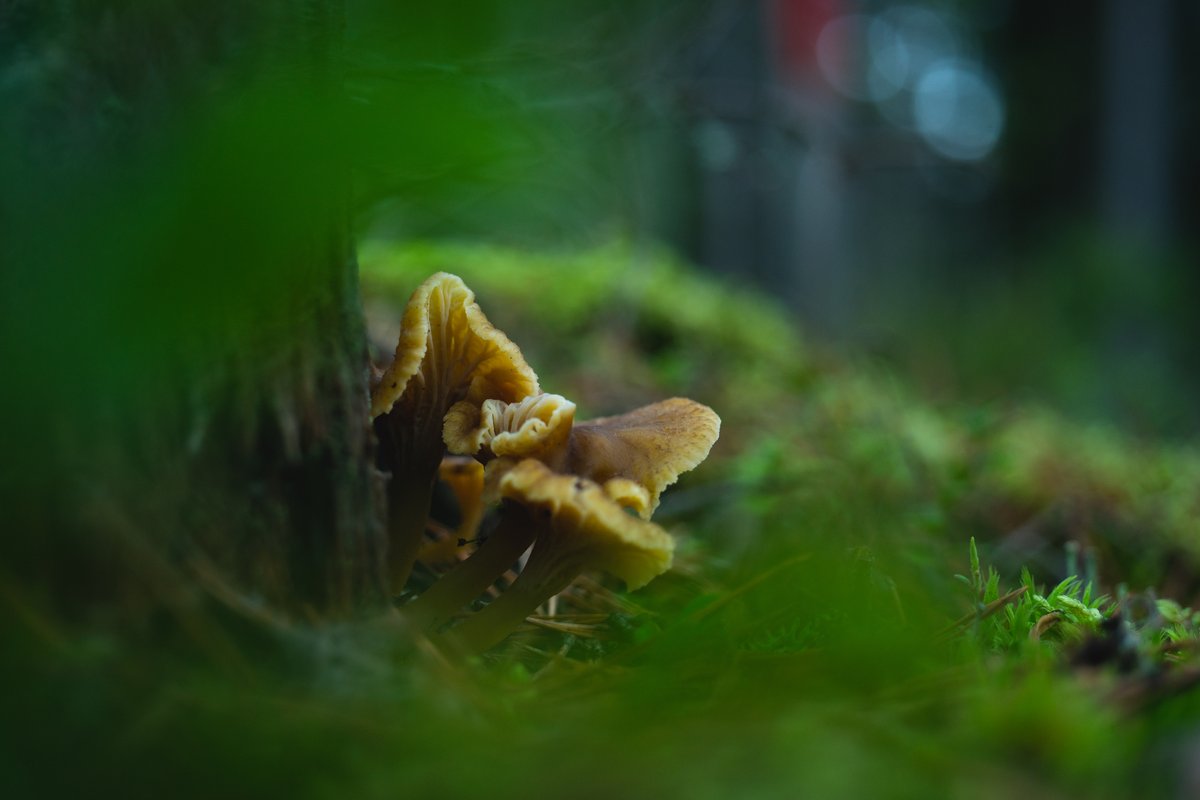
A small brown funnel cap (1–2.5 inches) sitting on a bright yellow, hollow stem — snap the stem in half and you'll see an empty tube.
The underside has blunt, forked ridges (false gills), not sharp blade-like true gills. Spore print white to pale yellow.
Fruits in troops in mossy conifer woods from late fall into winter, often after the first frosts. The very similar flame chanterelle (C. ignicolor) is also edible — the one to learn is the false chanterelle (Hygrophoropsis aurantiaca), which has true, bright-orange gills and a solid stem.
🌿 Traditional uses & research
A late-season gift for persistent foragers — where you find one, you'll usually find dozens. It's a staple of Scandinavian winter cooking: delicate, mildly peppery, and one of the few mushrooms that dries beautifully for later. Sautéed in butter, folded into pasta, or simmered into soup, it's an underrated edible that rewards the cold-weather walk.
⚠️ Safety notes
There's no truly toxic lookalike in the chanterelle group — every known Cantharellus and Craterellus is considered edible — but beginners do confuse winter chanterelles with the false chanterelle. Check for blunt ridges (not true gills) and the hollow yellow stem, and confirm your first finds with an expert.
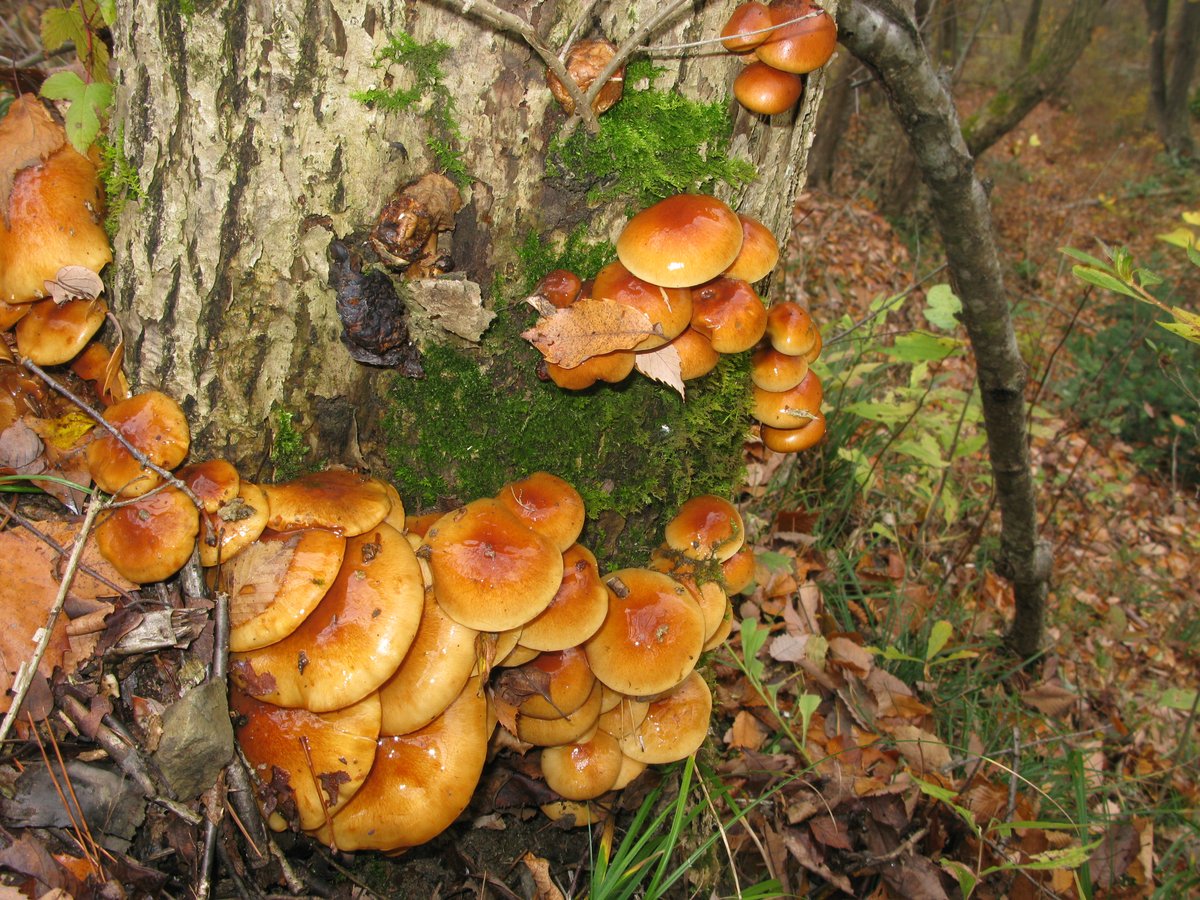
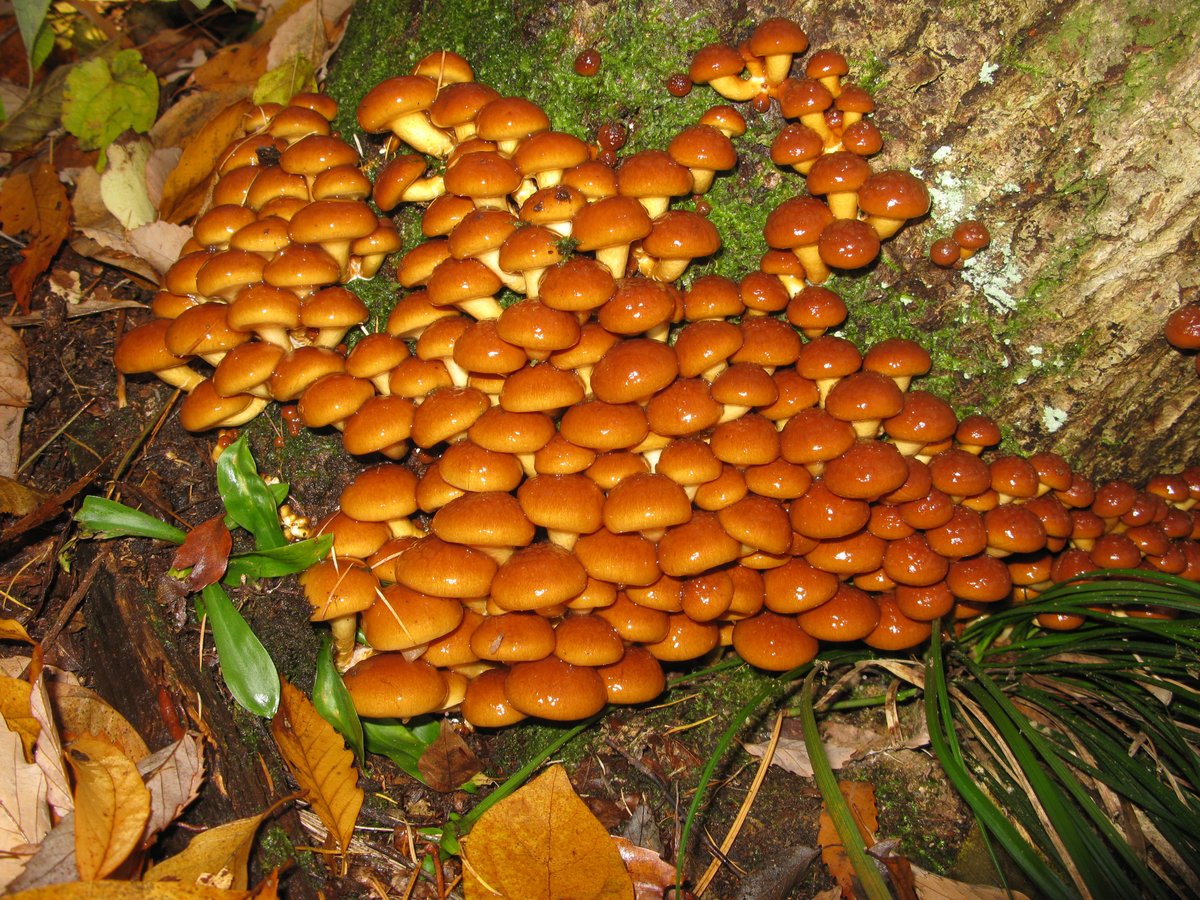
Small amber to orange-brown caps with a shiny, gelatinous slime coating — nameko literally means "slimy mushroom" in Japanese. That slipperiness is the field mark.
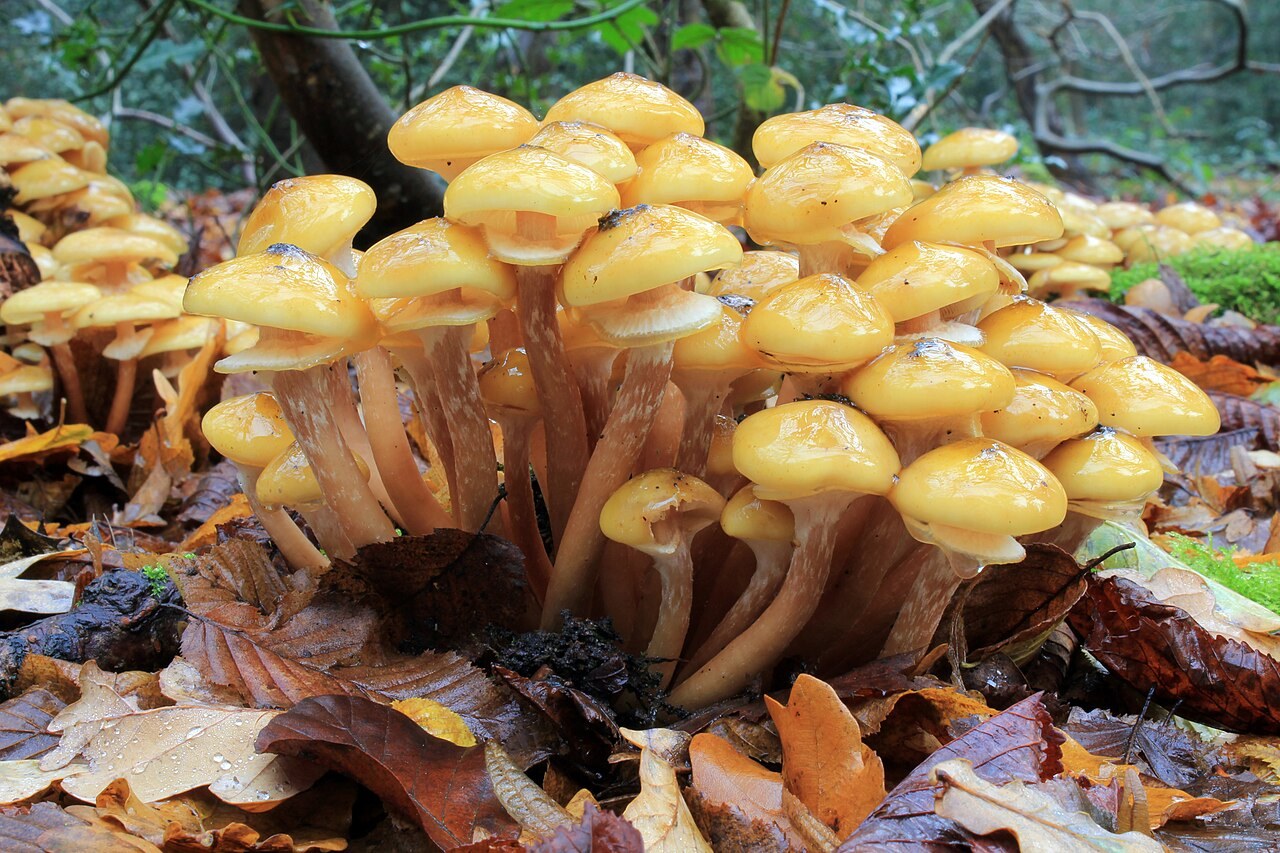
Grows in dense clusters on hardwood logs (oak, beech); a cold-triggered fall fruiter, available year-round from cultivation.
Slender stems, pale gills. Taxonomic note: mycologists now often list this mushroom as Pholiota microspora — same mushroom, newer name.
🌿 Traditional uses & research
Nameko is a classic of Japanese home cooking — the star of miso soup and hot pots, where its natural gelatin thickens the broth into something silky. The flavor is mild, nutty, and faintly like butterscotch, and the texture stays pleasantly slick through cooking. It's one of Japan's most popular cultivated mushrooms, also grown on logs and sawdust kits elsewhere.
⚠️ Safety notes
The Pholiota genus includes bitter and inedible species, so don't go by the slime alone in the wild. Stick with cultivated nameko or confirm any wild find with an expert.
Velvet brown clustered capsLong stems on poplar wood
Pioppino
Cyclocybe aegerita
🌍 Native to: Southern Europe and the Mediterranean
🔍 How to identify
Long, creamy-white stems topped with velvety brown caps (1.5–4 inches), fruiting in tight, elegant clusters.
Grows on poplar, willow, and other hardwood stumps and logs; dark brown spore print, with a faint veil ring on the stem.
You'll still see the older name Agrocybe aegerita on spawn and grow kits — same mushroom. Italy's favorite cultivated mushroom, foraged and grown since Greek and Roman times.
🌿 Traditional uses & research
Meaty, nutty, and faintly peppery, with a firm texture that holds its shape in pasta, risotto, and stir-fries — and unlike many mushrooms, the whole thing is good eating, stems included. Italian chefs have prized the pioppino for centuries, and it's gaining ground with growers and home cultivators in North America too.
⚠️ Safety notes
Brown-spored mushrooms fruiting in clusters include some tricky little brown mushrooms (LBMs), and related Agrocybe species are not beginner fare. Buy cultivated or confirm every wild ID with an expert.
Brown beech bouquet clusterWhite beech form, market bunch
Shimeji
Hypsizygus tessellatus
🌍 Native to: East Asia and North America
🔍 How to identify
Small caps on long white stems, growing in fused bouquets from a shared base. The brown form ("buna-shimeji," brown beech) has marbled, water-spotted caps; the white form ("bunapi," white beech) is a cultivated strain of the same species.
In the wild, clustered on hardwoods like beech, aspen, and maple in autumn; nearly every bunch in stores is cultivated.
Note: the true hon-shimeji is a different mushroom — Lyophyllum shimeji, a mycorrhizal species that resists cultivation. What's sold as shimeji is the beech mushroom.
🌿 Traditional uses & research
A staple of Japanese soups, hot pots, and stir-fries — it keeps its shape and a firm, slightly crunchy bite through cooking, turning nutty and savory with a deep umami character. It must be cooked: raw shimeji is bitter and hard to digest, but heat transforms it completely. Just trim the shared base, rinse, and cook.
⚠️ Safety notes
Always cook shimeji thoroughly — never eat it raw. If you find clustered brown-capped mushrooms on wood in the wild, confirm the ID with an expert before cooking.
Yellow to chestnut-brown caps (2–4 inches) with darker brown scales and a slightly greasy feel when wet — Pholiota means "scaly," adiposa means "greasy."
Grows in clusters on hardwood logs, especially beech; pale yellow gills maturing to rusty brown; reddish-brown spore print; stems yellow above, rusty toward the base.
Compare with its smaller, slimier cousin nameko. Many other Pholiota species look frustratingly similar.
🌿 Traditional uses & research
Now grown commercially in North America as a gourmet mushroom, valued for a rich, nutty, umami flavor and a satisfying bite — sautéed, roasted, or grilled. Pick them young, while the caps are still rounded, for the most tender texture. Worth knowing: European field guides are more cautious about eating wild scalycaps, so the "gourmet" reputation here rests on cultivated mushrooms.
⚠️ Safety notes
The Pholiota group is classic little-brown-mushroom territory, with bitter and inedible lookalikes. Rely on cultivated chestnut mushrooms or a confirmed expert ID — never eat a scalycap on a guess.
Tall white shaggy cylinders in grassCap melting into black ink
Shaggy Mane
Coprinus comatus
🌍 Native to: North America, Europe and Asia
🔍 How to identify
Unmistakable in its prime: a tall white cylinder (3–6 inches) covered in shaggy, upturned brown-tipped scales, like a lawyer's wig — one of its old nicknames.
Within hours of picking, the cap digests itself from the bottom up into black liquid — deliquescence. That inky melt was once actually used as writing ink.
Grows in grass, lawns, wood-chip beds, and path edges, often in troops after rain, spring through fall. Gills start white, blush pink, then blacken as the melt begins.
🌿 Traditional uses & research
Eat it the same day you pick it — young, firm, and still white — and it's one of the great lawn mushrooms: delicate, sweet, and lovely in eggs, soups, and a quick butter sauté. The clock is the whole game; a shaggy mane picked in the morning is ink by dinner. It's also widely cultivated in China, where researchers have studied its fiber and polysaccharide content. In the kitchen, though, it's simply a race you want to win.
⚠️ Safety notes
Only eat young specimens that are pure white inside, cooked promptly. Don't confuse it with the common inky cap (Coprinopsis atramentaria), a smoother, greyer mushroom that reacts badly with alcohol — shaggy mane is shaggy, taller, and grows more often in grass than on wood. When in doubt, let it melt, and confirm every wild identification with an expert.
Deep blue caps in pine woodsCut flesh showing indigo milk
Indigo Milk Cap
Lactarius indigo
🌍 Native to: Eastern North America, Central America and East Asia
🔍 How to identify
The blue mushroom. Cap, gills, and flesh are silvery indigo blue, and a cut mushroom bleeds dark blue "milk" (latex) that slowly turns green as it dries.
Caps are 2–6 inches, often with concentric blue zones, growing on the ground with pines and oaks — never on wood. Most common in the Gulf Coast, Southeast, and Southwest, and down through Mexico and Central America.
No other milk cap is blue. Faded older specimens go grey-blue and greenish where handled, which only makes the ID easier.
🌿 Traditional uses & research
A beloved market mushroom in Mexico, where it's sold as the azul and grilled, stewed, or folded into quesadillas. The firm, slightly grainy flesh keeps a blue-green tint even after cooking — dinner-party drama included free. Its pigments (a rare blue in the fungal world — the color comes from an azulene compound) have drawn chemists' attention, but at the table it's about looks and a mild, nutty flavor.
⚠️ Safety notes
The blue latex is close to a guarantee — no toxic milk cap shares it — but milk caps as a group demand care: several Lactarius species are acrid or cause stomach upset raw. Cook indigo milk caps thoroughly, eat a modest first portion, and confirm every wild identification with an expert.
Dense cluster at a tree baseRinged stems and white gills
Honey Mushroom
Armillaria mellea
🌍 Native to: North America, Europe and Asia
🔍 How to identify
Honey-brown caps (1–4 inches) in big, dense clusters at the bases of trees and stumps, with white gills, a cottony ring on the stem, and a white spore print — that print matters (see safety).
Under the bark you'll find its black "shoestrings" (rhizomorphs) and white mycelial fans. The mycelium glows faintly green in rotting wood on dark nights — the original foxfire.
A fall mushroom across North America and Europe. It's a tree parasite and a relentless one: its Oregon relative is the largest known organism on Earth, a single fungus spanning miles of forest.
🌿 Traditional uses & research
A cornerstone wild edible in Eastern Europe and Italy — pickled, stewed, and fried in quantity wherever it fruits. Firm, full-flavored, and a little slippery when cooked, it's a mushroom that rewards a long, thorough cook. Ecologically it's a double agent: gourmet prize above ground, forest pathogen below it, recycling dead wood while quietly killing stressed trees.
⚠️ Safety notes
Two rules are non-negotiable. First, always cook honey mushrooms thoroughly — raw or undercooked, they cause real GI misery, and some people are sensitive even cooked; try a small portion first. Second, the deadly galerina (Galerina marginata) grows on wood in the same season and can mix into the same woods: it is smaller, has NO ring-flecked cluster habit, and drops a rusty-brown spore print versus honey mushroom's white. Print every batch, and confirm your identification with an expert.
White football-sized sphere in grassSliced open, pure white inside
Giant Puffball
Calvatia gigantea
🌍 Native to: North America, Europe and Asia
🔍 How to identify
A smooth white ball the size of a soccer ball — sometimes much bigger. No cap, no stem, no gills: just a round white sphere sitting in grass, meadows, and garden edges in late summer and fall.
The test is inside: slice it top to bottom. A good one is pure, uniform white all the way through, like mozzarella. Any yellowing or browning means it's past eating and turning to spores.
One mature puffball releases trillions of spores — among the most fecund organisms on Earth.
🌿 Traditional uses & research
The forager's tofu: slice young puffballs into steaks and fry them, cube them into soups, or dry and crumble them as a base. The flavor is mild and mushroomy, the texture silky when cooked hot and fast. Historically, the spore mass was carried as a styptic to staunch wounds — a folk use best left to history. Fresh and young is the whole story with this one.
⚠️ Safety notes
The slice test is a safety test, not just a quality check: a young Amanita "egg" — including the death cap's — can look like a small puffball from outside, but cut it and you'll see the outline of a mushroom inside. A true puffball is uniform white with NO internal structure. Also pass on any puffball that's yellow, olive, or powdery inside, and avoid the thick-skinned earthballs (Scleroderma), which are dark purple-black inside and toxic. Confirm every first find with an expert.
Lilac stems under tan-brown capsViolet gills and stout stem, up close
Blewit
Clitocybe nuda (Lepista nuda)
🌍 Native to: North America, Europe and Asia
🔍 How to identify
A sturdy mushroom with a lilac-to-violet stem and gills under a cap that fades from violet-brown to plain tan — the color drains from the cap first, so the stem tells the truth.
Smells faintly perfumed, like frozen orange juice or flowers. Fruits late — fall into early winter, often after frosts — in leaf litter, compost, and garden mulch, sometimes in rings.
Spore print is pale pinkish-lilac. That print is the key safety check (see below).
🌿 Traditional uses & research
A classic of European markets and French country cooking, prized for its firm texture and floral, almost perfumed flavor that stands up to cream sauces and slow braises. It's one of the last good edibles of the year — a mushroom for the first cold weeks, when the woods have mostly emptied out. The name is old English: "blue hat," worn down to blewit.
⚠️ Safety notes
Purple mushrooms demand a spore print. Toxic Cortinarius species can share the blewit color and habitat, but they carry a cobwebby veil on young stems and drop rusty-brown spores; blewits print pale lilac-pink and have no veil. Also always cook blewits — raw or undercooked, they upset some stomachs, and a few people are allergic even cooked. Print, cook, small first taste, and confirm with an expert.
Carrot-orange caps under pineCut flesh bleeds orange
Saffron Milk Cap
Lactarius deliciosus
🌍 Native to: Europe
🔍 How to identify
A carrot-orange milk cap with fainter darker zones on the cap, a hollow stem with orange pits, and the giveaway: cut or bruised flesh bleeds bright carrot-orange latex, slowly staining green where it's handled.
Always with pines — it fruits from pine roots in plantations, forests, and even landscaped pine plantings, in fall. The green staining on older specimens is normal, not rot.
The name is a small lie: it's European royalty among edibles, but several close North American relatives share the orange-latex habit and vary in quality — key yours to species before the pan.
🌿 Traditional uses & research
In Spain it's the níscalo, grilled over coals and sold by the crate; in Russia it's the ryzhik, salted and pickled for winter. Few mushrooms carry more national pride per gram. The flavor is firm, earthy, and faintly resinous, and the texture stays meaty where other mushrooms go soft — built for the grill, the pickle jar, and a slow stew. (Fair warning it shares with its genus: it can tint your urine orange-red for a day. Harmless, but startling if nobody tells you.)
⚠️ Safety notes
Confirm the full package — pine habitat, orange latex, green staining, hollow pitted stem — and learn the woolly milk cap and other pale or hairy Lactarius, which are acrid and can cause gastric upset. Some people find even the true species rich; cook thoroughly, try a small portion first, and confirm every wild identification with an expert.
Grey-brown cap, ridged edgeFrom a white sac, ringless stem
Grisette
Amanita vaginata
🌍 Native to: Europe
🔍 How to identify
An elegant grey-brown Amanita with a distinctly ridged (striate) cap edge, free white gills, and a tall, fragile stem with NO ring — the feature that separates the grisette group from its lethal cousins.
It hatches from a loose white sac (volva) at the base, like an egg. Dig up the whole base: the sac is part of the ID, and it's the same structure the death cap has.
Summer and fall in all kinds of woodland, worldwide. The name covers a complex of very similar species, some still being split apart by science.
🌿 Traditional uses & research
In France and Italy the grisette is a respected edible — delicate, mild, and nutty, gathered for centuries by people who can read Amanita fluently. It has no medicinal tradition to speak of; its entire story is culinary expertise. That expertise is the entry fee: this is a mushroom for people who have keyed out dozens of amanitas, not for a first foraging season. We include it because it belongs in any honest guide to the genus — with the caution stated as loudly as we can state it.
⚠️ Safety notes
This is an advanced-ID mushroom in the genus that kills people. The death cap and destroying angels are close relatives; a grisette whose ring was lost to weather, or a young specimen still in the "egg," can be fatally misread. Only eat it if an expert who knows Amanita section Vaginatae has confirmed your find in person, always cook it (raw grisette is not safe), and skip it entirely if there is any doubt. When in doubt, don't — no meal is worth it.
A parasol tall enough to nameSnakeskin stem, shaggy scales
Parasol Mushroom
Macrolepiota procera
🌍 Native to: North America, Europe and Asia
🔍 How to identify
One of the tallest mushrooms in the field: a drumstick when young, opening into a broad parasol 8–12 inches across, on a stem that can reach a foot — with a double ring that slides up and down the stem like a loose collar.
Cap covered in shaggy brown scales over white, with a dark central bump; the stem shows a snakeskin pattern of brown bands. Gills white and free, spore print white.
Meadows, pasture edges, and open woods in late summer and fall, often in rings or loose troops. A European icon that also fruits in North America.
🌿 Traditional uses & research
Across Europe the parasol is market royalty — caps the size of dinner plates, dipped in crumbs and fried like schnitzel, stems dried and powdered for seasoning. The flavor is rich, hazelnutty, and unmistakably "mushroom" turned up loud. It's too big and too choice to hide: when a parasol ring fruits in a village meadow, everybody knows by lunch. In the kitchen, treat the cap like a cutlet and the tough stem like a stock ingredient.
⚠️ Safety notes
The dangerous lookalike is the green-spored parasol (Chlorophyllum molybdites) — North America's most common poisoning mushroom — plus small Lepiota species that carry the same toxins as the death cap. Rules: only collect tall parasols well over 8 inches with the snakeskin stem and movable double ring, take a white spore print (green = reject, always), never eat small parasol-like mushrooms, and confirm every wild identification with an expert.
A regal meadow mushroom: large golden-brown cap covered in fine scales, a thick white stem with a big skirt-like ring, and a smell that gives it away — sweet almonds, almost marzipan, especially when the cap is scratched or warmed in your hand.
Gills start pale pink, deepen through chocolate to nearly black as the spores mature; spore print is dark chocolate brown. Flesh may yellow faintly and slowly, never instantly or intensely.
Summer into fall in wood chips, compost-rich garden edges, and under conifers — a West Coast specialty that also appears across temperate North America and Europe.
🌿 Traditional uses & research
Foragers who know the almond-scented Agaricus group guard their prince patches like fishing holes. It's the grocery-store mushroom's wild aristocrat — same genus as the button mushroom, but bigger, sweeter, and perfumed with almond. Dry-sauté it to concentrate the flavor, grill thick slices, or fold it into eggs and risotto. Because it fruits in urban wood chips and garden mulch, it's one of the most accessible "expert" mushrooms on the West Coast — if your nose works.
⚠️ Safety notes
The trap in this genus is the yellow stainer and its kin: they stain chrome-yellow instantly when cut, smell of ink or chemicals instead of almonds, and cause real gastric distress. The nose test plus the stain test is the ID — almond scent, no instant yellow, or it goes back. Also avoid mushrooms from treated lawns and roadside mulch that may carry pesticides or heavy metals, and confirm every wild identification with an expert.
Pure white, translucent caps with a glossy, slimy glaze — held up to the light they genuinely look like fine porcelain, complete with a small ring on the slender stem and widely spaced white gills.
Only on dead beech: standing trunks, fallen logs, and high branches, in clusters from late summer into late fall. It's European — beech forest is its whole world.
The slime is a feature, not a flaw: it protects the cap from drying and from the fungivore flies that would otherwise move in.
🌿 Traditional uses & research
Eaten in parts of Europe after the slime is rinsed and the caps are cooked — mild, delicate, and more beautiful than bold. Its real research fame is chemical: porcelain fungus defends its beech log with a natural fungicide it secretes into the wood, and that compound (a strobilurin) became the template for an entire class of modern agricultural fungicides now used worldwide. A mushroom so committed to keeping its log that it changed farming. In the kitchen, a quick sauté keeps the caps' pearly look intact.
⚠️ Safety notes
Wash off the slime and always cook it — raw specimens are not recommended, and reactions vary; try a small amount first. Pale wood-growing mushrooms include genuine hazards (the deadly dapperlings and conecaps are small, but they are not porcelain-white and beech-bound). Key the habitat (dead beech), the ring, and the translucent cap together, and confirm every wild identification with an expert.
Yellow cap, white veil patchDig to find the volva cup
Coccora
Amanita calyptroderma
🌍 Native to: Western North America
🔍 How to identify
A big yellow to orange-yellow cap, 4–10 inches across, often carrying a large white patch of veil tissue on top like a bandage. The cap is smooth and slightly sticky when damp.
White gills and a thick white stem with a skirt-like ring — and at the very base, a large white sac-like cup (volva). Dig the whole mushroom up: the volva is often buried.
Grows with oaks — especially coast live oak — in fall and early winter. A California specialty: one of the state's most sought-after wild edibles.
Deadly serious lookalike — the death cap (Amanita phalloides) shares the volva, the ring, and the oak habitat. Pale death caps can look yellowish. If the cap is olive-toned at all, or anything doesn't fit, walk away.
🌿 Traditional uses & research
Known to California foragers as "coccoli," the coccora is one of the West Coast's great table mushrooms — thick, meaty, and mild, best sliced and fried or grilled. It fruits in the same oak woodlands as the death cap, which is why old-timers insist beginners learn it from an expert in person before ever eating one.
⚠️ Safety notes
Never eat any wild Amanita on a photo ID or a single feature — the volva, ring, yellow cap, and oak habitat must ALL check out, and even then, confirm with an expert your first time. Cook thoroughly. A small number of people react to coccora even when correctly identified, so eat a small portion first.
Dark wine-red capYellow pores underneath
Queen Bolete
Boletus regineus
🌍 Native to: Western North America
🔍 How to identify
A dark reddish-brown to wine-colored cap, 4–10 inches across, smooth and slightly velvety — like a porcini that went dark.
Yellow pores underneath that barely stain blue when pressed (or not at all), and white flesh that stays white when cut.
A thick pale stem with fine white netting (reticulation) near the top — the net is the bolete family's signature.
Grows with oaks and conifers in fall, in the Coast Ranges and Sierra foothills. One of California's finest edibles.
🌿 Traditional uses & research
The "queen" of California boletes — every bit as good as the porcini (Boletus edulis) it's often found beside, with dense white flesh that sautés beautifully and dries well. Foragers in the Sierra foothills plan fall weekends around it.
⚠️ Safety notes
Cook all boletes. Taste-test a tiny piece raw and spit it out: bitter means it's a bitter bolete, not a queen. Never eat a bolete with red or orange pores — that's the Satan's bolete group.
Dark cap, yellow poresThe red stem gives it away
Zeller's Bolete
Xerocomellus zelleri (formerly Boletus zelleri)
🌍 Native to: Western North America
🔍 How to identify
A nearly black, dark-brown velvety cap, 2–5 inches across — one of the darkest boletes you'll meet.
Bright yellow pores underneath that may stain blue slowly when pressed.
A slender red to reddish stem, yellow at the top — the dark cap plus red stem is the tell.
Grows with conifers (Douglas fir, hemlock) and oaks in fall, all along the California coast. Very common once you learn it.
🌿 Traditional uses & research
A solid everyday edible — not as prized as porcini or queen bolete, but abundant, good in the pan, and it dries well for winter soups. One of the first boletes new California foragers learn.
⚠️ Safety notes
Cook thoroughly; the slow blue staining is normal for this species. Do the nibble-and-spit bitterness test to rule out bitter boletes.
Slimy cap, ringed stemYoung buttons under pines
Slippery Jack
Suillus luteus
🌍 Native to: North America, Europe and Asia
🔍 How to identify
A slimy, sticky brown cap, 2–5 inches across — the slime layer peels off like a sticker. Always found under pines.
Yellow pores underneath, sometimes with a slight olive tint.
A pale stem with a distinctive purplish-brown ring — the ring sets it apart from the ringless slippery jacks.
Grows in clusters under pines (especially Monterey pine) in fall. One of the most common mushrooms in California pine plantings.
🌿 Traditional uses & research
Widely eaten across Europe, where it's a staple of the fall table. Peel the slimy cap skin off before cooking — the slime is the part that upsets stomachs. Good fried, pickled, or dried.
⚠️ Safety notes
Always peel the cap skin and cook well. A minority of people get stomach upset from Suillus even when cooked — try a small portion your first time, and skip old, waterlogged specimens.
Pink gills at firstIn the grass
Meadow Mushroom
Agaricus campestris
🌍 Native to: North America, Europe and Asia
🔍 How to identify
A white cap, 2–4 inches across, flattening with age, growing in grass — lawns, pastures, meadows, never on wood.
Gills start bright pink and turn chocolate brown as the spores mature — the pink-to-brown sequence is the signature.
A white stem with a thin, fragile ring — and no cup (volva) at the base. Dig it up and check.
Appears after fall rains, often in troops or fairy rings. The wild ancestor of the grocery-store button mushroom.
🌿 Traditional uses & research
The classic wild Agaricus — mild, nutty, and excellent fried in butter. Foragers have gathered it from pastures for centuries, and it's the species the cultivated button mushroom was bred from.
⚠️ Safety notes
The yellow stainer (Agaricus xanthodermus) is the dangerous twin — it stains bright yellow at the stem base and smells of ink or phenol. White gills or a volva cup mean an Amanita, not a meadow mushroom. Skip lawns that may have been sprayed.
Half-buried in the duffThe white funnel
Short-Stemmed Russula
Russula brevipes
🌍 Native to: North America
🔍 How to identify
A big white funnel, 4–10 inches across, often half-buried in pine needles or oak leaves — you mostly see the rim poking out of the duff.
White gills that snap like chalk when you bend them — all russulas have this brittle, crumbly flesh.
A very short, thick white stem, often stained with dirt. The cap is usually dirty too — this mushroom doesn't clean up pretty.
Grows with conifers and oaks in fall. One of the most common large mushrooms in California — and the host of the lobster mushroom.
🌿 Traditional uses & research
Edible but famously bland, and often buggy — most foragers walk past it. Its real claim to fame is what happens when the lobster fungus (Hypomyces lactifluorum) takes it over: it turns bright orange-red and becomes the lobster mushroom, a delicacy.
⚠️ Safety notes
Cook before eating. Do the nibble-and-spit test: a peppery or acrid taste means it's a hot russula, not brevipes — spit it out and move on.
Fruiting under red pines in Hiroshima Prefecture, JapanFresh buttons, basket-ready
Japanese Matsutake
Tricholoma matsutake
🌍 Native to: East Asia
🔍 How to identify
Stout and sturdy: a whitish cap (2–8 inches) that browns with age, overlaid with dark fibers and flat scales; a thick, firm stem with a cottony ring; white gills; white spore print. Often half-buried in pine duff — dig it out whole.
The giveaway is the smell — a powerful, spicy scent of cinnamon and pine resin that fills a room. Use it to back up your ID, never as the whole test.
Mycorrhizal above all with Japanese red pine (Pinus densiflora), in well-drained, nutrient-poor soil; fruits in autumn. The same species also grows in northern Europe — Sweden, Finland, Norway — under Scots pine, where it was long known as T. nauseosum before DNA work confirmed it is one species.
This is the original matsutake — matsu (pine) + take (mushroom). Its American cousins are the western T. murrillianum and the eastern T. magnivelare: three sibling species in the matsutake group (Tricholoma section Caligata) that share a common ancestor and split apart millions of years ago. The American species are native to North America, not introduced from Japan — see the American Matsutake.
🌿 Traditional uses & research
The taste of autumn in Japan. Matsutake is prized less for flavor than for fragrance, so the classic dishes are built to carry the scent: dobin mushi, a clear soup steamed in a teapot; matsutake gohan, rice cooked with sliced caps; and yakimatsutake, caps grilled over charcoal with nothing but salt and a squeeze of sudachi. Top specimens are among the world's priciest wild mushrooms. It cannot be farmed — it needs a living host tree, and the only trials ever to produce a fruiting body used pine seedlings infected with matsutake mycelium, planted out and left for six years or more. Japan's own harvest has collapsed, from thousands of tons a year in the 1940s to a few dozen tons today, mostly because pine wilt nematode has killed the red pines it partners with. The species is listed as Vulnerable on the IUCN Red List, and Japan now imports most of its matsutake from China, Korea, Canada, and the Pacific Northwest — the trade story is told in the American Matsutake entry. In the lab, researchers have isolated polysaccharides from its mycelium and screened them for antioxidant and immune-supporting activity in cell and animal models. That's early research, not proof of any benefit — here it's a food first.
⚠️ Safety notes
In Japan, the confusable is fool's matsutake (Tricholoma bakamatsutake) — the same look, a similar smell, but it grows under oaks, not pines, and runs smaller; edible, but not the real thing. Two more Japanese lookalikes, T. fulvocastaneum (nise-matsutake) and T. robustum (matsutake-modoki), grow in broadleaf woods and pine forests respectively. The deadly Amanita confusion — Smith's amanita — is a problem for the American species, not this one, but the rule is the same everywhere: never eat a wild mushroom on a photo ID. Confirm every identification with an expert before eating anything wild, and if someone eats a mushroom they shouldn't have, call Poison Control (1-800-222-1222).
Psychedelic Mushrooms
The well-known psilocybin mushrooms — presented for education and harm reduction. Psilocybin is illegal in California and federally.
Golden-caramel clusterClose-up
Golden Teacher
Psilocybe cubensis 'Golden Teacher'
🌍 Native to: Tropical and subtropical Americas (now pantropical)
🔍 How to identify
The archetypal cubensis: golden-caramel caps, medium to large, flattening with age.
Sturdy pale stems that bruise blue where handled; purple-brown spore print.
A stabilized cultivated variety — all material in circulation is grown, not wild.
🍄 Effects & potency
Moderate, classic cubensis potency. Onset in 20–60 minutes, peak around 2–3 hours, total duration 4–6 hours. Dose-dependent: perceptual shifts, euphoria, and introspection at moderate doses; anxiety, paranoia, and nausea possible at higher doses.
⚠️ Safety notes
Psilocybin is a Schedule I controlled substance under federal law and illegal in California — possession and cultivation carry criminal penalties. Potency varies unpredictably between batches, and psilocybin can be risky for people with psychotic disorders or on certain medications. Educational information only.
🌍 Native to: Tropical and subtropical Americas (now pantropical)
🔍 How to identify
Notably large, thick caramel-to-golden caps — among the beefiest cubensis varieties.
Robust pale stems with blue bruising; purple-brown spore print; classic cubensis structure.
A cultivated variety only.
🍄 Effects & potency
Moderate, in the typical cubensis range — the same general timeline (20–60 minute onset, 4–6 hour duration) and dose-dependent effect profile.
⚠️ Safety notes
Psilocybin is a Schedule I controlled substance under federal law and illegal in California — possession and cultivation carry criminal penalties. Potency varies unpredictably between batches, and psilocybin can be risky for people with psychotic disorders or on certain medications. Educational information only.
🌍 Native to: Tropical and subtropical Americas (now pantropical)
🔍 How to identify
Unmistakable: short, thick, dense stems with small bulbous caps that often never fully open.
Paler and fleshier than typical cubensis; strong blue bruising; purple-brown spore print.
A cultivated mutant variety — it does not occur in this form in the wild.
🍄 Effects & potency
Widely reported as markedly more potent than typical cubensis — published lab analyses have shown substantially higher psilocybin content. Same effect character, but equivalent doses hit harder; the strain most associated with unexpectedly intense experiences.
⚠️ Safety notes
Psilocybin is a Schedule I controlled substance under federal law and illegal in California — possession and cultivation carry criminal penalties. Its higher and variable potency makes dosing especially unpredictable; added caution for anyone with mental-health vulnerabilities. Educational information only.
🌍 Native to: Tropical and subtropical Americas (now pantropical)
🔍 How to identify
Leucistic variety: creamy-white caps and stems — not a true albino, since the spore print stays dark purple-brown.
Otherwise classic cubensis structure: medium caps, slender stems, veil remnants; blue bruising still visible on the pale flesh.
A cultivated variety only.
🍄 Effects & potency
Moderate, in the typical cubensis range — the same onset and duration profile. The pale coloration says nothing about strength.
⚠️ Safety notes
Psilocybin is a Schedule I controlled substance under federal law and illegal in California — possession and cultivation carry criminal penalties. Potency varies unpredictably between batches, and psilocybin can be risky for people with psychotic disorders or on certain medications. Educational information only.
Cultivated specimenDried specimen
Mazatapec
Psilocybe cubensis 'Mazatapec'
🌍 Native to: Tropical and subtropical Americas (now pantropical)
🔍 How to identify
Classic medium golden-brown caps, sometimes slightly mottled, on slender pale stems.
The "textbook" magic mushroom look; blue bruising; purple-brown spore print.
One of the oldest cultivated strains, named for the Mazatec region of Mexico with its deep ceremonial mushroom history.
Psilocybin is a Schedule I controlled substance under federal law and illegal in California — possession and cultivation carry criminal penalties. Potency varies unpredictably between batches, and psilocybin can be risky for people with psychotic disorders or on certain medications. Educational information only.
Wild clusterClose-up
Wavy Cap
Psilocybe cyanescens
🌍 Native to: Western North America
🔍 How to identify
Caramel-brown, hygrophanous cap that flattens with age and develops a distinctly wavy margin — the namesake feature.
Flesh and stem bruise a strong blue where handled or damaged; purple-brown spore print.
Grows on wood chips, bark mulch, and woody debris — never on dung — fruiting in fall across the Pacific Northwest and northern California.
🍄 Effects & potency
Among the most potent Psilocybe species known from the wild, often reported substantially stronger than common cultivated varieties. Effects are the classic psilocybin profile — perceptual shifts, emotional intensification, and introspection — with anxiety, nausea, and confusion possible, especially given the unpredictable potency of wild material.
⚠️ Safety notes
Psilocybin is a Schedule I controlled substance under federal law and illegal in California — possession and cultivation carry criminal penalties. The deadly Galerina marginata grows on the same wood-chip substrate, often fruiting side by side with wavy caps, and has killed foragers who mistook it for a psilocybin species; never eat a wild mushroom without expert confirmation. Educational information only.
Saucer-shaped capsClose-up
Flying Saucer
Psilocybe azurescens
🌍 Native to: Western North America
🔍 How to identify
Broad, flattened caramel cap with a pronounced central nipple (umbo) — the "flying saucer" silhouette; strong, dark blue-black bruising when damaged.
Pale, often tall stem; spore print blackish-brown to purple.
A coastal specialist: dune grasses, sandy soils, and wood chips along the Oregon and Washington coast (also northern California), fruiting late fall into winter and unusually cold-tolerant for a psilocybin mushroom.
🍄 Effects & potency
Widely regarded as one of the most potent naturally occurring psilocybin mushrooms — published analyses place it well above common cultivated species, and potency varies dramatically between individual specimens. The experience profile is intense and long-lasting; this is not a forgiving species for the inexperienced, and reports of temporary physical distress at strong exposures exist in the literature.
⚠️ Safety notes
Psilocybin is a Schedule I controlled substance under federal law and illegal in California — possession and cultivation carry criminal penalties. Like other wood-loving Psilocybes, it shares habitat with the deadly Galerina marginata, and its exceptional potency means misidentification or misjudged strength carries outsized risk. Educational information only.
Grassy pasture habitatPointed caps
Liberty Cap
Psilocybe semilanceata
🌍 Native to: Europe and North America
🔍 How to identify
Small and unmistakable in outline: a sharply pointed, nipple-tipped cap on a slender, wavy stem.
Grows in unimproved grassland and pasture — never on wood chips and never on dung; purple-brown spore print, and unlike its wood-loving relatives it bruises blue only faintly or not at all.
One of the most widespread psilocybin mushrooms in the world, common across Europe and present in the Pacific Northwest, fruiting in fall.
🍄 Effects & potency
A historically significant species — among the first European psilocybin mushrooms to be scientifically studied — with a classic moderate psilocybin profile: perceptual changes, euphoria, and introspection, with anxiety and nausea possible. As with all wild psilocybin mushrooms, potency is unpredictable from one patch to the next.
⚠️ Safety notes
Psilocybin is a Schedule I controlled substance under federal law and illegal in California — possession and cultivation carry criminal penalties. Its small size makes confident identification difficult, and pastures host genuinely dangerous lookalikes including toxic Conocybe species — some of which are deadly. Never eat a wild mushroom without expert confirmation. Educational information only.
Wild specimensClose-up
Blue Meanie
Panaeolus cyanescens
🌍 Native to: Pantropical
🔍 How to identify
Thin and delicate: bell-shaped, hygrophanous caps fading from chestnut-brown to pale cream, with dark mottled gray-black gills and a jet-black spore print.
Bruises blue readily when handled; grows on dung in warm subtropical climates (Hawaii and the Gulf states in the U.S., plus the tropics worldwide).
Taxonomy note: formerly classified as Copelandia cyanescens; not a Psilocybe at all.
🍄 Effects & potency
One of the most potent psilocybin mushrooms known, frequently reported several times stronger than common cultivated varieties, with a fast onset and intense effects. The common name is dangerously overloaded: "Blue Meanie" is also used for an unrelated Psilocybe cubensis line, and the abbreviation P. cyanescens collides with the wood-loving Psilocybe cyanescens — mislabeled material is a genuine safety problem.
⚠️ Safety notes
Psilocybin is a Schedule I controlled substance under federal law and illegal in California — possession and cultivation carry criminal penalties. Dung pastures host many small brown lookalikes, some of them toxic, and the name confusion described above means you cannot trust a common name alone — scientific identity and expert confirmation matter. Educational information only.
Cap viewGill view
Laughing Gym
Gymnopilus junonius
🌍 Native to: North America, Europe and Asia
🔍 How to identify
Huge and unmissable: rusty-orange to yellow-brown caps that can reach 20–30 cm across, growing in dense clusters on stumps, logs, and tree bases.
Intensely bitter taste; rusty-brown to orange spore print (never purple-brown); a frail ring on the stem dusted with rusty spores — and crucially, it does not bruise blue like Psilocybe species.
Also called the spectacular rustgill; similar large Gymnopilus species in North America are frequently misidentified, often requiring a microscope or DNA to separate.
🍄 Effects & potency
Honestly, the science here is unsettled: reports of psilocybin in this species are inconsistent and disputed, with the true European species appearing to contain little to none — many "laughing gym" collections likely belong to other Gymnopilus species entirely, and some researchers have identified unrelated neurotoxins in the group. It is generally regarded as inedible (the bitterness alone rules out the table), and it should not be treated as a reliable or safe psychoactive mushroom.
⚠️ Safety notes
Psilocybin is a Schedule I controlled substance under federal law and illegal in California — possession and cultivation carry criminal penalties. Misidentification within this genus is rampant, the chemistry is unreliable, and eating large bitter wood mushrooms on a rumor is a bad gamble with your liver and nervous system. Educational information only.
In wood chips, OaklandCluster close-up
Allen's Psilocybe
Psilocybe allenii
🌍 Native to: Western North America
🔍 How to identify
Caramel-brown, hygrophanous cap with a wavy margin at maturity — a near-twin of the wavy cap (P. cyanescens) that shares its habitat and season.
Strong blue bruising where handled or damaged; purple-brown spore print.
Fruits in fall on wood chips, bark mulch, and woody debris — never on dung — from the San Francisco Bay Area up through the Pacific Northwest.
Described to science in 2012 and named for mycologist John W. Allen; earlier collections were long filed under look-alike species, so old records are unreliable.
🍄 Effects & potency
Reported among the more potent wood-loving Psilocybe species — potency of wild material varies unpredictably from patch to patch. Effects follow the classic psilocybin profile: perceptual shifts, emotional intensification, and introspection, with anxiety, nausea, and confusion possible. Psilocybin is a Schedule I controlled substance under federal law and illegal in California.
⚠️ Safety notes
The deadly Galerina marginata fruits on the same wood-chip substrate, often side by side with Allen's, and has killed foragers who mistook it for a psilocybin species — a spore print and expert confirmation are non-negotiable. Possession and cultivation carry criminal penalties. Educational information only — never eat a wild mushroom based on photos alone.
On woody debrisBluing stems
Ovoid
Psilocybe ovoideocystidiata
🌍 Native to: Eastern North America (now also California)
🔍 How to identify
Ovate, dome-shaped brown cap with a separable pellicle; stems bruise a vivid blue-green — the namesake ovoid cystidia are microscopic.
Grows on wood chips, mulch, and woody debris, often near rivers and floodplains — the classic habitat is shaded riverbank soil mixed with woody litter.
The spring oddball: it fruits March through June, when almost no other psilocybin species is fruiting in North America — its season is its best field clue.
First described from the Ohio River valley in 2003; its range has expanded eastward across the eastern US and as far west as California.
🍄 Effects & potency
Reported as one of the more potent North American Psilocybe species, with highly variable potency in wild material. Effects are the classic psilocybin profile — perceptual shifts, emotional intensification, and introspection — with anxiety, nausea, and confusion possible. Psilocybin is a Schedule I controlled substance under federal law and illegal in California.
⚠️ Safety notes
The deadly Galerina marginata shares the same woody riverside habitat and fruits alongside it; several Galerina poisonings have involved foragers hunting this species. Its spring season also overlaps with little brown mushrooms of many kinds — expert confirmation is essential, never eat from photos. Possession and cultivation carry criminal penalties. Educational information only.
Collected specimensBotanical illustration
Teonanácatl
Psilocybe mexicana
🌍 Native to: Mexico and Central America
🔍 How to identify
Small, bell-shaped cap with a distinctive pointed nipple (papilla), striate nearly to the top when moist; bruises blue at the stem base.
Grows in grasslands and pastures of central and southern Mexico — not on dung — fruiting June through September.
The species behind the modern discovery of psilocybin: R. Gordon Wasson's 1955 night ceremony (velada) with the Mazatec curandera María Sabina in Huautla de Jiménez, Oaxaca, and the mushrooms Albert Hofmann later cultured to isolate psilocybin and psilocin in 1958.
"Teonanácatl" — "flesh of the gods" in Nahuatl — was the Aztec name for the sacred mushrooms used in ceremony centuries before the Spanish conquest.
🍄 Effects & potency
Reported as a moderate-potency species — the one science knows best historically, yet weaker than many North American wood-lovers. Effects follow the classic psilocybin profile: perceptual shifts, emotional intensification, and introspection, with anxiety, nausea, and confusion possible. Psilocybin is a Schedule I controlled substance under federal law and illegal in California.
⚠️ Safety notes
Pasture look-alikes include toxic Conocybe and Panaeolus species that share the same grassland habitat — expert confirmation is essential. Possession and cultivation carry criminal penalties. Educational information only — never eat a wild mushroom based on photos alone.
Cultivated specimenPreserved specimen
Philosopher's Stone
Psilocybe tampanensis
🌍 Native to: Southeastern United States
🔍 How to identify
Small, unremarkable brown mushroom with a convex to flattened cap — wild fruiting bodies are almost never seen, so nearly all photos and descriptions come from cultivated material.
Famous for its sclerotia — hard, truffle-like masses of mycelium sold under names like "philosopher's stones" — which form below ground alongside the mushrooms.
Known from a single 1977 collection near Tampa, Florida, found by Steven H. Pollock and described with Gastón Guzmán in 1978; it has never been reliably found in the wild again.
Because it exists almost entirely in culture, "identification" here is mostly about recognizing the sclerotia and understanding that this species has no real foraging tradition.
🍄 Effects & potency
Reported as moderate in potency, with the sclerotia form carrying the cultural fame rather than the mushrooms themselves. Effects follow the classic psilocybin profile — perceptual shifts, emotional intensification, and introspection — with anxiety, nausea, and confusion possible. Psilocybin is a Schedule I controlled substance under federal law and illegal in California.
⚠️ Safety notes
This is not a foraging species: with essentially no wild population, any material offered as "philosopher's stones" comes from unregulated cultivation of unknown content and potency. Possession and cultivation carry criminal penalties. Educational information only.
On dead woodFree gills, no ring
Willow Pluteus
Pluteus salicinus
🌍 Native to: Europe
🔍 How to identify
Grows directly on dead wood — willow, alder, and other hardwoods — with a gray-brown cap and gills that start pale and turn pink with the maturing spore print.
The diagnostic trio: gills free from the stem (no attachment), a pink spore print, and blue-green bruising at the stem base where handled.
Widespread but scattered across Europe and North America; North American material is often assigned to the close relative Pluteus americanus (described 2014) — the two are told apart microscopically.
Fruits summer through fall; no partial veil or ring, and the flesh of the cap never blues — only the stem base does.
🍄 Effects & potency
Reported as low to moderate in potency, with wide variation and many collections too weak to be notable — the Pluteus genus was not confirmed psilocybin-containing until the late 20th century. Effects follow the classic psilocybin profile, with anxiety, nausea, and confusion possible. Psilocybin is a Schedule I controlled substance under federal law and illegal in California.
⚠️ Safety notes
Wood-dwelling look-alikes include deadly Galerina species that also grow on dead wood — the pink-spore-print check is the make-or-break test (Galerina prints are rusty brown), but only expert confirmation counts. Possession and cultivation carry criminal penalties. Educational information only — never eat a wild mushroom based on photos alone.
Lawn-dwelling little brown mushroomsMottled gills and banded cap zone
Banded Mottlegill
Panaeolus cinctulus
🌍 Native to: Worldwide (temperate regions)
🔍 How to identify
A small brown lawn mushroom (cap 2–5 cm): brown when moist, fading to buff with a darker banded zone at the margin as it dries. The gills are mottled darkening to sooty black, and the spore print is grayish-black to black.
Grows singly or in clusters on lawns, composted garden beds, manured pasture, and dung — a true "little brown mushroom" (LBM) of ordinary neighborhoods.
Never eat wild LBMs: the same lawns and dung piles host deadly lookalikes, including Galerina species, whose amatoxins cause fatal liver failure. No trip is worth that gamble.
🍄 Effects & potency
Contains psilocybin and psilocin. When eaten, onset is typically 20–60 minutes, peak around 2–3 hours, total duration about 4–6 hours: altered visual perception, vivid color and pattern distortion, shifts in mood and thought, often with nausea early on. It is generally considered weaker and less predictable than Psilocybe cubensis — estimates put it around half as strong at best, and alkaloid content varies sharply between specimens, patches, and seasons, so the same dried weight can be mild one batch and unexpectedly strong the next. Psilocybin can trigger severe anxiety or dangerous behavior when judgment is impaired, and it is risky for people with psychotic disorders or on certain medications.
⚠️ Safety notes
Psilocybin is a Schedule I controlled substance under federal law and illegal in California — possession and cultivation carry criminal penalties. Potency varies unpredictably between batches, and psilocybin can be risky for people with psychotic disorders or on certain medications. And the identification risk deserves repeating: deadly Galerina species grow in the same habitats as this mushroom, so picking "little brown mushrooms" by sight alone can kill you — confirm every identification with an expert. Educational information only.
Pale stems, caramel-tan cap, dark gills. Photo: Greenmystery, CC BY-SA 3.0 (Mushroom Observer)Size reference — a small, slender species. Photo: Greenmystery, CC BY-SA 3.0 (Mushroom Observer)
Psilocybe natalensis
Psilocybe natalensis
🌍 Native to: Southern Africa
🔍 How to identify
A South African species, described in 1995 from KwaZulu-Natal. It resembles a slim, long-stemmed cubensis: caramel-brown caps, pale stems that bruise blue, purple-brown spore print.
Wild on compost-rich ground and dung-enriched soils in its home range; everything in circulation elsewhere is cultivated.
Recent genetic work suggests it may be cubensis's closest known relative — a sister species that evolved an ocean away.
🍄 Effects & potency
Regarded by cultivators as notably potent — commonly reported stronger than typical cubensis, with the same general timeline: onset in 20–60 minutes, peak around 2–3 hours, total duration 4–6 hours. Effects are dose-dependent: perceptual shifts, euphoria, and introspection at moderate doses; anxiety, paranoia, and nausea possible at higher doses. Strength reports are anecdotal and batch-dependent.
⚠️ Safety notes
Psilocybin is a Schedule I controlled substance under federal law and illegal in California — possession and cultivation carry criminal penalties. Potency varies unpredictably between batches, and psilocybin can be risky for people with psychotic disorders or on certain medications. Educational information only.
Knobbed, wavy caps in mulchBlue-staining stems, close view
Knobby Top
Psilocybe baeocystis
🌍 Native to: Western North America
🔍 How to identify
A small Pacific Northwest species with a distinctive knob (umbo) at the center of a wavy, olive-brown cap — the "knobby top" of the name. Caps often pleat and ripple as they open.
Thin stems stain blue-green where handled. Purple-brown spore print. It also produces baeocystin, a psilocybin relative named after this very mushroom ("baeocystis" gives us "baeocystin").
Fruits in fall on wood chips, mulch, and lawns with woody debris, from Oregon into British Columbia.
🍄 Effects & potency
Small but strong — considered potent for its size, with a cubensis-like timeline (onset 20–60 minutes, peak 2–3 hours, duration 4–6 hours). Dose-dependent effects range from perceptual shifts and euphoria to anxiety and nausea at higher doses. Wild potency varies widely, which is a core harm-reduction fact for every species in this section.
⚠️ Safety notes
Psilocybin is a Schedule I controlled substance under federal law and illegal in California. The serious risk in the Pacific Northwest is misidentification: deadly Galerina marginata grows on the same wood chips in the same season and does NOT bruise blue — learn it before trusting any blue bruise. Psilocybin can also be risky for people with psychotic disorders or on certain medications. Educational information only.
Caramel caps in wood-chip bedsThe blue-stained ring on the stem
Blue Ringers
Psilocybe stuntzii
🌍 Native to: Western North America
🔍 How to identify
Named for University of Washington mycologist Daniel Stuntz. Caramel-brown caps (1–3 cm), straight pale stems, and a fragile ring (annulus) on the stem that often stains blue — the "blue ringer" mark.
A mushroom of the human landscape: wood-chip beds, mulch, compost, and rich lawns in the Pacific Northwest, fruiting summer into late fall.
Purple-brown spore print; flesh bruises blue, most reliably at the stem base and ring.
🍄 Effects & potency
Moderate potency — generally reported milder than wavy caps, stronger than its size suggests. Timeline matches the family pattern: onset 20–60 minutes, peak 2–3 hours, total 4–6 hours, with dose-dependent perceptual and emotional effects and the usual possibility of anxiety or nausea at higher doses.
⚠️ Safety notes
Psilocybin is a Schedule I controlled substance under federal law and illegal in California. This species carries one of the starkest warnings in this encyclopedia: the deadly galerina shares its wood chips, its season, and its size. The galerina's print is rusty brown, its ring rusty, and it never bruises blue — but a mixed patch can hold both. Psilocybin can be risky for people with psychotic disorders or on certain medications. Educational information only.
Large papillate caps, Sierra habitatStrong blue bruising
Psilocybe zapotecorum
Psilocybe zapotecorum
🌍 Native to: Mexico, Central and South America
🔍 How to identify
A large, imposing species from the cloud forests of Oaxaca, Mexico — conical to bell-shaped caps with a pronounced central bump (papilla), on thick stems that bruise an intense blue-black.
Grows on muddy banks, landslide scars, and wet clay soils in the rainy season — an unusual habitat for the genus, which mostly prefers wood and dung.
Named for the Zapotec people, in whose ceremonial tradition it has a documented place; the Zapotec name is often rendered "derrumbe," the landslide mushroom.
🍄 Effects & potency
Considered one of the more potent Psilocybe species in traditional and modern reports alike. Timeline is the family pattern — onset within the hour, peak at 2–3 hours, 4–6 hours total — with strong perceptual and introspective effects at moderate doses and a correspondingly higher risk of anxiety, paranoia, and nausea as dose climbs. Historical use was ceremonial, guided, and dose-measured by experienced practitioners.
⚠️ Safety notes
Psilocybin is a Schedule I controlled substance under federal law and illegal in California — possession and cultivation carry criminal penalties. Potency varies unpredictably, and psilocybin can be risky for people with psychotic disorders or on certain medications. This entry exists for education and identification, in the context of a documented Indigenous tradition — not as a recommendation. Educational information only.
Sharp conical cap with long papillaCluster in subtropical forest soil
Psilocybe hoogshagenii
Psilocybe hoogshagenii
🌍 Native to: Mexico and Central America
🔍 How to identify
A subtropical Mexican species with a sharply conical cap topped by a long, pointed papilla — like a tiny dunce cap. Caps are reddish- to caramel-brown, stems pale and bruising blue.
Fruits in the rainy season on clay soils and coffee-plantation ground in Chiapas and Oaxaca. Described by French mycologist Roger Heim, who named it for anthropologist Searle Hoogshagen, his guide to the Mixe people.
Purple-brown spore print; the exaggerated papilla separates it from most lookalikes in its range.
🍄 Effects & potency
Reported as moderately to strongly potent, with the standard psilocybin timeline (onset 20–60 minutes, peak 2–3 hours, duration 4–6 hours) and dose-dependent perceptual, emotional, and introspective effects. In Mixe tradition it was used in guided divinatory ceremonies — context that mattered to how it was approached. Anxiety and nausea are possible, particularly at higher doses.
⚠️ Safety notes
Psilocybin is a Schedule I controlled substance under federal law and illegal in California — possession and cultivation carry criminal penalties. Potency varies unpredictably between batches, and psilocybin can be risky for people with psychotic disorders or on certain medications. Educational information only.
Small caramel caps in conifer debrisThin cap skin peels away
Psilocybe pelliculosa
Psilocybe pelliculosa
🌍 Native to: Western North America
🔍 How to identify
A small Pacific Northwest species of conifer forests: caramel-brown caps (1–3 cm) on slender pale stems, fruiting in fall on woody debris, twigs, and needle litter rather than dung or lawns.
Named for its pellicle — the cap's gelatinous skin peels away cleanly like a sheet of plastic wrap, a signature Psilocybe trait this species shows off better than most.
Blue bruising is weak or absent, which is part of why it hid in the "little brown mushroom" crowd for decades. Purple-brown spore print. Microscopy is part of a confident ID.
🍄 Effects & potency
One of the milder psilocybin species — analysis finds low and variable psilocybin content, and it's rarely reported in use at all. Where its stronger woodland cousins are sought out, pelliculosa mostly appears in the literature as an identification exercise: a true Psilocybe that barely registers. Effects at sufficient dose follow the standard psilocybin timeline (onset 20–60 minutes, 4–6 hours total), dose-dependent and unpredictable between collections.
⚠️ Safety notes
Psilocybin is a Schedule I controlled substance under federal law and illegal in California — possession and cultivation carry criminal penalties. The real-world hazard with this species is lookalikes: small brown mushrooms on forest debris include deadly Galerina and Conocybe species, and pelliculosa's faint bluing makes field ID genuinely risky. Educational information only.
Clusters on disturbed groundBlue bruising on handling
Psilocybe caerulescens
Psilocybe caerulescens
🌍 Native to: Southeastern United States, Mexico, Central and South America
🔍 How to identify
The "landslide mushroom" — derrumbe in Spanish — named for its habit of fruiting on the raw, eroded soil of mudslides, road cuts, and disturbed ground in the mountains of Mexico, and reported from the southeastern United States.
Caramel to cinnamon-brown caps, often with a raised center, silky pale stems that bruise blue (caerulescens means "turning blue"), and a purple-brown spore print.
Famously, this is the species R. Gordon Wasson collected near Huautla de Jiménez in 1955 — the mushroom at the center of the expedition that introduced psilocybin to the wider world.
🍄 Effects & potency
Historically used in Mazatec veladas (night ceremonies) in Oaxaca, where it was among the most respected of the sacred species. Reported potency is moderate to strong for the genus, with the standard psilocybin timeline: onset 20–60 minutes, peak around 2–3 hours, 4–6 hours total; perceptual shifts, euphoria, and introspection at moderate doses, with anxiety and nausea possible at higher ones. Potency varies unpredictably between collections — historical reverence is not a dosage guide.
⚠️ Safety notes
Psilocybin is a Schedule I controlled substance under federal law and illegal in California — possession and cultivation carry criminal penalties. Its disturbed-ground habitat overlaps with toxic little brown mushrooms, including deadly Galerina species. Psilocybin can be risky for people with psychotic disorders or on certain medications. Educational information only.
Slender stems at the forest edgeSmall caps in mountain grassland
Psilocybe galindoi
Psilocybe galindoi
🌍 Native to: Mexico
🔍 How to identify
A small Mexican species of high-elevation grasslands near pine-oak forest, described in 1978 and named for the Galindo family, who helped researchers find it. Straw-brown caps on thin stems, purple-brown spore print.
Belongs to the mexicana group — and like its relatives, its underground mycelium forms sclerotia: dense, hardened "truffle" nodules that wait out dry weather in the soil.
Nearly everything in circulation outside Mexico comes from cultivation, where the sclerotia are the whole story: they're sold in some jurisdictions as "magic truffles," which are this species' (and its cousins') survival structures, not true truffles.
🍄 Effects & potency
Moderate potency for the genus, with the sclerotia generally weaker per gram than the fruiting bodies of strong species — which is precisely why the truffle trade settled on this group. Effects follow the standard psilocybin timeline (onset 20–60 minutes, 4–6 hours total): perceptual shifts, euphoria, and introspection, dose-dependent, with anxiety and nausea possible. Content varies widely between strains and batches; "truffle" branding is marketing, not standardization.
⚠️ Safety notes
Psilocybin is a Schedule I controlled substance under federal law and illegal in California — the sclerotia are not a loophole. Possession and cultivation carry criminal penalties. Potency varies unpredictably, and psilocybin can be risky for people with psychotic disorders or on certain medications. Educational information only.
Bell caps in mown grassMottled black gills
Mower's Mushroom
Panaeolus papilionaceus
🌍 Native to: Worldwide (temperate regions)
🔍 How to identify
One of the most common lawn mushrooms on Earth: small grey-brown, bell-shaped caps on thin fragile stems, springing up on dung and compost-rich grass after rain — and right after the mower passes, hence the name.
The gills are the signature: they mature in a mottled patchwork of grey and black (like its cousin the banded mottlegill), finishing jet black. The spore print is black — the mark of the genus.
It's a species complex of near-identical mushrooms found on every continent with lawns, which matters for the story below.
🍄 Effects & potency
This entry exists because of a confusion, and it should be read that way. Older field guides listed Panaeolus papilionaceus as weakly psychoactive, and the claim has been copied ever since — but modern analysis of confirmed collections finds no meaningful psilocybin in this species complex. The likely story: some collections were actually its genuinely active relative, Panaeolus cinctulus, which grows in the same compost and looks nearly the same. Honest verdict: treat mower's mushroom as NOT an active species, whatever an old book says.
⚠️ Safety notes
The genus-level trap is real: lawns and compost heaps also grow small brown mushrooms from toxic genera, and "weak or disputed activity" has sent more than a few people to the ER with the wrong species entirely. Psilocybin (in genuinely active relatives) is a Schedule I controlled substance, illegal in California and federally. Educational information only — this mushroom's lesson is about identification, not use.
Golden clusters on dead woodRusty spore dust on the caps
Yellow Laughing Gym
Gymnopilus luteus
🌍 Native to: Eastern North America
🔍 How to identify
A bright yellow-gold wood mushroom of eastern North America: clustered caps on dead hardwood logs and stumps, summer into fall, dusting everything below them with rusty-brown spores.
Gills start yellow and go rusty as the spores mature; the cap flesh is intensely bitter — the old field test was a nibble-and-spit that we do not recommend. A faint ring zone may show on the stem.
It's the eastern counterpart to the bigger laughing gym (G. junonius) of the West and Asia — same genus, similar chemistry, smaller stature.
🍄 Effects & potency
Some eastern North American collections of G. luteus test positive for psilocybin — weakly and inconsistently, with many collections showing none at all. The genus earned its "laughing" name from reports in Japan of uncontrollable giggling after accidental meals, but modern accounts treat Gymnopilus potency as a lottery: species-level chemistry varies by region, substrate, and season. There is no reliable dose and no reliable expectation — which is the most honest summary available.
⚠️ Safety notes
Psilocybin is a Schedule I controlled substance under federal law and illegal in California. The practical danger is the company it keeps: deadly Galerina marginata fruits on the same logs, in the same season, at overlapping sizes, and has killed people who thought they had a laughing gym. Rusty-brown spores appear in both genera. Never eat a wood-growing LBM on a guess, and confirm every identification with an expert. Educational information only.
Poisonous Mushrooms
The toxic look-alikes every forager must know. Learn to recognize these — and never eat a wild mushroom without expert confirmation.
Wild specimenDetail view
Death Cap
Amanita phalloides
🌍 Native to: Europe
🔍 How to identify
Olive-green to yellowish-brown smooth cap, 2–6 inches across, often with a slight metallic sheen — no warts or spots.
White gills and a white stem with a fragile skirt-like ring.
A sac-like white cup (volva) at the stem base — often buried, so dig up the whole mushroom to check.
White spore print; grows with oaks and other hardwoods in fall and winter. An invasive species from Europe now spreading through California.
☠️ Toxicity profile
Amatoxins shut down the liver's and kidneys' cells. The cruelty is the delay: violent stomach illness 6–24 hours after eating, then a deceptive 1–2 day "recovery," then organ failure around days 3–5. Responsible for the majority of fatal mushroom poisonings worldwide. There is no home antidote.
⚠️ Safety notes
Never eat any wild Amanita — death caps resemble edible straw mushrooms, young puffballs, and Caesar's mushrooms — and the prized edible coccora (Amanita calyptroderma), which shares the same volva, ring, and oak habitat; pale death caps can look yellowish, so if the cap is olive-toned at all, or anything doesn't fit, walk away. If ingestion is suspected, call Poison Control (1-800-222-1222) and go to the ER immediately. Do not wait for symptoms: the delay is what makes amatoxins so deadly.
🦠 The Wild Story
The death cap is responsible for about 90% of fatal mushroom poisonings worldwide — and in California, it's an invader. It didn't evolve here: it arrived in 1938 riding the roots of imported cork oaks planted at the Del Monte Hotel in Monterey, and it has been spreading through the state's oak woodlands ever since, making Northern California one of its hot spots. Mycologists note it fruits most where people are — urban parks, schoolyards, dog-walking routes — which is exactly what makes it so dangerous. It also has the longest rap sheet of any mushroom: legend blames it for the death of Roman Emperor Claudius in 54 AD (his wife Agrippina is said to have slipped it into his favorite mushroom dish), for Holy Roman Emperor Charles VI in 1740, and possibly Pope Clement VII. Those stories are legend, not proven history — but after two thousand years, no mushroom has been accused of killing more royalty.
All-white with basal volvaIn the wild
Destroying Angel
Amanita bisporigera
🌍 Native to: Eastern North America
🔍 How to identify
One of the few all-white Amanitas: white cap, white gills, white stem.
Cap 2–5 inches, smooth, sometimes with a low bump in the center.
Thin skirt-like ring on the stem plus a sac-like cup (volva) at the base; white spore print.
Grows with oaks and pines in summer and fall. California's local twin is the western destroying angel (Amanita ocreata), found under coast live oaks in winter and spring.
☠️ Toxicity profile
The same amatoxins as the death cap — delayed stomach illness, a false recovery, then liver and kidney failure. Equally lethal: a single cap can kill an adult.
⚠️ Safety notes
Treat any all-white wild mushroom with a cup at its base as deadly until an expert proves otherwise — destroying angels resemble edible field mushrooms and young puffballs. Call Poison Control and seek emergency care at once; early treatment is the difference between life and death.
Cluster on woodClose-up
Deadly Galerina
Galerina marginata
🌍 Native to: North America, Europe and Asia
🔍 How to identify
A classic "little brown mushroom": sticky yellow-brown to reddish-brown caps, just ½–2 inches across.
Brown gills on a thin brownish stem, often with a faint ring zone.
Rusty-brown spore print — the key field test that separates it from its look-alikes.
Grows in clusters on dead wood, logs, and stumps; common year-round in mild climates.
☠️ Toxicity profile
Contains the same amatoxins as the death cap — despite its small size, a handful of caps can kill. Same delayed liver-and-kidney-failure syndrome.
⚠️ Safety notes
This is the mushroom that kills experienced foragers: it grows alongside honey mushrooms, enoki, and wood-loving psilocybes and resembles them all. Never eat small brown mushrooms from wood without expert identification and a spore print. Any suspected ingestion is a medical emergency.
Green gills — the key warning signScaly caps in a lawn cluster
Green-Spored Parasol
Chlorophyllum molybdites
🌍 Native to: North America and the tropics worldwide
🔍 How to identify
A big lawn parasol: white to cream caps 4–12+ inches with brownish scales, flattening with age.
Gills white when young, turning a dingy green with maturity — unique among gilled mushrooms.
Green spore print: the single definitive test. No other common gilled mushroom has one.
Grows in fairy rings on lawns and grass in warm regions, summer through fall — very common in California landscaping.
☠️ Toxicity profile
Gastrointestinal toxins (not amatoxins). Rapid onset in 1–3 hours: severe nausea, vomiting, and diarrhea lasting hours to days. Rarely fatal, but dehydration can require hospitalization — it is one of the most frequently reported causes of mushroom poisoning in North America.
⚠️ Safety notes
The classic beginner's mistake — it looks like the edible parasol and the shaggy mane. Always take a spore print of any large lawn parasol: green means do not eat. If eaten, call Poison Control; most cases resolve, but severe ones need IV fluids.
Classic red cap with white wartsIn the wild
Fly Agaric
Amanita muscaria
🌍 Native to: North America, Europe and Asia
🔍 How to identify
The storybook toadstool: bright red to orange cap dotted with white warts (heavy rain can wash the warts off).
White gills and white stem with a skirt-like ring; the stem base has warty rings rather than a sac-like cup.
White spore print; grows with pines, spruces, and birches in late summer and fall.
☠️ Toxicity profile
Ibotenic acid and muscimol — not amatoxins. Onset in 30 minutes to 2 hours: nausea, then a delirious, drunk-like state swinging between confusion and deep drowsiness for several hours. Rarely fatal in healthy adults, but the effects are unpredictable.
⚠️ Safety notes
Beautiful, but not food — and not a safe "trip" mushroom either; dosing is erratic and the delirium can be distressing or dangerous. Admire and photograph it; never eat it. Call Poison Control if ingested, especially with children or pets.
🦠 The Wild Story
No mushroom is wrapped in more folklore than the fly agaric. In Siberia, shamans used it in midwinter rituals — some accounts describe the shaman gathering the mushrooms beneath sacred trees, entering the yurt through the roof hole, and bringing dried fly agaric as ceremonial gifts. Travelers' tales going back to the 1730s describe Siberians drinking the urine of reindeer (or of the shaman) that had eaten the mushrooms, because the psychoactive compounds pass through the body largely unmetabolized while much of the nausea-inducing toxicity does not. That part is documented in historical accounts — but treat the rest with care: historian Ronald Hutton, who has studied Siberian shamanism closely, found that shamans didn't travel by sleigh, rarely took mushrooms for trances, and didn't wear red and white, and he rejects any link between shamanism and Santa Claus outright. The popular theory that Santa's red-and-white suit, flying reindeer, chimney descents, and gift-giving come from fly-agaric shamans is modern speculation — fun, and widely repeated, but with no historical chain connecting the two. Label it what it is: a story about a story.
Cluster with true gillsClose-up
Jack-o'-Lantern
Omphalotus olivascens
🌍 Native to: Western North America
🔍 How to identify
Bright orange, funnel-shaped mushrooms in dense overlapping clusters on wood or buried roots — often looking like they grow straight from the ground.
True sharp, blade-like gills running down the stem. Chanterelles have blunt, forked ridges instead — never true gills.
The western species often shows olive tones on the cap; fresh gills glow faintly in the dark.
☠️ Toxicity profile
Illudin-type compounds. Rapid onset in 30 minutes to 2 hours: severe nausea, vomiting, cramps, and diarrhea lasting hours to days. Rarely fatal but intensely unpleasant — the most common cause of chanterelle-season poisonings on the West Coast.
⚠️ Safety notes
The classic chanterelle mistake — always check for true gills versus the chanterelle's blunt ridges, and note what it's growing on. If eaten, call Poison Control; most cases resolve with time, but severe dehydration needs medical care.
Brain-like folded capIn the wild
False Morel
Gyromitra esculenta
🌍 Native to: North America, Europe and Asia
🔍 How to identify
Brain-like, irregularly folded reddish-brown cap — wrinkled and lobed, NOT the honeycombed pits of a true morel.
Cap is chambered inside rather than deeply pitted; the stem is often hollow or chambered.
Fruits in spring in conifer forests and burn areas — exactly where true morels grow.
☠️ Toxicity profile
Gyromitrin, which the body converts to monomethylhydrazine — a rocket-fuel compound. Onset 6–12 hours: stomach illness that can progress to liver damage and, in severe cases, seizures or coma. It can kill, and toxin levels vary — some people eat them for years before reacting.
⚠️ Safety notes
The morel hunter's nemesis. Learn the true morel's honeycomb pits versus the false morel's brain-like folds, and never eat a "morel" you aren't completely sure of. Suspected ingestion means Poison Control and the ER.
Brown cap with white wartsIn the wild
Panther Cap
Amanita pantherinoides
🌍 Native to: Western North America
🔍 How to identify
Western North America's panther: brown to yellowish-brown cap with white warts, 2–5 inches across.
White gills and stem with a skirt-like ring; the stem base has warty bands rather than a sac-like cup.
White spore print; grows with conifers and oaks in fall and winter — a close relative of the fly agaric.
☠️ Toxicity profile
Ibotenic acid and muscimol — the same compounds as fly agaric, but panther caps are generally considered more potent. Onset in 30 minutes to 2 hours: nausea followed by delirium, confusion, and agitation alternating with deep sleep. Unpredictable and occasionally dangerous.
⚠️ Safety notes
Another beautiful Amanita that is not food — and a riskier gamble than fly agaric because of its higher potency. Admire and photograph it; never eat it. Call Poison Control if ingested, especially with children or pets.
Tawny-brown clusterClose-up
Deadly Webcap
Cortinarius rubellus
🌍 Native to: North America, Europe and Asia
🔍 How to identify
Tawny to reddish-brown cap, 1–3 inches, often with a small pointed bump; dry and silky to the touch.
Young specimens show a cobweb-like veil stretching from cap to stem — the mushroom's namesake.
Rusty-brown spore print; grows with conifers in late summer and fall.
☠️ Toxicity profile
Orellanine, which destroys the kidney tubules. Terrifyingly delayed: mild stomach symptoms, then nothing for 3–14 days, then kidney failure. It can kill or leave the victim needing a transplant — and there is no antidote.
⚠️ Safety notes
The long delay is what makes webcaps so dangerous — by the time the kidneys fail, the meal is a distant memory. Never eat any Cortinarius; learn the rusty-brown spore print. Any suspected ingestion is an emergency — tell the ER doctor about the mushroom and the delay.
Tiny conecap in mulchClose-up
Deadly Conecap
Conocybe filaris
🌍 Native to: North America, Europe and Asia
🔍 How to identify
A tiny brown mushroom: conical to bell-shaped brown caps under an inch on a thin, fragile stem.
Brown gills; grows in mulch, wood chips, and compost — common in landscaping, gardens, and parks.
Rusty-brown spore print, like its cousin the deadly galerina.
☠️ Toxicity profile
Amatoxins — the same toxins as the death cap. Despite its tiny size, a small handful can kill. Same delayed syndrome: stomach illness at 6–24 hours, a deceptive recovery, then liver and kidney failure around days 3–5.
⚠️ Safety notes
The mulch-bed killer — teach kids never to eat little brown mushrooms from garden beds, and keep pets away from them too. Any suspected ingestion is a medical emergency: call Poison Control and get to the ER immediately; do not wait for symptoms.
Orange cap on conifer debrisWild cluster
False Chanterelle
Hygrophoropsis aurantiaca
🌍 Native to: North America, Europe and Asia
🔍 How to identify
Bright orange to orange-brown cap, usually darker in the center, with thin, crowded, blade-like true gills that are forked — the single most important difference from a real chanterelle.
Grows on decaying conifer wood or buried woody debris in pine and fir woods, not straight from soil. True chanterelles (Cantharellus) grow from the ground as mycorrhizal partners and have blunt, ridge-like false gills — never true blades.
Thin, wiry stem and a wavy, sometimes upturned cap margin; flesh is soft and unremarkable, with no apricot scent (true chanterelles smell faintly of apricots).
Fruits in summer and fall in conifer duff; the intense, almost artificial-looking orange is a warning color worth learning.
☠️ Toxicity profile
Reports of its toxicity have been disputed over the decades — older guides listed it as edible — but documented cases of nausea, vomiting, and stomach cramps have pushed every modern authority to class it as poisonous, or at minimum inedible. There is no reliable way to eat it safely, and its whole value to a forager is as a negative control: learn it so you can confidently rule it out when hunting true chanterelles.
⚠️ Safety notes
Never eat a mushroom with true thin gills just because it's orange. If ingestion is suspected, keep a whole specimen (including the stem base) for identification and call Poison Control (1-800-222-1222). Gastrointestinal symptoms typically start within a few hours. And remember the master rule: if you're not 100% certain it's a true chanterelle, it isn't dinner.
White caps in a lawn — the classic trapWild specimen
Yellow Stainer
Agaricus xanthodermus
🌍 Native to: North America and Europe
🔍 How to identify
Scratch or cut the stem base: it stains instant, vivid chrome yellow — faster and brighter than any edible Agaricus. The stain later fades to dingy brown, so test fresh specimens.
Smells of phenol — carbolic soap, ink, or a hospital ward — especially in the crushed stem base. Edible lookalikes smell sweet: meadow mushroom (A. campestris) is mild, horse mushroom (A. arvensis) smells of almond or anise.
White to grayish cap, often with a gray-brown center; young buttons are the most deceptive because the cap can look square-ish before it opens.
Pink-to-chocolate-brown gills and a white stem with a thick, skirt-like ring — the standard Agaricus silhouette, which is exactly why it fools foragers hunting field mushrooms in parks, lawns, and mulch.
☠️ Toxicity profile
Phenolic compounds make it one of the most common causes of mushroom poisoning worldwide — not because it's the deadliest, but because it's abundant in cities and looks so edible. Eating it typically brings on nausea, vomiting, stomach cramps, and diarrhea within 1–3 hours. It is rarely fatal in healthy adults, but it is reliably miserable, and pets (especially dogs) that eat lawn mushrooms are frequent victims.
⚠️ Safety notes
The two-step test is non-negotiable for any wild Agaricus: scratch the stem base and check for chrome-yellow staining, then crush the base and smell for phenol. Either one positive = do not eat. If eaten, save a whole specimen and call Poison Control (1-800-222-1222) — or a vet immediately if it's your dog. Note that cooking does not destroy the phenolics; some report even the fumes from cooking cause headaches.
Warty rind, round ball formWild cluster in leaf litter
Common Earthball
Scleroderma citrinum
🌍 Native to: North America, Europe and Asia
🔍 How to identify
A round ball 1–4 inches across with a thick, tough, warty or cracked rind in yellow-green to brown — no stem, no gills, just a dense ball sitting in leaf litter or woodland soil.
Cut it open: the interior is dark purple-brown to black and solid even in young specimens. This is the decisive test — true edible puffballs (Lycoperdon, Calvatia) are pure white all the way through when young.
Grows in woods, heaths, and disturbed ground with pines and hardwoods, often in numbers from late summer through fall.
As it matures it splits open at the top to puff out dark spores — by then it looks like a deflated gray sac and no one would mistake it for food, but young firm earthballs are the danger zone.
☠️ Toxicity profile
GI toxins that bring on nausea, vomiting, abdominal pain, and diarrhea — sometimes severe — typically within a few hours of eating. Earthballs are a leading reason every puffball rule starts with "slice it open": the firm young ones most likely to be mistaken for edible puffballs are exactly the ones with the most toxin, and there is no safe stage.
⚠️ Safety notes
The ironclad puffball rule: slice EVERY ball top to bottom and inspect the interior. Pure, uniform, marshmallow white with no gill or stem outline = puffball. Any purple, brown, black, or gill-like structure inside = leave it (it's either an earthball or a baby Amanita button). When in doubt, throw it out — and call Poison Control (1-800-222-1222) if one was eaten.
Decurrent gills on a funnel capInrolled rim — the namesake feature
Brown Roll-Rim
Paxillus involutus
🌍 Native to: Europe
🔍 How to identify
Yellow-brown to rusty-brown cap with the namesake inrolled rim in young specimens, flattening to a funnel shape with age; gills run down the stem (decurrent), are crowded, and bruise dark brown when handled.
Brown spore print — unusual among gilled mushrooms and a strong diagnostic. Grows in association with birches, alders, pines, and spruces in woods and wet areas.
Often clustered and slimy when wet; mature caps can be mistaken for other brown mushrooms, but the inrolled margin plus bruising-brown decurrent gills is a distinctive combination.
The real danger is its reputation: because it was eaten for generations in Eastern Europe without apparent harm, old field guides called it edible — those guides are wrong, and the reason why is in the toxicity section.
☠️ Toxicity profile
This is the famous case of a mushroom that kills by immune memory. Repeated meals build antibodies against its antigens; the next meal can trigger sudden autoimmune hemolytic anemia — the body's own red blood cells destroyed en masse — days after eating, sometimes fatally. The German mycologist Julius Schäffer died exactly this way in 1944, after eating brown roll-rims for years. Nausea and GI upset arrive within hours, but the immune catastrophe can be delayed and unpredictable. No number of "safe" meals makes it safe.
⚠️ Safety notes
Never eat this mushroom — "I've eaten it for years" is not a safety record, it's a sensitization history. If ingested, treat it as a medical emergency: call Poison Control (1-800-222-1222) and go to the ER even if early symptoms are mild, because the hemolytic reaction can follow days later. This entry exists so the old "edible" reputation dies before anyone repeats the experiment.
Dense clusters on dead woodSulfur-yellow caps on a stump
Sulfur Tuft
Hypholoma fasciculare
🌍 Native to: North America, Europe and Asia
🔍 How to identify
Grows in dense clusters — dozens to hundreds — on dead wood, stumps, and buried roots year-round; sulfur-yellow caps that fade toward olive-green in the center with age.
Gills start greenish-yellow and mature to a smoky purple-brown — the single best field mark separating it from the edible brick cap (H. capnoides, gray-lilac gills, not bitter) and honey mushrooms (Armillaria, white spore print).
Fiercely bitter taste: a cautious nibble-and-spit (chew a tiny piece, spit, rinse) reveals the bitterness instantly — nature's warning label, and the classic way foragers distinguish it from its lookalikes.
Thin, wiry yellow stems that stain brownish; no ring on the stem, unlike many honey mushrooms.
☠️ Toxicity profile
Fasciculols and related compounds cause violent gastrointestinal poisoning — vomiting, diarrhea, and cramping within a few hours of eating, occasionally severe enough to require hospitalization for dehydration. It is one of the most common GI mushroom poisonings precisely because it grows in enormous, tempting clusters on wood exactly where people hunt honey mushrooms. The extreme bitterness usually limits how much gets swallowed, which is merciful.
⚠️ Safety notes
When hunting honey mushrooms, check every cluster: greenish-yellow gills + bitterness = sulfur tuft, walk away. If eaten, save a specimen and call Poison Control (1-800-222-1222). Onset is usually fast, which means treatment is mostly supportive fluids — but severe cases need medical care, so don't tough it out at home.
Cluster melting to inkWild specimen
Inky Cap
Coprinopsis atramentaria
🌍 Native to: North America, Europe and Asia
🔍 How to identify
Grey-brown bell-shaped caps in clusters on disturbed ground, wood chips, and buried wood — the classic urban-path mushroom.
The signature: the cap and gills melt from the margin upward into a dripping black "ink" within hours of picking. No other common mushroom does this.
Tall, smooth white hollow stem; gills start pinkish-grey and turn black before liquefying; black spore print.
Don't confuse with the shaggy mane (taller, scaly, white) — another inky species that also contains coprine, so it shares the alcohol warning below.
☠️ Toxicity profile
Coprine blocks aldehyde dehydrogenase, the enzyme that clears alcohol's toxic breakdown product. Eat inky caps and drink alcohol — before the meal or for several days after — and acetaldehyde piles up: flushing, pounding heart, nausea, vomiting, and a drop in blood pressure. It is the same chemistry as Antabuse, the drug that punishes drinking. The mushroom itself is otherwise benign; the black "ink" was once literally used as writing ink.
⚠️ Safety notes
Do not eat inky caps if you drink — the reaction can hit with alcohol consumed before or up to about three days after the meal. If someone is reacting badly, call Poison Control (1-800-222-1222). Teach the rule, not just the mushroom: this is the mushroom that teaches foragers to ask "what did I drink?" before "what did I eat?"
🦠 The Wild Story
The inky cap's other name is Tippler's Bane, and it earned it. Eaten alone, the young mushroom is perfectly fine. But it contains coprine, a compound that blocks the enzyme your liver uses to break down alcohol — the exact same mechanism as the prescription drug Antabuse (disulfiram), which is given to alcoholics to make drinking unbearable. Drink any alcohol from about half an hour to three days after eating inky caps, and within minutes the trapped acetaldehyde hits: flushing, a metallic taste, nausea and vomiting, a racing heart, a pounding headache, and in severe cases a dangerous drop in blood pressure. The mushroom carries its own built-in sobriety test — no label required.
Wild specimenCut flesh bruises blue
Satan's Bolete
Rubroboletus satanas
🌍 Native to: Europe
🔍 How to identify
A brute: stocky, pale grey-to-olive cap up to 10 inches, and a massively swollen stem that is blood-red fading to yellow at the top.
Red to orange pores underneath — not gills. Cut the flesh and it stains deep blue within seconds.
Summer and fall under oak and beech; still listed as Boletus satanas in older field guides.
The rule this mushroom teaches: red-pored boletes are a pass, always. No beginner should be gambling on the red-pored group, on any continent.
☠️ Toxicity profile
Eaten raw it causes violent gastroenteritis — relentless nausea, vomiting, and diarrhea driven by bolesatine, a toxic protein in the flesh. It was historically eaten cooked in parts of Europe, which is exactly why it keeps poisoning people: parboiling doesn't reliably detoxify it, and the poisonings continue. Severe, not usually fatal — but a trip to the hospital for a mushroom you were warned off by its red pores is a lesson nobody needs twice.
⚠️ Safety notes
Treat it as poisonous, full stop — never eat it "prepared right." If a red-pored bolete was eaten and symptoms start, save a photo or a piece of the mushroom and call Poison Control (1-800-222-1222) or head to urgent care.
Flame-red coral fingersWild specimen
Poison Fire Coral
Podostroma cornu-damae
🌍 Native to: East Asia
🔍 How to identify
Flame-red to orange-red coral fingers, 1–3 inches tall, rising from the soil near tree roots and buried wood — it looks like a tiny underwater reef.
Native to Japan, Korea, and Southeast Asia, with confirmed finds as far as suburban Cairns, Australia (2019).
The fatal confusion: in 1999 five people in Japan steeped it in sake, mistaking it for a rare red medicinal mushroom. One was dead in two days.
☠️ Toxicity profile
Its weapons are macrocyclic trichothecenes (satratoxin H and relatives) — they shut down protein synthesis wherever cells divide fastest. Eating it brings vomiting and diarrhea within about 30 minutes, then a multi-day collapse: blood cell counts crash, skin peels from the face and hands, hair falls out, the cerebellum atrophies, and organs fail one after another. One gram of fruiting body can kill an adult. Even handling it can cause contact dermatitis — in 2019, Australian scientists advised photographing it, not touching it. There is no curative treatment; survival has depended on intensive care and luck.
⚠️ Safety notes
If you ever see this fungus: photograph it, don't touch it, and warn anyone nearby. Any suspected ingestion is a catastrophic emergency — call Poison Control (1-800-222-1222) and get to the ER immediately. Do not wait for the second wave of symptoms.
🦠 The Wild Story
This is the one mushroom on Earth known to poison people through skin contact alone. According to mycologist Matt Barrett of James Cook University, its trichothecene toxins can be absorbed straight through the skin — "if found, the fungus should not be touched, and definitely not eaten." The recorded deaths are tragedies of mistaken identity: in 1999, five people in Japan drank sake brewed from about one gram of it and one died two days later despite intensive treatment; in other Japanese cases 13 people were poisoned and two died; in Korea several people drank it as tea and one died of multi-organ failure. Each time, someone mistook the flame-red coral for something healing — antler reishi or a cordyceps. The resemblance is the whole danger: a medicine-looking mushroom that can shrink your cerebellum. Look, photograph, walk away.
Scaly brown caps on wood chipsWild specimen
Deadly Dapperling
Lepiota brunneoincarnata
🌍 Native to: Europe and temperate Asia
🔍 How to identify
Small: a brownish-pink scaly cap just 1–2.5 inches across, white gills, and a pale stem flushed pink — with a fragile ring that often vanishes.
The deadly confusion: it is mistaken for the fairy ring champignon (Marasmius oreades) and the grey knight (Tricholoma terreum), both beloved European edibles.
White spore print. But this is a mushroom you identify only to leave alone — no spore print is needed to walk away.
☠️ Toxicity profile
Amatoxins — the death cap's own poisons, in a package a tenth the size. Same cruelty: stomach illness 6–12 hours after eating, a deceptive recovery, then liver and kidney failure days later. Several deaths have been recorded in Europe, including family groups who thought they'd found fairy rings. Cooking changes nothing.
⚠️ Safety notes
The deadly dapperling is why no little brown mushroom is worth eating — children and dogs are the likeliest victims, since it grows where people picnic. Suspected ingestion is an immediate ER emergency: call Poison Control (1-800-222-1222), and do not wait for symptoms.
Glossy red cap in conifer duffWild specimen
The Sickener
Russula emetica
🌍 Native to: North America, Europe and Asia
🔍 How to identify
A glossy cherry-red cap with a white stem and white gills, growing in mossy conifer woods and boggy ground — a common sight in northern forests.
Brittle, chalky flesh that snaps like chalk instead of bending — the Russula family signature. The red cap skin peels back halfway.
The field test Russulas are famous for: chew a tiny piece and spit it out — The Sickener burns acrid and peppery. Mild-tasting red Russulas may be edible, but red caps are a minefield.
White to cream spore print. Identifying red Russulas to species is expert-only work — this entry exists so you learn to leave all of them alone.
☠️ Toxicity profile
Its name is the syndrome: violent vomiting and diarrhea within 30 minutes to 3 hours, driven by irritant sesquiterpenes. Rarely fatal in healthy adults, but it can dehydrate a child, an elder, or a pet into a real emergency. It is one of the classic Russula poisonings — and the reason foragers learn the nibble-and-spit test before they learn anything else about the genus.
⚠️ Safety notes
Never swallow a wild Russula you haven't had confirmed by an expert — the nibble-and-spit test means nibble and spit, never swallow. If anyone is vomiting heavily after eating a wild mushroom, call Poison Control (1-800-222-1222); for pets, call your vet or an emergency animal clinic immediately.
Overlapping white fans on conifer woodThin, translucent white flesh up close
Angel Wing
Pleurocybella porrigens
🌍 Native to: North America, Europe and East Asia
🔍 How to identify
Small, thin, fan- or ear-shaped caps, 2–6 cm across, white to ivory, smooth and almost translucent. The flesh is paper-thin and pliable.
Stem is virtually absent — the cap sits directly on the wood. Gills are white, crowded, and run across the whole underside.
Grows in overlapping clusters on dead conifer wood — stumps and fallen logs of hemlock, cedar, and pine — in late summer through fall.
Versus true oyster mushrooms (Pleurotus): oysters have noticeably thicker, meatier flesh and grow mostly on hardwood. Angel wings are thinner, more delicate, and stick to conifers.
☠️ Toxicity profile
The toxin has never been conclusively identified — candidates have been proposed (an unusual amino acid, cyanide compounds, vitamin D analogs), but a Japanese health-ministry study group disbanded in 2006 without pinning it down. What is known comes from autumn 2004, when 59 people across nine Japanese prefectures fell ill after eating it and 17 died of acute encephalopathy. Nearly all of the deaths were older people (average age about 70) with pre-existing kidney disease, many on dialysis. This is a brain poison, not a stomach poison: symptom onset comes up to about three weeks after eating, starting with leg weakness and lightheadedness, then involuntary muscle movements, paralysis, convulsions, and loss of consciousness as progressive brain swelling sets in. Older field guides list it as edible; newer guides treat it as poisonous.
⚠️ Safety notes
This is the dangerous oyster lookalike — the mushrooms taste fine and long sat on the "edible" list, which is exactly why it hurts people. Never collect small white shelf mushrooms for the table unless you can key them confidently to oysters (thicker flesh, hardwood substrate) or another safe species — and if you have kidney disease or reduced renal function, this mushroom is especially off-limits. If eaten, call Poison Control right away (1-800-222-1222) — symptoms take weeks to appear, so don't wait for them. Confirm every identification with an expert before eating anything wild.
Small white funnel mushrooms in grassClose-up of pale gills and stem
Ivory Funnel
Clitocybe rivulosa
🌍 Native to: Europe and North America
🔍 How to identify
A small, pale mushroom of lawns and grassy areas — ivory to whitish cap, often with concentric rings, that sinks into a shallow funnel shape with age.
Crowded pale gills that run down the stem (decurrent), a white spore print, and no ring on the stem. Often grows in rings or arcs in the grass.
Versus the edible fairy-ring mushroom (Marasmius oreades): the fairy ring has widely spaced gills that do not run down the stem, plus a tough stem that snaps like twine and often a small bump in the cap's center.
Versus the edible sweetbread mushroom (Clitopilus prunulus): the sweetbread has a strong floury/raw-pastry smell and a pink spore print; the ivory funnel's print is white.
☠️ Toxicity profile
The toxin is muscarine, which overstimulates the parasympathetic nervous system. Symptoms begin fast — 15 to 30 minutes after eating, usually within an hour and almost always by two hours: heavy sweating, drenching salivation, and streaming tears, followed by nausea, vomiting, abdominal cramps, and diarrhea; blurred vision with pinpoint pupils, slowed heart rate, and labored breathing can follow. Intoxication generally fades within a few hours, and most healthy adults recover, but large doses can be life-threatening — death, though rare, results from respiratory failure. The specific medical antidote is atropine.
⚠️ Safety notes
This is a lawn mushroom, where curious children and grazing pets encounter it — and it's the classic trap for fairy-ring foragers, since it grows in the same grass at the same season. The single most reliable field check against the fairy-ring mushroom is the gills: if they run down the stem, leave it. No amount of cooking, drying, or rinsing destroys muscarine. If eaten, call Poison Control immediately (1-800-222-1222) — onset is quick, so don't wait. Confirm every identification with an expert before eating anything wild.
Black fingers rising from a stumpCluster of swollen black stromata
Dead Man's Fingers
Xylaria polymorpha
🌍 Native to: North America, Europe and Asia
🔍 How to identify
Swollen black fingers, 3–8 cm tall, rising in a cluster from buried wood or a stump base — uncannily like a corpse's hand clawing up out of the ground. The name is earned.
Young fingers are dusted pale blue-grey with spores at the tips; mature ones are charcoal black and wrinkled. Inside, the flesh is white and tough.
Fruits spring through fall on dead hardwood roots and stumps, often right at ground level in mulch and garden beds.
☠️ Toxicity profile
Not a mushroom anyone eats — it's corky, tough, and considered inedible-to-toxic; Xylaria species produce a cocktail of secondary compounds under study for everything from antimicrobials to sedatives, which is a lab curiosity, not an invitation. There are no reliable records of it being safely eaten, and it sits in this section as a hard rule: fungi shaped like props from a horror film get admired, photographed, and left alone.
⚠️ Safety notes
Never eat it. The realistic confusion is with slender Xylaria relatives and black club fungi — none of them are food, so the whole group is a look-don't-taste. If a child or pet chews one, call Poison Control (1-800-222-1222). Confirm every identification with an expert before eating anything wild.
Red tentacle arms spread openThe "witch's egg" it hatches from
Devil's Fingers
Clathrus archeri
🌍 Native to: Australia and New Zealand
🔍 How to identify
It hatches from a white, leathery "witch's egg" in the mulch, then erupts into 4–8 bright red, octopus-like arms that spread and arch across the ground.
The arms are coated in a dark olive slime (gleba) that smells powerfully of rotting meat — the perfume is the point: it recruits flies to carry the spores away on their feet.
Native to Australia and New Zealand, now spread worldwide in wood-chip mulch; in North America it's an increasingly common garden and park surprise, spring through fall.
☠️ Toxicity profile
Considered toxic and never eaten — reports of ingestion describe GI distress, and the egg stage is the risky form, since a sliced "egg" can be mistaken for a small puffball or an Amanita button by the careless. Nothing about this fungus is food: the smell alone is a full warning system, evolved to be unmissable. Treat every part, egg included, as poisonous.
⚠️ Safety notes
Don't eat any part of it, egg stage included — and teach kids that the "eggs" in the mulch are not puffballs. The safe puffball rule still applies: a true puffball is uniform white inside with no structure; a stinkhorn egg shows the folded red arms waiting inside. If eaten, call Poison Control (1-800-222-1222). Confirm every identification with an expert before eating anything wild.
Cream shelves on eucalypt woodFunnel-shaped cluster, by day
Ghost Fungus
Omphalotus nidiformis
🌍 Native to: Australia
🔍 How to identify
By day: cream-to-orange funnel-shaped mushrooms in overlapping clusters on dead and living eucalypt wood in Australia. By night: the gills glow an eerie green — one of the world's strongest fungal bioluminescences. Aboriginal Australians knew it as a spirit light long before science named it.
The glow is in the gills, not the cap, and takes dark-adapted eyes to see — stand in true darkness for ten minutes and the shelves light up like runway markers.
It's the Southern Hemisphere cousin of the jack-o'-lantern in this encyclopedia — same genus, same glow, same toxins.
☠️ Toxicity profile
Ghost fungus carries illudin-type sesquiterpenes, the same family of compounds as its jack-o'-lantern relatives. Eating it brings on severe gastrointestinal poisoning — cramps, vomiting, and diarrhea typically within a few hours, sometimes lasting days. Australian hospitals see cases most years, usually from foragers who mistook the clusters for oyster mushrooms or other edibles growing on wood.
⚠️ Safety notes
Never eat it — and never assume a wood-growing cluster is safe because it looks like oysters. The honest field marks are the funnel shape, the clustered habit on eucalypt, and (at night) the glow itself; nothing that glows belongs in a pan. If eaten, seek medical care and call Poison Control (1-800-222-1222). Confirm every identification with an expert before eating anything wild.
Young cap beaded with red dropletsPale toothed underside
Bleeding Tooth
Hydnellum peckii
🌍 Native to: North America, Europe and Asia
🔍 How to identify
A young specimen looks like it's bleeding: bright red droplets bead across a white, velvety cap, as if the mushroom is sweating blood. (It's guttation — the fungus pushing out excess fluid, dyed red with pigment.)
Underneath there's no gills or pores — a brush of pale spines ("teeth"). Older caps darken to brown and the bleeding stops, leaving a tough, unremarkable tooth fungus.
Grows on the ground with conifers in North America and Europe, late summer into fall, often in mossy mountain woods.
☠️ Toxicity profile
Bleeding tooth sits in this section as a caution entry rather than a killer: it's intensely bitter and acrid — one taste is famously, pepperily awful — fibrous as cork, and considered inedible, with its red pigment (atromentin) studied in labs for anticoagulant activity. That's precisely why it belongs here: it's the mushroom every beginner photographs and asks about, and the answer must be unambiguous. Admire it, photograph it, do not put it in a pan.
⚠️ Safety notes
Inedible — never eat it, raw or cooked. The wider lesson: flashy field marks are not edibility marks, and the tooth fungi as a group are tough, bitter, and off the menu. If a child tastes one, the acrid burn usually ends the experiment; call Poison Control (1-800-222-1222) with any concern. Confirm every identification with an expert before eating anything wild.
Lilac caps in leaf litterSlender violet stem, white gills
Lilac Bonnet
Mycena pura
🌍 Native to: North America, Europe and Asia
🔍 How to identify
A small, pretty bonnet in shades of lilac, violet, and pink — cap 2–6 cm with a slightly grooved edge, white gills, and a slender, fragile stem in matching pastels.
Crush the cap: it smells of radish. That smell plus the color is the classic field combination.
Common in leaf litter and woodland mulch across North America and Europe, summer into fall. Its color is famously variable — lilac one day, nearly white the next — which is part of the problem.
☠️ Toxicity profile
Lilac bonnet contains muscarine, the toxin first named from fly agaric, in small but real amounts. Eating it can bring on the classic muscarine picture — sweating, salivation, tearing, stomach cramps, and slowed pulse — usually within an hour or two. Older guides sometimes called it edible after cooking; modern guides treat it as poisonous, and the color variability means a faded specimen can pass for other small bonnets (and worse) in a mixed basket.
⚠️ Safety notes
Never eat it, and be skeptical of any small lilac mushroom in a foraging basket — little bonnets are expert territory, full stop. If eaten and symptoms appear, seek medical care promptly and call Poison Control (1-800-222-1222); muscarine poisoning has a specific antidote (atropine) that hospitals can give. Confirm every identification with an expert before eating anything wild.
Sulphur-yellow, cap to stemCrowded yellow gills
Sulphur Knight
Tricholoma sulphureum
🌍 Native to: North America, Europe and Asia
🔍 How to identify
Yellow all the way through — cap, gills, and stem in shades from sulphur to mustard — with noticeably spaced, thick gills under a smooth, sometimes brownish-centered cap.
Your nose confirms it before your eyes finish: a powerful reek of coal gas or a struck match, so strong you can sometimes smell a patch before you see it. No edible knight smells like a gas leak.
Fall, in troops under oaks and other hardwoods (sometimes conifers) across Europe and North America, often along woodland paths.
☠️ Toxicity profile
Poisonous — raw or cooked, it reliably delivers the classic GI syndrome: nausea, vomiting, cramps, and diarrhea within a few hours. Older books sometimes listed the whole knight genus as suspect on its account. It has also lent its chemistry to the lab: sulphur knight produces striking pigments and volatile compounds that researchers use to study how fungi weaponize smell. Interesting on a microscope slide, miserable on a plate.
⚠️ Safety notes
Never eat it. The genus Tricholoma mixes good edibles with genuine poisons, and yellow species crowd together — but the gas smell is a free warning: trust it. If eaten, symptoms are GI and usually pass, but call Poison Control (1-800-222-1222), especially for children. Confirm every identification with an expert before eating anything wild.
Pale tan troop in the woodsDomed cap, clay-brown gills
Poison Pie
Hebeloma crustuliniforme
🌍 Native to: North America, Europe and Asia
🔍 How to identify
A pale, washed-out mushroom that seems designed to be ignored: cream to tan domed cap, clay-brown gills that sometimes bead with droplets in wet weather, and a radish-like smell that mycologists either love or hate.
Fruits in troops and rings in woods, gardens, and mulch, summer through late fall, partnered with tree roots — and the name covers a complex of very similar species, not all of them fully sorted.
"Poison pie" is an old English folk name, which tells you how long people have been learning this one the hard way.
☠️ Toxicity profile
Poisonous. The Hebeloma genus is treated as uniformly suspect — several species are documented GI toxins, and poison pie is the most commonly reported: vomiting, abdominal cramps, and diarrhea arriving within a few hours of a meal. Because the species complex is unresolved, no Hebeloma anywhere gets a pass; the genus name is the warning label. Nothing about it looks dangerous, which is exactly the danger — it reads as a bland "edible-looking" mushroom to anyone sorting by vibes.
⚠️ Safety notes
Never eat any Hebeloma — the whole genus is off the table, full stop. Its pale, generic looks invite confusion with meadow mushrooms and other light-capped species; the radish smell and clay-brown gills are the tells. If eaten, expect GI symptoms and call Poison Control (1-800-222-1222) if they hit hard. Confirm every identification with an expert before eating anything wild.
Orange-yellow, unmistakably AmanitaPale warts scattered on the cap
Yellow Patches
Amanita flavoconia
🌍 Native to: Eastern North America
🔍 How to identify
The most common Amanita of eastern North American summers: a vivid orange-yellow cap studded with paler yellow warts (the "patches"), white gills, a ringed stem, and a base wrapped in yellow-orange fragments of its universal veil.
The yellow powder is the signature — it dusts the stem base and the ground around young buttons, and it rubs off on your fingers.
Under oaks, pines, and mixed forest from early summer into fall. Buttons emerge from an egg-like sac; that structure alone should end any kitchen conversation.
☠️ Toxicity profile
Presumed poisonous — it's an untested relative in a genus that contains the worst mushroom toxins on Earth, and field guides treat it as toxic by association. Some of its close cousins in the yellow Amanita group are suspected of carrying the same class of compounds as better-known toxic species; nobody has volunteered to find out the hard way, and neither should you. It sits in this section as a bright, photogenic reminder that the genus with the death cap in it gets no benefit of the doubt, ever.
⚠️ Safety notes
Never eat it — and treat every yellow or orange Amanita as a look-don't-taste. The safest field rule for the genus: if it has white gills, a ring, and a sac at the base, it stays in the forest. If a child or pet eats any Amanita, call Poison Control (1-800-222-1222) immediately, even without symptoms. Confirm every identification with an expert before eating anything wild.
Small cap, dark scaly centerWhite gills, fragile ring
Stinking Dapperling
Lepiota cristata
🌍 Native to: North America, Europe and Asia
🔍 How to identify
A small, neat lawn-and-garden mushroom: white cap (1–3 inches) with a dark brown scaly center that breaks into concentric rings of scales, free white gills, and a thin, fragile ring on a skinny stem.
The name is earned — crush a piece and it smells unpleasantly rubbery and sweet-sickly, like old gas or a cheap eraser. Pleasant mushrooms in this size class don't smell like that.
Summer and fall in mulch, compost, garden beds, and woodland edges worldwide — it loves exactly the disturbed ground where foragers also pick.
☠️ Toxicity profile
Poisonous, and from a genuinely dangerous family: Lepiota is the genus of the deadly dapperling in this same encyclopedia, several of whose species carry amatoxins — the death cap's toxins. L. cristata itself is a documented GI poison (vomiting, cramps, diarrhea) and sits close enough to the amatoxin-bearing species that no small Lepiota should ever be eaten, by anyone, for any reason. Small brown-and-white dapperlings are where "it looked like a little parasol" stories come from.
⚠️ Safety notes
Never eat it — and make it a household rule: no small Lepiota species is food. The confusion risk with young parasol mushrooms is exactly why parasols should only be collected fully grown and tall (see the Parasol entry). If a child or pet eats a small dapperling, call Poison Control (1-800-222-1222) right away. Confirm every identification with an expert before eating anything wild.
Black goblets on a spring logUrn-shaped, rim rolled in
Devil's Urn
Urnula craterium
🌍 Native to: Eastern North America, Europe and Asia
🔍 How to identify
A black chalice for the spring woods: leathery goblets 1–3 inches tall, dark charcoal outside, blacker within, on a short stalk rising from buried oak wood — like a wine glass from a haunted cellar.
Young cups are closed, urn-shaped fists that slowly tear open at the top into a ragged star. They fruit early — often the first "mushroom" of spring in eastern oak-hickory forest, alongside the first morels.
That timing is its mischief: it shares the morel woods and the morel calendar with people scanning the ground for dinner.
☠️ Toxicity profile
Inedible and suspect — tough, leathery, and reported to cause GI upset when eaten; no tradition anywhere treats it as food. It sits in this section as a caution entry for the spring season: the devil's urn is the black cup that greets morel hunters, and every year someone wonders. Don't be the someone. (For the Halloween-minded: it's also one of the great gothic props of the fungal world — a black goblet that puffs spores when breathed on, best admired exactly as found.)
⚠️ Safety notes
Never eat it. Spring cup fungi as a group are a look-don't-taste — the black and brown cups include genuinely toxic species, and none are table mushrooms. Keep your spring eyes for morels and leave the goblets to the forest. If eaten and symptoms follow, call Poison Control (1-800-222-1222). Confirm every identification with an expert before eating anything wild.
A scaly orange vaseIn a cluster
Woolly Chanterelle
Turbinellus floccosus
🌍 Native to: North America and Asia
🔍 How to identify
A deep orange-red vase or funnel, 3–8 inches tall, with coarse woolly scales on the cap — much bigger, redder, and scalier than a true chanterelle.
The underside has blunt wrinkles and folds rather than true blade-like gills.
A hollow stem, and flesh that stains brown when handled.
Grows on the ground under conifers in fall, often in clusters. Also called the scaly chanterelle or scaly vase chanterelle.
☠️ Toxicity profile
Causes nausea, vomiting, and diarrhea within a few hours of eating — a miserable GI poisoning, though not usually dangerous for healthy adults. The culprit is norcaperatic acid. Symptoms typically pass within a day, but the experience is memorable for all the wrong reasons.
⚠️ Safety notes
Do not eat. The size and color fool people into thinking it's a giant chanterelle — but true chanterelles smell of apricots, grow under oaks, and have forked ridges, not a scaly vase. If eaten and symptoms follow, call Poison Control (1-800-222-1222).
🦠 The Wild Story
In some parts of the world this mushroom is eaten after parboiling — and in parts of Mexico it's sold in markets — but North American guides list it as poisonous, and the GI effects are well documented. It's a good reminder that "edible somewhere" doesn't mean edible here: the same species name can hide regional differences in chemistry and preparation.
Pale cap, pink gillsThick stem, mealy smell
Livid Pinkgill
Entoloma sinuatum
🌍 Native to: Europe and North America
🔍 How to identify
A large pale cap, 3–8 inches across, greyish-white to tan — "livid" for its pallid, leaden color.
Gills start pale yellow and turn salmon-pink as the spores mature. The pink spore print is the key test.
A thick white stem and a mealy, flour-like smell.
Grows with hardwoods (especially oaks) and in grass in fall. Looks big, meaty, and wholesome — which is exactly the problem.
☠️ Toxicity profile
One of the most common causes of mushroom poisoning in Europe. Severe vomiting, diarrhea, and cramps set in within a few hours and can last a day or more. Hospital visits are common; deaths are rare but the illness is violent.
⚠️ Safety notes
Pink gills on a big pale mushroom with a mealy smell — walk away. It mimics the blewit and the prince, both choice edibles. If eaten, call Poison Control (1-800-222-1222) and save a sample.
🦠 The Wild Story
Entoloma sinuatum has poisoned more European foragers than almost any other mushroom, largely because it looks so reassuringly like dinner. The pink gills are the giveaway — but they only turn pink as the mushroom matures, so young specimens with pale gills are the most dangerous of all.
Small and silky whiteTiny in the moss
Sweating Mushroom
Inocybe geophylla
🌍 Native to: North America, Europe and Asia
🔍 How to identify
A small silky-white cap, 1–2 inches across, conical when young and flattening with age, with a silky sheen.
Pale gills that turn grey-brown as the spores mature.
A thin white stem with no ring, and no volva cup.
Grows in small groups under hardwoods and conifers in fall. One of the most common small white mushrooms in California — and one of the most poisonous for its size.
☠️ Toxicity profile
Muscarine poisoning — sweating, salivation, tearing, slow pulse, and stomach cramps, starting 15–30 minutes after eating. Rarely fatal in healthy adults, but deeply unpleasant, and dangerous for people with heart or breathing conditions.
⚠️ Safety notes
Never eat a small white mushroom on a guess — the little white ones are the hardest group in mycology, and this genus (Inocybe) is full of toxic species. If symptoms follow a meal, call Poison Control (1-800-222-1222).
🦠 The Wild Story
The name is literal — muscarine makes you sweat. Inocybe is one of the largest and hardest mushroom genera to identify, with hundreds of species that all look like small brown or white cones. Even experts need a microscope for most of them, which is why the whole genus is a no-eat zone for foragers.
A small white funnel, 1–3 inches across, with a slightly domed center when young and a wavy rim with age.
White gills that run down the stem, crowded and narrow.
A thin white stem, and a faint sweet smell.
Grows in troops on lawns, in wood chips, and in leaf litter in fall — one of the most common small white mushrooms in California neighborhoods.
☠️ Toxicity profile
Muscarine — the same sweating, salivation, and cramping syndrome as the sweating mushroom. Onset is fast, usually within half an hour of eating.
⚠️ Safety notes
Small white funnels in lawns and wood chips are a classic poisoning trap — they look clean and harmless. Don't eat them. If symptoms follow, call Poison Control (1-800-222-1222).
🦠 The Wild Story
This species spent most of its scientific life as Clitocybe candicans before DNA work moved it to its own genus, Leucocybe, in 2015. It's a wood-chip specialist that followed landscaping mulch across California — one reason it turns up in yards and school grounds more than in deep forest.
Nature's Strangest Mushrooms
The bizarre bench — mushrooms that glow in the dark, bleed blue, hatch from eggs, and hijack their hosts. All real, all stranger than fiction.
Dead Man's Fingers
Xylaria polymorpha
🌍 Native to: North America, Europe and Asia
It looks like a charred hand clawing its way out of the ground. These stiff black fingers rise from buried dead wood through summer and fall — inedible, faintly spooky, and completely real.
It hatches from a slimy “witch's egg” and unfolds red tentacles that stink of rotting flesh. The smell is the strategy: flies land, pick up spores on their feet, and ferry them to the next log.
After dark, its gills glow an eerie green — one of the few mushrooms you can find by its own light. Australia's famous ghost fungus is beautiful and poisonous, best admired with the flashlight off.
Young specimens weep droplets of blood-red juice, like a strawberry pastry that bleeds. The “blood” is just water the fungus squeezes out of its cap — but it made this tooth fungus the internet's favorite mushroom.
It hijacks an ant from the inside, steering the doomed insect up a plant stem to clamp down in a death grip. Then a stalk grows out of the ant's head to shower spores onto the colony trail below.
🌍 Native to: Eastern North America, Central America and East Asia
Cut it, and it bleeds bright blue. This milk cap's latex is indigo, its flesh slowly stains green, and the whole mushroom looks dipped in denim — yet where it's known, it's a prized edible.
🌍 Native to: Eastern North America, Europe and Asia
A black goblet in the early spring woods, opening like a tiny chalice over buried oak wood. Old-timers watch for it as a sign: where the devil's urns are up, morel season is close behind.
Starve a reishi of fresh air and it does something strange: instead of a cap, it grows antlers. Cultivators raise these branching, coral-like forms on purpose — in Japan they're prized as living ornaments.
They look like lumps of coal scattered on dead ash trees — and they can carry fire. A dried specimen holds a glowing ember for hours, the way travelers once moved flame from camp to camp. The name comes from the legend of King Alfred, who hid among peasants and let a batch of cakes burn.
One honey mushroom in Oregon is among the largest and oldest living things on Earth — a single fungal network spanning miles of forest floor, thousands of years in the making. The same species' threads can even glow faintly underground.
Rare, far-flung, and wrapped in story — caterpillar fungus worth more than gold, the flesh of the gods, and the fairy-tale toadstool itself.
Himalayan Cordyceps (Yartsa Gunbu)
Ophiocordyceps sinensis
🌍 Native to: Himalayas (Tibetan Plateau)
Half caterpillar, half fungus: a ghost moth larva mummified by a parasite, sprouting a single dark blade from its head. Gatherers crawl Himalayan slopes above 10,000 feet to find it, and top-grade harvests have fetched more than their weight in gold.
🌍 Native to: North America (Japanese matsutake: East Asia)
Japan's most prized mushroom can't be farmed — it fruits only in partnership with living pines, and its spicy, piney perfume fades within days. A single perfect gift-grade specimen can sell for hundreds of dollars, presented like jewelry in a wooden box.
The “veiled lady” wears a lace skirt and smells like carrion. The foul slime on its cap draws flies that spread its spores — yet cleaned and cooked, this stinkhorn became a delicacy served at Chinese state banquets.
Hypomyces lactifluorum, parasitizing Russula brevipes (the short-stemmed russula)
🌍 Native to: North America
It's not one mushroom but two: a parasitic mold that hijacks a bland white russula and rebuilds it into a dense, seafood-orange delicacy. The invader even lends its host a faint smell of shellfish.
The storybook toadstool — red cap, white warts, straight out of a fairy tale. Siberian shamans prized it and Viking berserker legends cling to it; one beloved theory even links its reindeer-loving reputation to Santa's flying sleigh team.
The Aztecs called it teonanácatl — “flesh of the gods” — and used it in sacred ceremony. Driven underground by colonial authorities, the rites survived in hiding for centuries, until Mazatec curandera María Sabina shared them with the outside world in the 1950s.
This mushroom hides its prize underground: dense, truffle-like knots called sclerotia, built to sleep through hard times. Those “magic truffles” became famous in the Netherlands, where a quirk in how the law was written let smart shops sell them openly.
Malaysian legend says it sprouts where a tigress's milk fell on the jungle floor. What seekers are after hides underground — a dense knot of fungus with rarely a mushroom above ground to mark the spot.
It smells so powerfully of maple syrup that a single dried specimen can perfume a whole house. Cooks lean all the way in and bake it into cookies, ice cream, and cheesecake — a mushroom that belongs in dessert.
The Greek physician Dioscorides prescribed it nearly 2,000 years ago. This massive, chalky conk grows for decades on ancient conifers — and it has nearly vanished along with the old-growth forests it needs.
Maitake & shiitake photography via Wikimedia Commons contributors. Licensed CC BY / CC BY-SA.
Oyster photography via Wikimedia Commons contributors. Licensed CC BY / CC BY-SA.
Enoki, tremella, wood ear, agaricus & meshima photography via Wikimedia Commons contributors. Licensed CC BY / CC BY-SA.
Poisonous mushroom photography via Wikimedia Commons contributors. Licensed CC BY / CC BY-SA.
Psychedelic mushroom photography via Wikimedia Commons contributors. Licensed CC BY / CC BY-SA.
Fall 2026 entries photography via Wikimedia Commons and iNaturalist contributors. Licensed CC BY / CC BY-SA.
Japanese Matsutake photography: Japonica (CC BY-SA 4.0) and Tomomarusan (CC BY 2.5), via Wikimedia Commons.
🍄 Found a Mushroom That's Not in Here?
This encyclopedia grows with the community. If you photographed a mushroom out foraging — especially a species we haven't covered yet — send it in. Verified finds may be added to the encyclopedia, with credit to you.
Attach your photo right in the form and tell us where and when you found it. Clear shots of the cap, the underside, and the stem help most. Submissions are for the encyclopedia only — never eat a wild mushroom based on a photo ID.